

 Redefining business success: The case for B Corp certification
February 13, 2024


Carbon neutrality can describe a balancing exercise. Net zero describes a transformation pathway. Corporate teams need to keep those claims separate.
The difference affects strategy, reporting, procurement questionnaires and marketing language. It also affects the evidence required to defend a claim.
A carbon neutral statement may describe a defined activity, product, event or organisation. The company must state what the boundary covers, which gases are included, how emissions were calculated and how compensation was applied. ISO 14068-1:2023 provides a framework for managing and demonstrating carbon neutrality, including a carbon footprint and a neutrality management plan. [1]
Net zero is broader. It concerns greenhouse gas emissions across the relevant value chain and requires an emissions reduction pathway. The GHG Protocol Corporate Standard covers seven greenhouse gases and provides the accounting foundation for a corporate inventory. Its Scope 3 Standard helps companies assess value chain emissions and identify reduction priorities. [2]
The practical lesson is straightforward. The label should follow the method. A company should never use net zero to describe an offsetting programme that does not include a credible reduction pathway.
Carbon neutrality generally means that emissions within a declared boundary are balanced by reductions, removals or credits. The exact meaning depends on the standard, programme and claim wording.
The claim can be useful when it is precise. For example, a company might report that a defined event was carbon neutral after measuring its footprint, reducing avoidable emissions and compensating the remainder. That statement should explain the event boundary, reporting period, calculation method and compensation instrument.
The claim becomes weaker when it suggests that the company has eliminated its climate impact. Compensation does not demonstrate that operational emissions have disappeared. It shows that the company has balanced a defined footprint through a specified approach.
Net zero places emissions reduction at the centre of the target. The SBTi Corporate Net Zero Standard V2.0 describes a framework for context specific targets, implementation, progress reporting and ongoing emissions responsibility. It prioritises direct reductions in operations and value chains. [3]
The framework also recognises climate finance and market instruments as complements to emissions reduction. They cannot substitute for the work required to reduce a company’s footprint.
Companies preparing targets in 2026 should also track the SBTi transition timetable. SBTi states that companies setting or renewing targets in 2026 are strongly encouraged to use Version 1.3.1. Submissions using Version 1.3.1 or Version 2.0 are expected to be possible from the first quarter of 2027 until 31 January 2028. Version 2.0 then becomes mandatory for submissions. [3]
Understand more about the transition period and V2.0 in our on-demand session.
The target is only as credible as the pathway behind it. Decision makers should ask what will change in operations, capital allocation and the value chain.
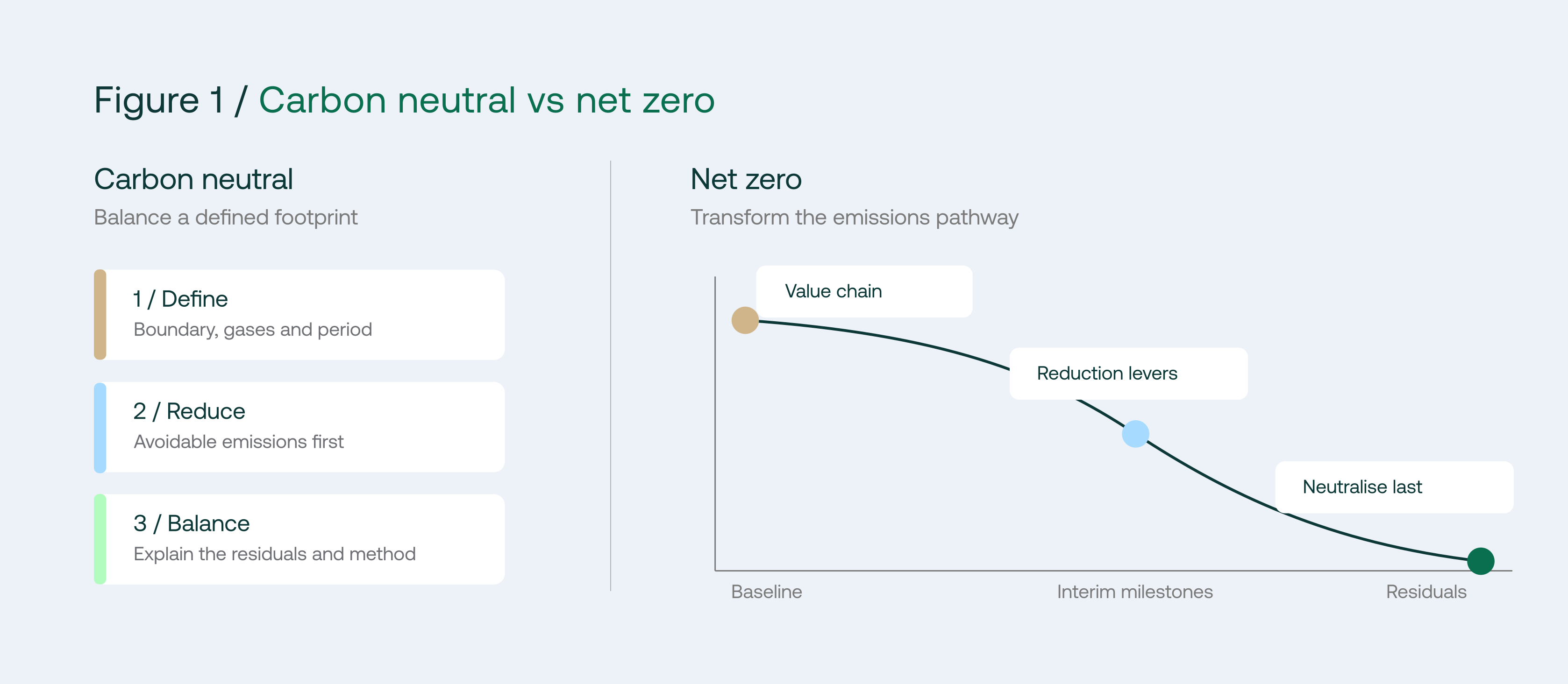
A robust target makes its assumptions visible. The board, finance team, sustainability lead and communications team should work from the same target architecture.
State whether the target covers the group, legal entity, product, service, event or project. State the reporting period and base year. Explain organisational boundaries and material exclusions.
Include Scope 1 and Scope 2 emissions. Address relevant Scope 3 categories using a transparent screening method. The GHG Protocol Corporate Standard and Scope 3 Standard provide recognised accounting foundations. [2]
A long-term net zero ambition needs interim milestones. Each milestone should have an owner, budget, delivery measure and review date. A statement such as “net zero by 2050” does not explain the actions required in the next twelve months.
The SBTi Version 2.0 framework strengthens the link between target setting and transition planning. It expects companies to assess barriers, use available reduction levers and report progress over time. [3]
Create a claim register for public statements. Record the precise wording, audience, product or activity, evidence, approval owner and review date.
This process helps companies distinguish an operational milestone from a corporate status claim. It also prevents an offset purchase from being presented as proof of structural decarbonisation.
Directive (EU) 2024/825, ECGT or EmpCo strengthens consumer protection against misleading environmental claims. Member States had to adopt and publish transposition measures by 27 March 2026, and the rules have applied since 27 September 2026. [4] Implementation remains uneven: in May 2026 the European Commission opened infringement procedures against 20 Member States for incomplete transposition. [4]
The Directive adds a prohibition on claiming, based on greenhouse gas offsetting outside the product’s value chain, that a product has a neutral, reduced or positive impact. This applies regardless of the quality or certification of the offsets. [4]
The rules concern consumer facing commercial practices. Purely business to business communications fall outside the directive’s harmonised scope, although national rules and the Misleading and Comparative Advertising Directive may still apply. They do not remove the need for careful business to business communication, investor reporting or voluntary disclosures. Those audiences still expect claims to be accurate, specific and supported by evidence.
Download our checklist to have your green claims checked against EmpCo!
The UK Green Claims Code also advises companies to ensure environmental claims are truthful, clear, complete and supported by reliable evidence. The guidance applies to claims made through words, symbols, labels, graphics and other marketing devices. [5]
Companies should therefore review claims in product pages, packaging, labels, websites, social media, tenders and procurement responses. Investor-facing reports such as CSRD disclosures fall outside ECGT, but the rules apply as soon as that content is reused in consumer marketing, so annual reports and investor materials deserve the same discipline. The review should test the wording, scope, evidence, timing and audience.
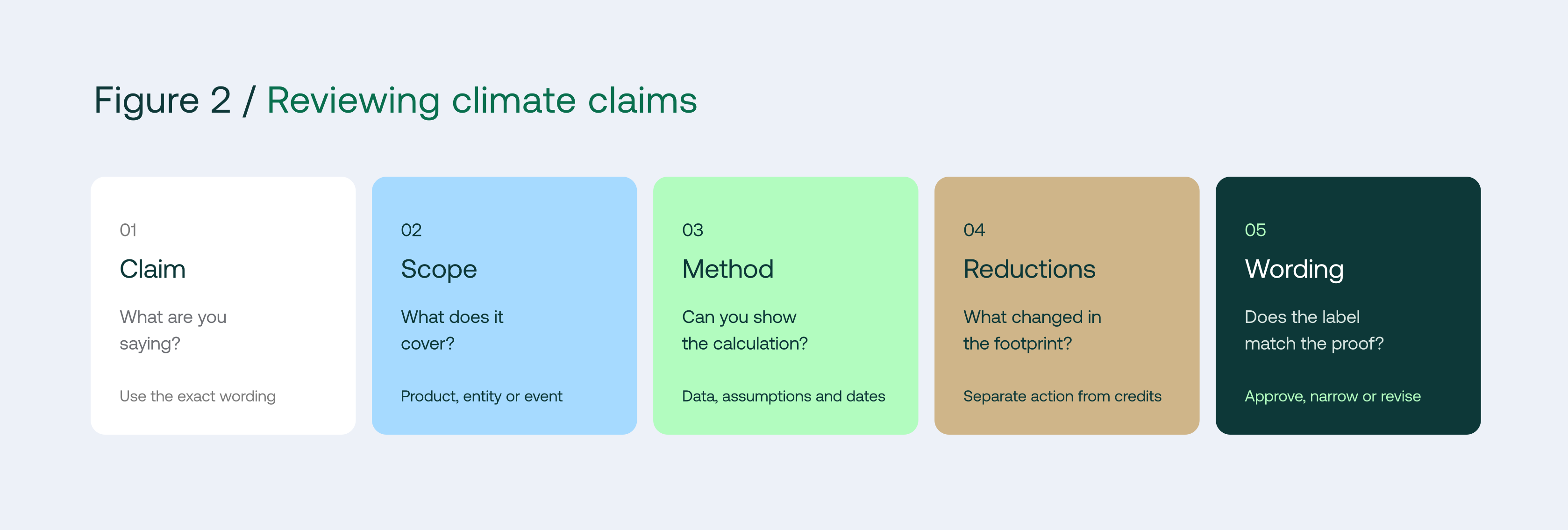
Start with a current inventory. A consistent accounting method and document data quality, assumptions and exclusions are the foundation for both target setting and defensible claims. With time, work on improvements in the accounting method and recalculate baseline with the new more accurate methods. For instance, if you started with spend-based method but then acquired better data, change your accounting approach to represent the highest accuracy possible.
identify the largest reduction opportunities based on your emission hotspots of your inventory. ‘That can take the form of prioritising energy, fuel, process emissions, purchased goods, logistics, product design and supplier engagement according to the footprint.
Then define the target architecture. Select the applicable standard, set milestones and assign accountability. Build the target into capital planning, procurement decisions and performance management.
Use credits and climate contributions carefully. Disclose their purpose, quality criteria, timing and relationship to the reduction pathway. Do not use compensation language to imply that operational emissions have been eliminated.
Finally, establish a review cycle. Update the inventory, assess progress, explain deviations and revise the action plan when evidence changes. A credible sustainability journey is built through transparent progress.
Nexio Projects supports organisations with corporate carbon footprint measurement, decarbonisation strategy and science based target setting. We connect the needs of business and the planet by helping teams move from compliance to positive impact.
Carbon neutral and net zero can both appear in a credible climate programme. They describe different claims and different levels of transformation.
Companies should define the boundary, measure the relevant emissions, prioritise reductions and reserve compensation for a clearly explained role. That discipline protects the accuracy of external communications and strengthens decision making.
Precise language is a control measure. It helps leadership teams see whether a climate programme is reducing emissions or only balancing an accounting boundary. To summarise:
We are an international sustainability consultancy dedicated to guiding organisations on their journey from compliance to positive impact. We provide expert support across climate strategy, target setting, carbon footprint measurement and sustainability reporting.
Recognised in Verdantix’s Buyer’s Guide for boutique ESG and sustainability strategy services and ranked among the best ESG consultancies in the Netherlands by Consultancy NL, we are here to help you turn climate commitments into a credible implementation roadmap.
Review your current carbon neutral or net zero claims with our climate team and identify the evidence, targets and actions needed for the next stage of your sustainability journey.
[1] International Organization for Standardization. ISO 14068-1:2023, Climate change management: Transition to net zero, Part 1: Carbon neutrality. https://www.iso.org/standard/43279.html. Accessed September 2026.
[2] Greenhouse Gas Protocol. Corporate Standard and Corporate Value Chain Scope 3 Standard. https://ghgprotocol.org/corporate-standard. Accessed September 2026.
[3] Science Based Targets initiative. The new Corporate Net-Zero Standard Version 2.0. https://sciencebasedtargets.org/corporate-net-zero-standard-v2. Accessed September 2026.
[4] European Parliament and Council. Directive (EU) 2024/825 of 28 February 2024. https://eur-lex.europa.eu/eli/dir/2024/825/oj. Accessed September 2026.
[5] Competition and Markets Authority. Green Claims Code. https://greenclaims.campaign.gov.uk/. Accessed September 2026.
[6] Nexio Projects. Carbon neutral vs net zero: What’s the difference and why it matters. https://nexioprojects.com/carbon-neutral-vs-net-zero-whats-the-difference-and-why-it-matters/. Accessed September 2026.
[7] Nexio Projects. How to build an effective decarbonisation strategy?. https://nexioprojects.com/how-to-build-an-effective-decarbonisation-strategy/. Accessed September 2026.
[8] Nexio Projects. Stakeholder mapping for effective decarbonisation. https://nexioprojects.com/stakeholder-mapping-for-effective-decarbonisation/. Accessed September 2026.
[9] Nexio Projects. Supply chain emissions: Unlocking supplier engagement for net zero. https://nexioprojects.com/knowledge-centre/supply-chain-emissions-unlocking-supplier-engagement-for-net-zero/. Accessed September 2026.


