

 What does double materiality mean for your ESG strategy?
February 23, 2023


“A useful emissions inventory gives leaders a short list of decisions. A complicated inventory that nobody uses does not.”
A decarbonisation strategy for SMEs often starts with incomplete energy, travel, purchasing, and logistics data. That should not prevent action. It should shape a phased method that improves data quality as the business learns.
The first objective is a consistent baseline. The second is to identify the emissions sources that influence cost, risk, customer requirements, and operational decisions.
Nexio Projects supports GHG inventory and decarbonisation strategy work for organisations across Europe and international value chains. Our team has completed more than 600 sustainability projects, helping clients turn emissions data into targets, reduction plans, and decision-ready reporting.
The GHG Protocol Corporate Standard provides requirements and guidance for designing and reporting a corporate GHG inventory. [1] It distinguishes Scope 1 (direct emissions from owned or controlled sources), Scope 2 (indirect emissions from purchased energy), and Scope 3 (other value-chain emissions).
For an SME, the inventory should begin with clear boundaries. Define the entities, facilities, activities, reporting period, and consolidation approach. Document exclusions rather than hiding them.
Then create a data map. List the activity data required for fuel, electricity, refrigerants, company vehicles, business travel, commuting, purchased goods, transport, waste, and other relevant categories.
The inventory does not need to be perfect before it becomes useful. It needs to be consistent, transparent, and capable of improvement.
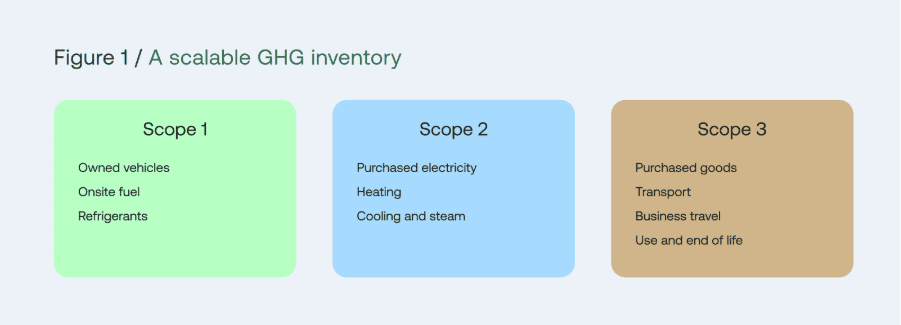
Use invoices, meter readings, fuel records, transport data, and purchasing information where available. Record units, dates, locations, and calculation assumptions.
Spend-based estimates can support an initial screening. They are less useful when the organisation needs to choose a specific reduction project or defend a material category.
The GHG Protocol Scope 3 Standard covers fifteen categories of value chain emissions. [2] SMEs can screen the categories first, then improve the most material or decision relevant sources.
For purchased goods, start with supplier spend and category information. Move toward product quantities, supplier-specific factors, or product carbon footprints where those inputs will change decisions.
Our article on counting what counts in Scope 3 explains how to focus effort on sources that can influence a reduction pathway.
Record the source, geography, unit, year, and rationale for every factor. This makes later updates easier and helps reviewers understand why a value changed.
“Data quality should follow the decision. Improve the data first where it can change a procurement, energy, product, or investment choice.”
A minimum viable inventory contains a defined boundary, a reporting period, activity data, emission factors, assumptions, exclusions, and a review record. It gives the organisation a stable starting point without pretending that every source has the same data quality.
Use data quality tiers to guide improvement. A measured fuel volume may sit at a higher tier than an estimate based on spend. A supplier-specific factor may be more useful than a generic category factor when purchasing decisions are under review.
The purpose of the tier is practical. It tells the team where to improve the inventory and where additional effort will have limited decision value.
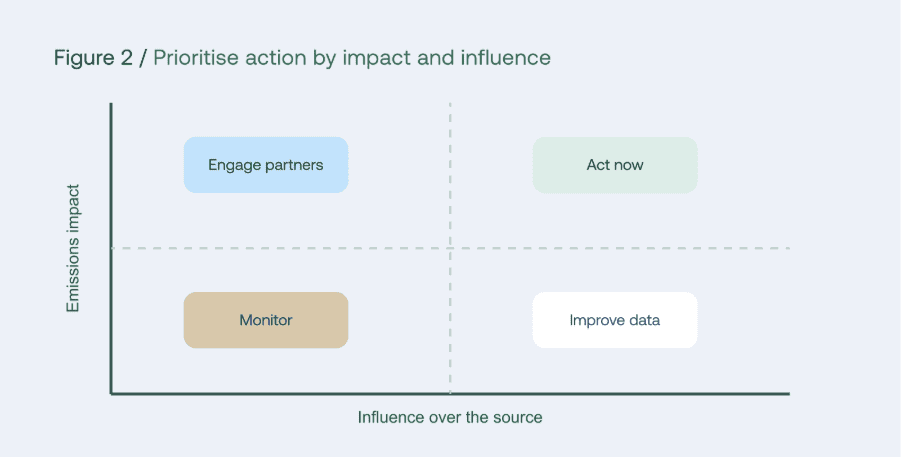
An inventory becomes strategic when it informs a sequence of actions. Rank hotspots using four questions:
Typical early actions include renewable electricity procurement (tracked through market-based Scope 2 alongside the location-based figure), energy efficiency, fleet transition, logistics optimisation, refrigerant control, lower-impact materials, supplier engagement, and product redesign.
Do not place every action on a single long-term list. Assign an owner, investment estimate, expected emissions effect, timeline, dependency, and monitoring indicator.
The PCF explained guide can help companies assess when product carbon footprint data will support customer or product decisions.
Assign one person to maintain the inventory and one senior owner to remove barriers. Review the baseline when the business changes facilities, products, suppliers, or logistics models.
At each review, track four measures: emissions, data coverage, action progress, and decision impact. The final measure asks whether the information changed a purchase, investment, design, contract, or operational choice.
This governance rhythm helps the organisation avoid a common failure mode. The inventory is calculated once, published, and then separated from the decisions that determine future emissions.
A reduction action should appear in the same planning process as other operational priorities. Include capital needs, procurement implications, maintenance requirements, supplier dependencies, and expected payback where relevant.
Finance and operations can then test the action against business constraints. This increases the chance that climate measures will survive changes in budgets, leadership, and customer demand.
A decarbonisation strategy becomes durable when it is connected to the decisions that already run the business.
A target should reflect the baseline and the reduction levers available to the organisation. It should also define the scope, base year, timeframe, and progress method.
The Science Based Targets initiative published its Corporate Net-Zero Standard V2.0 on 11 June 2026. [3] Submissions under V2.0 open in Q1 2027, and V2.0 becomes mandatory for all target submissions after 31 January 2028. Companies considering validation should check the current requirements and eligibility route before setting a target.
SMEs that are not pursuing external validation still benefit from governance. Review progress at a regular management meeting. Track absolute emissions, relevant intensity indicators, action completion, and changes in business activity.
Our article on science based targets by sector shows how sector context affects target design. The SBTi V2.0 guide provides further preparation support.
A decarbonisation strategy for SMEs should make emissions information useful to the people making operational and investment decisions. Start with a transparent baseline, improve the material data, and connect each hotspot to an owner and action.
This approach creates a sustainability journey that can mature from screening to assurance-ready reporting without delaying practical reductions.
“The purpose of a first inventory is to improve the next decision, then build the evidence needed for the decision after that.”
We help SMEs build GHG inventories, prioritise reduction levers, and develop credible climate action plans. Recognised in the Consultancy EU European sustainability consultancy rankings and as a leading ESG consultancy in the Netherlands by Consultancy NL, we are here to help you move from carbon data to a practical decarbonisation programme.
Request a GHG baseline review.
[1] GHG Protocol. Corporate Standard. https://ghgprotocol.org/corporate-standard. Accessed August 2026.
[2] GHG Protocol. Corporate Value Chain, Scope 3 Standard. https://ghgprotocol.org/scope-3-calculation-guidance-2.0. Accessed August 2026.
[3] Science Based Targets initiative. Corporate Net Zero Standard V2.0. https://sciencebasedtargets.org/standards/net-zero-standard. Accessed August 2026.
[4] Nexio Projects. Counting what counts: Scope 3. https://nexioprojects.com/counting-what-counts-scope-3/. Accessed August 2026.
[5] Nexio Projects. Science based targets by sector: Six concrete examples. https://nexioprojects.com/science-based-targets-by-sector-six-concrete-examples/. Accessed August 2026.
[6] Nexio Projects. PCF explained: Your roadmap for decarbonising products. https://nexioprojects.com/knowledge-centre/pcf-explained-your-roadmap-for-decarbonising-products/. Accessed August 2026.
[7] Nexio Projects. SBTi V2.0 and beyond: Your path to decarbonisation. https://nexioprojects.com/knowledge-centre/sbti-v2-0-and-beyond-your-path-to-decarbonisation/. Accessed August 2026.


