Top 6 Questions About Sustainable Procurement
February 10, 2022


“The strongest submission is built around the questions that matter most to the business.”
Companies often struggle with the EcoVadis Environment pillar because they have more evidence than the assessment can accommodate. They also face uncertainty about targets, document validity, activated topics, and rejected evidence.
The practical answer is a focused management approach. Companies should prioritise relevant topics, connect evidence to the assessed entity, keep KPIs current, and use the scorecard to guide improvement.
EcoVadis allows a maximum of 55 supporting documents per assessment.[1] This makes evidence selection an important part of the submission strategy.
The limit applies to new documents. Companies can usually keep documents from previous assessments when they remain valid and continue to support the questionnaire. This can preserve space for new evidence.
A sustainability report may also support several questions when it clearly covers the relevant topics. Companies should check whether it provides enough detail for each answer before relying on it.
The goal is a focused library of relevant documents. Uploading more files does not automatically strengthen the submission.
Yes. The evidence does not always need to appear in one document.
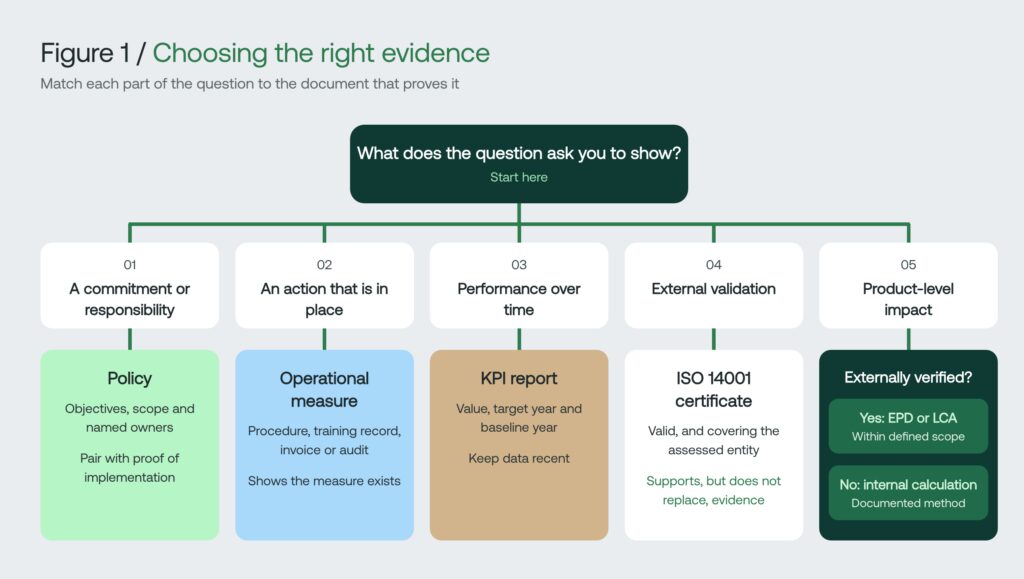
For example, a policy may explain qualitative objectives and strategic commitments. A sustainability plan or KPI report may provide the quantitative targets and performance data.
Submitting both documents can create a stronger evidence chain. Each document should have a clear role and answer a specific part of the question.
Companies should avoid uploading several files that repeat the same information. EcoVadis may prioritise the first document that sufficiently answers a question. Clear document selection therefore saves space and improves review efficiency.[2]
“A document should earn its place by answering a question clearly and showing how the system works.”
Document rejection does not always mean the underlying activity is weak. It can reflect a gap between the evidence and the assessment requirements.
Common reasons include:
Scope is especially important. Evidence from one site may support a group level assessment when the relationship is clear. Group evidence may not work for an entity level assessment.
Companies should also check small details. A missing logo, inconsistent company name, or unclear organisational structure can weaken otherwise useful evidence.
The EcoVadis guidance on supporting documents recommends checking relevance, validity, scope, and completeness before submission.[1]
A quantitative target should include three core elements:
EcoVadis introduced the baseline year requirement through a 2026 methodology update.[3] Including the baseline number is also useful because it shows the starting point and makes progress easier to track.
Targets should remain future looking. A target that has already expired should be reviewed and extended when appropriate.
The same principle applies to KPIs. Companies should maintain a structured database with the relevant years, definitions, calculation methods, and owners. This reduces the work required during each assessment.
EcoVadis states that KPI information must remain sufficiently recent for the assessment period.[1] Companies should therefore update environmental data regularly instead of waiting until the next questionnaire arrives.
EcoVadis activates key sustainability issues according to the company’s industry classification and assessment context. Different companies can therefore receive different Environment questions.
A company may see questions on energy, emissions, materials, chemicals, or waste. Other topics may include biodiversity, product use, product end of life, environmental services, or air pollution.
The practical concern is relevance. Companies may receive a question about a topic that does not appear material to their operations.
The recommended approach is to review the activated topics before collecting evidence. High importance topics should receive priority because they can carry greater weight in the assessment.
When a topic is genuinely irrelevant, the company should explain why. A clear explanation can be more useful than submitting weak evidence that does not reflect the business.
Evidence connected to inactive topics may not contribute to the final score. This makes targeted preparation more efficient than trying to answer every possible environmental question.
Certifications can support an environmental management system, but they are one part of the overall assessment.
The discussion highlighted ISO 14001 as a potentially useful certification for demonstrating an environmental management system. Its value depends on the assessment scope, certification validity, and entities covered.
Policies, measures, reporting, and performance data remain central to the management system. Companies should therefore avoid treating certification as a substitute for implementation evidence.
Other frameworks can also contribute. SBTi and UN Global Compact participation may support relevant questions, although their impact depends on how the information connects to the questionnaire.
Environmental Product Declarations and life cycle assessments can support product related evidence when the relevant criteria are activated.
Companies often face a practical resource constraint. They may have many products and lack the capacity to complete a full assessment for every product.
A focused approach can help. Start with the products, categories, or markets that are most relevant to the assessment. Then document the calculation method, scope, assumptions, and limitations.
Internal calculations can still be useful when they are transparent and supported by a clear methodology. They should not be presented as certified evidence when no certification exists.
Existing asset check: The in house team could adapt the support model shown on slide 11 of the 2026 EcoVadis Assessment Support presentation.
Group and entity assessments require different evidence strategies.
For a group level assessment, a document from one entity may support a measure when the entity belongs to the assessed group. The document should still show the activity, location, and relationship clearly.
For an entity level assessment, group level evidence may not demonstrate that the activity applies to the assessed entity.
Coverage indicators also require specific data. For example, a training KPI should show the percentage of employees covered, the reporting period, and the calculation method.
Companies should keep entity scope and coverage data visible in their internal KPI systems. This makes the evidence easier to prepare and review.
The scorecard improvement areas provide the first point of reference. Companies should then investigate why the evidence failed.
For measures, the missing element is often proof of implementation. A policy may describe an intention, but a procedure, training record, invoice, audit, or operational record may show that the measure exists.
A rejected document can also reveal a management system weakness. The right response is to improve the process, strengthen the evidence, and prepare a clearer document for the next assessment.
Companies can use practical steps to improve their EcoVadis Score to connect scorecard findings with a broader improvement plan.
Start with the corrective action plan and the highest importance activated topics.
The first priorities should usually include:
A higher score does not always guarantee an easier medal outcome. Performance expectations can rise as more companies strengthen their management systems.
The best objective is therefore a stronger sustainability management system. The EcoVadis Rating then becomes a useful signal of progress, rather than the only measure of success.
“The practical goal is a submission that reflects how the business operates throughout the year.”
We are an international sustainability consultancy supporting organisations on their journey from compliance to positive impact. As an accredited EcoVadis Strategic Partner since 2018, we help companies with Environment pillar gap analysis, evidence mapping, document prioritisation, target setting, KPI review, assessment preparation, supplier engagement, stakeholder training, and scorecard improvement planning.
Recognised as a Top Brand in sustainability by EUPD and listed among the best ESG consultancies in the Netherlands by Consultancy NL, we help companies turn EcoVadis questions into stronger management systems and practical sustainability improvements. Explore our EcoVadis assessment support.
[1] EcoVadis. Understanding supporting documents. Accessed November 2026.
[2] EcoVadis. EcoVadis Ratings Scoring Principles. Accessed November 2026.
[3] EcoVadis. Methodology Updates Q3 2026. Accessed November 2026.
[4] EcoVadis. Complete Guide for Document Submission. Accessed November 2026.
[5] Nexio Projects. How the EcoVadis scoring system works in 2025. Accessed November 2026.
[6] Nexio Projects. How to improve your EcoVadis score quickly. Accessed November 2026.
[7] Nexio Projects. 2026 EcoVadis Assessment Support presentation. Slide 11. Accessed November 2026.