Sweet success: Helping Hey Honey achieve EcoVadis Gold and showcase its positive impact
July 24, 2025


Both terms appear regularly in annual reports, investor presentations, and supplier questionnaires. Board members use them. Customers ask about them. Communications teams put them on websites. “Carbon neutral” and “net zero” are treated by many as interchangeable. They are not the same, and the gap between them is growing in both legal and strategic significance.
The distinction matters to finance teams and ESG leads because of what it means for the credibility of external claims, the accuracy of regulatory disclosures, and exposure to greenwashing litigation. From September 2026, one of those terms carries a specific legal prohibition in the European Union when applied to consumer-facing marketing based on offsets. Understanding the difference before that deadline is a compliance requirement, not a point of nuance.
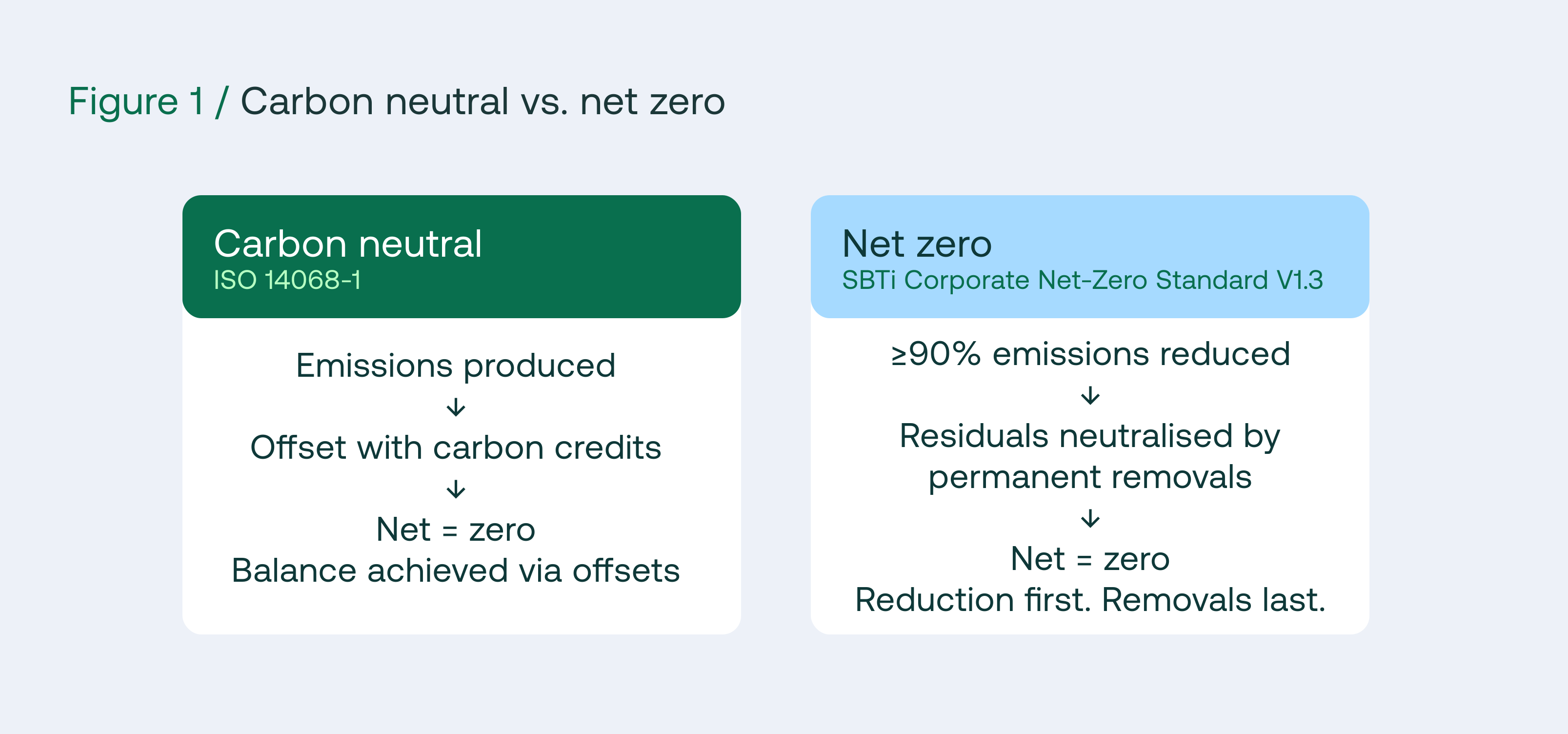
Carbon neutrality refers to a state in which the carbon dioxide emissions associated with an entity’s activities are balanced by an equivalent quantity of carbon removal or offsetting. In practice, a company measures its emissions, purchases carbon credits to counterbalance them, and claims that the net result is zero.
The standard governing carbon neutrality claims is ISO 14068-1:2023, which replaced BSI PAS 2060 on 1 January 2025 [1]. ISO 14068 requires a GHG inventory, a carbon neutrality management plan, and the use of verified carbon credits to offset remaining emissions. It sets no minimum level of actual emission reduction before offsets can be applied. A company that purchases sufficient credits with no internal reduction can, under ISO 14068, make a carbon neutrality claim.
Carbon neutral claims typically focus on carbon dioxide, sometimes expressed as CO2 equivalents. Coverage of other greenhouse gases varies by claim and is not always made explicit. Scope 3 value chain emissions are frequently excluded.
The term “carbon neutral” operates similarly. From 27 September 2026, the EU’s Empowering Consumers for the Green Transition (ECGT) Directive will prohibit consumer-facing claims of “climate neutral” where those claims rely on carbon offsets rather than actual emission reductions [2]. Companies with offset-based neutrality claims on consumer products, packaging, or digital marketing in the EU must review those claims before that date.
Net zero, as defined by the Intergovernmental Panel on Climate Change (IPCC), is achieved when human-caused greenhouse gas emissions are balanced by removing the same quantity from the atmosphere [3]. At the company level, the Science Based Targets initiative (SBTi) has translated this into a precise corporate standard.
Under the SBTi Corporate Net-Zero Standard V1.3, corporate net zero requires:
The sequence is fundamental. Deep emission reductions come first. Neutralisation of what remains is a final step, applied only to what is genuinely impossible to eliminate. Carbon credits serve this final neutralization function. They do not replace the reduction requirement.
Net zero covers all greenhouse gases (carbon dioxide, methane, nitrous oxide, and others) across the full value chain. Scope 3 emissions are included. The SBTi does not validate carbon neutrality claims and explicitly states that offset-based approaches do not align with what climate science requires to limit warming to 1.5°C [3].
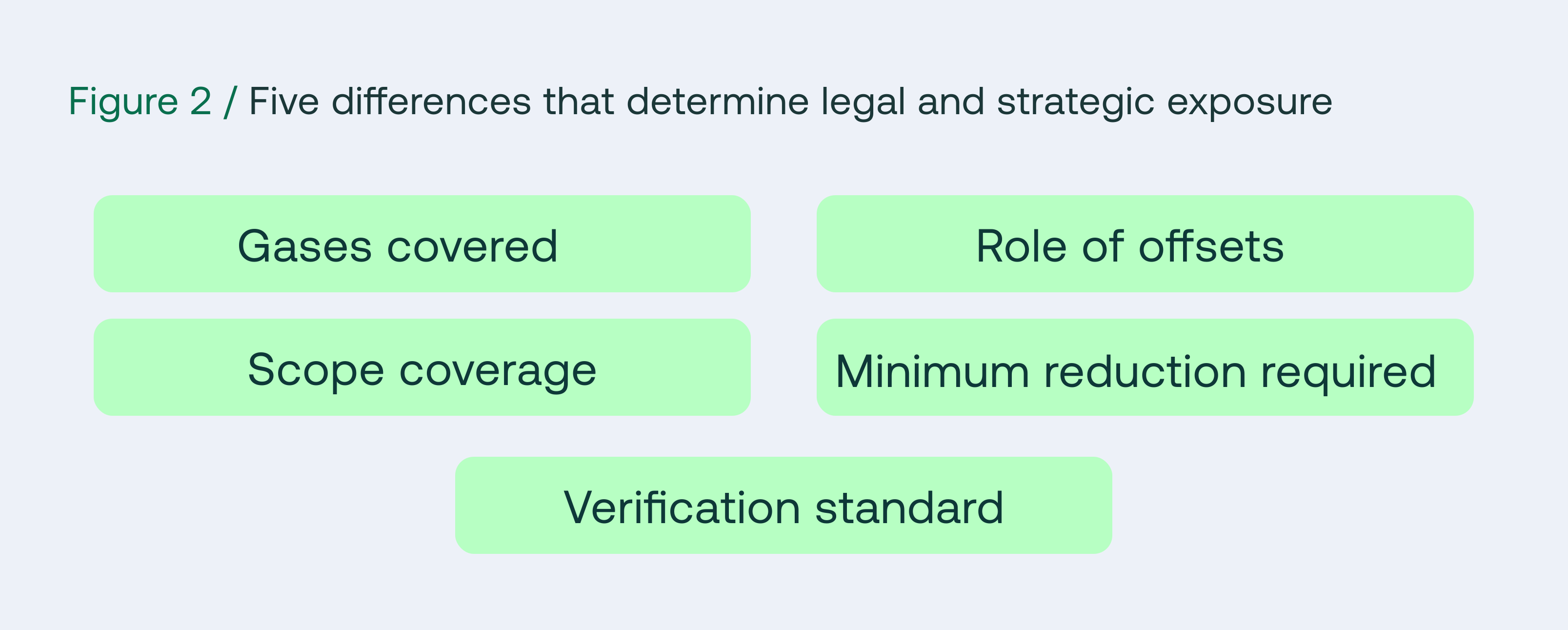
The two terms diverge across five dimensions that matter for corporate risk management and reporting.
Download our guide on reducing supply chain emissions!

The Empowering Consumers for the Green Transition (ECGT) Directive entered into force in March 2024 and must be transposed into national law across EU member states by 27 March 2026. Member states apply the new rules from 27 September 2026 [2].
From that date, generic environmental claims, including “climate neutral,” “carbon neutral,” “eco-friendly,” “green,” and “environmentally friendly”, are prohibited in consumer-facing communications unless substantiated by evidence meeting the directive’s requirements [2]. Requirements include clear, objective verifiable commitments, a detailed and realistic implementation plan, regular verification by a third party and public disclosure. Claims based on carbon offsets alone, without genuine underlying emission reductions, will not meet that standard.
Companies using offset-based “carbon neutral” or “climate neutral” language on product packaging, websites, or marketing materials in EU markets must assess those claims before September 2026. The exposure applies to product labels and brand-level claims in investor communications, annual reports, and press materials, depending on how they are framed.
The ECGT applies primarily to B2C claims, although the transposition of the Directive into country legislation varies on this principle. The Green Claims Directive, currently in the legislative process, will extend verification requirements further to specific environmental claims [2]. For companies operating across B2B and B2C channels, the combined regulatory direction is unambiguous: claims require substantiation, and offset-reliance without underlying reduction is the primary target of enforcement.
“The ECGT Directive targets a specific behaviour: presenting offset purchases as evidence of climate leadership. Companies with consumer-facing claims built on offset reliance have a fixed regulatory deadline in September 2026 and a clear standard to meet.”
For finance teams, this regulatory shift intersects with the accuracy requirements of CSRD ESRS E1.
Sustainability disclosures must be verifiable and free from misleading characterization. A “carbon neutral” claim in an annual report that relies on offsets, without disclosure of that dependency, creates assurance risk in the first CSRD reporting cycle. For a full breakdown of what CSRD requires on climate targets and disclosures, the Nexio Projects reporting guide covers the reporting obligations in detail.
The first step is precision about where the company currently stands.
A company that has purchased carbon credits to offset some or all of its emissions holds a carbon neutrality position, not a net-zero position, regardless of the language used in its communications. If that language needs to change to comply with ECGT, the review should begin now.
When “carbon neutral” is used loosely as a proxy for climate leadership, without clarity about the underlying evidence or a clear transition plan, it becomes a liability
For companies setting a long-term climate commitment, a validated SBTi net-zero target provides investor-grade credibility that carbon neutrality alone cannot. Validated targets are publicly listed on the SBTi dashboard, science-aligned, and reviewed against the Corporate Net-Zero Standard. They fulfil the primary evidence requirements for ESRS E1 climate mitigation disclosures under CSRD and carry direct weight in CDP and EcoVadis assessments.
The two positions are not mutually exclusive. A company can hold a documented ISO 14068 carbon neutral position as an annual interim claim while working toward an SBTi-validated net-zero commitment on a longer trajectory. The discipline is keeping the language of each claim accurate and distinct, and ensuring that interim offset activity is never presented as equivalent to the structural decarbonisation that net zero requires.
For companies that have not yet completed a GHG inventory, Why get support with your corporate carbon footprint explains the data requirements and why the quality of that foundation determines everything that follows. For companies considering a net-zero commitment, SBTi in 2026: the road to net zero and compliance maps the validation process, Scope 3 obligations, and connection to CSRD. The quantified business case for acting now is set out in Science-Based Targets: the competitive advantage case is now settled.
Carbon neutral and net zero describe two different relationships between a company and its emissions. Carbon neutrality balances emissions with offsets. Net zero eliminates them first, with offsets reserved only for what cannot be eliminated after deep reduction.
That distinction now has legal, regulatory, and investor consequences. Companies with consumer-facing offset-based climate claims must review them against the ECGT Directive before September 2026. Companies preparing CSRD disclosures must apply the correct terminology with substantiated evidence behind each claim. Companies communicating with investors and lenders must be clear about whether their commitment is to periodic neutrality or to a science-aligned, long-term net-zero trajectory.
Getting the language right is a risk management decision.
“Every credible climate commitment starts with an accurate inventory and precise language. Companies that know exactly what they have reduced, what they have offset, and what still needs to be done are building positions that hold up under investor, regulatory, and customer scrutiny.”
Nexio Projects is an international sustainability consultancy dedicated to guiding organisations on their journey from compliance to positive impact. Our mission is to provide expert support across strategy development, ESG ratings, climate solutions, and comprehensive sustainability reporting.
Ultimately, Nexio Projects helps their clients achieve their sustainability goals with a pragmatic, step-by-step approach.
Recognised by Verdantix in its Buyer’s Guide for Boutique ESG and Sustainability Strategy Services and as the best ESG consultancy in the Netherlands by Consultancy NL in 2025, we are here to help companies build climate claims that are accurate, audit-ready, and fit for the regulatory environment ahead.
Ready to clarify your climate position? Book a discovery call with the Nexio Projects team to review your current claims, assess the gap between where you are and where net zero requires you to be, and build a credible path forward.
[1] ISO. ISO 14068-1:2023 — Climate change management: transition to net zero — Part 1: Carbon neutrality. 2023. https://www.iso.org/standard/43279.html. Accessed May 2026.
[2] Carbon Trust. “ECGT Directive explained: what organisations who sell in Europe should know and do.” 2025. https://www.carbontrust.com/en-eu/news-and-insights/insights/ecgt-directive-explained-what-organisations-who-sell-in-europe-should-know-and-do. Accessed May 2026. (Note: For the primary legislative source, see also: European Commission. Green claims and ECGT. https://environment.ec.europa.eu/topics/circular-economy-topics/green-claims_en)
[3] Science Based Targets initiative. “Net-Zero Jargon Buster: a guide to common terms.” October 2024. https://sciencebasedtargets.org/blog/net-zero-jargon-buster-a-guide-to-common-terms. Accessed May 2026.
[4] Science Based Targets initiative. Corporate Net-Zero Standard V1.3 and Near-Term Criteria V5.3. September 2025. https://sciencebasedtargets.org/net-zero. Accessed May 2026.
[5] Nexio Projects. The strategic guide for sustainability reporting [guide]. https://nexioprojects.com/knowledge-centre/the-strategic-guide-for-sustainability-reporting/. Accessed May 2026.
[6] Nexio Projects. Why get support with your corporate carbon footprint? https://nexioprojects.com/why-get-support-with-your-corporate-footprint/. Accessed May 2026.
[7] Nexio Projects. SBTi in 2026: the road to net zero and compliance. March 30, 2026. https://nexioprojects.com/sbti-in-2026-the-road-to-net-zero-and-compliance/. Accessed May 2026.
[8] Nexio Projects. Science-Based Targets: the competitive advantage case is now settled. April 24, 2026. https://nexioprojects.com/science-based-targets-the-competitive-advantage-case-is-now-settled/. Accessed May 2026.