NHS Product Carbon Footprint requirements for 2028: What suppliers need to know
September 22, 2026


“A green claim is only as strong as the evidence that supports its exact wording.”
Empowering Consumers for the Green Transition Directive (EmpCo or ECGT), formally Directive (EU) 2024/825, applies from 27 September 2026. It strengthens EU rules against misleading environmental claims and unsupported sustainability labels in business to consumer communications. [1][2]
For many companies, the difficult question is not whether the directive exists. It is whether their product claims, website content, packaging, labels, and customer communications create exposure under the new rules.
In this article, we explain how to assess your position, what can happen when environmental claims mislead consumers, and which evidence can support your communications.
The EmpCo Directive amends the Unfair Commercial Practices Directive and applies to unfair business to consumer commercial practices. The European Commission’s June 2026 FAQ states that business to business commercial practices fall outside its harmonised scope. [1][2]
This distinction matters. A company selling only to other businesses does not automatically become subject to EmpCo because a customer requests sustainability information.
A B2B company may still need to review its communications when:
These customer requests are commercial or contractual requirements. They do not automatically extend EmpCo’s legal scope to every B2B supplier.
Member States may also apply national rules to certain B2B relationships. Other EU instruments, including the Misleading and Comparative Advertising Directive, can also affect B2B communications. [2]
According to Anna Ma, Climate Director at Nexio Projects,
‘Most mid-market companies assume that because they do not sell directly to consumers, EmpCo does not concern them. The formal scope is B2C. But the claims on your product label, your website, and your procurement responses operate in a world where that boundary is far less clear than the legal text suggests.’
EmpCo covers environmental claims made in writing, speech, images, packaging, labels, brand names, product names, and other commercial communications. A claim can be explicit or implied by its overall presentation. [1][2]
Generic terms such as “eco friendly”, “green”, “environmentally friendly”, “climate friendly”, and “nature’s friend” may be prohibited when the company cannot demonstrate recognised excellent environmental performance relevant to the claim. [1][2]. A specific claim is not automatically compliant. It still needs accurate, current, and appropriate evidence.
For example, “made with 80% recycled material” requires evidence that supports the percentage and the relevant product. “This product is sustainable” makes a much broader claim and requires substantially stronger substantiation.
The directive also addresses sustainability labels. Labels must be based on a certification scheme or established by a public authority. Certification schemes must include independent third party verification, publicly available requirements, and transparent conditions. [1][2]
Visual presentation matters as well. Green leaves, water drops, nature imagery, and similar design elements may imply environmental benefits when combined with sustainability language. Authorities and courts can assess the complete commercial context. [2]
EmpCo prohibits claims that a product has a neutral, reduced, or positive impact on greenhouse gas emissions when the claim is based on offsetting outside the product’s value chain. Examples include “carbon neutral”, “climate neutral”, “carbon positive”, and “climate net zero”. [1][2]
Companies may communicate about environmental initiatives or carbon credit investments when the communication is transparent and not misleading. Those investments cannot be presented as proof that a product itself has no environmental impact. [2]
Future environmental claims also require clear, objective, publicly available, and verifiable commitments. They must be supported by a detailed and realistic implementation plan with allocated resources. An independent third party must verify the claim. [2]
A statement such as “net zero by 2040” therefore needs more than a public ambition. It requires a credible transition plan, measurable targets, evidence of implementation, and appropriate verification.
Read our article on how ESG reporting can help make your business greenwashing proof.
“The question is not whether a company works hard on sustainability. The question is whether each public claim can be defended.”
EmpCo does not create one fixed fine for every breach across the EU. National authorities enforce the amended consumer protection rules under national procedures and sanctions. The European Commission’s FAQ confirms that enforcement lies with national competent authorities. [2]
Possible consequences include:
National implementation is still uneven. On 27 May 2026, the European Commission opened infringement procedures against 20 Member States for failing to communicate complete transposition measures. [3] Companies operating across several markets should therefore avoid treating one national penalty figure as an EU wide EmpCo tariff. The same claim may be assessed under different national rules, with different authorities and remedies.
The following examples illustrate the potential exposure under existing national consumer protection regimes. They are not standardised EmpCo penalties.
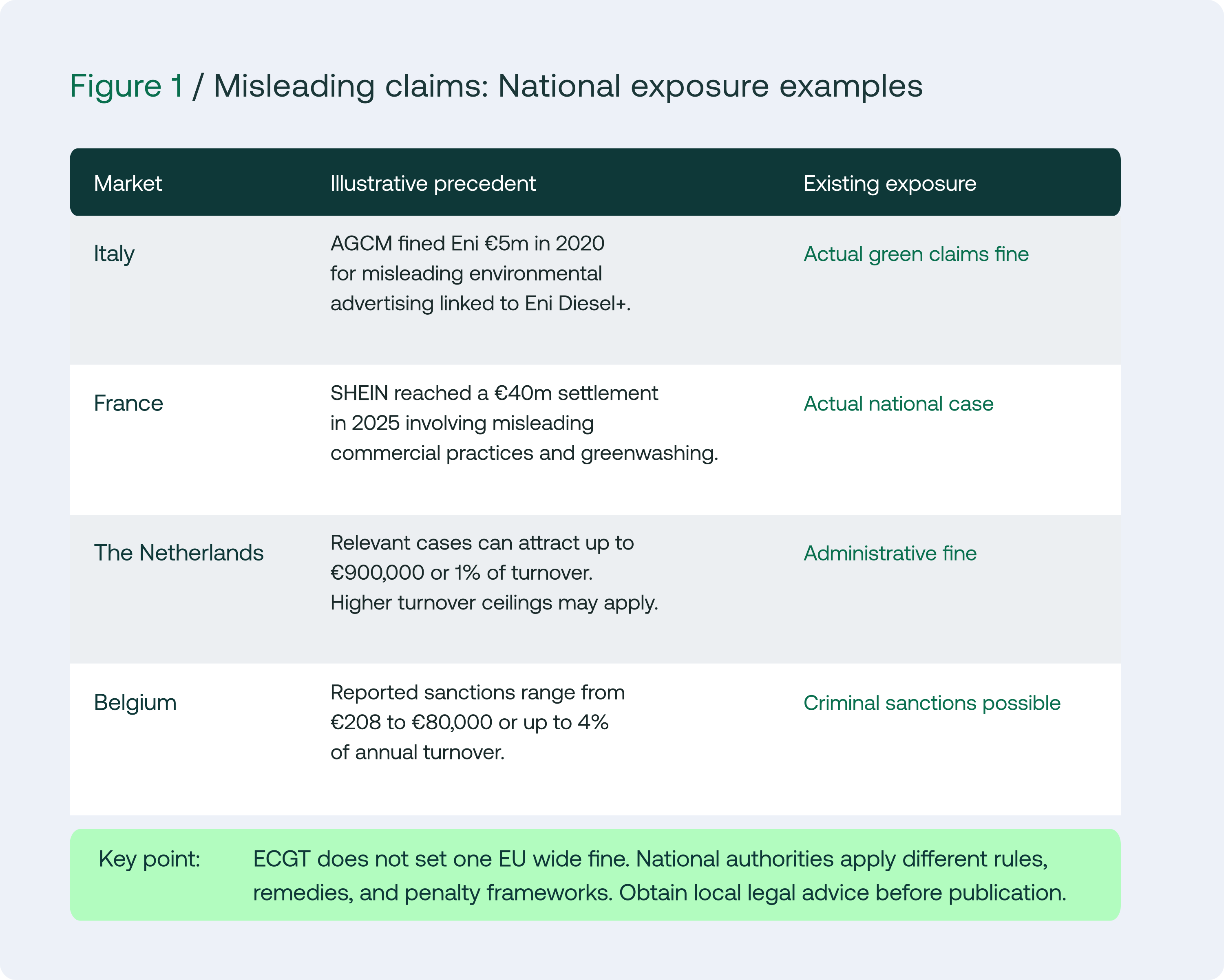
These examples show why a claim review should consider every market where products are sold. A corrective action in one country does not guarantee compliance elsewhere.
Our article on the true cost of greenwashing explores the wider financial, operational, and reputational consequences.
An EcoVadis score reflects the quality of an assessed company’s sustainability management system at the time of assessment. The assessment covers management practices across areas such as environment, labour and human rights, ethics, and sustainable procurement. [8]
This means an EcoVadis score can support a carefully worded management system claim, such as:
“Our sustainability management system has been independently assessed by EcoVadis.”
The score does not automatically substantiate:
EcoVadis also states that a medal or badge applies only to the assessed entity and remains valid for the relevant scorecard period. [8]
The evidence must therefore match the claim. A management system rating can support a management system statement. It cannot replace product level evidence, life cycle assessment, emissions data, or independent verification of a transition plan.
For practical guidance, read how to improve supply chain transparency with EcoVadis and consult our EcoVadis help desk.
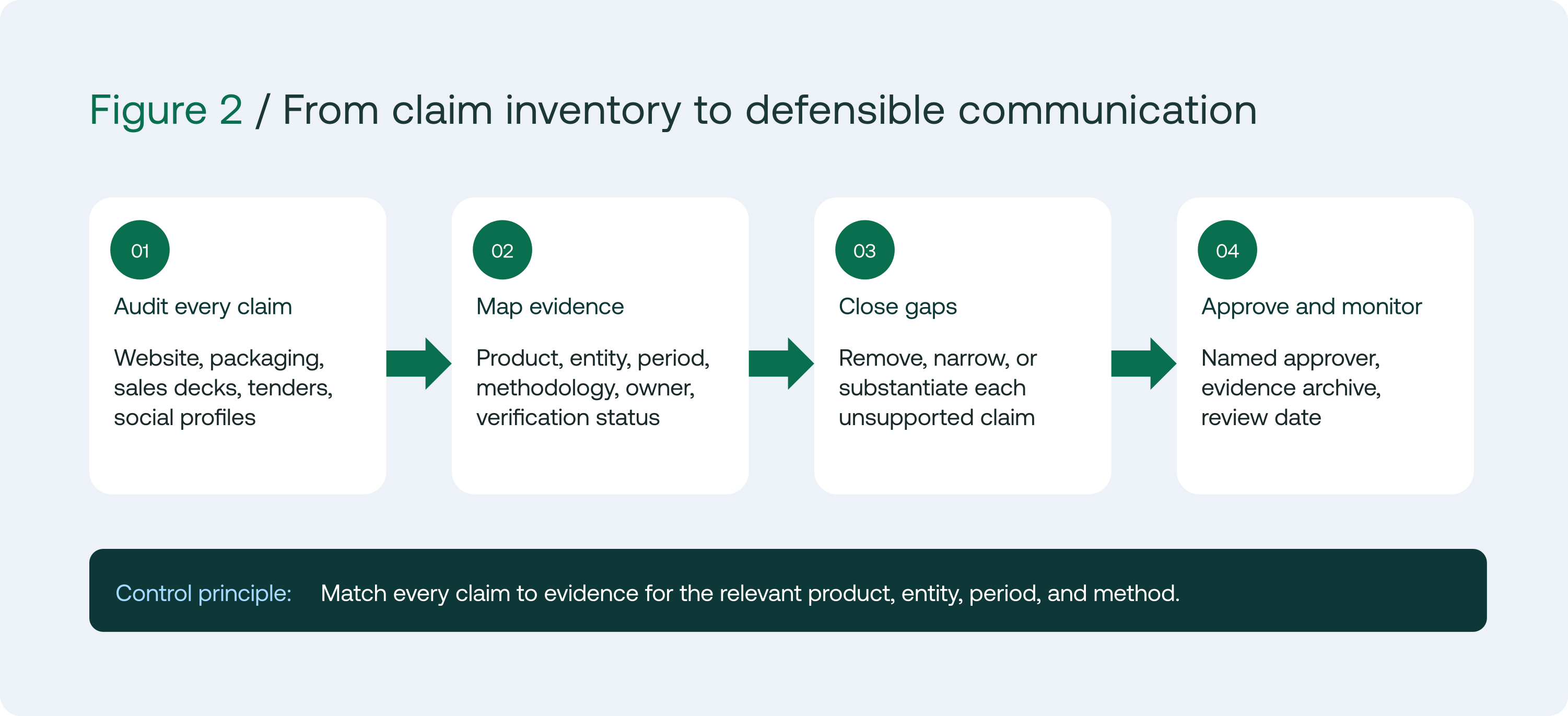
Review every environmental statement across your:
Include claims about sustainability, recycled content, emissions, climate neutrality, biodiversity, circularity, renewable energy, and future targets.
Record the evidence supporting each statement. Identify the owner, date, scope, methodology, assurance status, and relevant product or entity. A broad claim requires broader evidence. A claim about one product should not rely on evidence covering a different product, business unit, or reporting period.
Remove claims that cannot be supported. Replace broad language with precise statements where appropriate. For example, “eco friendly packaging” could become a specific claim about recycled content, renewable energy use, or a verified product characteristic. The revised wording must remain accurate in its full commercial context.
Create a short internal process for reviewing new environmental claims. Assign an owner from marketing, legal, sustainability, or compliance. Keep each approved claim with its supporting evidence. Set a review date and update the evidence when the product, methodology, or target changes.
EmpCo formally targets B2C commercial practices. That scope does not make every B2B company directly subject to the directive, and customer requests do not automatically create a legal EmpCo obligation. The practical risk is still significant where B2B companies supply consumer products, publish consumer accessible claims, support customer marketing, or operate across markets with different enforcement rules.
The safest approach is precise language supported by evidence that matches the claim. That evidence must cover the relevant product, entity, period, methodology, and environmental characteristic.
“Green claims compliance begins with disciplined language, evidence, and ownership.”
We are an international sustainability consultancy dedicated to guiding organisations from compliance to positive impact. We support green claims reviews, evidence mapping, product sustainability assessments, EcoVadis preparation, and climate strategy.
Recognised as the best ESG consultancy in the Netherlands in 2025 by Consultancy NL and a Top Brand in sustainability by EUPD, we are here to ensure that your sustainability claims are as robust as your sustainability programme. [14][15]
Request a green claims scoping session to review your EmpCo exposure, identify evidence gaps, and agree a practical action list before 27 September 2026.
A purely B2B communication falls outside the harmonised EmpCo scope. A company should still review claims that appear on consumer visible packaging, consumer accessible product pages, or customer communications directed at consumers. Other national or EU rules may also apply. [2]
A generic sustainability claim may be prohibited when the company cannot demonstrate recognised excellent environmental performance relevant to the claim. A specific claim with clear substantiation may be assessed differently, but it must still comply with the wider rules against misleading practices. [1][2]
No. An EcoVadis score reflects the assessed company’s sustainability management system. It does not automatically support product environmental claims, carbon neutral statements, offset based claims, decarbonisation plans, or future net zero commitments. [8]
The European Commission states that the new rules apply from 27 September 2026 to existing products and packaging in B2C contexts. Companies may need to remove or correct non compliant claims before or during distribution. [2]
[1] European Parliament and Council. Directive (EU) 2024/825 of 28 February 2024 amending Directives 2005/29/EC and 2011/83/EU as regards empowering consumers for the green transition through better protection against unfair practices and better information. https://eur-lex.europa.eu/eli/dir/2024/825/oj/eng. Accessed August 2026.
[2] European Commission. Questions and Answers: Empowering Consumers for the Green Transition Directive. June 2026. https://commission.europa.eu/document/download/3c257883-bb2a-4dd9-a6dc-501d587bb34f_en?filename=faq-empowerting-consumers-gtd.pdf. Accessed August 2026.
[3] European Commission. Commission takes action to ensure complete and timely transposition of EU directives. 27 May 2026. https://ec.europa.eu/commission/presscorner/detail/en/inf_26_1097. Accessed August 2026.
[4] Italian Competition Authority. ICA: ENI fined 5 million euros for misleading advertising in its ENI Diesel+ campaign. 15 January 2020. https://en.agcm.it/en/media/press-releases/2020/1/PS11400. Accessed August 2026.
[5] CMS. The Green Claims Directive: a legal update on developments, evolving enforcement, and overview of local regulations and judgments in selected jurisdictions. https://www.cms.law/en/che/publication/the-green-claims-directive-a-legal-update-on-developments-evolving-enforcement-and-overview-of-local-regulations-and-judgments-in-selected-juri. Accessed August 2026.
[6] Bird & Bird. Netherlands: Omnibus Directive. https://www.twobirds.com/en/trending-topics/omnibus-directive/omnibus-directive-countries/netherlands. Accessed August 2026.
[7] Bird & Bird. Belgium: Green Claims Tracker. https://www.twobirds.com/en/trending-topics/green-claims/belgium. Accessed August 2026.
[8] EcoVadis. Understanding EcoVadis Medals and Badges. https://support.ecovadis.com/hc/en-us/articles/210460227-Understanding-EcoVadis-Medals-and-Badges. Accessed August 2026.
[9] Nexio Projects. Unveiling the true cost of greenwashing. https://nexioprojects.com/unveiling-the-true-cost-of-greenwashing/. Accessed August 2026.
[10] Nexio Projects. How ESG reporting helps sustainability managers make their business greenwashing proof. https://nexioprojects.com/how-esg-reporting-help-sustainability-managers-make-their-business-greenwashing-proof/. Accessed August 2026.
[11] Nexio Projects. Improve supply chain transparency with EcoVadis. https://nexioprojects.com/improve-supply-chain-transparency-with-ecovadis/. Accessed August 2026.
[12] Nexio Projects. EcoVadis help desk: Your questions answered. https://nexioprojects.com/ecovadis-help-desk-your-questions-answered/. Accessed August 2026.
[13] Nexio Projects. Stay ahead of the rising standards: EcoVadis 2026 unlocked. https://nexioprojects.com/knowledge-centre/stay-ahead-of-the-rising-standards-ecovadis-2026-unlocked/. Accessed August 2026.
[14] Consultancy NL. Best ESG consultancy in the Netherlands, 2025. https://www.consultancy.nl/rankings/2025/beste-adviesbureaus-van-nederland-per-vakgebied-2025/esg. Accessed August 2026.
[15] EUPD. Nexio Projects: Top Brand in sustainability. https://eupd-group.com/top-brand/nexio-projects/. Accessed August 2026.