

 Choosing the best ESG supply chain consultant in Europe: What to expect
October 21, 2026



“Assurance readiness starts when sustainability information becomes part of the company’s control environment.”
Sustainability information is becoming more closely connected to financial reporting, risk management, and investor communication. Companies need reporting processes that can explain how information was produced, reviewed, approved, and used.
IFRS S1 and IFRS S2 provide a global baseline for sustainability related financial disclosures. IFRS S1 addresses sustainability related risks and opportunities that could reasonably be expected to affect an entity’s prospects. IFRS S2 focuses specifically on climate related risks and opportunities. [1][2]
The IFRS Foundation does not require every company to apply the standards. Jurisdictions, regulators, stock exchanges, and other authorities decide whether the standards are required, permitted, or relevant to a specific reporting population. [3]
The UK has done this through an endorsement process. UK SRS S1 and UK SRS S2 are the UK-endorsed versions of IFRS S1 and IFRS S2, finalised by the Department for Business and Trade in February 2026. [4] They follow the ISSB standards closely but include targeted UK amendments, including changes to transition reliefs and the removal of effective dates. [5] Applying UK SRS therefore does not automatically mean meeting IFRS S1 and IFRS S2 in full. Other jurisdictions that adopt the ISSB standards may make their own changes, so each version needs to be checked on its own terms.
All of these are disclosure standards. The standards themselves do not set when a company must report, and they do not create a reporting or assurance obligation. In the UK, the reporting obligation comes from the FCA’s UK Listing Rules, which set the effective date and decide how the transition reliefs apply. [5][6] Assurance requirements likewise depend on applicable legislation, regulatory rules, listing requirements, contractual arrangements, or a voluntary engagement.
Groups with operations or reporting exposure in more than one jurisdiction need to assess several frameworks at the same time.
On 30 September 2026 the FCA published Policy Statement PS26/19. It replaces the existing TCFD-aligned listing rules with requirements to report against UK SRS S1 and UK SRS S2 for accounting periods beginning on or after 1 January 2027, with first reports published in 2028. [6][7][8] For listed companies in scope, UK SRS reporting is therefore no longer a purely voluntary choice. It is not an absolute requirement either: the rules apply on a comply or explain basis, transition reliefs apply in the early years, and several listing categories are excluded. Companies outside scope may still apply UK SRS voluntarily. [4][6]
A credible assurance process begins before the report is written. It starts with clear reporting boundaries, consistent data definitions, documented judgements, and accountable owners. Let’s discover the details in this article.
Assurance readiness means an independent reviewer can understand where information came from, how it was calculated, who approved it, and how management uses it.
The first step is to map the reporting architecture.
Companies should document which standards and legal requirements apply to each reporting entity. The register should distinguish between:
This prevents the reporting team from treating every sustainability disclosure as a legal requirement. It also helps identify information that can support several frameworks.
A single reporting system can support multiple standards. The reporting team still needs to document why each disclosure is required, which materiality concept and which version of the standard apply, and which reporting purpose it serves.
The boundary should cover legal entities, operations, value chain activities, reporting periods, and consolidation methods.
A clear boundary statement should explain which entities are included, which activities are excluded, which estimates are used, how data gaps are handled, and how acquisitions and disposals are treated.
IFRS S1 and IFRS S2 focus on sustainability related risks and opportunities that could reasonably be expected to affect an entity’s prospects. Their core content covers governance, strategy, risk management, and metrics and targets. [1][2] UK SRS keep the same investor focus and core content structure, because the UK amendments are targeted rather than structural. [5]
Groups that also report under frameworks with a different materiality concept should document each assessment separately. One control environment can support several reporting standards. It cannot remove the need to document the underlying materiality assessment.
Separate spreadsheets for each reporting framework create duplicated work and inconsistent answers. A stronger approach uses one control environment with framework specific disclosure mapping.
Every material disclosure should have an accountable owner. The owner may sit in Finance, Risk, Sustainability, Procurement, Human Resources, Legal, Operations, or Information Technology.
The ownership register should connect each disclosure requirement with its data owner, control owner, calculation method, source system, review frequency, approval authority, and evidence location.
The sustainability team can coordinate the process. It should not own every underlying data point. Clear ownership also improves the assurance conversation. A reviewer can see who produced the information, who challenged it, and who approved the final disclosure.
Assurance providers need to understand how reported figures were produced. A practical calculation file should document the formula, activity data, emission factors, assumptions, estimation method, and review steps.
This is especially important for greenhouse gas emissions. IFRS S2 includes climate related metrics and targets. In December 2025, the ISSB issued targeted amendments to IFRS S2 greenhouse gas disclosure requirements. The amendments apply for annual reporting periods beginning on or after 1 January 2027, with earlier application permitted. Local endorsement may affect when they apply in each jurisdiction. [2][9]
A calculation file should therefore include version history. It should identify the reporting standard, methodology, emission factors, estimation approach, and review evidence used for each reporting period.
Sustainability reporting involves judgement. Common examples include whether a risk could affect the company’s prospects, whether an estimate is reasonable and supportable, whether a value chain issue is material, and whether a target remains achievable.
The reporting team should record significant judgements before assurance begins. A short memorandum can explain the evidence reviewed, the conclusion reached, and the person who approved it.
Comply or explain adds a further set of judgements. Under the FCA rules, a company that does not make a UK SRS disclosure in full must summarise the requirements not met, give its reasons, and set out any steps it plans to take to make the disclosures in future. [6] These explanations should go through the same review, challenge, and approval as the disclosures themselves. [7]
“The strongest reporting controls make important judgements visible before an assurance provider asks for them.”
This documentation also helps management maintain consistency between reporting periods. A future reporting team can understand why a conclusion was reached and identify what has changed.
Companies applying different reporting standards or different versions of the same standard ,in more than one jurisdiction, should maintain a framework comparison table. The table should show common disclosure requirements, differences between the ISSB and endorsed versions, reporting locations, assurance expectations, transition reliefs, jurisdictional dates, and required compliance statements.
Groups that also fall within the EU’s CSRD should treat interoperability with UK SRS as a separate assessment. For many groups, 2027 will be the first financial year reported under both. [7]
The FCA rules apply to the five listing categories already subject to the TCFD-aligned rules: [6]
Closed-ended investment funds, open-ended investment companies, shell companies, and issuers of debt securities, securitised derivatives, warrants, and options are outside scope. [6]
International companies with a secondary listing and depositary receipt issuers must also report on a comply or explain basis. They may rely on home-jurisdiction reporting, but must explain where it does not meet UK SRS in full. [6][10]
Assurance itself is not mandatory, and the FCA will keep the case for mandatory sustainability assurance under review. [6] For assurance readiness, this means the assurance decision, its scope, and its level will be visible to investors from the first reporting year.
The FCA is consulting on supporting guidance, Technical Note 803.1, until 28 October 2026. It plans to set out its supervisory approach in the second half of 2027. [6][7]
If you are not an in-scope entity, you may still apply UK SRS voluntarily. [4] Companies may do this to prepare for future requirements, respond to investor expectations, strengthen internal information systems, or improve consistency across group reporting.
The reporting team should state clearly whether it reports voluntarily or under the listing rules. It should also monitor further UK Government and FCA developments, including the Government’s September 2026 Modernising Corporate Reporting consultation. [7]
Both sets of standards include transition reliefs, but the UK changed how they work. Under IFRS S1 and S2, the reliefs are tied to the first annual reporting period. UK SRS removed the time limits from the climate-first and Scope 3 reliefs, so voluntary adopters can use them indefinitely, while mandatory reporters follow the relevant rules. UK SRS also removed the IFRS S1 relief that allows sustainability information to be published after the financial statements in the first year. [1][2][5]
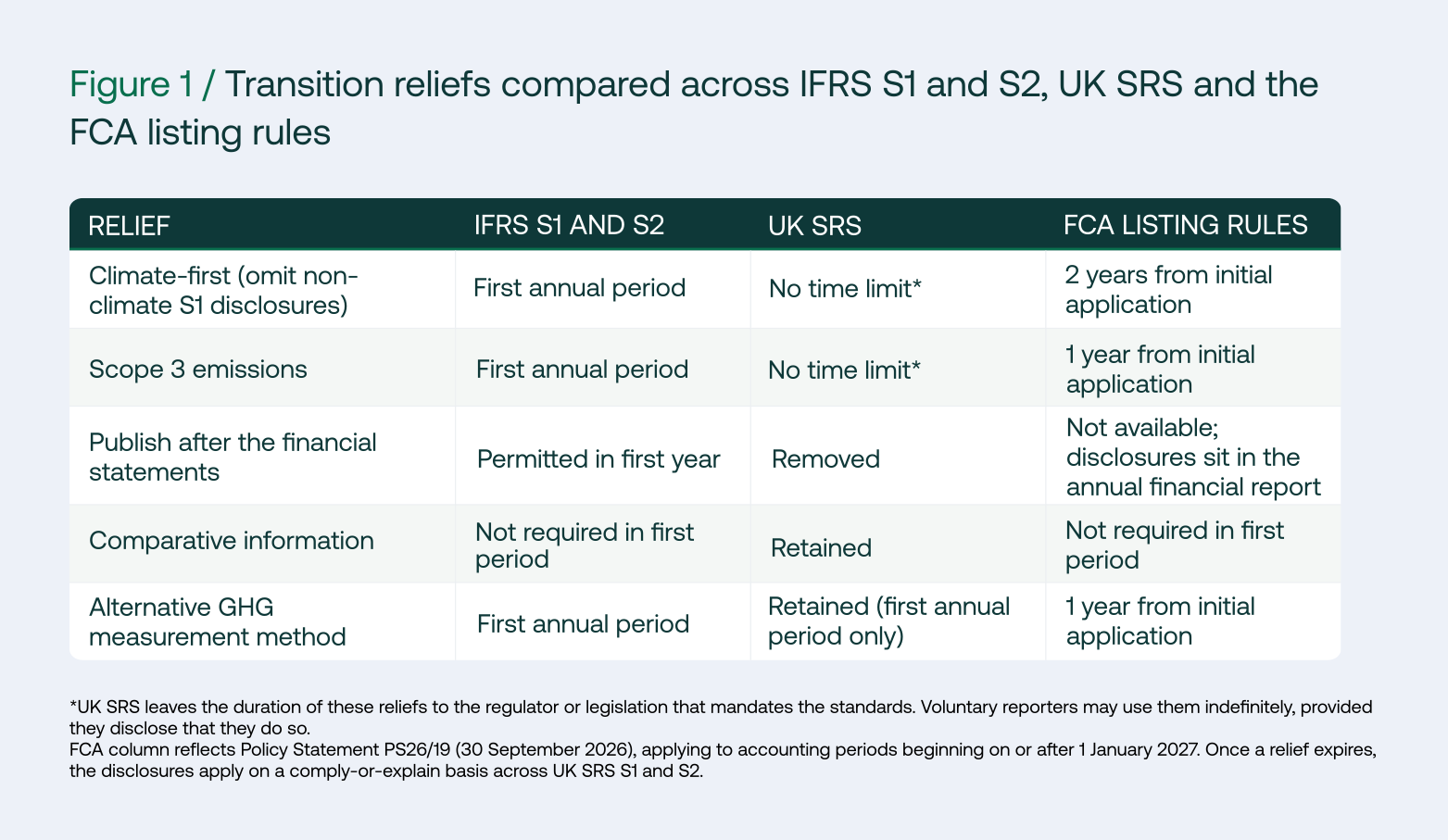
Sources: [1][2][5][6]
Under the FCA rules, a company using a relief must state which relief it uses, but does not need to explain why during the relief period. Early adopters may also use the reliefs. [6] Relief periods should be built into the assurance plan, because what is reported, and what an assurance provider can examine, changes as each relief expires.
As Nexio Projects, we can support organisations like yours with financial materiality assessment, IFRS S1 and IFRS S2 and UK SRS gap analysis, implementation, and reporting and assurance readiness.
Download our reporting guide to learn more on different standards!

A readiness review should take place before the reporting period closes. The objective is to identify weak controls while the company can still improve the underlying process.
Select a sample of disclosures and trace each one from the final report back to the original source.
The review should connect source data, calculation files, assumption records, review evidence, management approval, and the final disclosure.
The sample should cover different data types. Examples include emissions, workforce data, capital expenditure, transition plans, supplier information, and climate risk metrics.
This exercise shows whether the company can explain a reported figure from beginning to end. It also reveals where evidence is stored outside the formal reporting process.
Compare sustainability disclosures with the financial statements, annual report, risk register, transition plan, website, and investor presentations.
Inconsistencies can create assurance questions. They can also reduce confidence when individual figures appear reasonable in isolation.
The company should define which document takes priority when information differs. It should also record who approves corrections and how the change is reflected across related reports.
A reporting control is useful only when it operates on time. The calendar should show when data is collected, reviewed, challenged, approved, and archived.
The first reporting cycle may require more manual controls. Over time, recurring checks can be automated and sustainability data can become part of existing financial reporting processes.
IFRS S1 requires sustainability related financial disclosures to cover the same reporting period and be published at the same time as the related financial statements. [1][3] IFRS S1 offers first-year relief from this timing, but UK SRS removed that relief, and the FCA rules place the disclosures in the annual financial report. [5][6]
This timing makes early coordination essential. Sustainability reporting cannot remain a late-stage exercise managed after financial close.
The practical challenge is building a reporting system that can explain which framework applies, how information was produced, and why management considers it reliable.
Companies should first confirm whether they are in scope of the FCA rules and which transition reliefs they will use. They should then define their reporting basis, map reporting boundaries, assign control owners, document calculations, and record significant judgements, including any comply or explain decisions. Finally, they should test the evidence trail before an assurance provider begins work.
A coordinated control environment can support IFRS S1, IFRS S2, UK SRS, investor requests, and internal risk management. Each framework, and each jurisdiction’s version of it, still requires its own scope, disclosure purpose, and legal assessment.
This approach supports regulatory readiness and better decision making. It also helps organisations connect the needs of business and the planet through reporting that is consistent, useful, and defensible.
“Assurance becomes more efficient when the company can explain its reporting decisions before the first evidence request arrives.”
We are an international sustainability consultancy helping organisations connect regulatory requirements with reliable data, accountable governance, and practical implementation.
Nexio Projects has delivered more than 1,000 sustainability projects for more than 400 customers across more than 20 countries. Our sustainability reporting work includes IFRS S1 and IFRS S2 readiness, UK SRS gap analysis, financial materiality assessment, climate-related disclosure support, and reporting and assurance support.
Recognised as a leading boutique ESG and sustainability strategy consultancy by Verdantix and included among the top sustainability advisory firms in the MT/Sprout SD400 2025, we are here to help you prepare reporting that can withstand scrutiny across jurisdictions.
Contact our sustainability reporting team to assess your reporting basis, control environment, evidence trail, and readiness for IFRS S1, IFRS S2, or UK SRS reporting and assurance.
Subscribe to our newsletter for more updates on IFRS, UK SRS and reporting frameworks.


