

 Our insights from January 2026: Sustainability in motion
January 31, 2026


saya Stephanie Pragastis, Senior Sustainability Consultant and Trainer, Nexio Projects to summerise the challenge when it comes to being a top performer in the assessment.
EcoVadis Platinum is held by the top 1% of all companies rated on the platform globally. As of May 2026, the approximate score observed at this level sits at 86 out of 100 [1]. Gold sits at approximately 80 [1]. Six points in raw score terms looks manageable. In practice, those six points require a company to push several scoring indicators simultaneously closer to their ceiling.
What Nexio Projects observes across its client portfolio is that Gold companies are rarely far from the substance of Platinum. The gap tends to concentrate in three specific places: Policies coverage extended to a wider range of activated criteria; Measures implemented across every activated criterion rather than most; and Reporting that carries third-party verification and multi-year longitudinal depth. This article maps those patterns using the indicator structure that drives the EcoVadis score, drawing on Nexio Projects’ benchmarking data and client experience.
Since January 2024, EcoVadis has awarded medals based entirely on percentile ranking, not fixed score thresholds. Your overall score is compared against every company rated on the EcoVadis platform over the previous 12 months. Your medal depends on where you rank within that global group: Bronze goes to the top 35%, Silver to the top 15%, Gold to the top 5%, and Platinum to the top 1%. Because the database keeps growing and companies keep improving, the approximate score required for each medal shifts over time. The score benchmarks referenced in this article are drawn from Nexio Projects’ internal client portfolio data, last updated May 2026. They are directional indicators, not fixed targets published by EcoVadis. What it takes to reach Platinum in any individual case also depends on the weighting of a company’s activated sustainability criteria, its size band, and how it currently performs on each individual indicator.
Based on Nexio Projects’ benchmarking data and client portfolio work, companies scoring in the Platinum range in 2026 tend to have the following in place [1]:
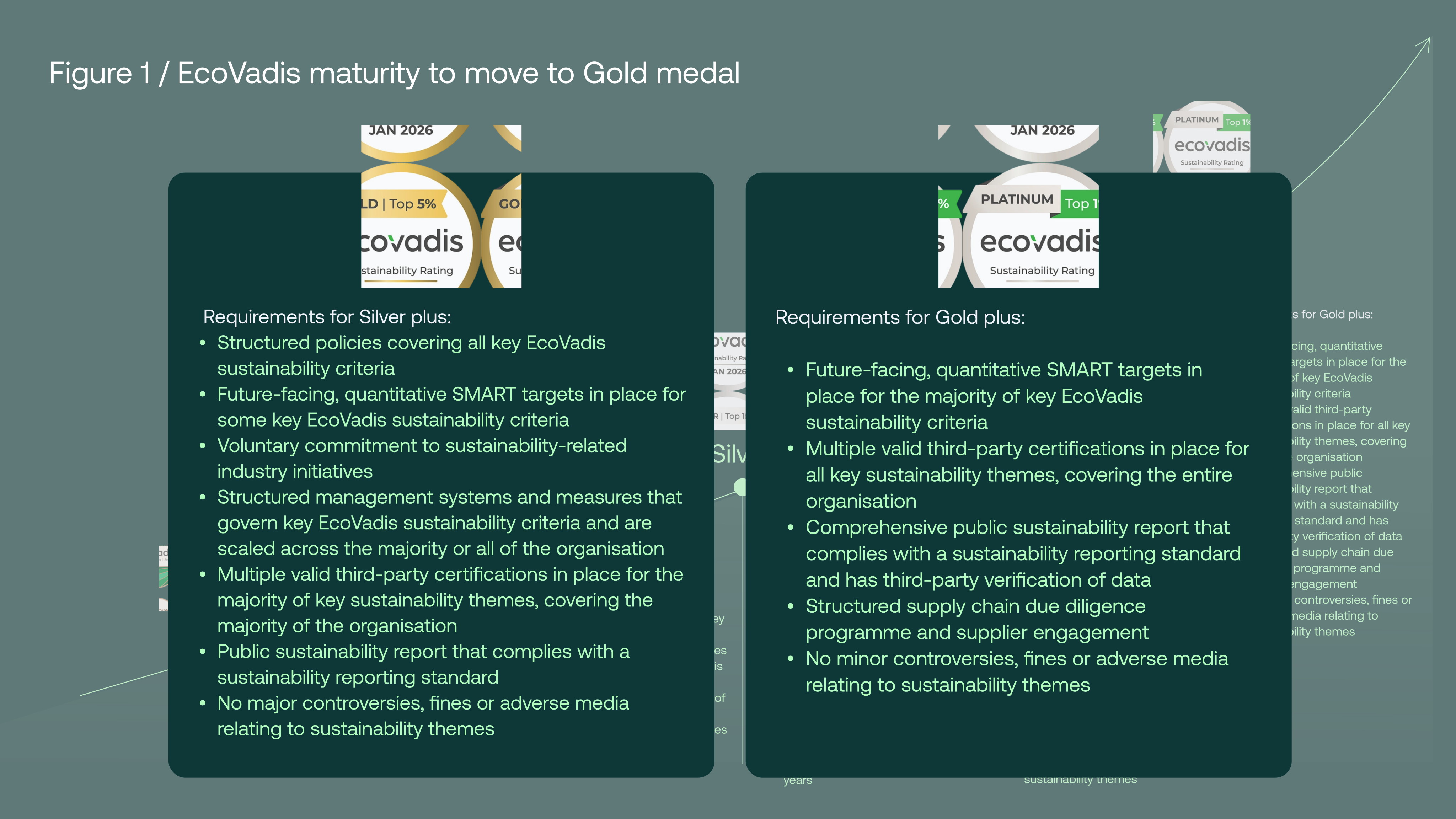
These are observations from Nexio Projects’ portfolio, not a formal EcoVadis Platinum checklist. EcoVadis awards medals based on percentile ranking. What any individual company needs depends on which sustainability criteria are activated, how those criteria are weighted for its sector and size, and where its current indicator scores sit.
Nexio Projects’ benchmarking data through May 2026 shows the following [1]:
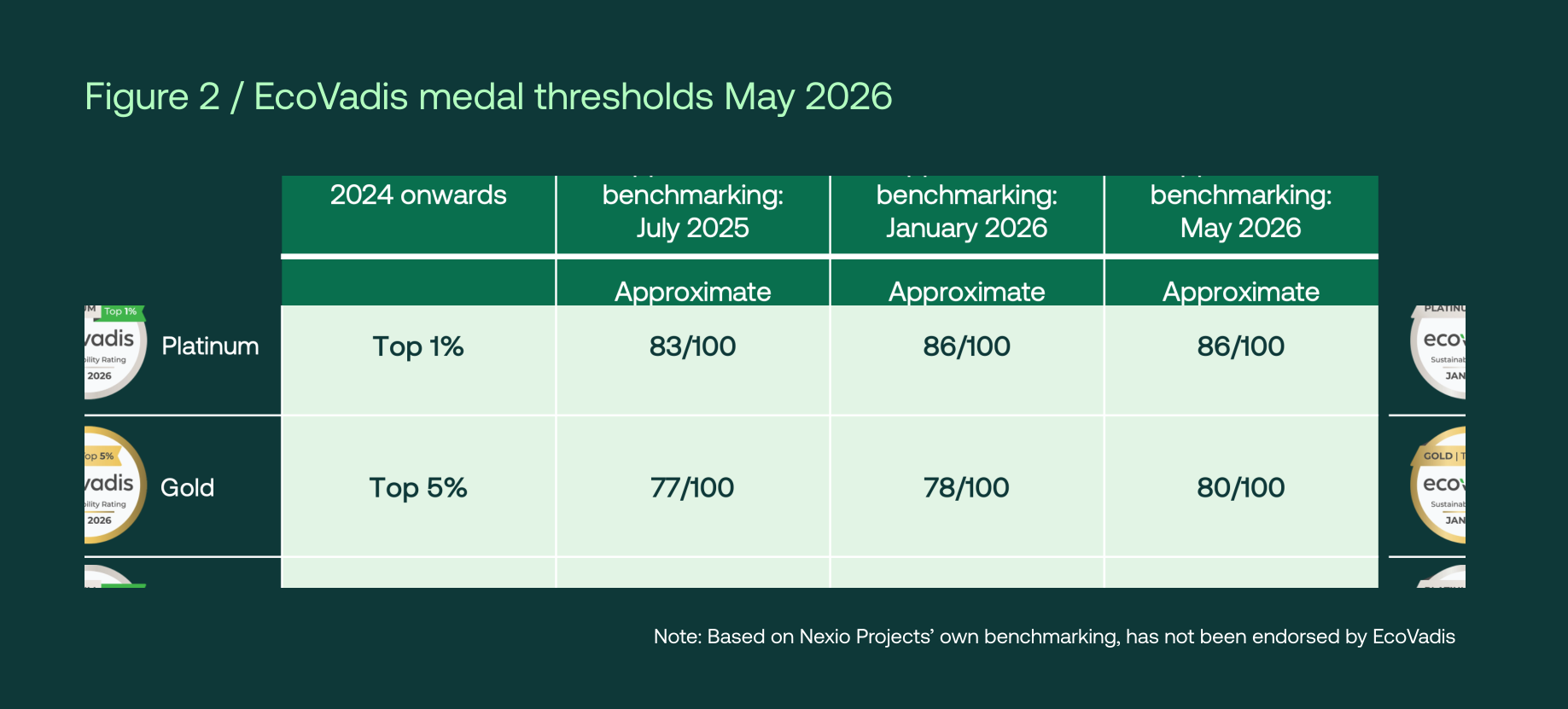
Platinum stabilised at approximately 86 between January and May 2026. The Gold cohort continued to improve in that period, narrowing the gap from 8 to 6 points. This movement reflects continued investment in sustainability management systems by top-quartile companies and reinforces the importance of understanding precisely where indicator scores can still move before the next assessment cycle.
Before mapping specific levers, it helps to understand how the EcoVadis scoring formula distributes weight. The decisions that move a score from Gold into Platinum territory are disproportionately concentrated in a few of the scoring indicators.
EcoVadis evaluates companies across four sustainability themes (Environment, Labour and Human Rights, Ethics, and Sustainable Procurement) and assigns scores across four main content indicators:
For large companies, a Coverage multiplier is applied to the Actions category (which includes both Measures and Certifications), meaning the organisational scope of management systems and certifications affects how these indicator scores translate into overall score points.
EcoVadis 360° Watch findings can affect medal eligibility. A company becomes ineligible if it has at least one severe finding in any theme, at least one major finding each in two different themes, or five or more major findings within a single theme. Findings remain valid for three years for Environment, Labour and Human Rights, and Sustainable Procurement, and for between five and ten years for Ethics. Different thresholds apply to very large companies (50,000+ employees).
Gold companies in Nexio Projects’ portfolio typically score well on Policies at the theme level and hold multiple certifications for their main operations. The gaps to Platinum most commonly concentrate in Measures (breadth and depth across all activated criteria, particularly Ethics), Reporting (third-party assurance and multi-year longitudinal data), and, for large companies, in Coverage (extension of management systems to all relevant entities).
“Gold companies tend to have robust policies and strong certification coverage for their core operations. What most often holds the Platinum score back is the depth and breadth of measures across all activated criteria, and whether the organisation’s sustainability management systems genuinely reach every relevant entity.”
states Rachit Paliwal, Senior Sustainability Consultant, Nexio Projects.
Many Gold companies publish a sustainability report aligned to a recognised standard. Scoring at or near the maximum on the Reporting indicator requires more. The key elements are: compliance with a recognised standard (GRI “in accordance with,” SASB, ESRS, IFRS, or VSME Comprehensive. Note that GRI “with reference” now scores a maximum of 75/100 following the April 2026 methodology update); independent third-party verification or assurance; a materiality analysis documented and included; and at least three consecutive years of KPI data from a single document, covering more than 85% of activated criteria by weight. The most common pattern observed in Gold companies is a report that covers one or two years, references GRI without full “in accordance with” compliance, and has never been externally assured.
The Measures indicator rewards both the number of measures implemented and the extent to which they address activated criteria. Scoring 100/100 on Measures generally requires at least four implemented measures, with more than two-thirds of activated criteria addressed by weight, and at least one documented measure for every single activated criterion. Gold companies in Nexio Projects’ portfolio tend to score well on Measures for Environment and Labour and Human Rights, where procedures and training programmes are more routinely in place. Ethics frequently lags at this level: scoring above 75/100 on the Ethics Measures indicator requires documented corruption risk assessments and documented information security risk assessments. Sustainable Procurement maximum score requires six or more implemented actions. Gold companies are often held back by not reaching maximum points in the Measures indicator – typically because all activated criteria don’t have multiple measures in place.
Gold companies in Nexio Projects’ portfolio tend to have quantitative SMART targets on their highest-priority criteria, typically GHG reduction, energy efficiency, and in some cases food waste or water. Extending those targets to all activated criteria across all four themes is the differentiator between Gold and Platinum.
The levers below are organised by scoring indicator. The relative priority of each will depend on where a company’s current indicator scores sit and which criteria are activated and heavily weighted for its sector and size. Understanding how EcoVadis scores each criterion in the 2026 assessment is the recommended starting point before prioritising improvement effort. [4]
The Policies indicator scores how well a company’s written commitments cover its activated criteria, with SMART targets as a key differentiator at higher score levels. Where SMART targets exist for Environment but not for other themes, the path is to set time-bound, quantitative targets for Labour and Human Rights (e.g. a target to reduce lost-time injury frequency rate by a defined percentage by a defined year), Ethics (e.g. a target for anti-corruption training completion across all entities), and Sustainable Procurement where it is activated and ahigh-weight theme (e.g. a target for the percentage of procurement spend subject to supplier sustainability screening). Strengthening the governance framework by formally assigning sustainability responsibilities at senior level and documenting the performance review cycle adds further to the Policies score across all themes.
Measures is the highest-weighted single indicator and the area where Gold companies most commonly have room to advance.
For Environment, measures to add beyond energy and GHG tracking include formal procedures for water management, waste management, and biodiversity (where activated), dedicated training programmes on environmental topics specific to the company’s sector, and documented environmental impact assessments for key processes or products.
For Labour and Human Rights, additional measures include specific training programmes on individual Labour topics such as modern slavery, discrimination and harassment, and ergonomics; documented human rights due diligence processes; and, where activated, a formal occupational health risk management process that extends beyond basic regulatory H&S compliance.
For Ethics, the two measures most commonly absent at Gold level are a documented corruption risk assessment and a documented information security risk assessment. Both are required to score above 75/100 on the Ethics Measures indicator. A formal whistleblower procedure with evidence of operationalisation is also credited. These three measures together move the Ethics Measures score significantly for most Gold-level companies.
For Sustainable Procurement, maximum Measures scores require six or more implemented actions. Where Sustainable Procurement is a high-weight criterion, the actions that advance the score include: supplier self-assessment questionnaires, SMETA or equivalent social audits of key suppliers, a supplier capability-building programme, documented corrective action tracking for underperforming suppliers, and reporting on procurement spend covered by sustainability criteria. Where SP is lower-weighted for the sector and size, the priority of these actions relative to other indicators will be lower, and the gap analysis against the scorecard should guide sequencing.
The EcoVadis essentials guide documents the evidence standards required for each type of measure to be credited within the assessment platform. [5]
Certifications contribute 16% to the overall score. For large companies (1,000+ employees), a Coverage multiplier is additionally applied to the Actions category, meaning the organisational scope of certifications and measures affects the overall score – the aim is coverage of the majority of relevant entities, not necessarily every entity in every geography. Coverage is not activated for medium-sized or smaller companies. Adding certifications that extend scope to previously uncertified subsidiaries or sites, or obtaining certifications that cover currently uncertified sustainability themes (ISO 37001 for Ethics, Enterprise Citoyenne for Sustainable Procurement, SMETA for Labour and Sustainable Procurement), can move the Certifications score for the relevant themes significantly.
For companies already publishing a sustainability report, the Reporting indicator levers are precise. Scoring 100/100 requires all of the following:
For companies reporting under GRI “with reference,” the two highest-impact changes are upgrading to “in accordance with” compliance and commissioning limited third-party assurance. The three-year data requirement means companies publishing their first or second sustainability report can still score 100/100 on Reporting, provided they include at least three years of KPI data – either within the report itself or through supplementary evidence. Building that longitudinal record begins now.
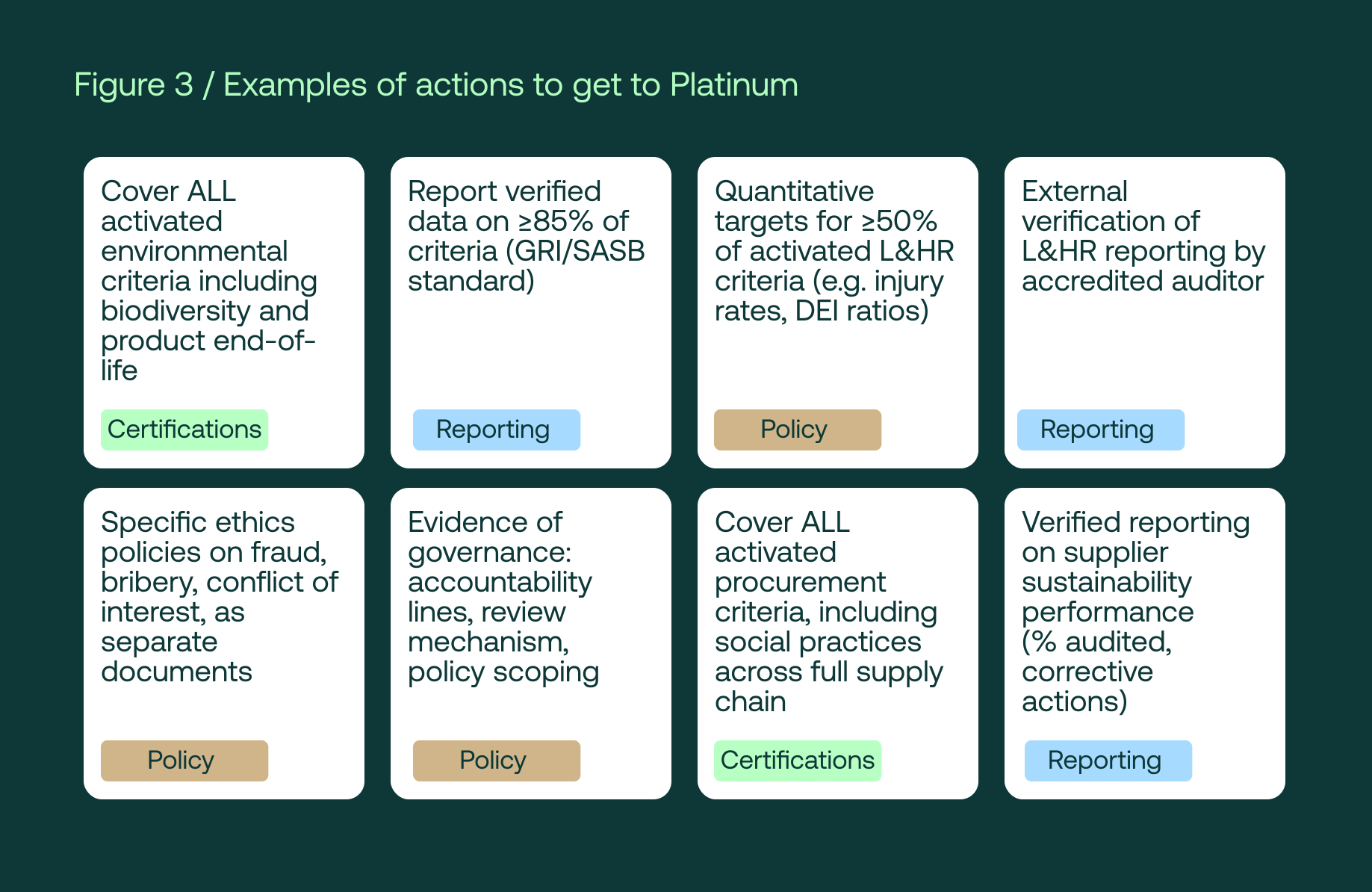
A large food and beverage company with approximately 1,500 employees operating across five European countries had held the EcoVadis Gold Medal for two consecutive assessment cycles. A combined requirement from a key retail client and an institutional investor required Platinum within one cycle.
Nexio Projects conducted a gap analysis against the company’s current scorecard and identified three bottlenecks. First, the company published a GRI-referenced sustainability report but had never commissioned third-party assurance, and the current report covered only two years of KPI data. Second, SMART targets existed for GHG and food waste but not for any Labour, Ethics, or Sustainable Procurement criteria. Third, documented measures for Ethics were limited to a Code of Conduct and anti-corruption training. There was no corruption risk assessment and no information security risk assessment, holding the Ethics Measures score below 75/100.
The improvement programme over five months addressed all three gaps: limited assurance was commissioned from an independent auditor; new quantitative SMART targets were introduced for H&S frequency rate, diversity and inclusion training completion, supplier assessment coverage, and ethical sourcing spend; a corruption risk assessment and an information security risk assessment were formalised and documented; and ISO 14001 and ISO 45001 were extended to cover two remaining country operations.
At reassessment, the company scored 88, earning the Platinum Medal. The improvement was 7 points from a starting position of 80. The largest gains were in Reporting (assurance and standard compliance) and Ethics Measures (the two risk assessments previously missing). Nexio Projects clients achieve an average score improvement of 13.8 points across the portfolio [3]. The CIRFOOD multi-year partnership illustrates what sustained Platinum looks like across multiple consecutive assessment cycles. [6]
“Platinum is not a destination to reach and hold. It is a position within a moving peer group. The companies that sustain it treat each assessment cycle as an opportunity to go further, not as a confirmation of where they already are.”
concludes Stephanie Pragastis, Senior Sustainability Consultant and Trainer, Nexio Projects.
Platinum is a percentile position, not a fixed score. The benchmark held steady at approximately 86 between January and May 2026, but the trajectory since 2024 has been upward overall. Sustaining Platinum requires active maintenance across all four indicators: updating SMART targets as methodology expectations evolve, extending Measures to new activated criteria, maintaining certification coverage as the organisation changes, and keeping Reporting current, externally assured, and compliant with the latest recognised standards.
For a full picture of what the 2026 assessment requires across all medal levels, the Nexio Projects guide Stay ahead of the rising standards: EcoVadis 2026 unlocked covers the methodology changes most relevant to companies at Gold and above. [7]
Nexio Projects is an international sustainability consultancy dedicated to guiding organisations on their journey from compliance to purpose. Their expert team provides EcoVadis assessment support, scorecard analysis, gap identification, and structured improvement planning for companies at every medal level including those at Gold, where the path to Platinum is precise. Recognised as a top boutique ESG and sustainability strategy firm by Verdantix and as the best ESG consultancy in the Netherlands by Consultancy NL, Nexio Projects helps clients reach their EcoVadis goals with a structured, evidence-based approach.
Ready to close the gap from Gold to Platinum? Book a free discovery call with the Nexio Projects EcoVadis team and get a clear read on which indicators offer your fastest path to the top 1%.
[1] Nexio Projects. Ecovadis infographic.pptx — EcoVadis score benchmarking data. Internal benchmarking slide, 26Q2 EcoVadis medal articles folder, Marketing Team SharePoint. May 2026.
[2] EcoVadis. EcoVadis Medals and Badges: Levels, Criteria and Meaning. https://ecovadis.com/suppliers/ecovadis-medals-and-badges/. Accessed May 2026.
[3] Nexio Projects. Internal track record data: average client improvement of 13.8 points. Portfolio analysis, 2026.
[4] Nexio Projects. EcoVadis 2026: Your questions answered. https://nexioprojects.com/ecovadis-2026-your-questions-answered/. Published February 2026.
[5] Nexio Projects. EcoVadis essentials: A guide for beginners and reassessed companies. https://nexioprojects.com/ecovadis-essentials-a-guide-for-beginners-and-reassessed-companies/. Published September 2025.
[6] Nexio Projects. CIRFOOD’s multi-year sustainability partnership with Nexio Projects: From vision to leadership. https://nexioprojects.com/cirfoods-multi-year-sustainability-partnership-with-nexio-projects-from-vision-to-leadership/. Published November 2025.
[7] Nexio Projects. Stay ahead of the rising standards: EcoVadis 2026 unlocked. https://nexioprojects.com/knowledge-centre/stay-ahead-of-the-rising-standards-ecovadis-2026-unlocked/. 2026.


