Supply chain emissions: The hidden impact of your carbon footprint
August 19, 2025


Your largest customer has just told you that your EcoVadis score needs to reach Silver by Q3. You’re the sustainability manager. You’re also the sustainability team. And the first thing you need to figure out is what data EcoVadis actually wants on greenhouse gas emissions.
This guide gives you exactly that: what a GHG baseline is, what EcoVadis requires it for, and how to build one that improves your score and delivers value well beyond the assessment.
EcoVadis rates companies across four themes: Environment, Labour and Human Rights, Ethics and Sustainable Procurement (1). Within the Environment theme, energy consumption and GHG emissions is a primary criterion. EcoVadis rates companies across four themes: Environment, Labour and Human Rights, Ethics and Sustainable Procurement. Within the Environment theme, energy consumption and GHG emissions are a primary criterion for most rated companies. Which criteria are activated depends on your country, sector and size (1), so not every environmental topic appears in your assessment. Alongside GHG emissions, the theme can cover materials, chemicals and waste, water and biodiversity. It can also cover product use, product end-of-life, customer health and safety, and environmental services and advocacy. Of these, GHG management carries the highest commercial visibility and is the criterion most buyers scrutinise.
For manufacturing, chemicals, packaging and logistics companies, the Environment theme typically carries the highest weight in your overall score. That means your GHG management is not a minor subsection. It’s a core determinant of whether you reach Silver, Gold or Platinum.
EcoVadis uses a Policy, Actions and Results (P-A-R) model to assess each criterion (1). Assessors look at three things for GHG emissions:
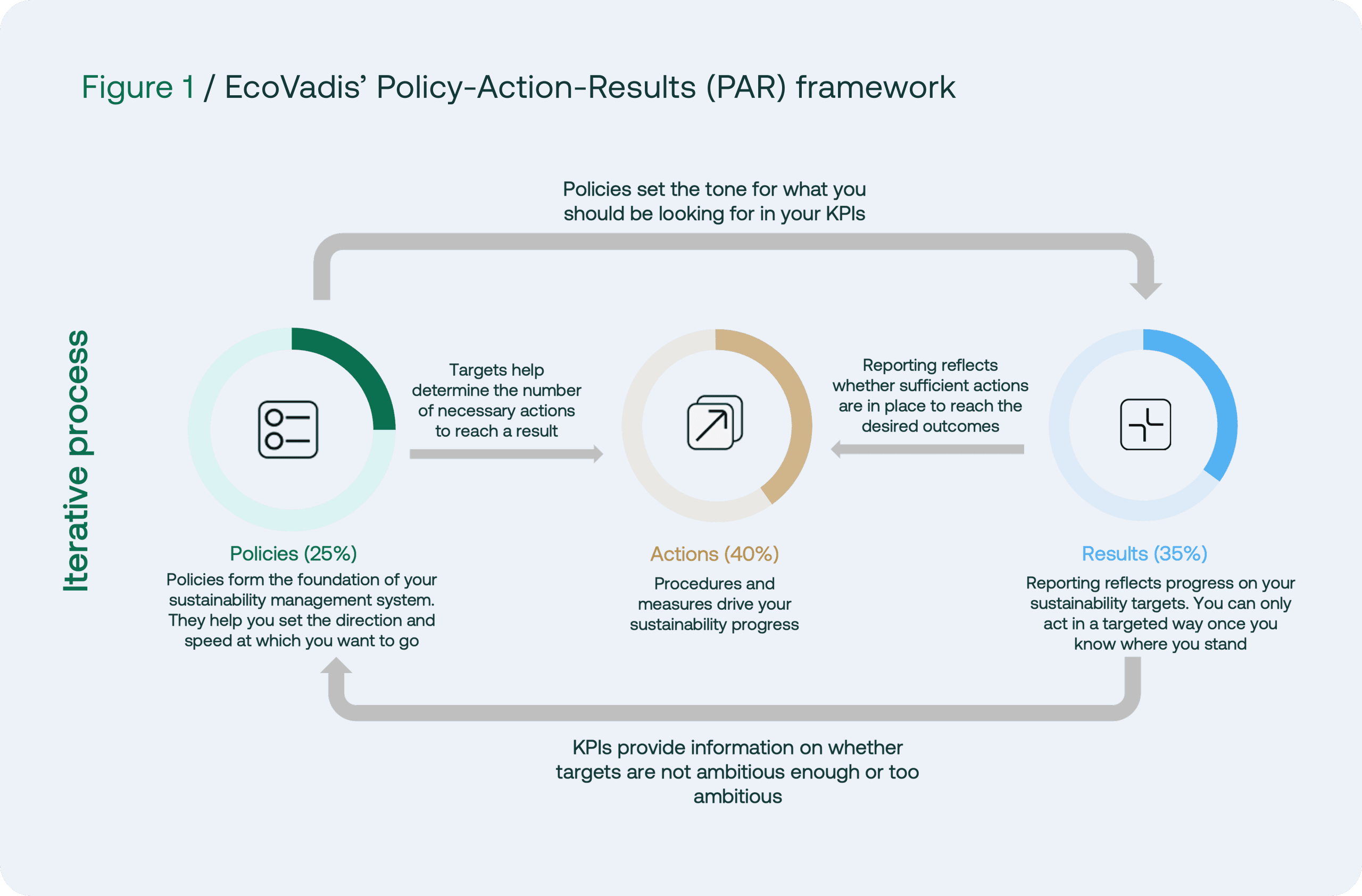
A GHG policy with no supporting measurement data scores at Policy level only. That means you’re leaving Actions and Results points entirely on the table. Companies that write a policy but never complete the baseline exercise consistently fail to break through to Silver, regardless of how good their other submissions look.
A GHG baseline is a quantified measurement of your company’s greenhouse gas emissions across three scopes.
Scope 1 covers direct emissions from sources you own or control: gas boilers, company vehicles and on-site manufacturing processes. These are typically the easiest to measure.
Scope 2 covers indirect emissions from the electricity, heat or steam you purchase. A significant change took effect in 2026: EcoVadis now requires companies to report Scope 2 using both location-based and market-based methods. If you hold renewable electricity certificates (RECs or Guarantees of Origin), your market-based figure will be lower, but you need to document both.
Scope 3 covers everything in your value chain: purchased goods and services, employee commuting, business travel, distribution, waste and use of sold products. Scope 3 typically represents the vast majority of a manufacturing company’s total carbon footprint.
For EcoVadis, a reliable Scope 1 and Scope 2 baseline is the minimum to demonstrate credible GHG management (4). Including Scope 3, even for the most material categories, strengthens your Actions and Results evidence significantly (4).
You don’t need a large team to start. Here’s the core data set:
Scope 1 data:
Scope 2 data:
Scope 3 starter data:
You calculate emissions by applying emission factors to each activity. The GHG Protocol Corporate Standard, published by the World Resources Institute and WBCSD (3), is the globally accepted standard for this methodology. EcoVadis assessors recognise GHG Protocol-based inventories directly (3).
[SOURCE: GHG Protocol Corporate Standard, World Resources Institute and WBCSD — ghgprotocol.org]
Once you have a baseline, here is what you can do with it in your EcoVadis submission.
You’re building this data for your EcoVadis cycle. But it’s also the foundation for almost everything else in your sustainability programme.
The single baseline investment supports four compliance and disclosure pathways simultaneously. For a sustainability manager working with limited internal resource, that efficiency matters more than any one framework’s requirements.
Nexio Projects is the number one global EcoVadis strategic partner. We’ve delivered 600+ sustainability projects since 2018, and 87% of our EcoVadis clients improved their score, with an average improvement of 13.8 points.
Our EcoVadis and GHG support for sustainability managers typically covers:
Working directly with EcoVadis as a strategic partner means we understand how assessors review evidence and where most submissions fall short. We bring that inside knowledge to every engagement.
What GHG data does EcoVadis ask for in the assessment?
EcoVadis asks whether you measure GHG emissions, which scopes you cover and whether you have reduction target (4)s. Scope 1 and Scope 2 reporting is expected for most rated companies. A 2026 methodology update now requires both location-based and market-based Scope 2 reporting where applicable (2). Including material Scope 3 categories strengthens your Environment score further.
Do I need a sustainability consultant to build a GHG baseline for EcoVadis?
Not necessarily for smaller companies with simple operations. For companies with multiple sites, complex supply chains or no existing emissions data, specialist support typically saves time and reduces the risk of errors that lead to a resubmission. The baseline needs to be defensible, not just documented.
How does the GHG baseline connect to my EcoVadis score improvement?
Your GHG baseline supports your Environment theme score at every level of the P-A-R model. A policy alone scores at Policy level. Measurement data with documented initiatives scores at Actions level. Moving from Policy to Results on GHG is one of the highest-impact improvements you can make to your total score.
Will my EcoVadis GHG baseline be useful for CSRD as well?
Yes. ESRS E1 under CSRD requires Scope 1, 2 and 3 GHG disclosures from companies in scope for mandatory reporting. The data structure you build for EcoVadis is the same foundation CSRD requires. Starting now means you’re building a dual-purpose asset rather than running two separate exercises later.
Our company got a low EcoVadis score on environment. Where should we start?
Start with your GHG baseline. In most cases, a low Environment score reflects limited Actions and Results evidence on GHG management, not a fundamental performance problem. Measure your Scope 1 and Scope 2 emissions, document the process and set an internal reduction target. That single intervention typically moves the needle more than any other.
“As EcoVadis’s number one global strategic partner, we’ve seen thousands of assessments. The Environment theme gap between average and Silver performers is rarely about what companies are doing. It’s about what they can prove. A GHG baseline is how you bridge that gap.”
Download our guide to have a more detailed look into these learnings and changes!

Your EcoVadis score is a live commercial asset. When a customer requests Silver or Gold, the window to prepare is shorter than it looks. And a GHG baseline that you build reactively, two weeks before your questionnaire is due, is a GHG baseline that shows in your score.
Nexio Projects is the number one global EcoVadis strategic partner, with 87% of clients improving their score and an average 13.8-point improvement. We’ve helped 600+ companies across Europe and North America prepare submissions that deliver real results, not just policy documentation. Request a call with our experts today!
Additionally, subscribe to our newsletter for more EcoVadis updates.