Step by step to become net zero
January 7, 2025


states Liliia Kalimullina, Sustainability Princpial Consultant.
Climate risk disclosure has expanded substantially. According to the IFRS Foundation’s Report, 82% of the 3,814 public companies reviewed disclosed information in line with at least one of the eleven TCFD recommendations in fiscal year 2023, up from 73% in 2022 [1]. Yet integration into financial decision-making remains shallow: fewer than 3% of companies disclosed in line with all eleven recommendations, and only 11% reported on the resilience of their strategies under different climate-related scenarios – the recommendation most directly tied to financial planning [1]. The result is a growing body of organisations that have completed TCFD-aligned reports, but whose CFO has never seen the numbers in a capex model.
That gap is the subject of this article. Drawing on a recent Nexio Projects webinar, what follows sets out the practical case for moving climate risk from the sustainability function into financial decision-making, and what that shift is worth in concrete terms.
“Climate risk assessment without integration is just expensive storytelling” – as Liliia Kalimullina, Nexio Projects Principal Consultant put it during Nexio Projects’ webinar on climate risk integration. [2]
Disclosure is up. Integration is not. Climate risk sits in the sustainability department, referenced in annual reports but largely absent from capital planning, insurance renewal negotiations, or M&A due diligence. The regulatory floor is pushing organisations to quantify, not merely narrate.
The distinction matters because when climate risk remains a reporting exercise, it generates cost and compliance burden with no corresponding decision benefit. When it is translated into financial terms, it becomes a tool for protecting cash flows, defending valuations, and allocating capital more accurately.
Nexio Projects works with organisations across a four-level maturity model that runs from initial awareness through full integration of climate risk into financial decision-making. The pattern across their European client base is consistent: most companies sit at Level 2 “Disclosed”. The four levels break down as follows:
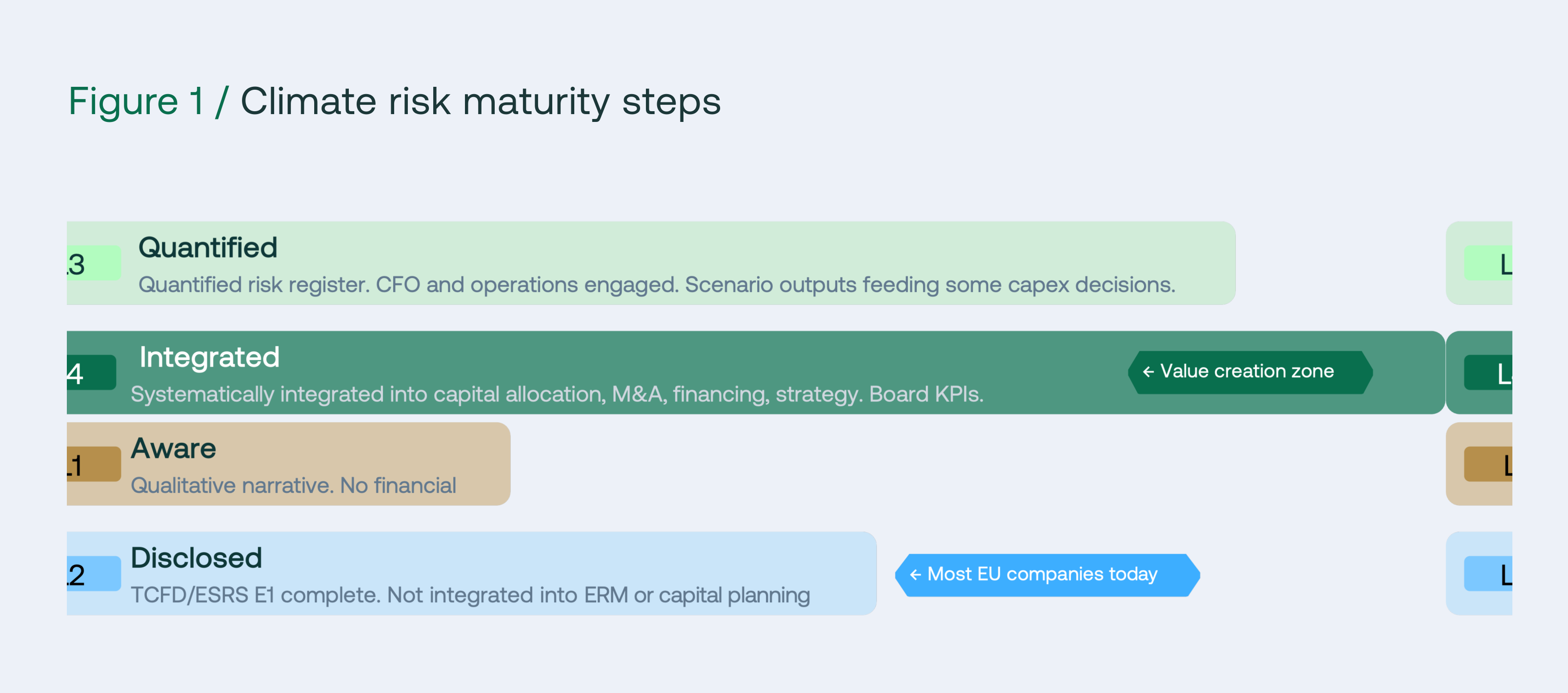
• Level 1 — Aware. Qualitative narrative. No financial quantification. Climate risk has not yet entered the risk register in any structured form.
• Level 2 — Disclosed. TCFD or ESRS E1 complete. Risk register exists but climate risk is not integrated into capital planning or enterprise risk management. This is where the majority of EU companies sit today.
• Level 3 — Quantified. Quantified risk register. The CFO and operations teams are engaged. Scenario outputs are feeding some capex decisions.
• Level 4 — Integrated. Systematically embedded into capital allocation, M&A, financing, and strategy. Board KPIs reflect climate exposure. This is the value creation zone.
The sprint from Level 2 to Level 4 is a governance and methodology challenge. The knowledge level among practitioners is often higher than the maturity level of the systems they are working within – the gap between knowing and embedding is where most organisations lose ground.
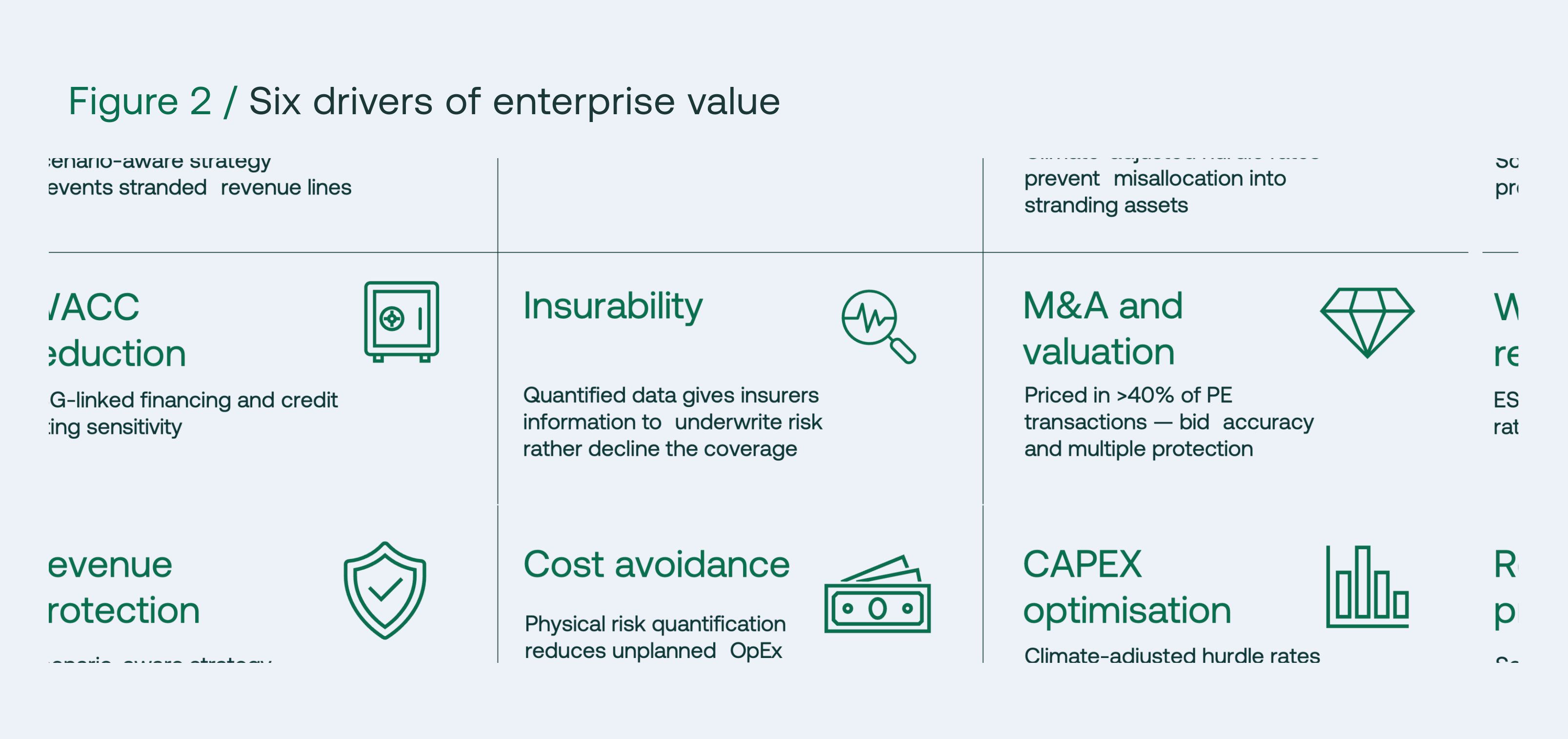
When climate risk is properly quantified and integrated, it acts on six discrete drivers of enterprise value [2]:
Companies are increasingly able to quantify their own revenue exposure. Among 18,700 companies disclosing to CDP in 2023, the median firm identified $3.1 billion in climate-related opportunities – and material revenue at risk from regulation, shifting markets, and acute physical events [3].
Asset damage, supply chain disruption, and production downtime all carry costs that appear, without warning, on organisations that have not modelled them.
The pattern is consistent: a single drought, flood, or heatwave at a key sourcing location moves the operating cost line by hundreds of millions, and companies without granular physical-risk mapping are repeatedly caught flat-footed.
Climate-driven supply chain disruptions cost companies an estimated $100 billion globally in 2024, with delivery delays, transportation interruptions, and inventory losses the primary drivers. By mid-century, cascading supply chain effects from extreme heat alone could compound global GDP losses by an additional 0.05–0.15 percentage points per year [4].
Physical risk quantification reduces unplanned operating expenditure.
Climate-adjusted hurdle rates prevent misallocation into stranding assets. Every major capital decision today embeds implicit climate assumptions.
BP took a $17.5 billion impairment in 2020 tied to a downward revision of its long-term oil and gas price assumptions, citing the energy transition. Every major capital decision today embeds implicit climate assumptions; making them explicit upfront produces better allocation decision and is materially cheaper than impairing them later.
ESG-linked financing and credit rating sensitivity are now material. Moody’s and S&P embed physical and transition risk into credit rating methodologies [5]. The ECB’s 2022 climate stress test found that climate-exposed loan books face higher loan losses under a disorderly transition [6]. Demonstrating quantified climate risk management improves access to green bond markets and ESG-linked financing.
ECB-supervised banks face cumulated credit impairments around 73 basis points higher than baseline under a short-term disorderly transition scenario, rising above 200 basis points for exposures to the most carbon-intensive sectors [7]. On the financing side, European corporate green bonds have historically priced at a yield discount of around 15 basis points for banks and 40 basis points for non-financial corporates relative to conventional bonds, though this “greenium” has narrowed materially since 2022 as the market has matured [8, 9].
ECB-supervised banks face cumulated credit impairments around 73 basis points higher than baseline under a short-term disorderly transition scenario, rising above 200 basis points for exposures to the most carbon-intensive sectors [5]. On the financing side, European corporate green bonds have historically priced at a yield discount of around 15 basis points for banks and 40 basis points for non-financial corporates relative to conventional bonds, though this “greenium” has narrowed materially since 2022 as the market has matured [6,7].
Quantified climate risk data gives insurers the information they need to underwrite risk rather than decline coverage, For some assets, coverage is no longer available at any price. Organisations with granular physical risk data are in a materially stronger negotiating position.
Global insured losses from natural catastrophes reached $137 billion in 2024, the fifth consecutive year above $100 billion, with Europe recording its second-costliest year ever for flood losses at around $10 billion [10]. Of total economic losses of $318 billion, 57 percent, $181 billion, went uninsured, defining the global protection gap. Swiss Re projects insured losses will continue to grow at 5–7 percent annually in real terms, with the United States already accounting for nearly 80 percent of insured losses and average household premiums in Florida running roughly double the national average.
For commercial property, the renewal conversation has changed structurally: insurers now ask for granular physical risk data: asset-level flood, wind, and wildfire exposure, and companies that can supply it are securing materially better terms than those who cannot. The negotiating leverage now sits with whoever brings the data to the table.
Climate findings are now changing deal terms, not just deal narratives. In KPMG’s 2024 Global ESG Due Diligence+ Study, 52% of corporate investors said they had encountered an ESG-related “deal stopper,” and 45 percent reported significant deal-level financial implications – adjusted purchase price, escrow provisions, or specific indemnities – driven by climate or wider ESG findings [11]. On the upside, 59% dealmakers report willingness to pay a premium of 1–5% for targets with high ESG maturity. The premium and the discount now both have a number on them [11].
The Nexio Projects webinar presented three real business case examples. Each demonstrates a different dimension of the economic impact of climate change on corporate financials.
A European chemicals company was evaluating a €200M gas-based plant expansion with a base-case IRR of 14% [2]. Climate scenario analysis told a different story. Under a delayed transition scenario with carbon prices at €130 per tonne by 2030, IRR fell to 6.5% — below the company’s 8% hurdle rate. Under a net zero scenario, IRR turned negative by 2032. By redirecting €40M of the planned investment into assets that delivered a positive IRR across all four NGFS scenarios, the company avoided a capital misallocation that would have been visible only in hindsight.
A 45-asset EMEA portfolio faced a proposed 35% insurance premium increase at renewal [2]. Nexio Projects conducted asset-by-asset flood, heat, and windstorm quantification across the top eight assets. That data-led negotiation reversed 12 percentage points of the proposed increase, producing an annual saving of over €2M. The same data enabled green bond integration, delivering approximately 22 basis points of spread tightening versus conventional financing. As the client noted: “The lender tightened the spread because we showed them the data and solid adaptation plan in place.” [2]
An €800M revenue consumer goods business had zero visibility below its Tier 1 suppliers [2]. A 2022 flood event had produced €1M of unplanned costs, undisclosed. IPCC AR6 hazard mapping identified a single Tier 2 packaging supplier in a high physical risk geography, representing €15M of annual revenue exposure. The cost of dual-sourcing was €1.2M. The return on risk investment: 13 times. This is the logic of supply chain resilience strategies applied to physical climate risk.
For organisations at Level 2 looking to reach Level 4, Nexio Projects structures the transition as three sequential sprints across 120 days [2].
This is a governance and methodology sprint, not a five-year transformation. The key design decision is whether short-term and long-term climate risks sit in a unified register or are assessed at different cadences with different owners and different review cycles for each horizon [2].
On carbon pricing integration, the practical entry point is shadow pricing, using benchmarks aligned to the regulatory levels applicable to each geography where the company operates, then integrating that price into project-level and portfolio-level financing decisions [2]. For organisations with CDP reporting obligations, this analysis directly strengthens CDP climate reporting quality and score.
The methodology draws on several established frameworks. TCFD and IFRS S2 define the disclosure requirements. ESRS E1 sets the CSRD obligation. NGFS and IEA scenario sets, alongside IPCC AR6, provide the physical and transition risk inputs. For financial modelling, marginal abatement cost curves support business case construction and comparison of decarbonisation alternatives. These are not new tools, but their application at the level of individual assets, business units, and P&L lines is where most organisations have not yet arrived.
Ready to move from disclosure to decision? Nexio Projects runs the full climate risk integration pathway, from hazard identification through to board-level financial integration.
Organisations that treat climate risk as a reporting obligation are absorbing the cost of analysis without capturing its value. The business case examples from the Nexio Projects webinar are not edge cases, they reflect what becomes visible when physical and transition risk is translated into the language of capital allocation: prevented capex misallocation, recovered insurance premiums, avoided revenue exposure.
The regulatory floor, CSRD, IFRS S2, ESRS E1, is moving. The financial floor, ETS pricing, CBAM, credit rating sensitivity, is already in place. The organisations that move now, from disclosure to integration, are building a structural advantage in how they allocate capital, manage risk, and access financing. Those that continue to treat this as a sustainability department responsibility are deferring a cost that will arrive regardless.
For a practical entry point into this process, the Nexio Projects climate risk assessment service offers the full pathway from hazard identification through to board-level integration.
Nexio Projects is an international sustainability consultancy dedicated to guiding organisations on their journey from compliance to purpose. Their mission is to provide expert support across strategy development, ESG ratings, climate solutions, and comprehensive sustainability reporting. Ultimately, Nexio Projects helps their clients achieve their sustainability goals with a pragmatic, step-by-step approach.
Recognised among the Verdantix best boutique ESG consultancies and named Best ESG Consultancy in the Netherlands by Consultancy NL, we are here to help your organisation move climate risk from the sustainability function to the boardroom.
Ready to build the business case for climate risk action? Book a free consultation with Nexio Projects’ climate team.
[1] IFRS Foundation (2024) Progress on Corporate Climate-related Disclosures: 2024 Report. London: IFRS Foundation. Available at: https://www.ifrs.org/content/dam/ifrs/supporting-implementation/issb-standards/progress-climate-related-disclosures-2024.pdf (Accessed: 4 June 2026).
[2] Nexio Projects. Climate risk: Building the business case for action — webinar slides. May 2026. Internal presentation delivered by Cilia Keser (Managing Partner) and Liliia Kalimullina (Principal Sustainability Consultant).
[3] CDP (2023) World’s biggest companies eye USD5 trillion in climate opportunities, doubling previous estimates. Available at: https://www.cdp.net/en/press-releases/worlds-biggest-companies-eye-usd5-trillion-in-climate-opportunities-doubling (Accessed: June 2026).
[4] Sun, J. et al. (2024) ‘Global supply chains amplify economic costs of future extreme heat risk’, Nature, 627. Available at: https://www.nature.com/articles/s41586-024-07147-z (Accessed: June 2026).
[5] Moody’s Investors Service; S&P Global Ratings. Climate risk integration into credit ratings. Available at: https://www.moodys.com; https://www.spglobal.com. Accessed May 2026. (Note: these references represent the organisations’ publicly stated methodologies as of 2023 — verify for the most current rating methodology publications before publishing.)
[6] European Central Bank. Banks must sharpen their focus on climate risk, ECB supervisory stress test shows. 2022. Available at: https://www.bankingsupervision.europa.eu/press/pr/date/2022/html/ssm.pr220708~565c38d18a.en.html. Accessed May 2026.
[7] European Central Bank (2022) 2022 Climate Risk Stress Test. Frankfurt: ECB. Available at: https://www.bankingsupervision.europa.eu/ecb/pub/pdf/ssm.climate_stress_test_report.20220708~2e3cc0999f.en.pdf (Accessed: June 2026).
[8] Grishunin, S. et al. (2024) ‘Greenium and its determinants at various phases of life cycle of European green bond market’, E3S Web of Conferences, 595. Available at: https://www.e3s-conferences.org/articles/e3sconf/pdf/2024/104/e3sconf_congreentax2024_03005.pdf (Accessed: June 2026).
[9] WBCSD (2025) Financial quantification: discount rate and the financing greenium. Geneva: World Business Council for Sustainable Development. Available at: https://www.wbcsd.org/news/financial-quantification-discount-rate-and-the-financing-greenium/ (Accessed: June 2026).
[10] European Central Bank. Banks must sharpen their focus on climate risk, ECB supervisory stress test shows. 2022. Available at: https://www.bankingsupervision.europa.eu/press/pr/date/2022/html/ssm.pr220708~565c38d18a.en.html. Accessed May 2026.
[11] European Financial Reporting Advisory Group (EFRAG). ESRS E1 — Climate change. Available at: https://www.efrag.org/en/projects/esrs-detailed-pages/esrs-e1. Accessed May 2026.