“Sustainability progress becomes easier to manage when commitments, evidence and ownership move in the same direction.”
Welcome back to ‘Sustainability in Motion’. In this edition, we cover:
Inspire – It’s back to school season: EcoVadis refresher for beginners and pros
Educate – ESG reporting in a nutshell: Mandatory and voluntary reporting after Omnibus
Share – Celebrating 9 years of Nexio Projects
Regulatory updates – ECGT applies from September 2026: Are you ready?
EcoVadis assessment: preparation starts with the basics
The return from summer often brings a familiar task for sustainability and procurement teams: preparing for an EcoVadis assessment.
Some organisations are approaching their first questionnaire. Others are preparing for reassessment and looking closely at their previous scorecard.
Both groups face the same underlying challenge. EcoVadis evaluates the quality of a company’s sustainability management system through policies, actions and results. Each assessment is also shaped by the company’s activity, size, location and assessment scope. [1]
For first time assessors
Start by understanding what the assessment covers. A policy can show intent, yet it does not prove that the organisation has implemented the commitment.
Strong preparation connects the policy with practical evidence. This may include training records, implementation procedures, targets, monitoring data, responsibilities and performance results.
The assessment scope also matters. A site assessment does not automatically support group wide claims. The entity, operational sites and activities covered by the assessment must match the evidence submitted. [2]
Our EcoVadis Essentials article provides a useful starting point for understanding the questionnaire, four themes and evidence requirements.
For experienced teams
Reassessment requires a different type of preparation. The priority is to understand what has changed since the previous scorecard.
Review the improvement areas first. Then ask whether each action has been implemented, documented and measured.
EcoVadis introduced several methodology updates during 2026. These included more detailed improvement areas, changes to accepted certification evidence, environmental risk preparedness questions and more granular Scope 2 reporting. [3]
The practical lesson is clear. Reuse evidence only when it remains current, relevant and representative of the assessed scope.
Our EcoVadis 2026 guide explains where teams can focus their preparation as assessment expectations evolve.
ESG reporting after Omnibus: choose the driver first
The reporting landscape has become more proportionate for some organisations. The decision about what to report still requires careful judgement.
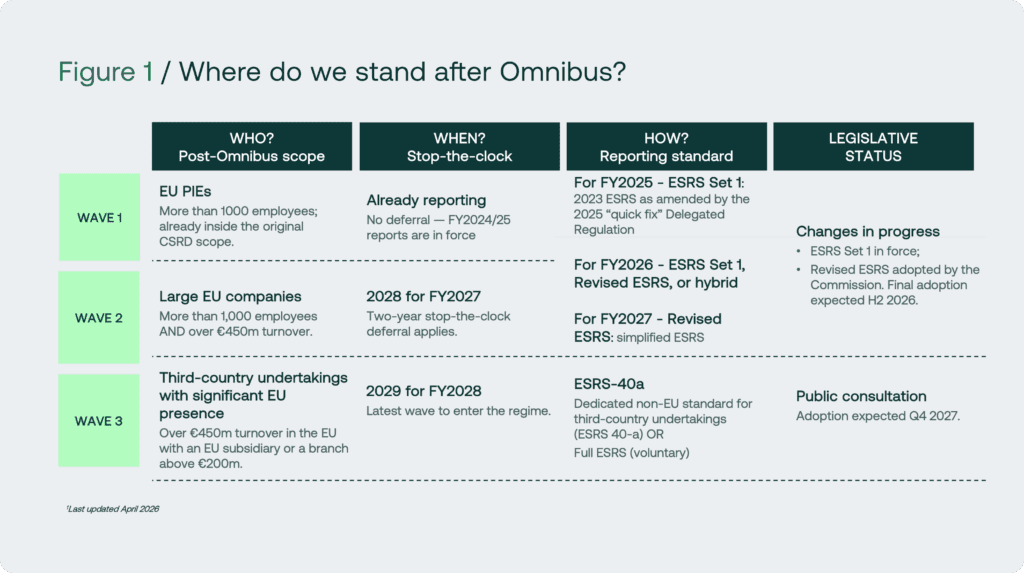
Companies preparing for future reporting under the revised ESRS need to understand their scope, reporting period, material topics, data owners and evidence trail.
The revised ESRS delegated regulation has a date of effect of 10 November 2026. It applies to financial years beginning on or after 1 January 2027. [4]
The revised framework changes the reporting requirements. It does not remove the need for reliable processes.
A robust double materiality assessment remains important. So do clear responsibilities, consistent data, internal controls and documentation that explains how reported information was produced.Companies outside mandatory reporting may still face reporting expectations from customers, lenders, investors and procurement teams.
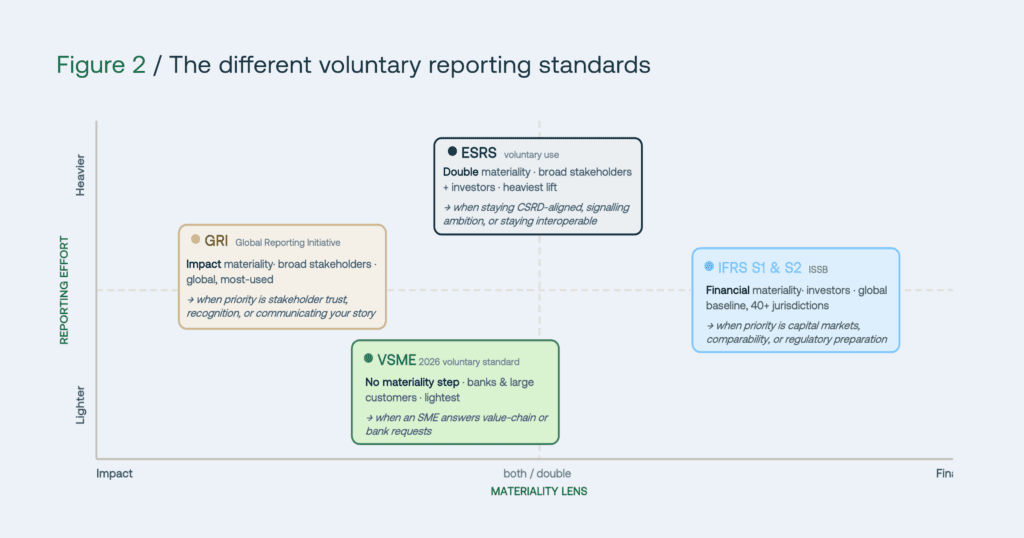
EFRAG describes the voluntary standard as a proportionate framework for undertakings with fewer than 1,000 employees. [5]
The right question is therefore practical: What is driving your reporting? VSME may support value chain requests. GRI may support broader impact reporting. IFRS S1 and S2 may serve investor and lender needs. ESRS may provide a more comprehensive double materiality perspective.
The strongest approach starts with the intended audience and decision. The standard should serve that purpose.
“A reporting framework is useful when it helps people make better decisions. The label matters less than the quality of the process behind it.”
Nine years of moving from compliance to purpose
Nexio Projects reaches its ninth anniversary in 2026.
The sustainability function has changed significantly since the company was founded. Sustainability now connects with strategy, risk, finance, procurement, operations and leadership.
Our work has developed alongside that shift. We support organisations with EcoVadis assessments, climate strategy, sustainability reporting, decarbonisation and implementation.
The company’s ecosystem now includes more than 480 customers, over 1,500 projects and a growing network of partners, raters, certifiers, software providers and subject matter experts.
A recent NPS of 79 reflects the qualities clients tell us they value: clear communication, practical guidance, structured roadmaps and close collaboration.
The wider lesson is relevant beyond our own anniversary. Sustainability work creates value when it helps organisations move from compliance to purpose.
EmpCo: review the evidence behind every green claim
The Empowering Consumers for the Green Transition Directive, known as EmpCo, applies from 27 September 2026. It changes EU rules on environmental claims and sustainability labels in consumer facing communication. [6]
The Directive restricts generic claims such as “green” or “eco friendly” when recognised environmental performance does not support the wording.
It also restricts sustainability labels that are not based on a certification scheme or established by a public authority. Claims based on external greenhouse gas offsetting can also create exposure. [6]
Future commitments require particular care. A statement such as “net zero by 2040” needs credible implementation planning, interim targets, allocated resources and appropriate verification.
Companies should review each claim across their website, packaging, advertising and product communication.
For every claim, record:
• The exact wording • The product, service or business boundary • The evidence supporting the claim • The responsible owner • The review date • Any assumptions or limitations
Our EmpCo green claims checklist can help teams identify where wording, evidence, responsibility or scope needs attention.
The goal is not to make every claim sound greener. The goal is to ensure every claim can withstand scrutiny.
The summer period often creates a useful pause before the final months of the year accelerate. Use that pause to strengthen evidence, clarify reporting decisions and review the claims your organisation makes.
The most effective sustainability journey combines preparation with action. That is how organisations move from compliance to positive impact.
“Credible sustainability communication begins with a disciplined question: what exactly can we prove?”
Upcoming webinars
Next steps
We help organisations turn sustainability requirements into practical systems, evidence and decisions across their sustainability journey. Recognised in the Verdantix Buyer’s Guide and named among the best ESG consultancies in the Netherlands by Consultancy NL, we are here to help you prepare for assessments, reporting requirements and green claims scrutiny.



 SBTi in 2026: The road to net zero and compliance