

 4 practical steps to implement ISO20400
September 22, 2022


mentions Camilla Savanco, Sustainability Consultant at Nexio Projects to open up the discussion on moving to a Silver-level performance.
Earning the Bronze Medal is a genuine milestone. It sigals a sustainability management system that has been documented, structured , and validated against a global peer group. For many global supply chains, it clears the entry threshold to work with the biggest buying organisations.
Silver is a different proposition. As of May 2026, the approximate score required for Silver sits at 73 out of 100, up from approximately 68 in July 2025 [1]. The gap between Bronze and Silver is approximately 9 points in raw score terms. In management system terms, it is the shift from having policies and some initial measures in place to having structured systems covering the majority of your activated criteria or material EcoVadis sustainability topics, reported consistently over multiple cycles.
This article profiles exactly what a Silver-level management system looks like in 2026, identifies the levers that move the score most efficiently at this stage, and draws on Nexio Projects’ client experience to show what the transition looks like in practice.
Since January 2024, EcoVadis has awarded medals based entirely on percentile ranking, not fixed score thresholds. Your overall score is compared against every company rated on the EcoVadis platform over the previous 12 months. Your medal depends on where you rank within that global group: Bronze goes to the top 35%, Silver to the top 15%, Gold to the top 5%, and Platinum to the top 1%. Because the database keeps growing and companies keep improving, the approximate score required for each medal rises over time. The score benchmarks referenced in this article are drawn from Nexio Projects’ internal client portfolio data, last updated May 2026. They are directional indicators, not fixed targets published by EcoVadis.
Silver places your company in the top 15% of all companies rated on EcoVadis globally over the previous 12 months [2]. Based on Nexio Projects’ benchmarking data and the EcoVadis methodology, a company scoring in the Silver range in 2026 might typically have the following in place [1]:
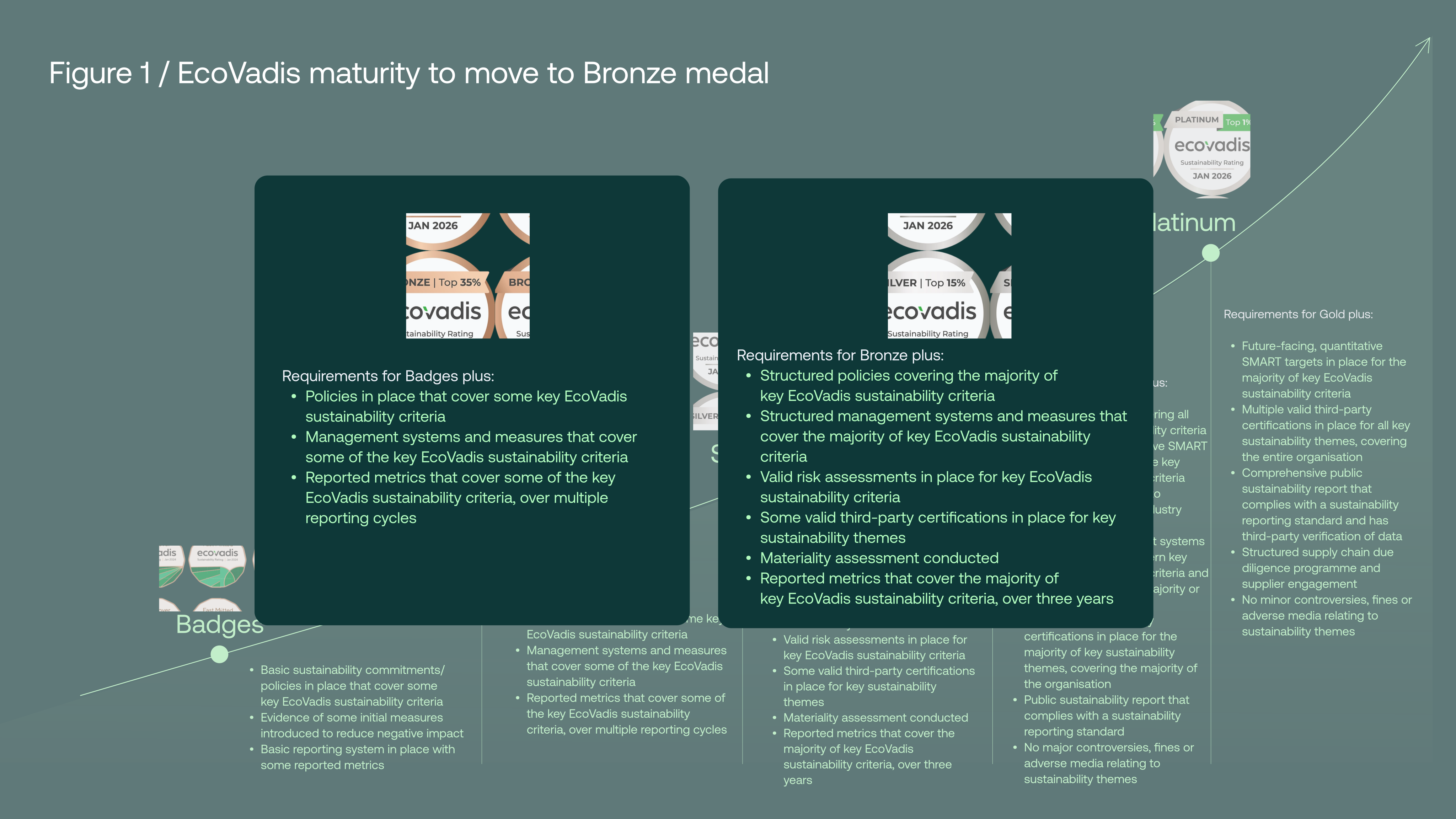
The defining word at Silver level is “structured.” Bronze requires evidence that policies and some measures exist. Silver requires evidence that those policies are backed by functioning management systems, that measures cover the activated criteria consistently, and that performance is being tracked and reported. The EcoVadis 2026 questions answered guide explains how each of these elements is evaluated within the PAR scoring framework. [4]

The Bronze-to-Silver gap has widened over the past twelve months, making the transition more demanding than it was in 2024 [1]:
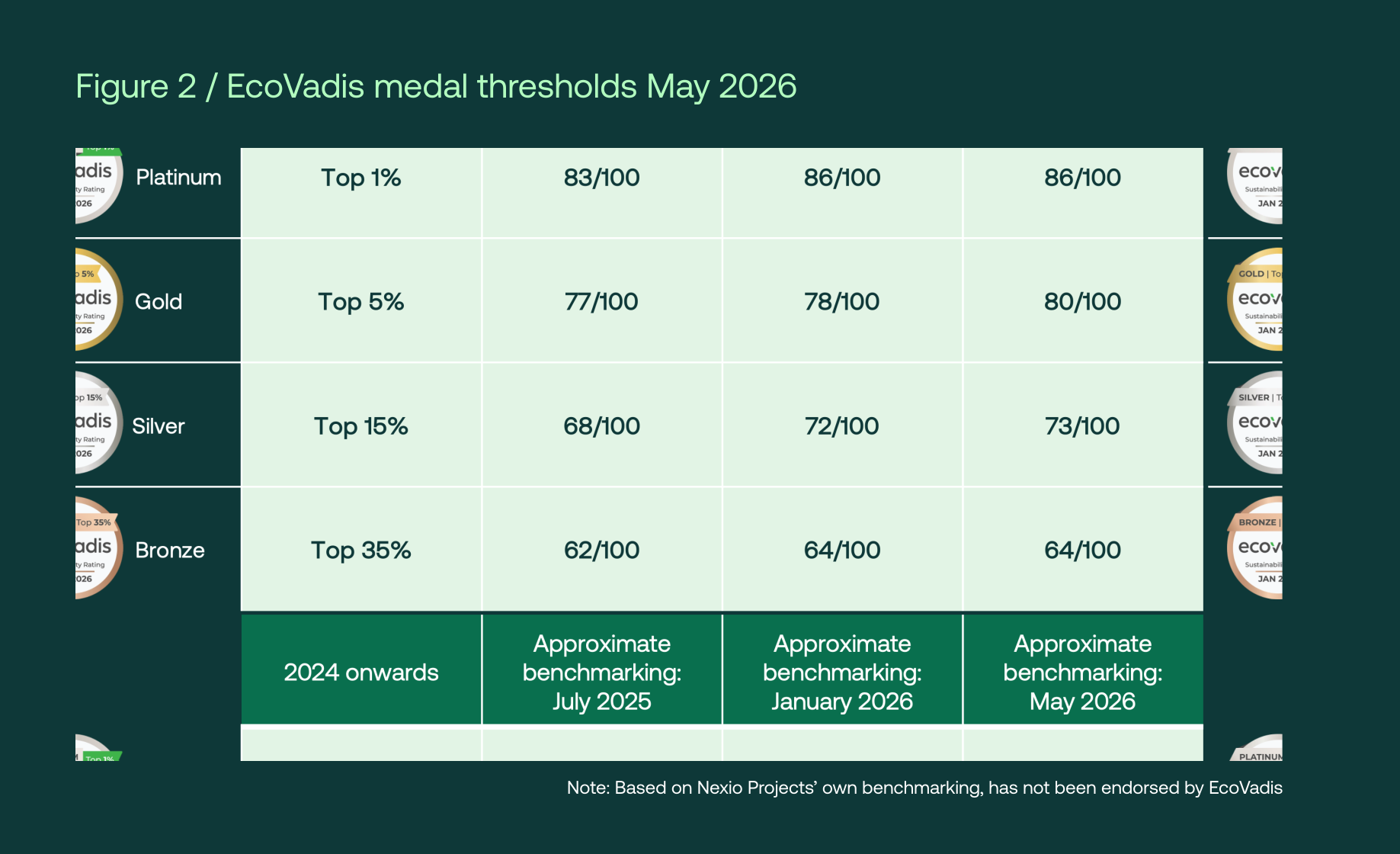
The widening gap reflects that Silver-level companies are improving faster than the Bronze cohort. To close that gap, Bronze holders need to address the structural difference between the two levels, not simply add more documents.
“EcoVadis’s corrective action plan provides prioritised recommendations. Filtering by highest weight and cross-referencing with the scorecard helps ensure improvements are targeted for maximum impact.”
adds Rachit Paliwal, Senior Sustainability Consultant, Nexio Projects.
The most common misread at the Bronze-to-Silver stage is treating it as a continuation of what worked before: finding more documents, filling in more fields, ticking more boxes.
Silver is not achieved by doing more of the same. It is achieved by doing things differently. The key requirement is demonstrating that sustainability management is systematic across the organisation, not isolated to head office or concentrated in one or two themes.
Three patterns consistently hold back Bronze companies trying to reach Silver:
Bronze companies often track data internally but do not formalise it as reported metrics submitted to EcoVadis. Silver requires reported metrics covering key criteria over multiple cycles, meaning the data needs to be structured, consistent, and submitted as formal evidence.
At Bronze level, a procurement policy and some sustainability clauses may suffice. At Silver, EcoVadis expects structured supplier engagement: a Supplier Code of Conduct, a screening or self-assessment process for key suppliers, and reporting on the coverage of that engagement. This is the most underinvested theme in Bronze-level companies and the one with the fastest score-gain potential [3].
Bronze-scoring organisations often implement measures that apply only to headquarters or the largest site. Silver requires evidence that management systems are scaling across a growing portion of the organisation. Certifications, training programmes, and reporting should cover the majority of the company’s relevant operations.
A note on these recommendations: The actions described below are drawn from patterns observed across Nexio Projects’ client portfolio. They represent common high-impact levers at the Bronze-to-Silver transition, they are not a universal checklist. The relative weight of each action varies significantly depending on your company’s size, industry, country of operation, and the specific criteria EcoVadis has activated for your scorecard. Use these as a starting point for diagnosis, not a fixed prescription. A gap analysis against your own scorecard is always the recommended first step.
Set quantitative GHG reduction targets with a defined timeline and baseline year. A target such as “reduce Scope 1 and 2 emissions by 20% by 2030 against a 2023 baseline” constitutes a future-facing commitment and directly improves the Policies indicator. Introduce formal procedures for waste, water, or air pollution management where these are activated criteria. Begin submitting an annual KPI report on key environmental metrics: this alone shifts the Results indicator towards a higher score for many companies.
Formalise Health and Safety procedures beyond the policy level: incident reporting processes, risk assessment methodologies, and corrective action frameworks. Introduce a diversity and inclusion policy with at least one measurable commitment. Report on training completion rates, H&S incident frequency, and any DEI-related KPIs. This moves Labour and Human Rights from documented to measured.
Deploy a structured anti-corruption training programme with formal completion records. A training completion rate above 80% of relevant employees significantly improves the Coverage indicator. Introduce a formal data privacy or GDPR policy where not yet in place. Report on ethics training completion and any incident tracking data across the reporting cycle.
This is the priority theme at the Bronze-to-Silver transition for most companies. Implement a formal supplier screening process or self-assessment questionnaire for strategic and high-risk suppliers. Roll out a Supplier Code of Conduct to the top tier of your supply base. Report on the percentage of procurement spend covered by sustainability criteria. Each of these actions directly addresses the most underscored area in Bronze-level Sustainable Procurement. The EcoVadis essentials guide covers how to evidence supplier engagement within the assessment platform. [5]
A mid-size chemicals company based in Northern Europe, with around 600 employees and operations across four sites, had held the Bronze Medal for two consecutive assessment cycles. Their largest customer introduced a Silver requirement as part of a supply chain sustainability programme, giving the company one assessment cycle to improve.
Gap analysis carried out by Nexio Projects identified three clear bottlenecks. First, GHG data was tracked internally but no reduction targets had been set and no formal KPI report on environmental metrics had been submitted. Second, the Sustainable Procurement theme sat at 38 out of 100: no supplier self-assessment questionnaire existed, no supplier risk assessment had been performed on their supply base, and no Supplier Code of Conduct had been distributed to the supply base. Third, Labour and Human Rights-related procedures covered the main site only, with no formal extension to the three subsidiary locations.
The improvement programme over five months introduced: quantitative GHG reduction targets, a supplier SAQ deployed to the top 25 suppliers by spend, a supplier risk assessment framework to determine high-risk vendors, a Supplier Code of Conduct distributed and acknowledged, an annual environmental KPI report, and a formal H&S procedure covering all four sites.
At reassessment, the company scored 74, earning the Silver Medal at the 86th percentile. The single largest gain was in Sustainable Procurement, which moved from 38 to 61. The total score improvement was 10 points from a starting position of 64.
Nexio Projects clients achieve an average score improvement of 13.8 points across the portfolio [3]. For companies in the Bronze-to-Silver range, structured investment in Sustainable Procurement and KPI reporting typically delivers the fastest gains. The Stolthaven Terminals case study illustrates how a disciplined approach to structured measurement drove a company through Silver and on to Gold. [6]
“With Nexio Projects’ journey-based approach, each EcoVadis assessment becomes more about confirming your organisation’s progress already underway — a way of mapping the road you have already travelled, not just the road ahead.”
Stephanie Pragastis, Senior Sustainability Consultant & Trainer, Nexio Projects
Silver places a company in the top 15% of the global EcoVadis database. For most corporate supply chain requirements, it signals a sustainability management system that is structured, actively managed, and improving.
The path from Silver to Gold requires a further shift: moving from “structured for most criteria” to “comprehensive across all activated criteria, with risk assessments, certifications, and multi-year verified reporting.” That is the subject of the next article in this series. The full 2026 methodology requirements across all levels are covered in Stay ahead of the rising standards: EcoVadis 2026 unlocked. [7]
• As of May 2026, the approximate score for Silver is 73/100, up from 68 in July 2025. The Bronze-to-Silver gap has widened to 9 points as Silver-level companies improve faster than the Bronze cohort.
• A Silver-level management system has structured policies and management systems covering the majority of activated criteria, metrics reported over multiple cycles, and a commitment to at least one industry sustainability initiative.
• The shift from Bronze to Silver is structural, not incremental. More documents alone will not close the gap. Systematic coverage, KPI reporting, and supplier engagement are the requirements.
• Sustainable Procurement is the most underinvested theme at Bronze level and the fastest route to Silver for many companies. A supplier SAQ, a Supplier Code of Conduct, and spend coverage reporting can move this theme significantly in a single cycle.
• Coverage matters. Silver requires management systems and measures that extend across the organisation, not concentrated in one site or function.
Nexio Projects is an international sustainability consultancy dedicated to guiding organisations on their journey from compliance to purpose. Our expert team provides EcoVadis assessment support, gap analysis, scorecard coaching, and structured improvement planning to help companies at every medal level improve efficiently. Recognised as the best ESG consultancy in the Netherlands by Consultancy NL and among the top sustainability advisory firms by MT/Sprout SD400 2025, Nexio Projects helps clients move through the medal levels with a structured, step-by-step approach. We’re also an accredited strategic partner of EcoVadis since 2018, and thre #1 EcoVadis consultancy by number of projects completed.
Ready to move from Bronze to Silver before your next assessment? Book a free discovery call with the Nexio Projects EcoVadis team and get a targeted gap analysis for your Silver transition.
[1] Nexio Projects. Ecovadis infographic.pptx. Internal benchmarking slide, 26Q2 EcoVadis medal articles folder, Marketing Team SharePoint. May 2026.
[2] EcoVadis. EcoVadis Medals and Badges. https://ecovadis.com/suppliers/ecovadis-medals-and-badges/. Accessed May 2026.
[3] Nexio Projects. Internal track record data: average client improvement of 13.8 points. Portfolio analysis, 2026.
[4] Nexio Projects. EcoVadis 2026: Your questions answered. https://nexioprojects.com/ecovadis-2026-your-questions-answered/. Published February 2026. [5] Nexio Projects. EcoVadis essentials: A guide for beginners and reassessed companies. https://nexioprojects.com/ecovadis-essentials-a-guide-for-beginners-and-reassessed-companies/. Published September 2025.
[6] Nexio Projects. CIRFOOD’s multi-year sustainability partnership with Nexio Projects. https://nexioprojects.com/cirfoods-multi-year-sustainability-partnership-with-nexio-projects-from-vision-to-leadership/. Published November 2025.
[7] Nexio Projects. Stay ahead of the rising standards: EcoVadis 2026 unlocked. https://nexioprojects.com/knowledge-centre/stay-ahead-of-the-rising-standards-ecovadis-2026-unlocked/. 2026.


