What’s the difference between a product carbon footprint and a product environmental footprint?
January 14, 2025



states Francesc Romero. Senior Climate Consultant, to open up the landscape for packaging manufacturer’s sustainability landscape.
Packaging manufacturers are entering a period of compressing regulatory timelines and rising customer expectations. Three major EU frameworks, the Packaging and Packaging Waste Regulation (PPWR), the Eco-design for Sustainable Products Regulation (ESPR), and the Corporate Sustainability Reporting Directive (CSRD), are now active simultaneously, each requiring credible, product-level environmental data from the sector.
The companies navigating this well are not responding to each framework in isolation. They are building a shared programme that satisfies all three at once, with a life cycle assessment (LCA) capability at its centre. This article explains why LCA has become the operational foundation of packaging sustainability strategy in 2026, what the regulatory landscape looks like in practice, and how packaging manufacturers can move from reactive compliance to deliberate competitive positioning.
The PPWR was adopted by the EU Council in February 2025 and entered into force in March 2025 [1]. Its requirements take effect progressively from August 2026. The regulation sets mandatory recyclability standards for all packaging placed on the EU market, minimum recycled content targets for plastic packaging ranging from 10% to 35% by 2030 depending on packaging category, and waste reduction targets of 5% by 2030 and 10% by 2035 [1]. It also introduces extended producer responsibility (EPR) registration requirements across member states. (Note: the specific implementation schedule for delegated acts remains subject to ongoing Commission guidance — verify current status before publication.)
The ESPR (Regulation (EU) 2024/1781) entered into force in August 2024 [2]. The ESPR Working Plan, adopted April 2025, sets delegated acts for textiles, steel, aluminium, electronics, and furniture between 2026 and 2029 [3]. Packaging-specific delegated acts are in development. The ESPR’s Digital Product Passport mechanism will require machine-readable lifecycle and environmental data for priority categories from 2026 onwards, with the DPP registry planned for July 2026 as currently proposed [3].
CSRD requires companies in scope to conduct a double materiality assessment (DMA) to identify which sustainability topics are material to their business. For many CSRD-reporting companies, Scope 3 Category 1 emissions from purchased goods and services will emerge as material through that process, and where they do, product-level carbon and lifecycle data from suppliers becomes a reporting requirement.
The extent of that data requirement, and how it flows through procurement processes, depends on each company’s DMA outcome and the carbon footprint assessment that follows. Packaging manufacturers should expect these requests to arrive through supplier qualification processes, contract renewals, and due diligence programmes, but the precise scope will vary by customer [4].
Important notice: As the revised ESRS has not yet been formally adopted, this content reflects the standards as currently set out in the exposure draft. It remains subject to revision pending any further simplifications or amendments introduced through the final ESRS delegated act.
Three frameworks, one shared data requirement: credible, product-level environmental data. An LCA programme generates that data once and deploys it across all three compliance contexts simultaneously.
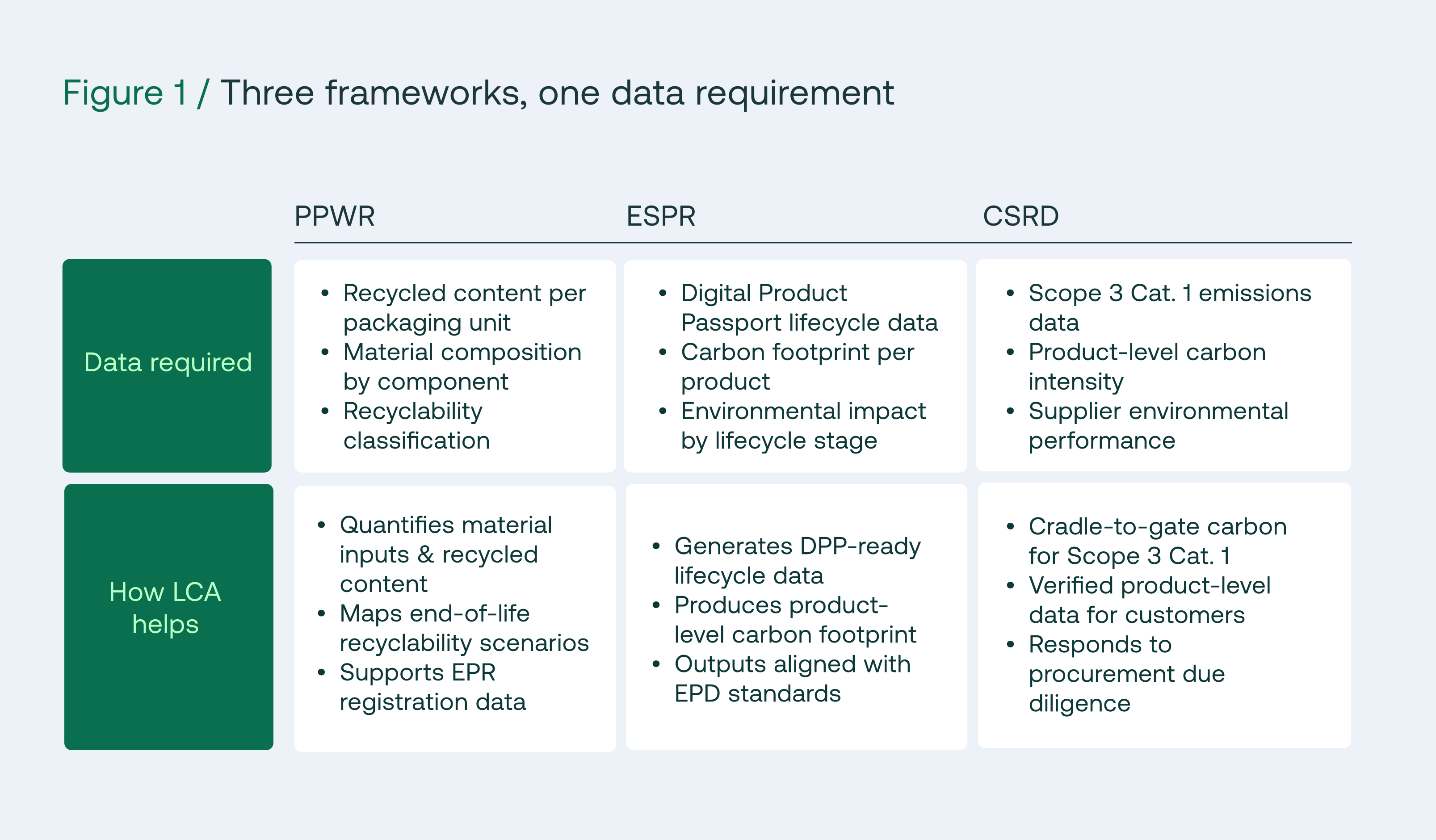
A life cycle assessment systematically quantifies the environmental impacts of a product across its full lifecycle: from raw material extraction through manufacturing, transport, use, and end-of-life. Governed by ISO 14040 and ISO 14044, it covers greenhouse gas emissions, water use, land use, resource depletion, and multiple other impact categories [5].
For packaging manufacturers, LCA delivers three outputs that regulatory frameworks and enterprise customers require:
For packaging companies that have already invested in an LCA, extending to a verified EPD is often the most cost-effective way to convert internal analysis into external credibility. The distinction matters: the right output depends on who will scrutinise the data and in what context.
“Sustainable product design in packaging goes beyond measuring what already exists. Circular economy principles require rethinking what is manufactured and how.”
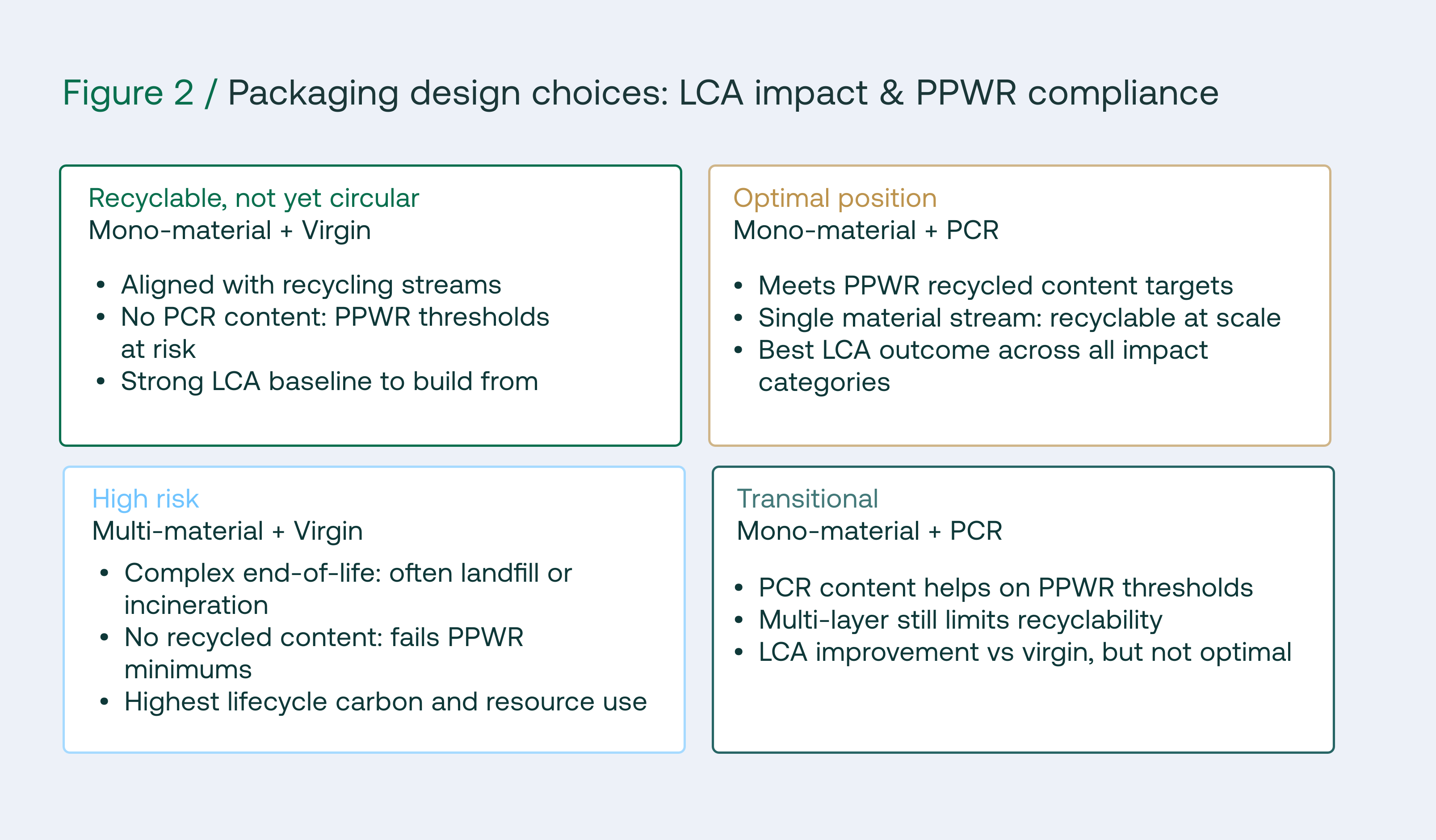
For packaging manufacturers, this means designing for mono-material outputs aligned with established recycling streams, right-weighting to eliminate excess material without compromising performance, integrating post-consumer recycled (PCR) content to meet PPWR minimum thresholds, and developing take-back or closed-loop programmes for industrial applications.
These design decisions have direct LCA consequences. A shift from a multi-layer laminate to a mono-material film changes the end-of-life scenario modelled in the assessment and can materially alter the climate impact figure. Companies applying LCA at the design stage catch these trade-offs before a product is specified rather than after. They build eco-design strategies that are both commercially viable and regulatory-ready [7].
The ESPR formalises this approach. Once packaging-specific delegated acts are adopted, manufacturers will be required to meet minimum performance thresholds on recyclability, recycled content, and lifecycle environmental impact [2]. An existing LCA programme makes those requirements manageable. Building one under a regulatory deadline is substantially harder.
EcoVadis, the most widely used supplier sustainability rating platform, evaluates companies across four themes: environment, labour and human rights, ethics, and sustainable procurement. The weighting applied to each theme varies depending on the company’s industry, geography, and risk profile, meaning that the evidence priorities for a packaging manufacturer assessed in one market may differ from those for a comparable company assessed elsewhere [8].
EcoVadis Platinum performance requires more than a sustainability policy. It requires documented evidence of embedded practice: sustainability considerations integrated into product development and procurement decisions, engagement with suppliers on environmental and social criteria, and reporting aligned with recognised frameworks such as GRI. These are expectations EcoVadis applies broadly across all submitting companies, not requirements specific to the packaging sector.
LC Packaging, a global flexible and bulk packaging manufacturer, worked with Nexio Projects to achieve exactly this. Starting from an EcoVadis Gold medal in 2019, the company optimised its reporting practices, developed GRI-aligned policies, and achieved Platinum in 2020 [9].
For supply chain directors whose enterprise customers require EcoVadis data from their suppliers, the connection between EcoVadis scoring and supply chain sustainability is direct: a strong score is evidence that the company’s sustainability programme can withstand external scrutiny, and it directly influences supplier selection decisions.
The packaging companies making the most progress in 2026 are managing PPWR, ESPR, CSRD, and EcoVadis as a single integrated programme rather than four parallel workstreams. Each element generates data that reinforces the others.
An integrated programme connects:
This integration is what allows a packaging manufacturer to respond to a customer’s CSRD Scope 3 request, a procurement team’s EPD requirement, and an EcoVadis assessor’s evidence request from the same underlying data programme. The ESG leadership priorities Nexio Projects has documented across 25 manufacturing sectors show consistently that integration separates sustainability leaders from those still managing compliance on a case-by-case basis.
For guidance on how sustainability reporting frameworks interoperate across these obligations, the Nexio Projects strategic guide for sustainability reporting provides a practical overview.
The regulatory pressure on the packaging sector is not easing. PPWR timelines begin in August 2026, ESPR delegated acts are in active development, and CSRD Scope 3 data requests from enterprise customers are already arriving through supplier qualification processes. The companies that hold their market position through this period are those that have built the sustainability data infrastructure in advance.
An LCA programme is that infrastructure. It generates product-level environmental data that satisfies multiple compliance obligations simultaneously, supports credible external claims, and enables better product design decisions from the inside. The journey from compliance to positive impact in the packaging sector runs through the product itself.
Nexio Projects is an international sustainability consultancy dedicated to guiding organisations on their journey from compliance to positive impact. Our mission is to provide expert support across strategy development, ESG ratings, climate solutions, life cycle assessment, and comprehensive sustainability reporting, helping packaging manufacturers build the data infrastructure that performs across every compliance context simultaneously.
Recognised as a top boutique ESG and sustainability strategy consultancy by Verdantix and as the best ESG consultancy in the Netherlands in 2025 by Consultancy NL, Nexio Projects is here to help you move from compliance to competitive advantage.
If your company is navigating PPWR obligations, CSRD supplier data requests, or an EcoVadis improvement programme, book a discovery call to discuss where to start.
[1] European Council. Packaging and Packaging Waste Regulation (PPWR) — Council adoption. February 2025. https://www.consilium.europa.eu/en/press/press-releases/2025/02/17/packaging-and-packaging-waste-council-adopts-new-regulation/ Accessed May 2026. (Note: full Official Journal citation including regulation number should be verified before publication.)
[2] European Parliament and Council. Regulation (EU) 2024/1781 — Eco-design for Sustainable Products Regulation (ESPR). July 2024. https://eur-lex.europa.eu/legal-content/EN/TXT/?uri=CELEX:32024R1781 Accessed May 2026.
[3] European Commission. ESPR Working Plan 2025–2030. April 2025. https://commission.europa.eu/energy-climate-change-environment/standards-tools-and-labels/products-labelling-rules-and-requirements/sustainable-products/ecodesign-sustainable-products-regulation_enAccessed May 2026.
[4] EFRAG. ESRS E1 — Climate Change: Implementation Guidance. https://www.efrag.org/en/projects/esrs-implementation-guidance Accessed May 2026.
[5] International Organisation for Standardisation. ISO 14040:2006 — Environmental management: Life cycle assessment — Principles and framework; ISO 14044:2006 — Requirements and guidelines. https://www.iso.org/standard/37456.html Accessed May 2026.
[6] International Organisation for Standardisation. ISO 14025:2006 — Environmental labels and declarations: Type III environmental declarations. https://www.iso.org/standard/38131.html Accessed May 2026.
[7] Ellen MacArthur Foundation. Circular economy in packaging. https://www.ellenmacarthurfoundation.org/topics/packaging Accessed May 2026. (Note: verify most current version of this resource before publication.)
[8] EcoVadis. EcoVadis methodology overview. https://support.ecovadis.com/hc/en-us/articles/204975629 Accessed May 2026.
[9] Nexio Projects. LC Packaging case study. https://nexioprojects.com/customers/ Accessed May 2026.
[10] European Parliament and Council. Directive (EU) 2024/825 — Empowering Consumers for the Green Transition (ECGT). https://eur-lex.europa.eu/legal-content/EN/TXT/?uri=CELEX:32024L0825 Accessed May 2026.
[11] Nexio Projects. LCA, PCF or EPD: Which verification route is right for you? https://nexioprojects.com/lca-pcf-or-epd-which-verification-route-is-right-for-you/ Published May 2026.
[12] Nexio Projects. Environmental Product Declarations: Why your supply chain needs one in 2026. https://nexioprojects.com/environmental-product-declarations-why-your-supply-chain-needs-one-in-2026/ Published April 2026.
[13] Nexio Projects. Improve supply chain transparency with EcoVadis. https://nexioprojects.com/improve-supply-chain-transparency-with-ecovadis/
[14] Nexio Projects. ESG leadership for manufacturers: Key trends and best practices. https://nexioprojects.com/esg-leadership-for-manufacturers-key-trends-and-best-practices/ Published November 2025.
[15] Nexio Projects. The strategic guide for sustainability reporting. https://nexioprojects.com/knowledge-centre/the-strategic-guide-for-sustainability-reporting/