How businesses can reduce their fossil fuel dependency
August 26, 2022


“ECGT raises a straightforward question for every sustainability practitioner: can you substantiate what you claim? Companies with a verified programme have a clear path through the September deadline. Companies relying on vague language have fewer options and less time than currently realise.”
Anna Ma, Climate Director at Nexio Projects
Most European companies making environmental claims have operated under the same legal rules for over a decade. Terms like “eco-friendly”, “sustainable”, and “carbon neutral” have appeared freely on product packaging, websites, and procurement materials with limited legal risk. EU Directive 2024/825 changes that on 27 September 2026.
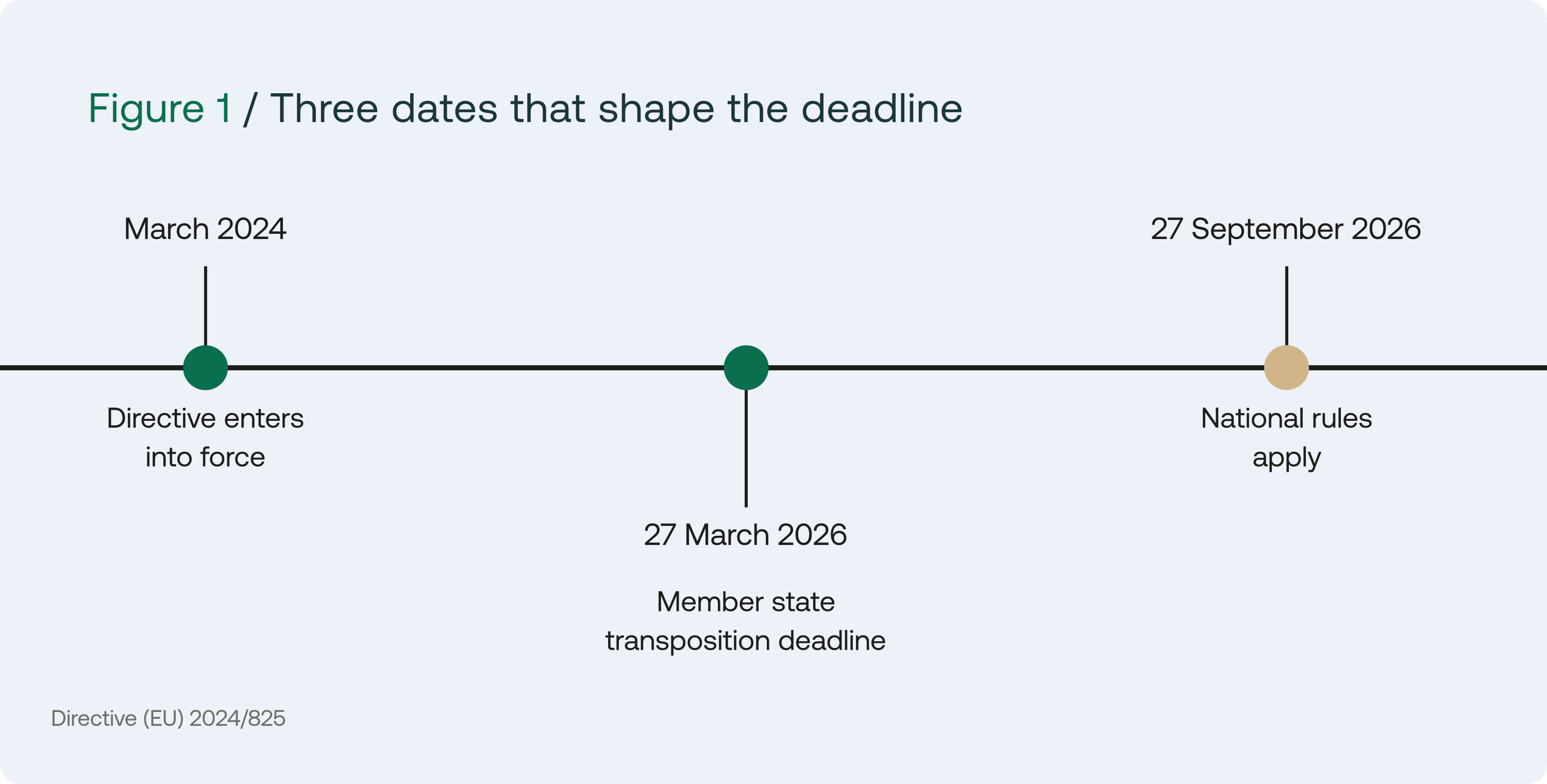
Known as the Empowering Consumers for the Green Transition Directive (ECGT or EmpCo), it entered into force on 26 March 2024 [1]. It becomes enforceable across all 27 EU member states on 27 September 2026. Member states had until 27 March 2026 to transpose it into national law. ECGT works by amending the EU’s Unfair Commercial Practices Directive, adding specific environmental claims to the list of practices that are prohibited in all circumstances [1]. Enforcement authorities do not need to demonstrate consumer harm on a case-by-case basis. The prohibition is automatic.
From 27 September 2026, companies making those claims face automatic legal exposure. This article sets out what is banned, what remains permitted, and what verified evidence satisfies the new requirements.
ECGT adds the following to Annex I of the Unfair Commercial Practices Directive. These are commercial practices prohibited outright, in all circumstances [1][2]:
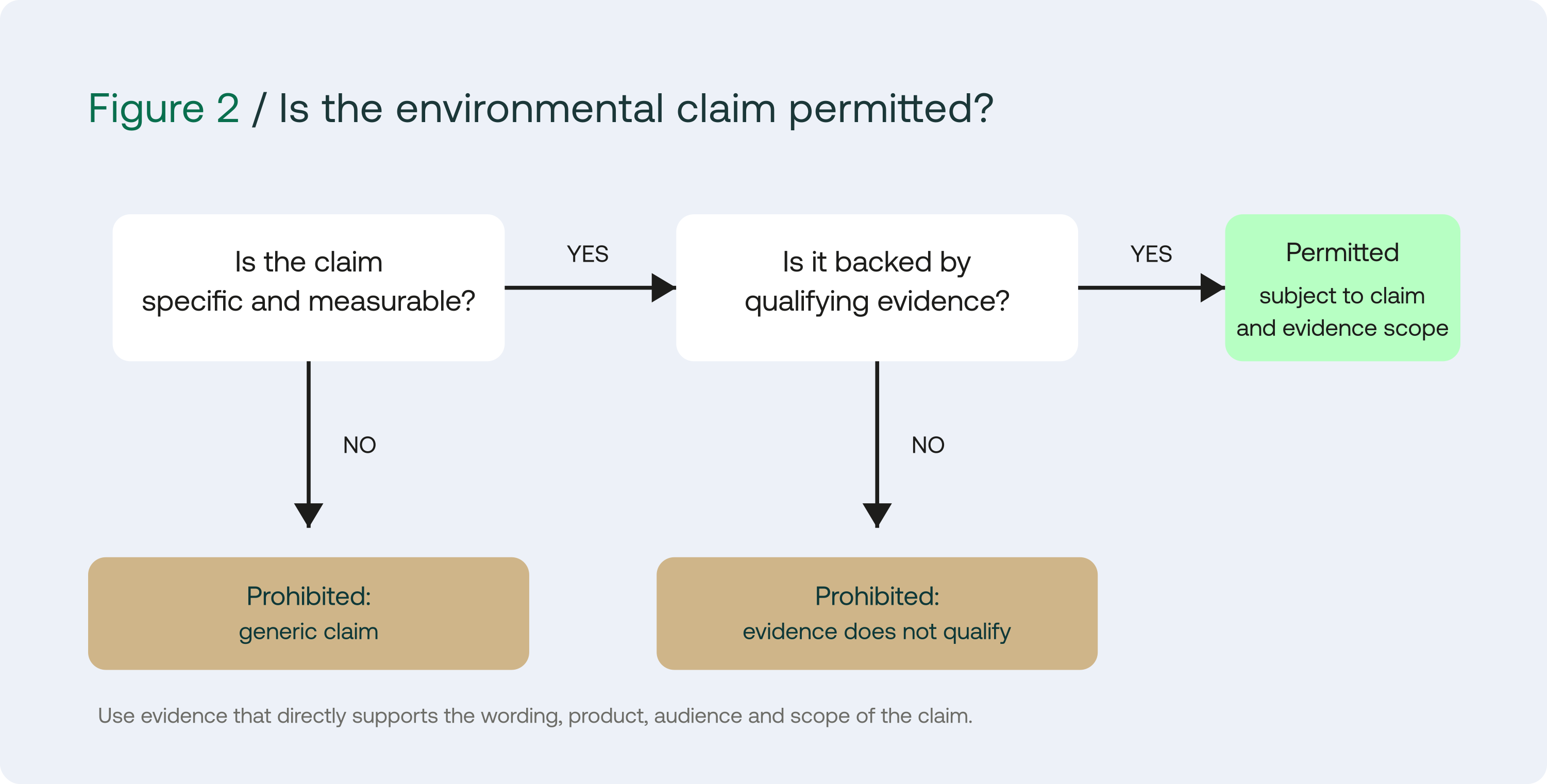
ECGT does not ban all environmental claims. Specific, substantiated, and independently verified claims remain permitted [2].
As Anna Ma, Climate Director at Nexio Projects:
“The permitted/banned line under ECGT is not about the size of your sustainability programme. A company with ten years of genuine work behind it can still publish a prohibited claim if the evidence is not documented and linked. That is what the September deadline demands: not a better programme, but a provable one.”
ECGT amends EU consumer protection rules governing business to consumer commercial practices. It does not directly regulate purely business to business commercial practices. The scope should be assessed by the audience, product, and communication, rather than by the company’s primary business model [1].
Purely business to business communications remain outside the directive’s formal scope. A B2B company may still need to review claims appearing on products sold to consumers or in consumer facing marketing. Downstream customers may also request supporting evidence contractually, although that is a commercial requirement rather than a direct application of ECGT. A public website is not automatically a B2C communication solely because anyone can access it [2].
For mid market B2B companies, three areas deserve review: product labels that reach consumers, marketing materials directed at consumers, and customer requests for evidence linked to downstream consumer claims. Third, customer cascade requirements, where ECGT-in-scope buyers impose substantiation requirements on their own suppliers.
The broader regulatory context for companies navigating anti-greenwashing obligations is covered in our article Unveiling the true cost of greenwashing, which sets out the legislative landscape and best practices for keeping claims compliant.
Companies with established sustainability frameworks are better positioned under ECGT. None of those frameworks provide automatic, full-spectrum compliance.
Companies holding independently assessed sustainability ratings have evidential grounding for management-system level claims. Those ratings do not automatically extend to product-level claims or net zero commitments. A full breakdown of what each scheme covers under ECGT is available in our companion article ECGT and your EcoVadis score: are your green claims covered?.
A CSRD-aligned GHG inventory and transition plan, where disclosed and independently assured, provides the documentation basis for future climate performance claims under ECGT.
SBTi-validated targets, where held, supports ECGT’s substantiation requirement for net zero and future climate commitment claims, as they are independently verified against the Corporate Net-Zero Standard. For companies working through the latest standard revision, SBTi Corporate Net-Zero Standard V2.0: what you need to know today explains the new requirements and key dates.
As Anna Ma, Climate Director at Nexio Projects:
“September 27 is the point at which vague sustainability language becomes a legal liability. What changes is not the standard of evidence companies need to hold. It is the cost of not holding it.”
From 27 September 2026, the default position for any European environmental claim changes. The question is no longer whether a claim sounds reasonable. It is whether it can be verified, and whether that verification meets the criteria set out in Annex I of the UCPD.
Companies that have invested in EcoVadis assessments, CSRD-aligned reporting, or SBTi validation have the foundations in place. The work ahead is translating those foundations into compliant marketing language: specific, substantiated, and documented. Companies without those foundations face a harder conversation, and a shorter runway than many realise.
Nexio Projects is an international sustainability consultancy guiding organisations on their journey from compliance to positive impact. We provide expert support across strategy development, ESG ratings, climate solutions, and comprehensive sustainability reporting, with a pragmatic, step-by-step approach.
Recognised as a top boutique ESG consultancy by Verdantix and among the SD400’s leading sustainability advisory firms by MT/Sprout, we work with sustainability directors and CFOs across Europe and beyond on compliance readiness that holds up to scrutiny. We support companies preparing for ECGT compliance through green claims audits, EcoVadis programme management, and CSRD-aligned sustainability advisory. Our team has completed 600+ sustainability projects across 30+ countries.
If you are preparing for the 27 September deadline and need to review your environmental claims against ECGT requirements, speak with our sustainability advisory team. We can help you run a green claims audit aligned to your CSRD disclosures and identify your exposure.
27 September 2026. There is no transition or grace period after this date.
The directive governs B2C commercial practices. Purely B2B communications remain outside its formal scope. B2B companies should review claims appearing on consumer facing products or marketing and distinguish direct ECGT exposure from customer requirements for supporting evidence [1].
Not without qualifying substantiation: a recognised certification, demonstrated excellent environmental performance, or a verifiable and specific performance claim. A generic “sustainable” label without substantiation is prohibited from 27 September 2026.
Offset-based neutrality claims for products are banned outright. Claiming a product is “carbon neutral” or “climate net zero” based on offsets is prohibited. Companies can still disclose carbon credit investments as supplementary information, but cannot use them to support product-level carbon neutral claims.
An EcoVadis score provides strong evidence for management-system level claims. It does not protect all environmental claims automatically, particularly product-level claims or net zero commitments, which require separate substantiation.
[1] EUR-Lex. Directive (EU) 2024/825 of the European Parliament and of the Council. https://eur-lex.europa.eu/legal-content/EN/TXT/?uri=CELEX%3A32024L0825. Accessed July 2026.
[2] European Commission. Questions and Answers: Empowering Consumers for the Green Transition Directive. [VERIFY: full URL not confirmed at time of drafting. Locate the June 2026 publication at ec.europa.eu before publication.] June 2026.
[3] EcoVadis. Methodology Disclosure Document. [VERIFY: full URL for the April 2026 version before publication. Locate at ecovadis.com/methodology.] April 2026.
[4] Nexio Projects. Unveiling the true cost of greenwashing. https://nexioprojects.com/unveiling-the-true-cost-of-greenwashing/. Accessed July 2026.
[5] Nexio Projects. How ESG reporting helps prevent greenwashing. https://nexioprojects.com/how-esg-reporting-help-sustainability-managers-make-their-business-greenwashing-proof/. Accessed July 2026.
[6] Nexio Projects. SBTi Corporate Net-Zero Standard V2.0: what you need to know today. https://nexioprojects.com/sbti-corporate-net-zero-standard-v2-0-what-you-need-to-know-today/. Accessed July 2026.
[7] Nexio Projects. Stay ahead of the rising standards: EcoVadis 2026 unlocked. https://nexioprojects.com/knowledge-centre/stay-ahead-of-the-rising-standards-ecovadis-2026-unlocked/. Accessed July 2026.