PCF, LCA or EPD: Which assessment does an NHS supplier need?
September 25, 2026


Most organisations have heard of science-based targets. Many know that over 10,000 companies globally now hold validated commitments. Corporate climate target-setting grew 40% in 2025 alone [1]. The direction of travel is clear.
But knowing that science-based targets are standard, and knowing what one actually looks like in practice, are two different things. For sustainability managers, compliance directors, CFOs, and procurement leaders preparing to commit, the most useful question is not “why science-based targets?”, It is “what do they look like for a company like ours?”
This article answers that question across the six industries Nexio Projects works with most intensively: FMCG and retail, manufacturing, chemicals, packaging, shipping and logistics, and finance and legal. It draws on validated company commitments and sector methodology, and reflects the practical experience of a team that has guided organisations through SBTi target-setting across more than 20 countries and 1,000+ projects [2]. For a full account of the SBTi framework, its alignment with CSRD, and the upcoming Corporate Net-Zero Standard V2, see our earlier article on SBTi in 2026.
Science-based targets are not a single template. The SBTi has developed distinct methodologies for more than ten industries, each reflecting the sector’s specific emissions profile, technology pathway, and decarbonisation timeline [3].
For most companies, a near-term science-based target requires an absolute reduction of Scope 1 and 2 emissions consistent with a 1.5°C pathway. Where Scope 3 emissions exceed 40% of total footprint, a Scope 3 near-term target is also required [4]. For businesses with significant land-use in their supply chains such as food, agriculture, forestry, a Forest, Land and Agriculture (FLAG) target addresses those emissions separately [5]. The result: two companies in different sectors can hold equally valid, independently verified commitments that look structurally very different. The six sections below show what that means in practice.
The SBTi validated HEINEKEN’s Scope 3 and FLAG targets in September 2023, making it the first global brewer to hold both net-zero and Forest, Land and Agriculture commitments under the SBTi framework [6]. In December 2025, HEINEKEN refreshed its “Brew a Better World” strategy, the SBTi targets remain in place and unchanged [7].
HEINEKEN’s SBTi-validated near-term targets, by 2030 from a 2022 baseline, are:
Beyond its validated targets, HEINEKEN’s updated Brew a Better World strategy commits to net zero across Scopes 1 and 2 by 2030 and full value chain net zero by 2040 [7].
The 2025 annual report, published in February 2026, shows strong progress against all commitments: Scope 1 and 2 emissions are already down 38% against the 2022 baseline, with 88% of electricity now from renewable sources. Scope 3 FLAG emissions have reduced by 23% and non-FLAG Scope 3 by 15%, both on trajectory for the 2030 targets [8].
The FLAG methodology applies because a material share of HEINEKEN’s footprint sits in agricultural supply chains with barley, maize, and sugarcane. Addressing land-use emissions and deforestation risk in those crops is inseparable from the company’s decarbonisation programme, not an add-on to it.
For food, beverage, and FMCG companies, the lesson is structural: where supply chains are land-intensive, the target boundary extends beyond operational control and into the agricultural value chain. HEINEKEN’s progress figures demonstrate that ambitious Scope 3 targets can move meaningfully within three years of validation.
In Nexio Projects’ work with FMCG clients, a recurring challenge is building the granular Scope 3 Category 1 data that underpins a credible FLAG or supply chain target. This often means establishing baseline emissions across dozens of suppliers before the target calculation can begin, a process that requires both technical rigour and supplier engagement capacity.
Read our guide that shows practical tips to conquer supply chain emissions!

Koninklijke Philips N.V. holds a current SBTi-validated target to reduce absolute Scope 1 and 2 GHG emissions by 90% by 2030, from a 2015 base year [9]. By 2025, Philips had already achieved an 85% reduction against that same baseline [10], placing the company within five percentage points of its 2030 goal, five years ahead of schedule.
The target is delivered through renewable energy sourcing, manufacturing efficiency programmes, and property portfolio management. The structure, a large absolute reduction over a 15-year baseline window, is the most common form for manufacturers in sectors ranging from industrial equipment to food processing to consumer goods.
What Philips illustrates as powerfully as the target itself is the trajectory: an 85% reduction reached by 2025 demonstrates that for manufacturers with strong operational control and a sustained renewable energy programme, ambitious absolute targets are achievable well ahead of schedule. For mid-market manufacturers beginning their SBTi journey now, this is a useful benchmark for what five years of focused execution can deliver.
Nexio Projects supports manufacturers from first GHG inventory through to validated SBTi submission. One consistent finding from the team’s work in this sector is that manufacturers often underestimate their Scope 3 footprint, particularly Category 11 (use of sold products) and Category 1 (purchased goods and services), before completing a full inventory. Understanding what that GHG measurement process involves is the essential first step before any target calculation can begin.
In December 2025, the SBTi published dedicated Chemicals Sector Pathways and Implementation Criteria [11], establishing for the first time how companies across specialty chemicals, industrial gases, agricultural chemicals, and consumer chemicals should set science-based targets.
The guidance makes a critical distinction between two types of emissions. Energy-related emissions from fuel combustion and purchased electricity follow the standard 1.5°C absolute reduction trajectory. Process emissions, which are inherent to chemical manufacturing reactions and cannot be eliminated through energy switching alone, are addressed through sector-specific reduction rates based on the best available abatement technologies [11].
This distinction matters. Before December 2025, chemicals companies applying the general corporate criteria faced a legitimate methodological question: how to treat emissions that arise from chemistry itself, not from energy choices. The new guidance resolves that, making baseline calculations more precise and target commitments more defensible under scrutiny.
Swiss specialty chemicals company Clariant had its science-based targets revalidated by the SBTi in 2025, increasing the ambition of both near-term commitments in the process [12]. Clariant’s updated validated targets, by 2030 from a 2019 base year, are:
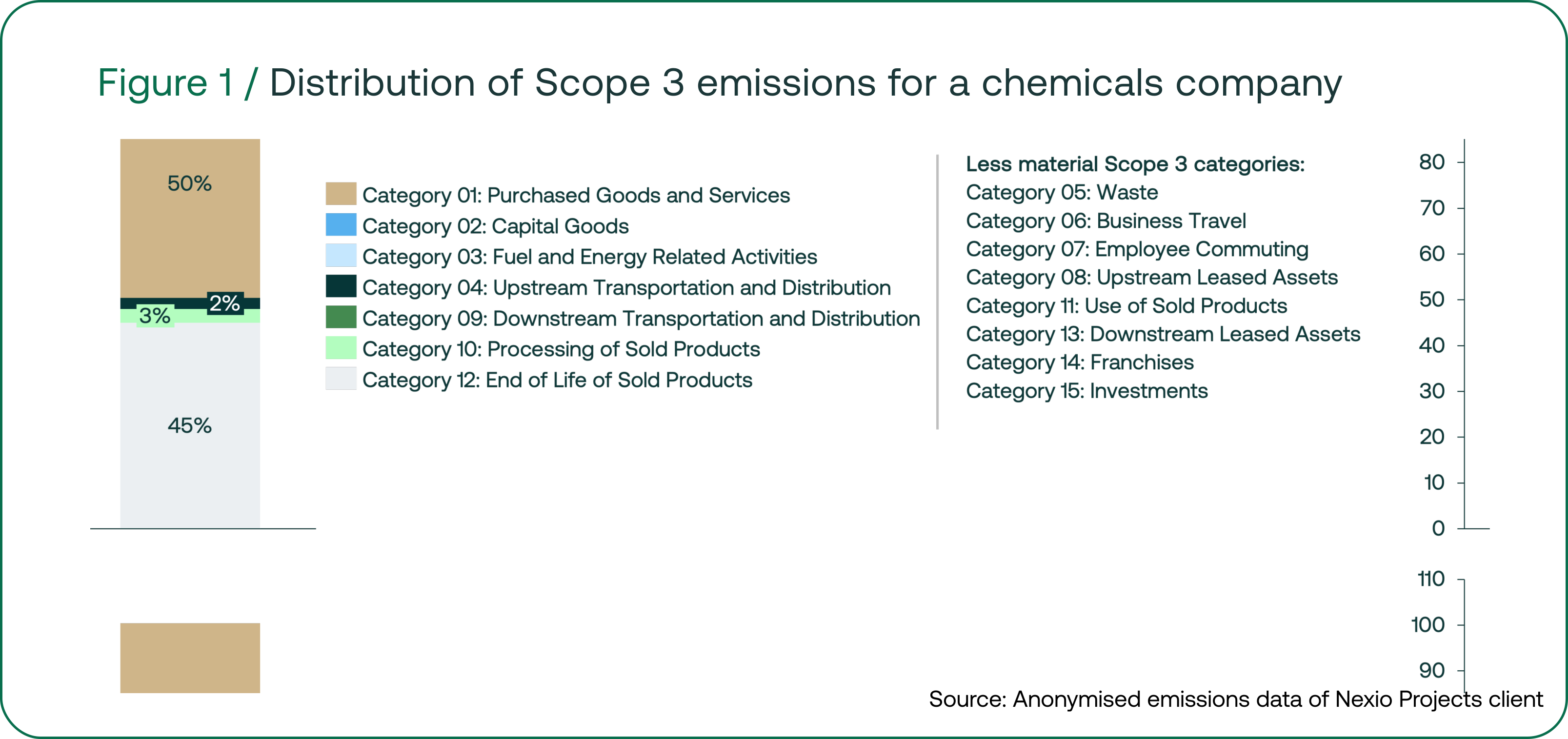
The revalidation carries two lessons. First, it demonstrates the SBTi process as a mechanism for raising ambition over time, not simply locking in an initial commitment. Second, it reflects what the new SBTi Chemicals Sector Pathways are designed to accelerate [11]: a clearer methodology that allows chemicals companies to set more precise, more credible targets and revisit them as science and technology develop.
For specialty chemicals, where Scope 3 Category 1 emissions from raw material inputs often dominate the total footprint, the ability to set a specific, validated target for purchased goods and services is a material step forward in target credibility.
Chemicals is one of Nexio Projects’ top five client sectors by volume. The team supports chemicals companies through Scope 1, 2 and 3 GHG inventories, methodology selection under the new sector pathway, and SBTi submission, including the specialist process emissions accounting that distinguishes chemicals target-setting from most other industrial sectors.
The SBTi does not yet have a dedicated sector guidance document for packaging. Companies spanning flexible packaging, rigid containers, paper and board, and glass set targets under the SBTi Corporate Near-Term Criteria and Corporate Net-Zero Standard [4].
In practice, this means:
Material portfolio decisions directly shape the emissions baseline. The carbon profile of virgin plastic, recycled plastic, paper, bio-based materials, and glass differ substantially. A company actively transitioning its materials mix will see that reflected in its baseline trajectory and in what is technically achievable by the near-term target year.
Amcor, the world’s largest flexible packaging company with operations across 212 locations in 40 countries, holds both near-term and long-term SBTi-validated targets [13]. Its near-term targets, confirmed in early 2024 and using FY2022 as a base year, are:
Amcor’s long-term net-zero target, validated by the SBTi in September 2024, covers the full value chain by FY2050, spanning purchased goods and services, energy-related activities, upstream transportation, waste management, and the end-of-life treatment of sold products [13].
What Amcor’s target structure illustrates for the wider packaging sector is the scale of the Scope 3 commitment required. For a flexible packaging manufacturer, material inputs, virgin polymer, aluminium, paper, and the end-of-life processing of sold packaging products together account for the majority of the total GHG footprint. Achieving a 32.5% Scope 3 reduction requires not only supplier engagement and material substitution but credible baseline data across a complex, global supply chain.
Packaging is one of Nexio Projects’ core focus industries. From the team’s experience, packaging companies are increasingly encountering science-based target requirements through enterprise customer procurement processes, often ahead of formal regulatory mandates. The ability to present a credible, submission-ready target, or a clear roadmap to one, is becoming a prerequisite for retaining major accounts, not just a sustainability credential.
“The most useful thing Nexio Projects can show a company at the start of an SBTi journey is a validated target from a peer in their sector. A specific percentage. A defined baseline year. Stated scope boundaries. That precision does more to move a conversation forward than any framework explanation.”
A.P. Moller-Maersk became the first company in the shipping industry to have climate targets validated under the SBTi Maritime Sector Guidance, in February 2024 [14].
Maersk’s validated long-term targets, all by 2040, are:
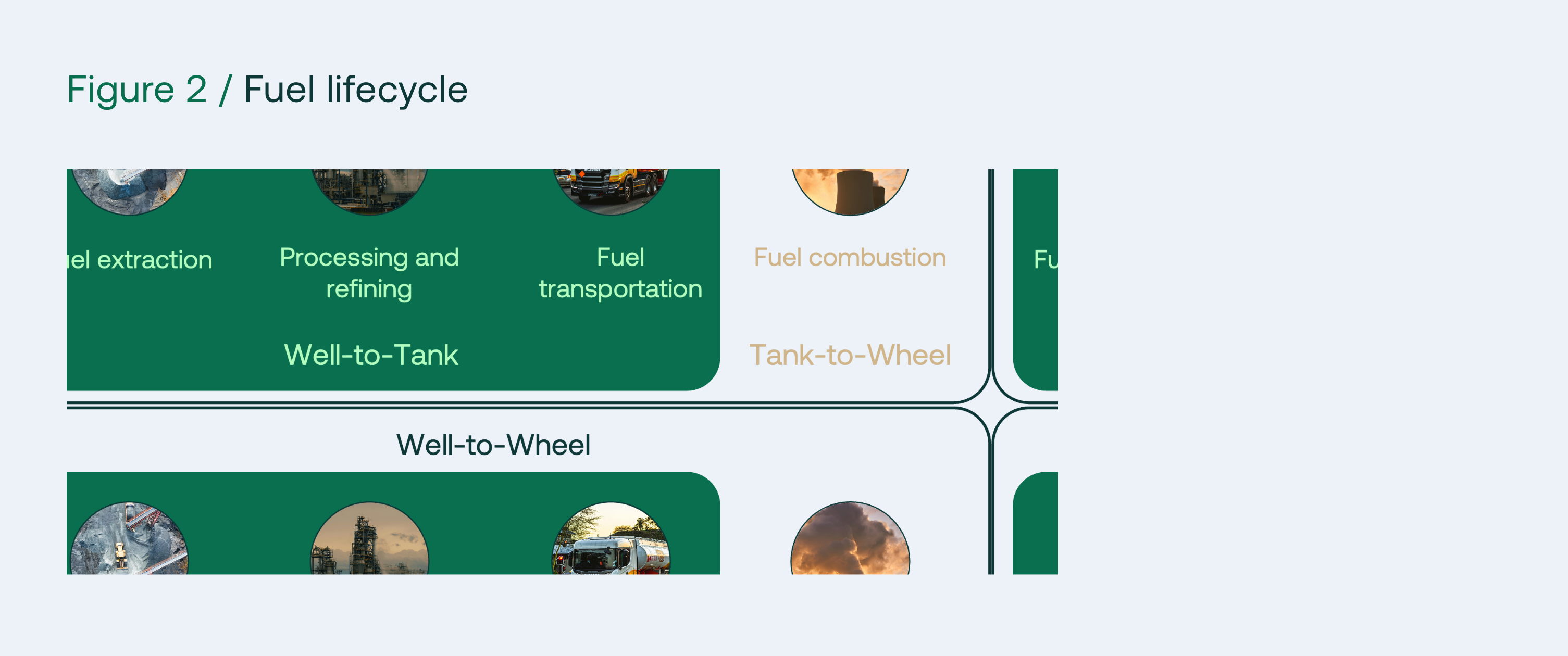
The maritime sector uses a well-to-wake boundary: it covers not only direct combustion of fuel onboard, but also upstream extraction and refining of that fuel. This is unique to shipping, reflecting the SBTi Maritime Sector Guidance methodology [3], and results in a wider and more complete emissions boundary than the tank-to-wake measure previously used as industry standard.
Shipping and logistics is Nexio Projects’ highest-volume client sector by project count. The team has guided major European logistics providers including multimodal freight operators with operations across more than 35 countries through the full SBTi journey: from methodology selection and GHG inventory build to target calculation, submission documentation, and validated outcome. In this sector, the challenge is rarely a lack of ambition. It is the complexity of multi-modal operations, fragmented emissions data from subcontractors, and terminal activity that requires specialist methodology expertise to resolve credibly. For a closer look at how upstream logistics emissions factor into this process, see Mastering Scope 3 for logistics: upstream emissions explained.
For banks and financial institutions, science-based targets do not primarily address operational emissions as office energy and business travel are typically a small share of total impact. The target centres on financed emissions: Scope 3 Category 15, the emissions attributable to the lending and investment portfolio.
In March 2025, ING had its portfolio-level climate targets validated by the SBTi [16]. The validated targets cover 67% of ING’s total financed emissions across its full balance sheet, using 2021 as the reference year. The target boundary spans seven emission-intensive sectors in ING’s loan book: fossil fuels, power generation, cement, steel, automotive, aviation, and commercial real estate [16].
A bank’s validated SBT takes the form of a financed emissions reduction trajectory per sector, aligned with each sector’s own 1.5°C pathway. A bank with significant lending exposure to the cement sector, for example, must track and reduce financed emissions from cement clients in line with the SBTi Cement Guidance methodology.
For corporate borrowers and clients of financial institutions with validated targets, the practical implication is direct: their lenders are monitoring the emissions trajectory of the companies they finance. Nexio Projects works with finance and legal sector organisations, from banks and asset managers to professional services firms, on Scope 3 Category 15 inventories and SBTi alignment. As financed emissions targets cascade into lending criteria and client due diligence processes, the requirements reaching corporate clients are becoming more specific by the reporting cycle.
Each of the six examples above shares one feature: specificity. A percentage reduction. A defined baseline year. Stated scope boundaries. A validated methodology. That precision is what distinguishes a science-based target from a general climate ambition and what makes it credible to investors, auditors, customers, and regulators.
The sectors covered here reflect the range of SBTi methodologies now available. Sectors including maritime shipping and financial institutions have dedicated guidance with distinct emissions boundaries. Packaging and other sectors without dedicated guidance apply the corporate criteria directly. For chemicals, the dedicated sector pathway was published only in December 2025 [11]. The methodology landscape is maturing fast, and the bar for what constitutes a credible commitment is rising with it.
The starting point is always the same: a complete, scope-appropriate GHG inventory. Without a credible baseline, no target calculation can begin. With it, the sector methodology sets the floor, and the level of ambition above that is a strategic decision. Nine in ten companies surveyed by the SBTi report positive business impact from validated targets across strategic cohesion, stakeholder confidence, and financial performance [17].
“Every validated target in this article started with a complete GHG inventory. The sector methodology then sets the floor. Ambition above that floor is a strategic choice. Building the data foundation first and treating the target calculation as the output of that process is what the strongest programmes across all six sectors have in common.”
Download Nexio Projects’ SBTi factsheet for a practical overview of the submission pathway.

Science-based targets are sector-specific, technically defined, and independently verified. From an FMCG group managing land-use risk in an agricultural supply chain to a bank mapping financed emissions across seven lending sectors, the methodology shapes both the target and the programme needed to achieve it.
Nexio Projects supports organisations from first GHG inventory through to validated SBTi submission and ongoing progress tracking. With over 400 clients, 1,000+ projects, and dedicated sector expertise across all six industries covered here, the team is positioned to help you move from understanding what your sector requires to building a programme designed to meet it.
Ready to understand what a science-based target looks like for your sector? Download Nexio Projects’ SBTi factsheet for a practical overview of the framework and submission pathway, or speak directly with our climate team to identify the right target type for your business and take the next step toward validated status.
Recognised among the best boutique ESG consultancies by Verdantix and one of the top sustainability advisory firms in the SD400 2025 by MT/Sprout, we are here to help organisations across all six of these sectors move from compliance to positive impact, one validated target at a time.
Contact us about your science-based target journey,e mission reductions and more. Our climate team would be happy to help!
[1] Science Based Targets initiative (SBTi). “Corporate climate target-setting up 40% in 2025, with Asia emerging as a centre of gravity.” April 9, 2026. https://sciencebasedtargets.org/news/corporate-climate-target-setting-up-40-in-2025-with-asia-emerging-as-a-centre-of-gravity
[2] Nexio Projects. About Nexio Projects. https://nexioprojects.com. Accessed April 2026.
[3] Science Based Targets initiative (SBTi). Sector Resources Summary. https://sciencebasedtargets.org/sector-resources-summary. Accessed April 2026.
[4] Science Based Targets initiative (SBTi). Corporate Near-Term Criteria V5.3. September 2025. https://sciencebasedtargets.org/net-zero (Note: verify 42% minimum reduction reflects latest published version before publication.)
[5] Science Based Targets initiative (SBTi). Forest, Land and Agriculture (FLAG) Science-Based Target-Setting Guidance V1.1. Updated March 2026. https://sciencebasedtargets.org/sectors/forest-land-and-agriculture
[6] The HEINEKEN Company. “HEINEKEN has its long-term Net-Zero and FLAG targets approved by the Science Based Targets initiative.” September 18, 2023. https://www.theheinekencompany.com/newsroom/heineken-has-its-long-term-net-zero-and-flag-targets-approved-by-the-science-based-targets-initiative/
[7] The HEINEKEN Company. Brew a Better World 2030 Strategy Booklet. December 2025. https://www.theheinekencompany.com/sites/heineken-corp/files/2025-12/babw-2030-strategy-booklet-dec-2025.pdf
[8] HEINEKEN N.V. Brew a Better World — 2025 Progress and Results. Annual Report 2025, published February 2026. https://www.theheinekencompany.com/sites/heineken-corp/files/2026-02/brew-better-world-2025-progress.pdf
[9] Koninklijke Philips N.V. SBTi Validation Statement (current). https://www.philips.com/c-dam/corporate/about-philips/sustainability/downloads/sustainability-policies/science-based-targets-initiative-certificate.pdf. Accessed April 2026.
[10] Koninklijke Philips N.V. Climate Resilience Report 2025. https://www.philips.com/c-dam/corporate/about-philips/sustainability/lives-improved/philips-climate-resilience-report.pdf. Accessed April 2026.
[11] Science Based Targets initiative (SBTi). “SBTi publishes new pathways to accelerate chemicals sector’s net-zero transition.” December 2, 2025. https://sciencebasedtargets.org/news/sbti-publishes-new-pathways-to-accelerate-chemicals-sectors-net-zero-transition
[12] Clariant. “Climate Change.” https://www.clariant.com/en/Sustainability/Environmental/Climate-Change. Accessed April 2026. (Note: verify base year (2019) unchanged in the 2025 revalidation before publishing.)
[13] Amcor. “Amcor’s long-term SBTi targets confirmed.” September 26, 2024. https://www.amcor.com/media/news/amcor-long-term-sbti-targets-confirmed
[14] A.P. Moller-Maersk. “Maersk is first to have climate targets validated by SBTi under new Maritime Guidance.” February 9, 2024. https://www.maersk.com/news/articles/2024/02/09/maersk-is-first-to-have-climate-targets-validated-by-sbti-under-new-maritime-guidance (Note: verify no revision to targets since 2024.)
[15] A.P. Moller-Maersk. “Climate.” https://www.maersk.com/sustainability/climate. Accessed April 2026.
[16] ING Group. “ING’s climate targets validated by the Science Based Targets initiative (SBTi).” March 2025. https://ing.com/news/2025/03/ings-climate-targets-validated-by-the-science-based-targets-initiative-sbti.html
[17] Science Based Targets initiative (SBTi). The Impact of Setting Science-Based Targets on Businesses. November 2025. https://files.sciencebasedtargets.org/production/files/The-Impact-of-Setting-SBTs.pdf