 Navigating the first years of the B Corp journey for medium-sized companies
December 22, 2025


“The focus moves from ambition to verifiable implementation. V2.0 closes the gap between what companies commit to and what they are required to demonstrate year on year.”
The Science Based Targets initiative published the Corporate Net-Zero Standard V2.0 on 11 June 2026 [1]. It is the most substantial revision of the framework since its launch. It changes how targets are structured, how progress is assessed, and what companies must demonstrate on an ongoing basis. For organisations that already hold validated targets, or are preparing to submit, V2.0 introduces requirements that call for action now, well ahead of the 2028 mandatory deadline.
Over 13,000 companies hold SBTi commitments or validated targets across 86 territories and 52 sectors, representing more than 40% of global market capitalisation [2]. Science-based targets have moved from a voluntary leadership signal to a procurement condition, an investor expectation, and an input into mandatory reporting frameworks. V2.0 reflects that shift.
Nexio Projects has guided more than 75 clients through their SBTi journey and supported more than 100 organisations in developing a full GHG inventory [3]. With V2.0 now published, that experience directly supports companies preparing for the new transition plan requirements, third-party assurance obligations, and the move to cycle-based reporting.
V2.0 introduces two company categories. Your category determines which requirements are mandatory and which are recommended.
A company falls into Category A if it meets any one of these thresholds [1]:
For companies in high-income countries (defined using World Bank country classifications by income level), lower thresholds apply:
All other companies fall into Category B. SMEs (fewer than 250 FTE, net turnover below €50 million, and balance sheet below €25 million) in lower-income countries are Category B by default.
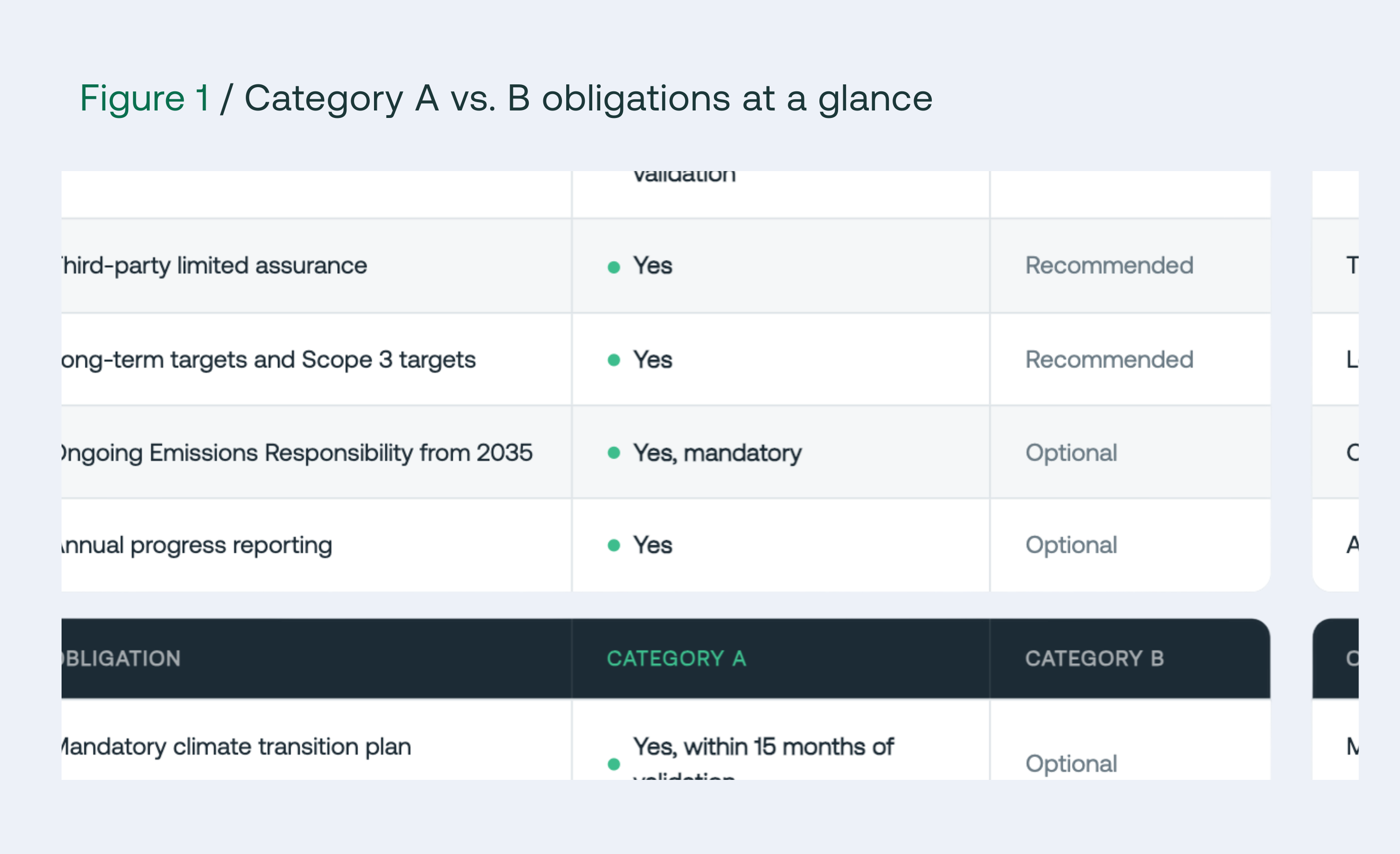
For companies already operating within the existing framework, the structural changes under V2.0 are significant [1]:
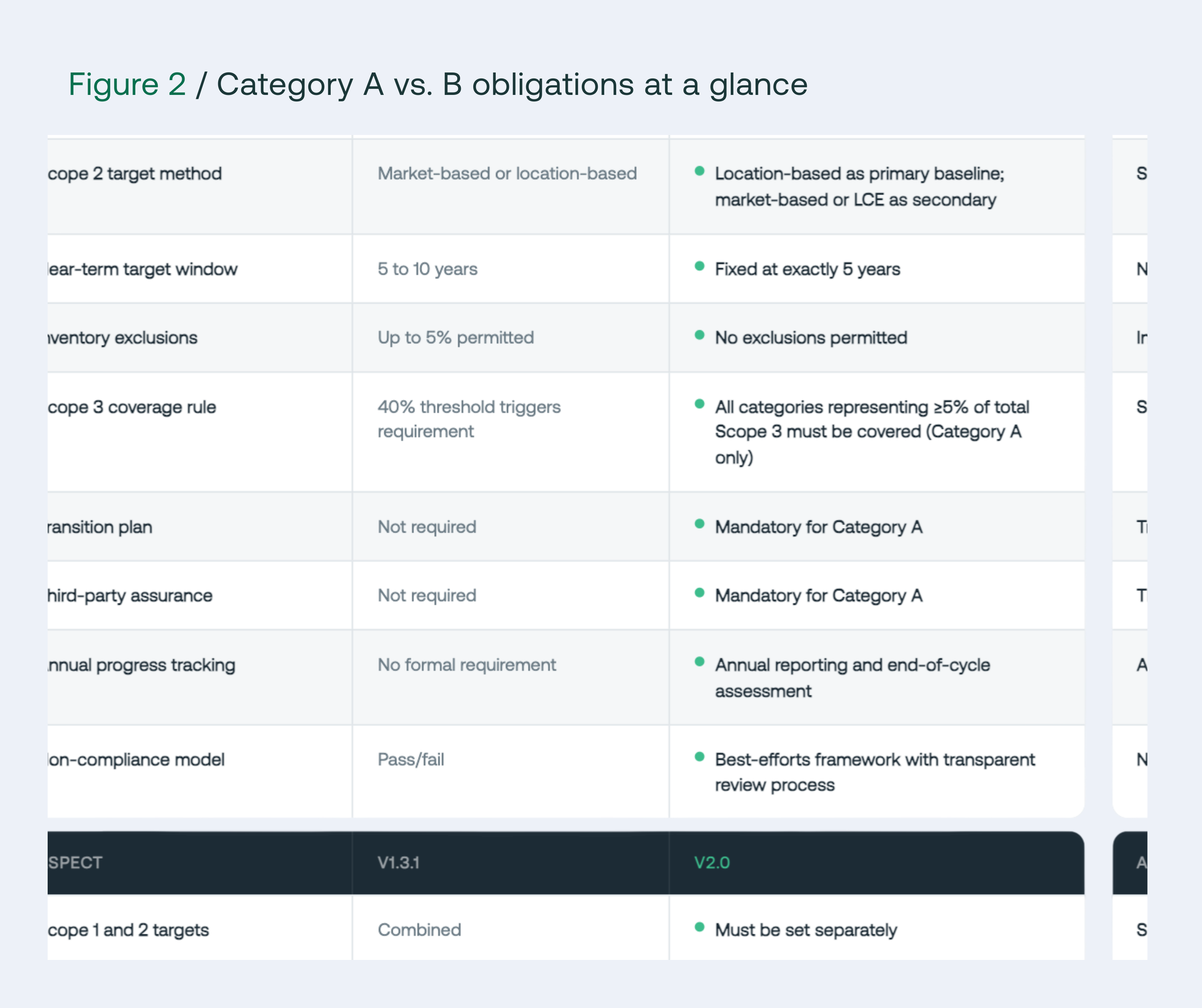
The compliance model change is particularly relevant for companies with complex value chains. Under V1.3.1, a missed target meant failure. V2.0 introduces a best-efforts framework: companies can remain compliant within the SBTi ecosystem if they follow a transparent review process that addresses shortfalls and sets corrective actions.
The Scope 3 change is equally important. Under V1.3.1, a near-term Scope 3 target was triggered when Scope 3 emissions exceeded 40% of total GHG emissions. Under V2.0, that threshold is replaced. Category A companies must instead cover all individual Scope 3 categories that represent 5% or more of their total Scope 3 emissions, with written justification required for any excluded categories [1]. Category B companies may set Scope 3 targets voluntarily.
For a practical framework on reducing Scope 3 emissions at scale, our article How to reduce scope 3 at scale: a five-phase approach covers the implementation steps in detail.
David Vazquez states,
“V2.0 is not a harder version of the same game. It is a different game: one where demonstrated progress, not just a validated commitment, defines whether your targets carry credibility.”.
V2.0 separates the physical GHG inventory from market instrument accounting. All target-setting and progress tracking uses a location-based inventory. Energy attribute certificates, RECs, and Guarantees of Origin are accounted separately as “system contribution claims” and cannot substitute for direct emissions reductions in the target inventory [1].
Three positions govern carbon credits under V2.0:
Direct operational emissions reduction comes first. Market instruments and credits play a supplementary role, with clearly defined integrity requirements.
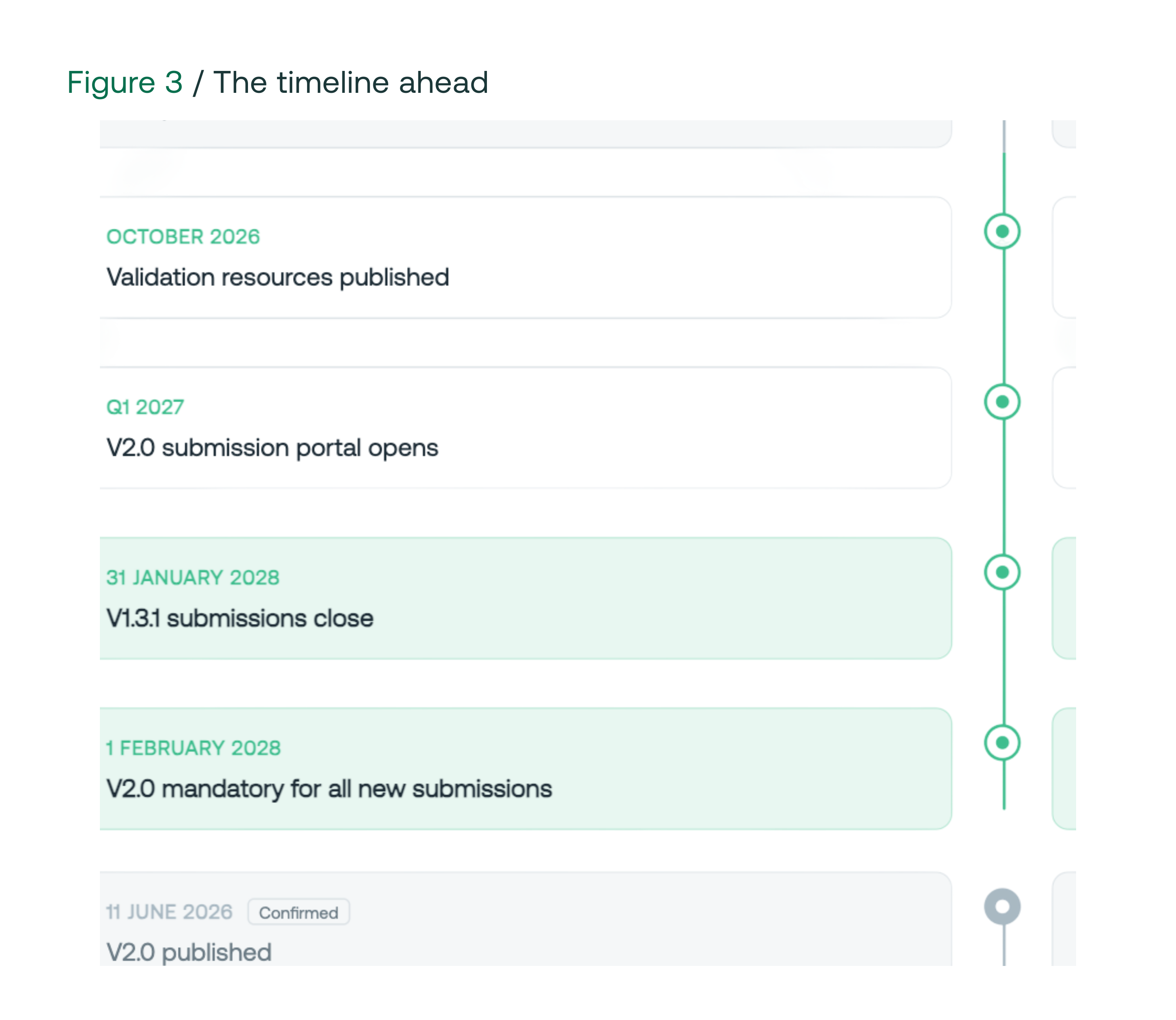
Companies submitting before 31 January 2027 must use V1.3.1. From 1 February 2027, both V1.3.1 and V2.0 are available for new submissions until the January 2028 deadline.
If you already have validated V1.3.1 targets: Existing targets remain valid until their defined end date, or the mandatory five-year review point, which falls on the last day of the calendar month exactly five years after your validation publication date. You do not need to resubmit before February 2028. Use this window to build inventory quality, establish assurance processes, and draft your transition plan so that V2.0 revalidation is straightforward when the time comes.
Validated SBTi targets create audit-ready documentation that supports compliance with two major frameworks now in force.
Under the CSRD (revised under the EU Omnibus package, applicable to EU companies with more than 1,000 employees and €450 million or more in turnover, and to non-EU companies with more than €450 million in EU turnover [4]), ESRS E1 is the applicable climate standard. Validated SBTi targets practically fulfil key ESRS E1 requirements: the transition plan (E1-1, mandatory for Category A under V2.0), emissions reduction actions (E1-5), climate mitigation and adaptation targets (E1-6), gross Scope 1, 2, and 3 emissions (E1-8), and removal actions (E1-9) [1, 4].
Validated targets do not replace all CSRD obligations. Companies must still format emissions data into the structured reporting templates prescribed by European regulators, disclose exposure under the EU Emissions Trading System or applicable carbon taxation schemes, and report on climate adaptation risks with quantified financial impact. (Regulatory note: ESRS standards referenced here reflect the post-Omnibus draft legislation as of June 2026 and remain subject to finalisation [4].)
For US-based organisations, California’s SB 253 requires entities with annual revenue above $1 billion doing business in California to report Scope 1 and Scope 2 emissions for 2025 data by 10 August 2026, with Scope 3 reporting required from 2027 [5]. An SBTi-aligned GHG inventory is inherently audit-friendly and compatible with ISAE 3000 or AA1000 assurance standards. One gap remains: SB 253 requires a separate limited assurance engagement for Scope 1 and 2 data, outside the SBTi validation process itself.
Three actions to take before the V2.0 submission window opens:
For companies building the internal case for science-based targets, Science-Based Targets: the competitive advantage case is now settled provides the evidence base. For sector-specific approaches, Science-based targets by sector: six concrete examples illustrates how companies across industries are structuring their submissions.
V2.0 marks a structural shift in how science-based targets operate. The framework now requires separate Scope 1 and Scope 2 targets, mandatory transition plans and third-party assurance for larger companies, annual progress tracking, and a clear position on carbon credits. The window before February 2028 is preparation time. Companies that build inventory quality, establish assurance processes, and draft their transition plans now will find the V2.0 transition straightforward. Those that treat the deadline as the starting line will not.
David Vazquez concludes:
“The companies that will handle V2.0 most smoothly are those already building toward it. They are treating this window as design time for a more credible, more verifiable climate programme.”
Nexio Projects is an international sustainability consultancy that guides organisations from compliance to positive impact, with expert support across climate strategy, GHG inventory development, science-based target setting, and sustainability reporting.
Recognised as a leading boutique ESG and sustainability strategy firm by Verdantix and as the best ESG consultancy in the Netherlands by Consultancy NL, we are here to help your organisation build a science-based climate programme ready for V2.0.
If V2.0 raises questions about your current targets, your transition plan, or your assurance readiness, get in touch with our team today. Start the conversation.
[1] SBTi. Corporate Net-Zero Standard Version 2.0. files.sciencebasedtargets.org. Published 11 June 2026. Accessed June 2026.
[2] SBTi / Nexio Projects. SBTs in practice: The road to net zero and compliance (webinar slides, March 2026). nexioprojects.com. Accessed June 2026.
[3] Vázquez, David. SBTi in 2026: The road to net zero and compliance. https://nexioprojects.com/sbti-in-2026-the-road-to-net-zero-and-compliance/. Published March 2026. Accessed June 2026.
[4] European Commission. Corporate Sustainability Reporting Directive (post-Omnibus). ec.europa.eu. Note: based on draft post-Omnibus legislation as of June 2026; confirm final text before publication.
[5] State of California / Nexio Projects. SB 253 Climate Corporate Data Accountability Act. https://nexioprojects.com/californias-carbon-countdown-preparing-for-sb-253-compliance/. Accessed June 2026.
[6] Nexio Projects. How to reduce scope 3 at scale: a five-phase approach. https://nexioprojects.com/how-to-reduce-scope-3-at-scale-a-five-phase-approach/. Published July 15, 2026.
[7] Nexio Projects. Science-Based Targets: the competitive advantage case is now settled. https://nexioprojects.com/science-based-targets-the-competitive-advantage-case-is-now-settled/. Published April 24, 2026.
[8] Nexio Projects. Science-based targets by sector: six concrete examples. https://nexioprojects.com/science-based-targets-by-sector-six-concrete-examples/. Published May 19, 2026.