

 SBTi 2025: Tracking the global shift to science-based climate targets
September 9, 2025


Many companies treat DPP as a product design issue, but much of the work will be gathering supplier data. Exactly what data is needed will depend on each sector’s delegated act, and most are still being drafted.
“Companies that start mapping their supply chains now will be better placed once the requirements are set.”
For selected product groups, EU market access will depend on structured product information that can be accessed throughout the product lifecycle. The Digital Product Passport turns that requirement into an operational data challenge.
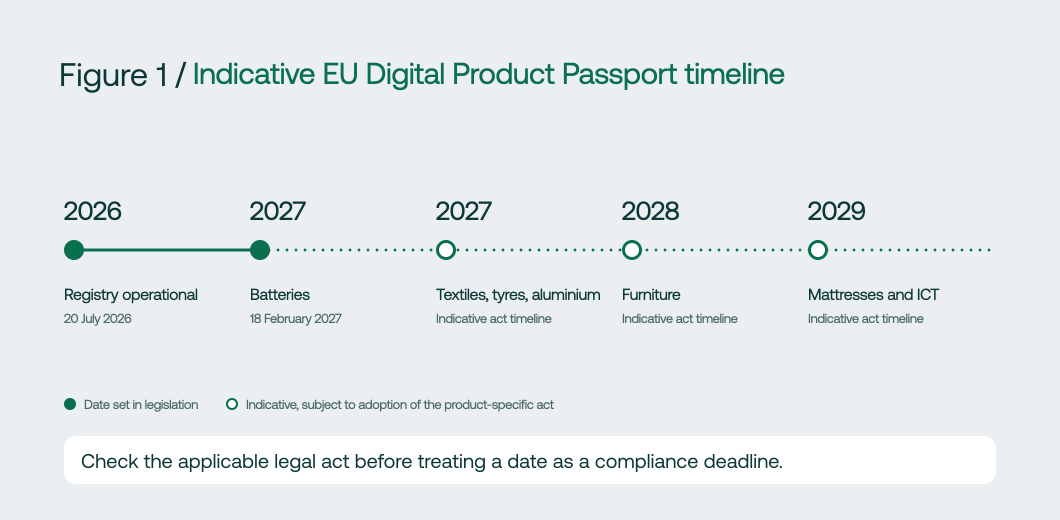
The ESPR provides the main legal framework for product-specific sustainability requirements. From 18 February 2027, certain batteries placed on the EU market must have a battery passport. The DPP Registry became operational on 20 July 2026, while category-specific requirements continue to be established through EU legal acts [1][2].
If your company manufactures, imports or distributes products in a category covered by a DPP rule, you need to understand which product categories, suppliers and data fields are relevant to your portfolio.
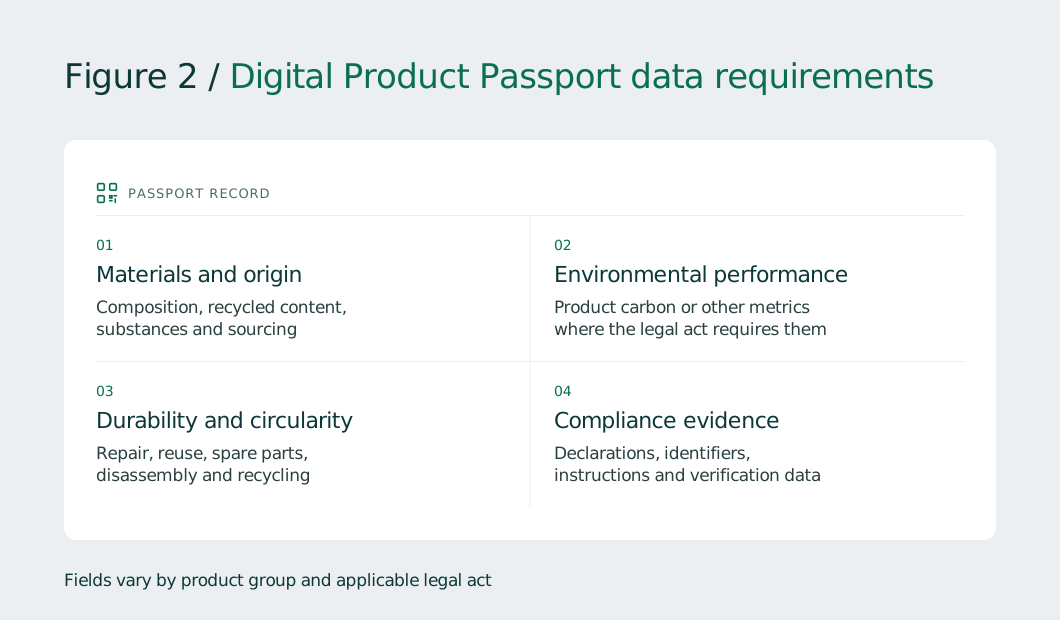
A DPP is a structured, machine-readable record linked to a physical product. Depending on the product group, it may contain information about materials, substances, environmental performance, durability, repair, reuse, recycling and compliance. The applicable legal act defines the required fields [1].
The record connects to the product through a unique identifier, such as a QR code or other permitted data carrier. Access rights differ by stakeholder: under Article 11 of ESPR, customers, economic operators, repairers, recyclers, authorities and other relevant actors can access passport data according to their access rights, with the details set in each product group’s delegated act.
This is not a sustainability report. A report describes company-level performance. A DPP describes one specific product. The two serve different regulatory purposes.
The ESPR, Regulation (EU) 2024/1781, entered into force on 18 July 2024. It broadens the EU ecodesign framework to a wider range of physical products, subject to exclusions and product-specific rules [2].
The regulation allows the EU to establish requirements for particular product groups through delegated acts and other legal measures. The DPP supports access to product information and can support market surveillance, compliance and circularity. It is not a single enforcement mechanism that applies identically to every product.
The DPP Registry became operational on 20 July 2026. Adoption dates and transition periods must be checked in each product-specific legal act. Do not assume that every category has an 18-month transition period.
The EU has prioritised product categories by environmental impact, market size, and data readiness.
Other product groups may receive requirements through later legal acts or horizontal measures. The ESPR working plan is a planning document, not a substitute for the final product-specific act.
If your product category is on the indicative timeline, begin data mapping before the compliance date is fixed.
Nexio Projects can help connect this work with Scope 3 emissions measurement and supplier engagement programmes.
Specific requirements vary by product category and legal act. Depending on the product group, a DPP may include:
The economic operator must maintain accurate information in line with the applicable requirements. Incomplete or inaccurate data can create compliance, enforcement and market access risk.
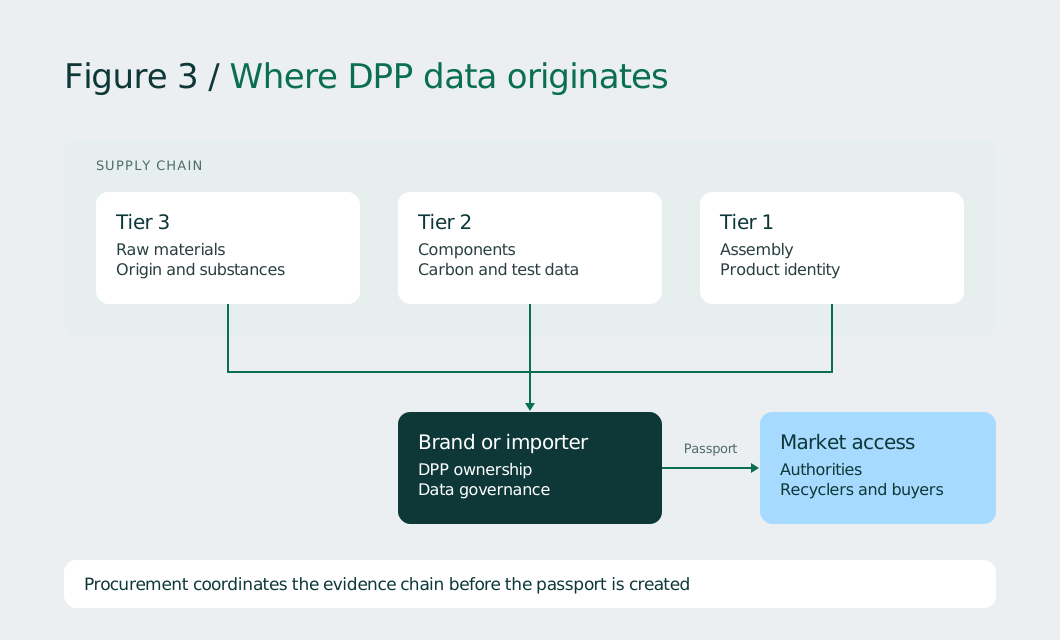
For supply chain and procurement directors, the DPP is not a product management problem. It is a data supply problem.
Most of the data a DPP requires originates upstream in your supply chain: raw material composition from material suppliers, emission factors from tier-2 and tier-3 suppliers, substance compliance records from component manufacturers.
Recent supplier sustainability data shows that carbon information remains uneven across supply chains [4]. Product-level DPP data usually requires more detailed evidence than a company-level supplier response.
Building DPP-ready supply chain data takes three steps.
Identify which products face the earliest compliance obligations. Steel is the highest priority in the working plan as of now.
What product data do you hold today? Bills of materials, product specifications, test reports and supplier assessments are your starting point. For most product groups, the exact DPP requirements will only be set once the relevant delegated act is adopted, but they are likely to cover information such as material composition, recycled content, substances of concern, durability, repairability and environmental footprint. Use these as a guide to identify gaps now, and refine the list once your sector’s requirements are published.
Communicate to key suppliers what data you will need, in what format and by when. This is a recurring obligation, not a one-off request.
Nexio Projects’ supplier engagement approach can help procurement teams turn these requirements into a repeatable supplier data programme.
“A DPP is a supplier data problem before it is a product design problem.”
The first mandatory DPP applies to batteries from February 2027. The Commission’s indicative timeline places textiles, tyres and aluminium in 2027, furniture in 2028, and mattresses and ICT products in 2029. Companies should check their specific product category against current ESPR delegated act timelines on the EU Commission website.
The “producer” under ESPR: the economic operator placing the product on the EU market. This is typically the brand owner or importer. If a non-EU manufacturer sells through an EU importer, the importer holds primary compliance responsibility.
An Environmental Product Declaration is a voluntary, third-party verified lifecycle assessment summary. A DPP is a mandatory EU regulatory requirement covering broader product data. Companies with existing EPDs have a useful head start on carbon footprint and materials data requirements.
No. The DPP is product-level data for market compliance. CSRD and ESRS cover company-level sustainability reporting. Both draw on some of the same underlying data, which makes building a shared data architecture efficient.
Nexio’s experience across 600+ supply chain projects shows that stable supplier data collection programmes typically take 12 to 24 months to reach audit-ready quality. Companies facing 2027 DPP obligations should begin supplier engagement and data mapping now.
Nexio Projects can support the underlying data work through product carbon footprint support and supplier engagement consultancy.
The DPP is not a theoretical future requirement. The regulatory infrastructure is building up. Product-specific obligations are rolling out category by category. The companies that will comply with the least disruption are those building product sustainability data infrastructure now, not when the delegated act reaches their category.
“The strongest preparation starts with one product category, one supplier data model and clear evidence ownership.”
As Nexio Projects, we can support with your supply chain data collection, Digital Product Passport and other climate initiatives. Speak to our DPP and supply chain specialists to map your product data gaps and build your collection programme.
[1] European Commission. Digital Product Passport overview and indicative timeline. https://single-market-economy.ec.europa.eu/single-market/digital-product-passport_en. Accessed November 2026.
[2] European Parliament and Council. Regulation (EU) 2024/1781 establishing a framework for the setting of ecodesign requirements for sustainable products. Current consolidated text dated 28 June 2024. https://eur-lex.europa.eu/eli/reg/2024/1781/oj/eng. Accessed November 2026.
[3] European Parliament and Council. Regulation (EU) 2023/1542 concerning batteries and waste batteries. Current consolidated text. https://eur-lex.europa.eu/eli/reg/2023/1542/oj/eng. Accessed November 2026.
[4] EcoVadis. 10th Edition Sustainability Ratings Index. https://ecovadis.com/blog/10th-edition-ecovadis-sustainability-ratings-index/. Accessed November 2026.
[5] Nexio Projects. Making product carbon footprints work at scale. https://nexioprojects.com/making-product-carbon-footprints-work-at-scale/. Accessed November 2026.
[6] Nexio Projects. How to effectively engage your suppliers. https://nexioprojects.com/how-to-effectively-engage-your-suppliers/. Accessed November 2026.
[7] Nexio Projects. Scope 3 emissions: Measurement and reduction strategies. https://nexioprojects.com/scope-3-emissions-measurement-reduction-strategies/. Accessed November 2026.
[8] Nexio Projects. Supplier engagement consultancy. https://nexioprojects.com/solutions/supplier-engagement/. Accessed November 2026.


