Supply chain decarbonisation: A procurement manager’s playbook
June 3, 2026


“EcoVadis is much more than just a simple rating. It gives organisations a structured way to understand their sustainability management system and identify where practical improvements can make the greatest difference.”
Cilia Keser, Managing Partner
If you are preparing for your first EcoVadis assessment, this article distils the practical guidance from our webinar on preparing your first assessment into a clear starting point, covering the assessment process, evidence requirements and the steps that can strengthen your submission.
Preparing your first EcoVadis assessment starts before the questionnaire opens. Many organisations approach their first EcoVadis Assessment as a form filling exercise. That approach creates avoidable pressure. The questionnaire reflects the quality of your sustainability management system, so preparation starts before anyone uploads a document.
A strong submission connects policies, actions and results. It also brings together information from procurement, human resources, legal, operations, finance and sustainability teams.
The assessment process has five steps. Each step creates a decision point for the company being assessed.
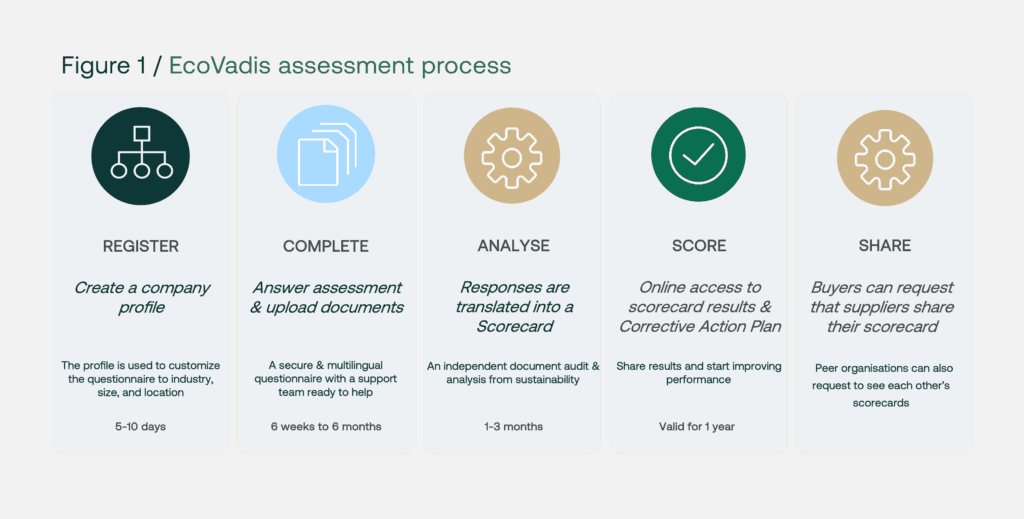
The process rewards early preparation. Registration details should be accurate before the questionnaire is launched. Ensure that your industry, company size and structure are accurate at registration, and align the timeline if major changes are planned before submission. This helps EcoVadis provide an accurate questionnaire and gives you time to prepare accordingly.
For anyone asking what is EcoVadis, the practical answer is a structured review of a company’s sustainability management system. An EcoVadis assessment evaluates the quality of that system.
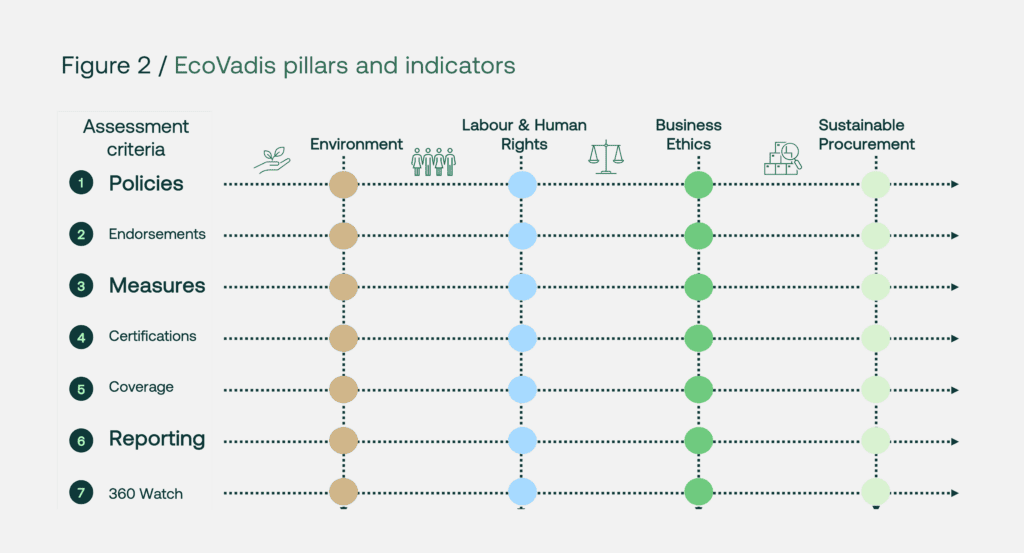
The methodology looks at three connected areas: policies, actions and results. These areas are assessed across four themes: environment, labour and human rights, ethics, and sustainable procurement. [1]
Policies show what the organisation has formally committed to. Actions show how those commitments are implemented through procedures, training, programmes and other measures. Results show whether the organisation tracks performance through key performance indicators, reporting, audits and stakeholder information.
The EcoVadis score reflects performance across the assessment indicators. The EcoVadis Rating adds a comparative view through the scorecard, percentile and medal or badge.
The scorecard also includes certifications, external endorsements and a 360 Watch review. For larger companies, coverage acts as a multiplying factor. It considers how widely policies, actions and certifications are deployed across the organisation.
“EcoVadis is a document based questionnaire. Every answer needs relevant evidence that shows how your policies, actions and results work in practice.”
Aurora Benedetti, Sustainability Consultant at Nexio Projects. [1]
The distinction between the three areas matters. A policy can demonstrate a commitment, but it does not prove implementation. A training procedure can describe an action, but it does not prove that employees completed the training. A performance indicator can show a result, but it needs a clear connection to the relevant activity.
For a deeper explanation of how to interpret the result after submission, read our guide to how to read and use an EcoVadis scorecard.
Evidence selection is one of the most important preparation tasks.
The right document should answer the specific indicator in the questionnaire. A sustainability report may support several topics, while a policy document may only support a policy question.
The same principle applies to procedures, training records, audit evidence and performance data. Uploading a policy as evidence for an action does not demonstrate that the action exists. Uploading a general statement without a date, company identification, or implementation detail can also weaken the answer.
First time participants can attach up to 55 new documents to the questionnaire; therefore, it is crucial to prepare strong documents, ideally ones that can answer multiple questions at the same time. Strong evidence includes sustainability repots, employee handbooks or KPI Dashboards. Lack of document space is the most common challenge companies face in the first reporting year, so preparation is key. Keep existing documents separate when they represent different pieces of evidence. Combining different documents into one merged document can lead to rejection. Documents should show the company logo or name, creation or revision date and validity information. Policies and procedures can remain valid for longer periods, while key performance indicators, audits and certifications require closer attention to their reporting or expiry dates.
An internal evidence register can make this work more manageable. It should record the question, indicator, document owner, document date, expiry date and intended use. Reviewers can then check whether each document answers the question before submission.
Cilia Keser sums it up: ‘We really encourage our clients to think that it is a collective exercise.’ [1]
That principle affects the quality of the submission. The sustainability lead may coordinate the process, but the evidence often sits with other teams. Involve colleagues early, agree responsibilities and create a review process before the questionnaire deadline approaches.
The assessment becomes easier to manage when preparation starts before the questionnaire opens. These practical steps can help you organise the process and avoid preventable delays.
EcoVadis evidence rarely sits with one person or department. Policies may belong to sustainability or legal teams, training records may sit with human resources, and performance data may come from operations or finance.
Create a list of the colleagues who hold relevant information. Agree responsibilities early and give each person a clear deadline for reviewing or providing documents.
An internal register can help you collect, review and track documents before submission. Include the relevant question, document owner, creation date, revision date, expiry date and intended use.
This process helps the team confirm that each document answers the question it supports. It also reduces the risk of uploading an outdated document or using the same evidence for an unsuitable indicator.
Your industry, company size, location and organisational structure help determine the questionnaire you receive. Review these details carefully during registration.
If your company information changes after the questionnaire launches, EcoVadis may adapt it without notice, or may not generate a new questionnaire. Accurate registration information helps reduce unexpected questions and supports better preparation.
Documents should clearly identify your organisation and include a creation or revision date. You should also check whether the document remains valid for the relevant assessment period.
Policies, procedures, key performance indicators, audit reports and certificates can have different validity periods. Reviewing these details before submission helps prevent avoidable evidence gaps.
The assessment allows up to 55 new documents to be attached. This makes document selection important.
Prioritise evidence that directly answers the question and demonstrates implementation. A smaller set of relevant documents will be more useful than a large collection of general files.
Your scorecard and corrective action plan can show where your sustainability management system needs attention. Review these outputs as soon as you receive them.
Early action gives your organisation more time to strengthen policies, improve implementation and collect stronger results before the next assessment. This supports a more effective sustainability journey over time.
Usually, separate pre existing documents should remain separate. Combining them can lead to rejection.
Certificates covering several sites can be grouped. Documents that provide supplementary information for one measure can also be combined, such as training material, a training record and a training certificate. The combined file should only support that specific option.
The source material gave a rough indication of more than 90 points for Platinum and approximately 81 points for Gold. These thresholds move because medals depend on the percentile of all companies assessed during the previous 12 months.
The figures should therefore be treated as a reference, not a guarantee.
A public sustainability report can support the reporting score. Without publicly available key performance indicators, the reporting score can be capped at 50.
For a first assessment, the absence of a public report may be manageable. Companies seeking stronger reporting performance should consider publishing relevant data.
At the time of publication, companies could submit up to 55 new documents. Documents submitted in a previous assessment remain available for reassessment and do not count towards this limit. This allows companies to build on their evidence base over time.
Yes. An export, hyperlink or screenshot can be accepted when the company name or logo is visible and the training content is clear.
A screenshot showing only a course title may be rejected because it does not explain what the training covered.
A first EcoVadis assessment becomes more manageable when the company treats it as a structured review of its sustainability management system.
Start with the registration information, map the three assessment areas, assign document owners and review evidence against each question.
The scorecard should also become a management tool. After submission, use the corrective action plan to identify practical improvements and begin work before the next assessment cycle.
This turns the assessment into part of the organisation’s sustainability journey, from compliance to positive impact.
We are an international sustainability consultancy dedicated to guiding organisations on their journey from compliance to positive impact. We support first time EcoVadis participants with evidence reviews, gap analysis, training and practical preparation.
Recognised in Verdantix’s Buyer’s Guide for boutique ESG and sustainability strategy services and named a Top Brand in sustainability by EUPD, we are here to help you turn your first EcoVadis Assessment into a foundation for continuous improvement.
Book a discovery call with Nexio Projects to discuss how to prepare your first submission.
[1] Nexio Projects. EcoVadis: Preparing your first assessment. Webinar transcript and slide deck supplied for this article. https://nexioprojects.com/webinars/ecovadis-back-to-school-your-first-assessment/. Accessed September 2026.
[2] Nexio Projects. EcoVadis scorecard: How to read, share & maximise your rating. https://nexioprojects.com/ecovadis-scorecard-how-to-read-share-maximise-your-rating/. Accessed September 2026.
[3] Verdantix. Buyer’s Guide: Boutique ESG and Sustainability Strategy Services. https://www.verdantix.com/client-portal/report/buyer-s-guide-boutique-esg-and-sustainability-strategy-services-2023. Accessed September 2026.
[4] EUPD. Nexio Projects: Top Brand in sustainability. https://eupd-group.com/top-brand/nexio-projects/. Accessed September 2026.