What’s the difference between a product carbon footprint and a product environmental footprint?
January 14, 2025


states Anna Ma, Climate Director when asked about product sustainability initiatives.
Product carbon footprints were, until recently, the preserve of well-resourced sustainability teams with time for thorough life cycle assessment studies. That reality has shifted. Customer contracts, EU regulation, and investor demands are converging on a single ask: carbon data at the product level, produced consistently, and exchanged reliably across supply chains. [1]
The challenge most organisations face is no longer whether to run a PCF programme. The challenge is making one that scales. A single product study is manageable. Hundreds of SKUs, dozens of suppliers, and an annual recalculation cycle are a structurally different problem.
In June 2026, Nexio Projects hosted a webinar with the Partnership for Carbon Transparency (PACT), part of WBCSD, to address this challenge directly. Francesc Romero, Senior Climate Consultant at Nexio Projects, and Isobel Farnsworth, Senior Associate for PACT Implementation at WBCSD, walked through the barriers companies encounter and the levers that actually move things forward. This article draws directly from that session. Download the PCF roadmap factsheet from the Nexio Projects knowledge centre for a step-by-step reference alongside this article.
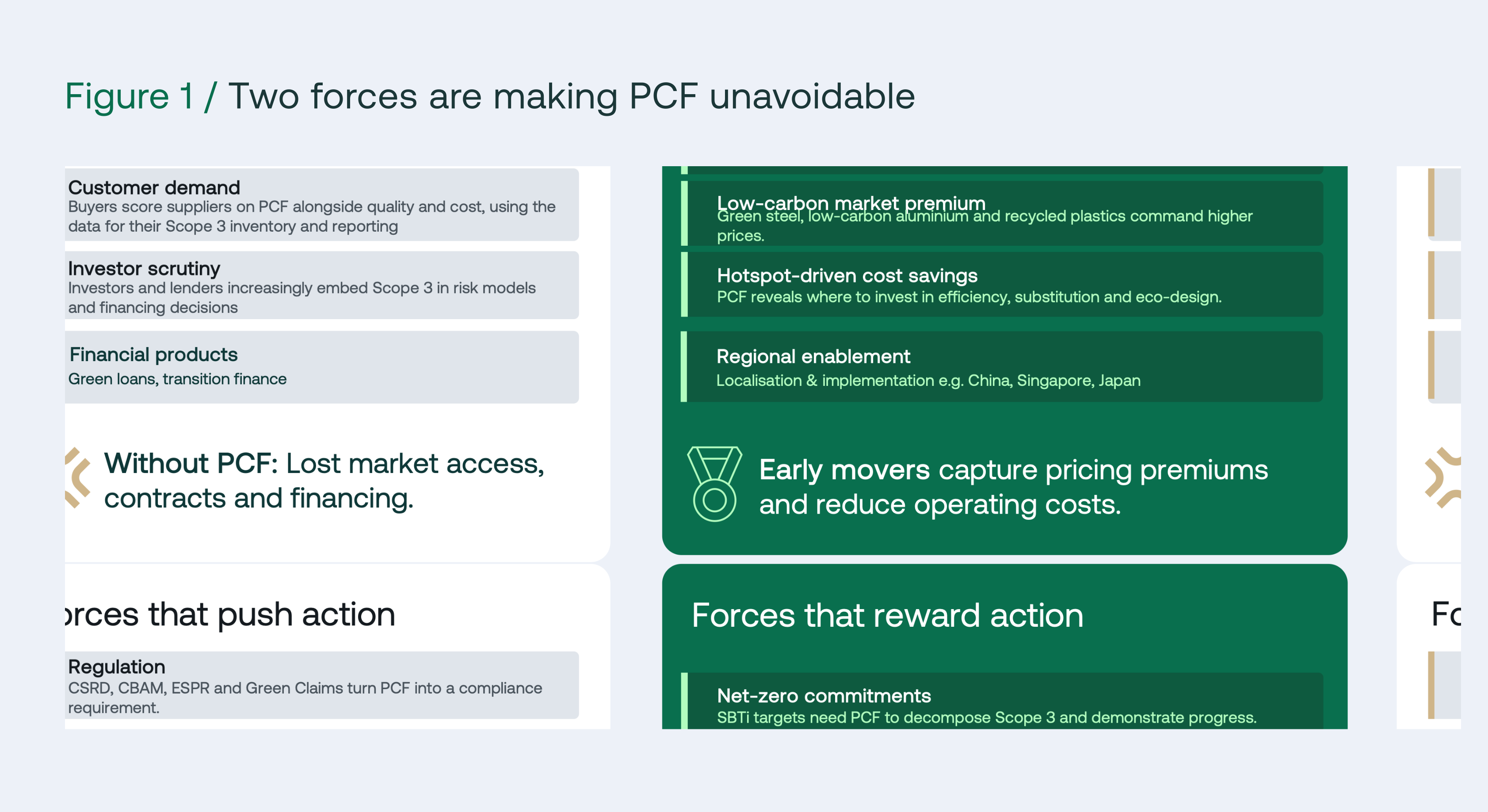
Two sets of forces are making product-level carbon accounting unavoidable. [1]
Regulatory pressure is the first driver. CSRD, the EU Carbon Border Adjustment Mechanism, and the Ecodesign for Sustainable Products Regulation are each turning product carbon data into a compliance requirement. Buyers are the second driver. Large corporations with Science-Based Targets embed PCF data requirements into procurement contracts to feed their own Scope 3 Category 1 reporting. Suppliers without that data face delisting. [1]
The business case for acting early is equally concrete. PCF data reveals emission hotspots that translate directly into cost savings and operational efficiency. Low-carbon product variants command pricing premiums in sectors including steel, aluminium, and recycled plastics. SBTi target-setting requires PCF data to decompose Scope 3 and demonstrate year-on-year progress.
The webinar poll confirmed the dominant driver among participants: most were using, or intending to use, PCF data to inform decarbonisation decisions and reduction plans. The companies that extract the most value from PCF investment are the proactive ones. They act before external pressure demands it, and they build resilience systems rather than reactive responses. [1]
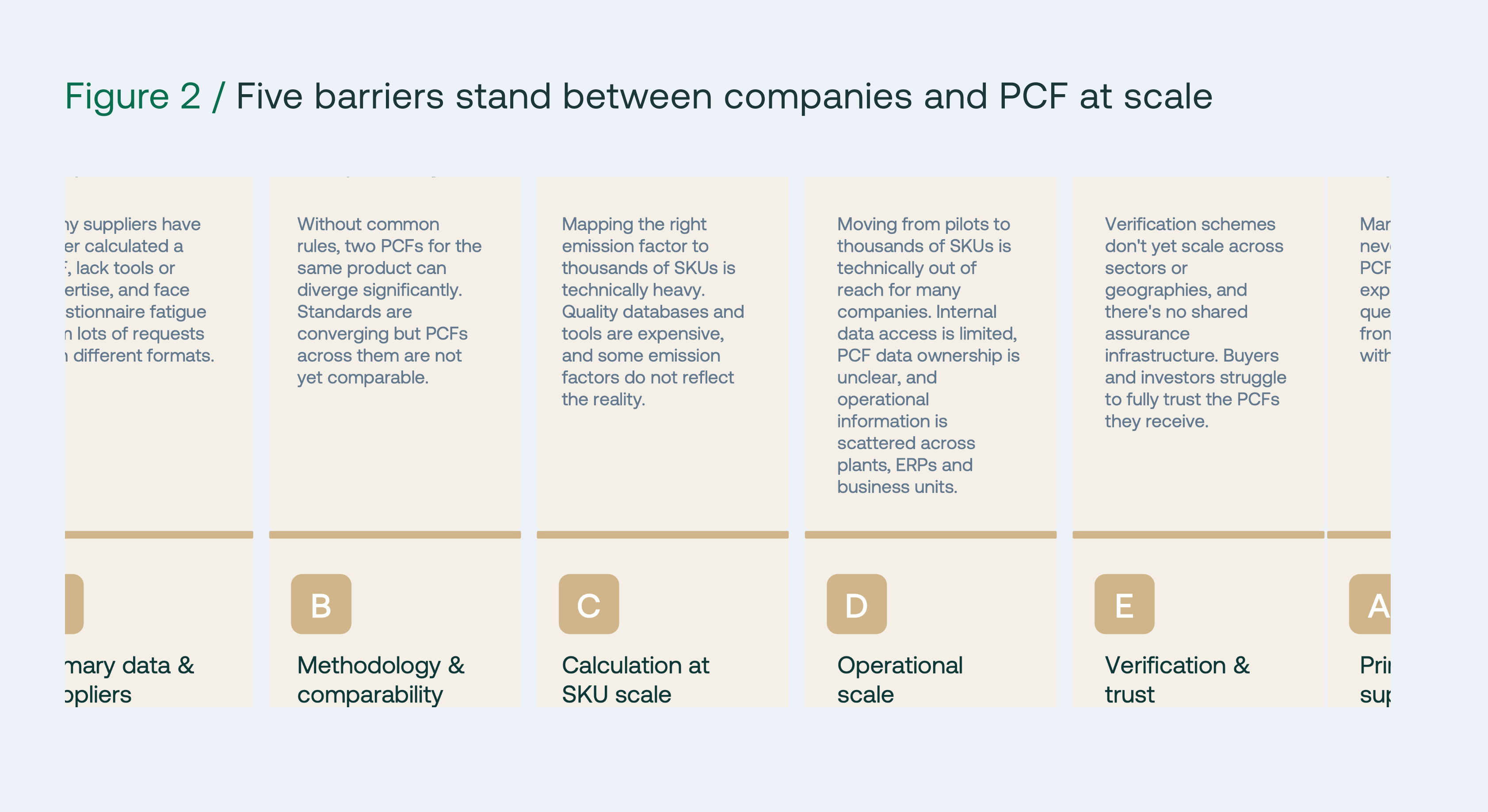
We identified five barriers that appear consistently across client engagements. Understanding where programmes fail is the first step to designing around the failure points. [1]
Most suppliers have never calculated a PCF. They lack tools, expertise, and budget. Survey fatigue compounds the problem: suppliers receive questionnaires from multiple customers, each with a different format and methodology. Response rates collapse. [1]
Mapping the correct emission factor to thousands of SKUs is technically demanding and one of the heaviest workloads in any PCF programme. Good emission-factor databases are expensive to license. Recalculating across a large portfolio when recipes or specifications change quickly breaks any manual approach. [1]
Methodology and comparability.
Two PCFs of the same product, calculated under different standards, can diverge significantly. Allocation rules, biogenic emissions, electricity accounting, and recycled content are the common fault lines. Standards including PACT, ISO 14067, and the GHG Protocol Product Standard are converging, but products calculated under different standards remain difficult to compare. [1]
Key input data is scattered across ERP systems, MES platforms, PLM tools, and procurement records. Ownership of PCF data across Sustainability, Product, and Procurement teams is frequently unclear, slowing every iteration. [1]
Verification and trust. Buyers and investors cannot easily distinguish verified PCFs from self-declared ones. Without a shared assurance backbone, trust in the numbers remains low and decisions based on that data are hard to defend. [1]
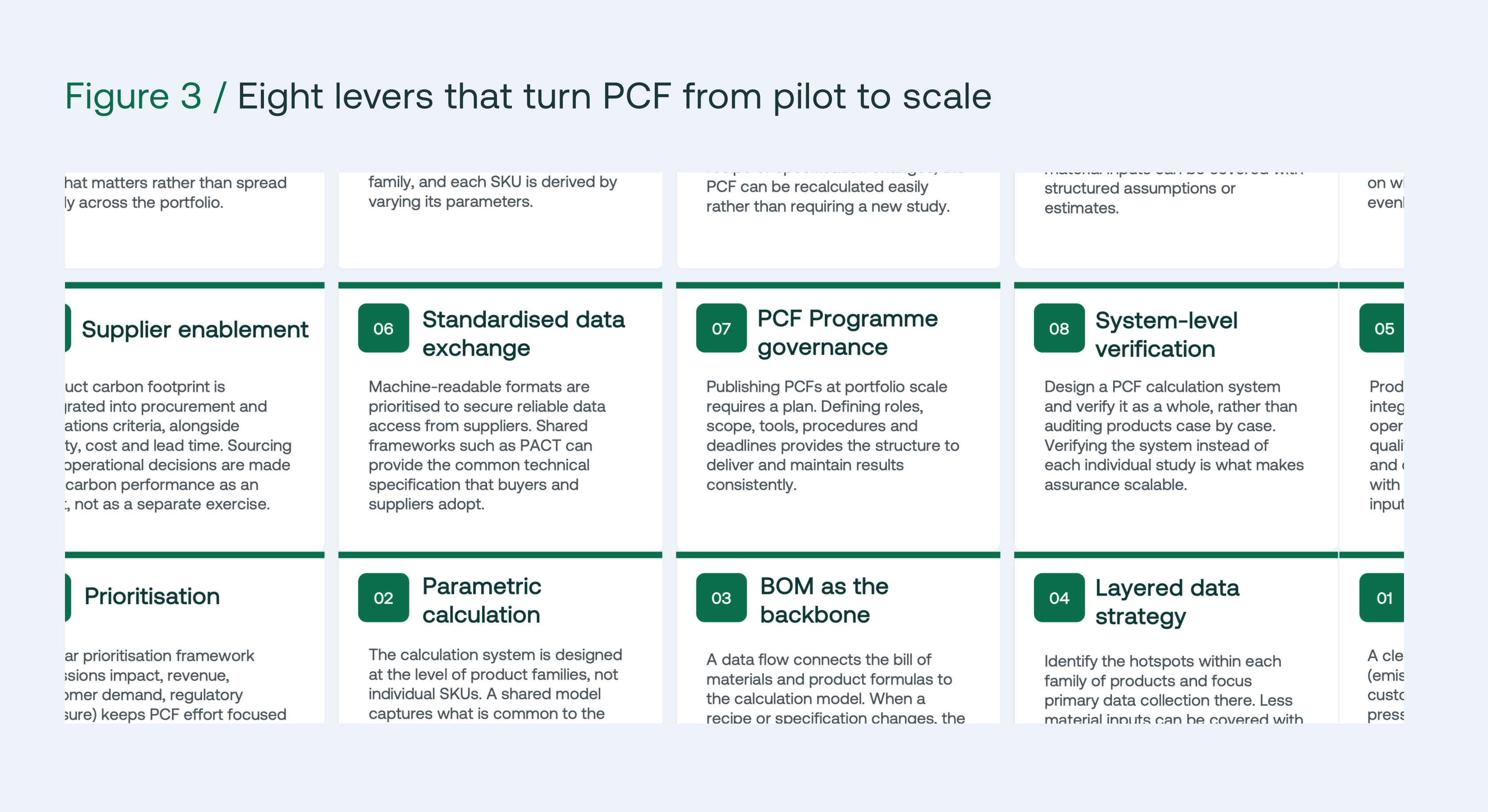
The session’s central argument is a shift in mindset: from calculation-as-event to calculation-as-system. WE identified eight levers that make this operational [1]. The three with the most immediate impact are:
The five remaining levers, layered data strategy, supplier enablement, standardised data exchange, PCF programme governance, and system-level verification, reinforce this architecture. For a full environmental life cycle assessment of the data system design, the session’s slide on the five-step data system (diagnosis, ownership assignment, source mapping, standardisation, centralisation) is available in the webinar materials. [1]
Nexio Projects’ experience with the Rose Acre Farms and Unilever supplier engagement programme demonstrates what this systems approach produces in practice: a replicable PCF framework built to expand across an entire product portfolio. For a fuller treatment of the LCA methodology underpinning these programmes, see Understanding LCAs to reduce product impact.
Izzy introduced a framework that addresses one of the most common failure modes in scaling PCF programmes: the gap between the data companies hold and the decisions they want to make.
Earlier in 2026, PACT published a white paper proposing the PCF usability model. [2] It has two components. The first is a set of PCF levels (1 through 3, plus a conditional Level+) characterising how methodologically complete a dataset is. The second is a fit-for-purpose matrix establishing whether a PCF at a given level is adequate for a specific use case.
At Level 1 (indicative PCFs), companies can already identify high-priority product categories for decarbonisation, prioritise supplier engagement, and direct capability-building efforts across a broad supplier base. Level 2 (consistent PCFs) enables clustering suppliers by relative carbon intensity, credible evaluation of supplier reduction plans, and a meaningful input into carbon-informed tendering decisions. Level 3 (methodologically complete PCFs) supports Scope 3 Category 1 inventory integration, year-on-year emissions tracking with confidence, and product redesign decisions. [1, 2]
The practical value for scaling is significant. Organisations do not need Level 3 data everywhere. The use case determines the level required, and the level required determines the depth of supplier engagement needed. Starting broad at Level 1 and deepening engagement with strategic suppliers over time is economically viable. It also builds supplier relationships more effectively than demanding comprehensive data upfront. [1, 2]
One PACT member described the alignment of PACT and TfS (Together for Sustainability) methodologies as life-changing, because their suppliers stopped having to answer the same question in different ways. That standardisation, not technology alone, is what creates the conditions for scale. [1]
“The standardisation of methodologies does some of the most important work before technology even gets involved.”
stated Isobel Farnsworth, Senior Associate, PACT Implementation at WBCSD during the session.
The shift from PCF pilot to operational programme requires more than technical skill. It requires a deliberate governance structure: clear data ownership assigned before collection begins, a calculation system designed for reuse rather than single use, a methodology that suppliers learn once and apply across all their customers, and a verification approach planned from day one for the volumes involved.
PACT’s technical infrastructure, now supporting more than 4 million PCF calculations annually across 50 conformant solution providers and 180 corporate participants, provides the interoperability layer that makes supply chain-level scaling possible. [1] For Nexio Projects clients, PACT alignment has served as a practical accelerator: it closes the methodological gaps that generalist standards leave open, and it enables PCF data to flow across sector boundaries without reformatting at every handover point.
For organisations starting this journey, the detailed guidance in Product carbon footprints: navigating practical questions covers the strategic prioritisation and data quality considerations that sit at the foundation of any scalable programme.
“The idea is to stop thinking of PCF calculation as a one-off exercise and create a system that is already prepared to be scaled.”
concluded Francesc Romero, Senior Climate Consultant at Nexio Projects.
The session closed with a live Q&A. Below are three questions from participants, with answers summarised from the hosts.
A shared standard is the prerequisite for scaling, because without it every attempt will hit the same wall. PACT enables scalability through three mechanisms. First, suppliers learn the methodology once and reuse it across all their customers, which changes the economics of building PCF capability entirely. Second, PACT’s technical specification creates interoperability between solution providers, so data moves between platforms without being reformatted at each handover. Third, PACT closes the interpretation gaps that standards such as ISO 14067 leave open on allocation, biogenic emissions, and electricity accounting. For companies that supply into multiple sectors, a sector-agnostic standard sitting beneath sector-specific initiatives is the only approach that works at supply chain scale. [1]
A common language is a functional requirement, not an organisational preference. When a chemical supplier, a packaging company, and a food manufacturer are all exchanging PCF data, the numbers need to mean the same thing at every handover point. Where they do not, what is being exchanged are numbers that require reprocessing at each step, creating cost and the risk of material misinterpretation. In supplier programmes specifically, a standardised methodology reduces the burden on suppliers who would otherwise respond to multiple requests in multiple formats. The TfS and PACT methodology alignment, which took effect in 2025 and 2026, is a concrete example of what happens when this standardisation occurs at industry level: supplier engagement becomes structurally easier for everyone in the chain. [1]
Industry-specific standards are being published at an increasing pace and they address questions that generalist standards leave open, particularly around specific materials, processes, and allocation approaches. The appropriate resource depends on the industry and the specific product in question. For most companies, aligning calculations with a framework such as PACT provides a practical anchor regardless of sector: it makes assumption-setting more rigorous, enables results to be compared across suppliers, and means decisions can be taken with confidence. Where sector-specific guidance exists, it applies on top of the PACT layer rather than in place of it. Nexio Projects and PACT are each available to advise on the right combination for a given industry context. [1]
Nexio Projects is an international sustainability consultancy dedicated to guiding organisations on their journey from compliance to positive impact. Our mission is to provide expert support across strategy development, ESG ratings, climate solutions, and comprehensive sustainability reporting. Ultimately, we help ourclients achieve their sustainability goals with a pragmatic, step-by-step approach.
Recognised as a leading boutique ESG and sustainability strategy firm in the Verdantix Buyer’s Guide and among the top sustainability advisory firms by MT/Sprout SD400 2025, Nexio Projects brings specialist PCF, LCA, and supplier engagement expertise to organisations at every stage of their product carbon footprint journey.
Ready to move from pilot to programme?
Contact the Nexio Projects team to book a discovery call on product carbon footprint calculation, PACT methodology alignment, or supplier engagement programme design.
[1] Nexio Projects / WBCSD PACT. Making Product Carbon Footprints Work at Scale. Webinar recording and slides, June 2026. Available to registered attendees via email.
[2] WBCSD PACT. PCF Usability Model White Paper. https://www.carbon-transparency.org. Published 2026. Accessed June 2026.
[3] Nexio Projects. PCF explained: Your roadmap for decarbonising products. https://nexioprojects.com/knowledge-centre/pcf-explained-your-roadmap-for-decarbonising-products/. Accessed June 2026.
[4] Nexio Projects. Carbon footprints decoded: A collaborative approach to climate action. https://nexioprojects.com/carbon-footprints-decoded-a-collaborative-approach-to-climate-action/. Accessed June 2026.
[5] Nexio Projects. Understanding LCAs to reduce product impact. https://nexioprojects.com/understanding-lcas-to-reduce-product-impact/. Accessed June 2026.
[6] Nexio Projects. Product carbon footprints: navigating practical questions. https://nexioprojects.com/product-carbon-footprints-navigating-practical-questions/. Accessed June 2026.