Reflecting on Economist Sustainability Week: The role of climate in business resilience
March 13, 2026


“Target quality starts with a clear distinction between the target a company must act on now and the endpoint it intends to reach.”
Companies setting science-based targets in 2027 face a transition between two SBTi standards. Corporate Net-Zero Standard V2.0 opens for validation in February 2027, but Corporate Net-Zero Standard V1.3.1 remains relevant during the transition period.[1][2][3]
This distinction matters for sustainability directors coordinating climate target setting with CSRD reporting. SBTi validation can provide external support for a target methodology, but it does not replace ESRS disclosures, statutory assurance, or the company’s own transition plan.
Near-term targets drive action during the next target cycle. Long-term targets describe the emissions endpoint that supports a path towards net zero.
Under V2.0, a near-term target covers a five-year period starting at the beginning of the most recent reporting period at submission. Companies setting targets under V2.0 for the first time may choose a shorter period to align with their business or reporting cycle. Requirements depend on company category and scope.[1]
V2.0 requires all companies to set separate Scope 1 and Scope 2 targets. Category A companies must also set a separate Scope 3 target covering every Scope 3 category (categories 1–14) that represents 5% or more of Scope 3 emissions, with limited exclusions that must be reported and justified. For Category B companies, Scope 3 targets are optional.[1]
Target ambition comes from the eligible SBTi methods, metrics and pathways for each scope, so there is no universal “50% by 2030” rule under V2.0.[1]
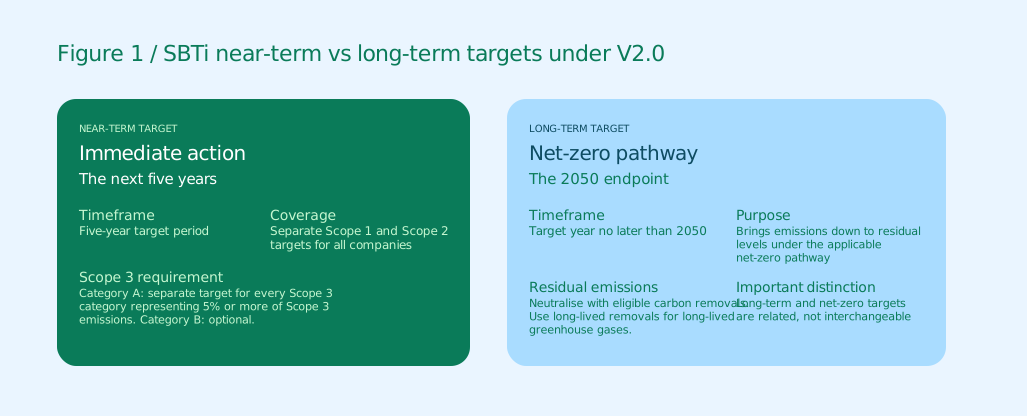
A long-term target and a net-zero target are related, but not interchangeable. A near-term target does not automatically constitute a net-zero commitment.
Under V2.0, long-term targets are required for any company setting a net-zero target, and for Category A companies whose near-term Scope 1 target uses an intensity or asset transition approach. Long-term targets must be set for 2050 at the latest and bring emissions down to residual levels in line with the applicable net-zero pathway, rather than summarized as a fixed 90% to 95% reduction.[1] Companies pursuing corporate net-zero validation must meet the applicable requirements for near-term action, long-term decarbonisation, and residual emissions. At the net-zero target year, residual emissions must be neutralised with eligible carbon removals, using long-lived removals for long-lived greenhouse gases. Avoided emissions do not neutralise residual emissions.[1]
The main changes concern target architecture, Scope 3 coverage, progress transparency, and transition rules.
Under V1.3.1, a Scope 3 target is required once Scope 3 reaches 40% of total Scope 1, 2 and 3 emissions, and near-term targets must cover at least 67% of Scope 3 emissions. V2.0 replaces this with a category test: Category A companies must cover every Scope 3 category that represents 5% or more of Scope 3 emissions (categories 1–14), with limited exclusions that must be reported and justified. Both routes rely on a defensible Scope 3 inventory.[1][2][3]
The transition materials highlight important differences between the standards. Earlier V1 criteria allow more flexibility, including a combined Scope 1 and Scope 2 target and greater flexibility around Scope 3 boundaries. V2.0 introduces more differentiated requirements by scope and company category.[2]
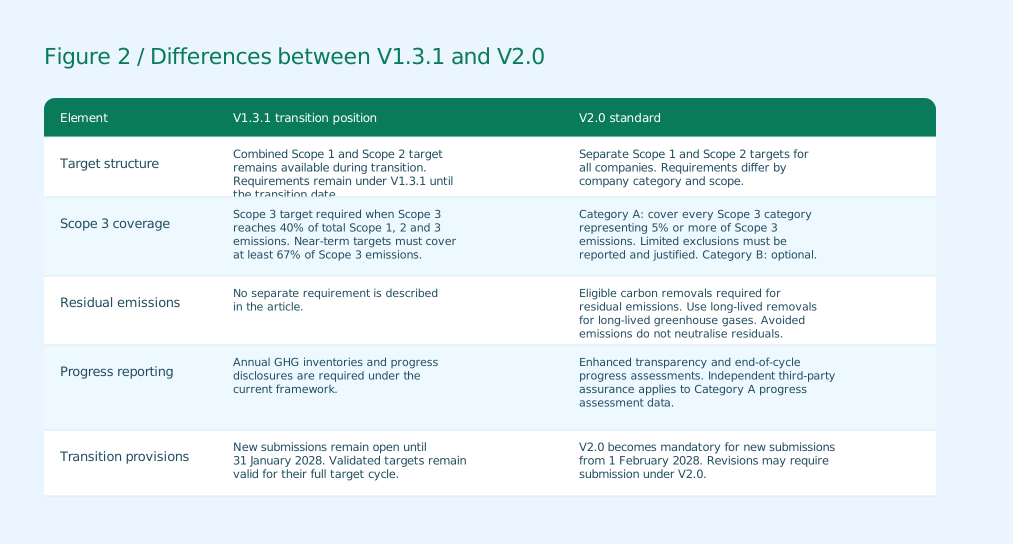
Companies already have responsibilities to disclose annual GHG inventories and progress against targets under the current framework. V2.0 adds an enhanced transparency framework, including end-of-cycle progress assessments. Category A companies need independent third-party assurance of the data behind progress assessments, as well as limited assurance of base-year emissions and target-setting metrics at validation. SBTi recommends that companies using V1.3.1 adopt third-party assurance for end-of-cycle progress reporting voluntarily.[2][8]
SBTi’s transition materials allow companies to continue using V1.3.1 during the transition period. Validated V1 targets remain valid for their full target cycle.[8] The transition guidance should be checked before revising an existing target, because a revision may require submission under V2.0.[2]
V2.0 validation opens on 1 February 2027. V1.3.1 remains open for new submissions until 31 January 2028, and V2.0 becomes mandatory for all new submissions from 1 February 2028. Companies setting or updating targets before that date need to confirm the current submission route, available criteria, and any changes to SBTi guidance before starting the process.[2] For context, read our overview of the SBTi Corporate Net-Zero Standard V2.0.

The GHG Protocol is revising its Corporate Standard and Scope 3 Standard. Companies should use current applicable guidance, document boundaries and calculation methods, and monitor official updates from both organisations.[4] SBTi states that targeted amendments to the accounting aspects of V2.0, and any related transitional arrangements, will be considered once the GHG Protocol revision is complete. Companies should not assume an automatic transition period until that guidance is published.[1]
ESRS E1-1 requires in-scope companies to disclose their climate transition plan, including how their GHG reduction targets are compatible with limiting global warming to 1.5°C. Target details such as target year, base year, scopes, and methodology are disclosed under ESRS E1-4.[5]
ESRS E1-1 does not require companies to use SBTi validation. SBTi can provide external substantiation for the methodology and ambition of a target, but validation does not automatically satisfy every E1-1 disclosure requirement. It also does not replace limited assurance or other statutory assurance procedures.
The European Commission adopted simplified ESRS on 3 July 2026 for financial years beginning on or after 1 January 2027, and the revised standards refer to third-party target validation as one possible input when showing 1.5°C compatibility. The applicable CSRD scope, reporting year, and ESRS version must still be checked against the latest EU legislation and national implementation. Companies should not assume that all organisations face the same FY2027 reporting or assurance timeline.
The strongest approach is to develop the SBTi package and ESRS E1-1 plan from the same evidence base. The inventory, target years, reduction levers, governance, and progress indicators should tell one consistent story.
“SBTi validation can strengthen the evidence behind a climate target, but it cannot replace the transition plan that explains how the business will deliver it.”
Companies beginning the process should take five practical steps. Our guide to how to set science-based targets for your company provides additional background on the starting point:
SBTi evaluates the target package against its own criteria. CSRD requires a broader explanation of the transition plan, governance, implementation, and performance.
A near-term target drives emissions reductions during a five-year target period under V2.0. A long-term target describes the company’s pathway towards the emissions level required at the net-zero endpoint. The requirements differ according to company category and scope.
Yes, during the transition period. SBTi’s transition materials allow companies to continue setting targets under V1.3.1 until 31 January 2028, after which V2.0 becomes mandatory for all new submissions. Existing validated targets remain valid for their full target cycle, subject to the applicable SBTi requirements.[2]
No. SBTi validation can provide external support for a target methodology and pathway, but it does not replace the E1-1 transition plan disclosures or statutory assurance process.
At the net-zero target year, residual emissions must be neutralised with eligible carbon removals, using long-lived removals for long-lived greenhouse gases. From 2035, Category A companies must also support carbon removals equal to a share of their ongoing emissions that rises each year until the net-zero year. Avoided emissions cannot be used to neutralise residual emissions under the net-zero framework.[1]
SBTi V2.0 changes the target-setting architecture, but the transition does not require every company to replace a valid target immediately. The right route depends on company category, submission timing, target status, inventory quality, and the purpose of the target.
One robust inventory should support the submission, transition plan, internal decisions, and assurance evidence.
Nexio Projects supports organisations with SBTi target setting, submission preparation, climate transition planning, and CSRD implementation. Our sustainable climate support connects emissions accounting, target design, decarbonisation planning, governance, and reporting so companies can move from compliance to positive impact.
“The most defensible climate target is one that the inventory, transition plan, and governance system can all explain in the same language.”
We are an international sustainability consultancy dedicated to guiding organisations on their journey from compliance to positive impact. We provide expert support across climate strategy, SBTi target setting, net-zero planning, and CSRD implementation.
Our SBTi support covers inventory readiness, organisational and operational boundaries, Scope 3 materiality, target route selection, submission preparation, and responses to SBTi review feedback. We also connect the target package to the transition plan, decarbonisation levers, governance, investment planning, and ESRS E1-1 reporting. This helps organisations move from a technically valid target to a transition plan that can be implemented and monitored.
Recognised as the best ESG consultancy in the Netherlands in 2025 by Consultancy NL and a Top Brand in sustainability by EUPD, we help companies connect credible target setting with practical transition planning.
Speak with Nexio Projects to review your SBTi submission route, inventory readiness, and ESRS E1-1 transition plan before committing to a target pathway.
[1] Science Based Targets initiative. Corporate Net-Zero Standard V2.0. Published 11 June 2026. https://files.sciencebasedtargets.org/production/files/Corporate-Net-Zero-Standard-version-2.pdf. Accessed October 2026.
[2] Science Based Targets initiative. SBTi Services. Guide for Companies in the Transition to Corporate Net Zero Standard Version 2.0. June 2026. https://docs.sbtiservices.com/resources/GuideTransitionCorporateNetZeroStandardV2.pdf. Accessed October 2026.
[3] Science Based Targets initiative. Corporate Net-Zero Standard Version 1.3.1. April 2026. https://files.sciencebasedtargets.org/production/files/Net-Zero-Standard.pdf. Accessed October 2026.
[4] GHG Protocol. Scope 3 Standard Revisions Phase 1 Progress Update. March 2026. https://ghgprotocol.org/sites/default/files/2026-03/S3-Phase1ProgressUpdate-20260331.pdf. Accessed October 2026.
[5] European Commission. Commission Delegated Regulation (EU) 2023/2772 supplementing Directive 2013/34/EU as regards sustainability reporting standards. Current consolidated version and subsequent EU amendments should be checked for the relevant reporting year. https://eur-lex.europa.eu/eli/reg_del/2023/2772/oj/eng. Accessed October 2026.
[6] Nexio Projects. SBTi Corporate Net-Zero Standard V2.0: What you need to know today. https://nexioprojects.com/sbti-corporate-net-zero-standard-v2-0-what-you-need-to-know-today/. Accessed October 2026.
[7] Nexio Projects. How to set science-based targets for your company. https://nexioprojects.com/how-to-set-science-based-targets/. Accessed October 2026.
[8] Science Based Targets initiative. Continuing Use of Corporate Net-Zero Standard Version 1.3.1 and Transition to Corporate Net-Zero Standard Version 2.0. June 2026. https://files.sciencebasedtargets.org/production/files/Continuing-Use-of-Corporate-Net-Zero-Standard-Version-1.3.1-and-Transition-to-Corporate-Net-Zero-Standard-Version-2.pdf. Accessed October 2026.