

 EcoVadis essentials: A guide for beginners and reassessed companies
September 23, 2025


“A strong supply chain partner does more than organise data. It turns incomplete information into the next decision your team can defend.”
A customer request for supplier ESG data can quickly become a cross functional project. Procurement may need to coordinate suppliers, sustainability teams, finance, sales and legal before a commercial deadline.
The information required may cover EcoVadis, product carbon footprints, Scope 3 emissions, human rights risks or evidence of corrective action. Each request creates work across systems that were rarely designed to connect.
The right ESG supply chain consultant should reduce that complexity. The partner should clarify the decision, structure the data, engage suppliers and leave your organisation with a process it can operate.
Nexio Projects is an international sustainability consultancy dedicated to guiding organisations on their journey from compliance to positive impact. We support European and international organisations with supplier engagement, sustainable procurement, Scope 3 and supply chain due diligence. We have delivered more than 1,000 projects for over 400 clients across 25 sectors. [2]
A credible partner starts with the business requirement. That may be a customer deadline, a tender condition, a supply chain incident or a need to improve Scope 3 data quality.
The first phase should answer five practical questions:
This diagnostic prevents a common problem. A consultant may produce a technically sound assessment that does not help the organisation decide which suppliers to contact, what evidence to request or how to escalate risk.
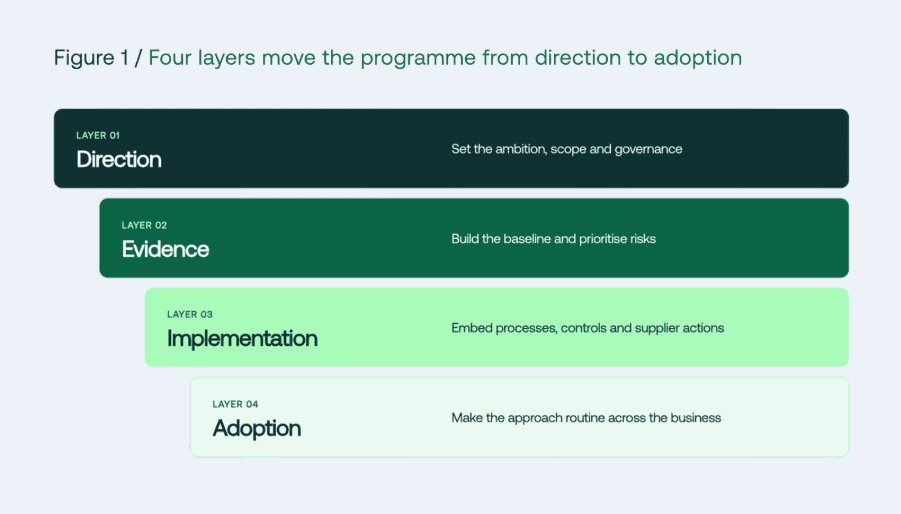
A strong workplan should connect four elements:
Our guide to sustainable procurement for mid market companies sets out a similar principle. A credible programme should be proportionate, documented and capable of improving over time. [9]
A questionnaire is one tool within a supply chain programme. It does not replace risk mapping, supplier prioritisation, engagement planning or remediation.
The consultant should help you segment suppliers using criteria such as:
The segmentation should lead to different actions. A low-risk supplier may need a code of conduct acknowledgement and basic declaration. A high-risk supplier may need an assessment, audit, training, corrective action plan and more frequent review.
That approach matters because supplier capacity varies significantly. A large manufacturer may have dedicated ESG staff and verified emissions data. A smaller supplier may need a clear template, guidance session and reasonable timeline before it can respond.
EcoVadis and Accenture found that only 41% of suppliers surveyed considered their large customers highly committed and actively engaged in sustainability. [3] This finding reinforces a practical point for buyers. Sending requirements without support is unlikely to create strong participation.
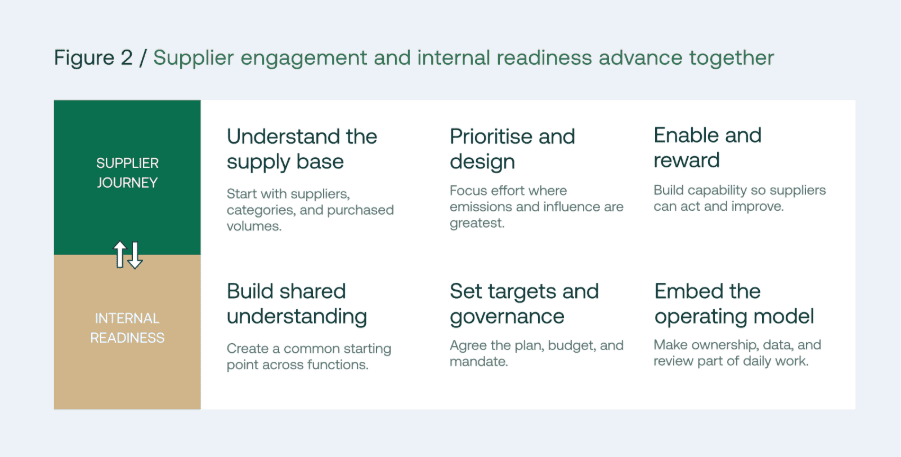
The consultant should therefore provide a supplier engagement model. It should define the message, channel, timeline, escalation route, support available and evidence required for each supplier segment.
The supplier engagement advantage explains why structured engagement can improve the connection between supplier action and Scope 3 progress. [8]
“The quality of a consulting engagement is visible in the handover: clear owners, usable tools, and decisions that continue without the consultant in the room.”
An ESG supply chain consultant should explain how supplier data will be used. Data collection is more valuable when it supports procurement decisions, customer responses, product comparisons and emissions reduction.
For purchased goods and services, supplier specific product data is generally more accurate than broad industry averages. The GHG Protocol identifies supplier specific product level data as the most accurate approach for Category 1 calculations where it is available. [7]
The consultant should assess the quality of existing data before proposing a collection campaign. This includes reviewing:
Your partner should also define a practical progression. A mid-market company may begin with spend based estimates, improve coverage through supplier activity data and then develop product level data for priority categories.
The process should connect to customer needs. If a strategic customer requests a product carbon footprint, your consultant should be able to explain the methodology, evidence requirements, review process and limitations in plain language.
The article on hidden supply chain emissions provides further context on connecting upstream emissions data to decarbonisation decisions. [10]
For practical implementation, the supply chain emissions guide covers supplier prioritisation, data quality, governance and reduction actions. [11]
Regulatory awareness is now part of supplier programme design. Directive (EU) 2026/470 entered into force on 18 March 2026. It amended the Corporate Sustainability Due Diligence Directive and raised the direct scope threshold to companies with more than 5,000 employees and global net turnover above €1.5 billion. It also postponed the application deadline for the amended due diligence requirements to 26 July 2029. [4]
Many mid-market companies will therefore sit outside the amended direct scope. They may still receive requests from larger customers that need value chain information. A consultant should distinguish between a legal obligation, a customer requirement and a voluntary improvement measure.
The partner should help establish a due diligence process that identifies risks across relevant supplier tiers and prioritises them by severity and likelihood. This process should include engaging suppliers through information requests and setting clear contractual expectations. Where issues arise, the partner should support corrective action plans as well as escalation and remediation. The process should also provide for ongoing monitoring and review, backed by thorough evidence retention and reporting.
The European Commission’s voluntary sustainability reporting recommendation for small and medium sized undertakings was published on 30 July 2025. The VSME framework is voluntary and aims to create a proportionate way for smaller companies to communicate sustainability information. [6]
This matters for procurement teams because supplier requests need structure. A consultant should help you define which information is necessary, which framework is relevant and how to avoid asking suppliers for overlapping data.
Compare proposals by delivery quality, internal workload and expected adoption. Price and consultant days provide limited insight without a clear definition of the work.
Ask each ESG supply chain consultant to provide:
Request an anonymised example involving a similar sector, supplier profile, data maturity and geographic footprint. Ask what the starting problem was, which obstacles arose and what changed after implementation.
Confirm who will lead the work, who will perform the analysis and how senior expertise will be available. The team presented during an RFP should match the team assigned to delivery.
The workplan should include milestones, dependencies, responsibilities, review points and client inputs. It should show what happens after the final report.
Agree which skills your team should have at the end. These may include supplier communication, data review, risk prioritisation, corrective action management or reporting.
A defined assessment may suit a fixed scope. A supplier engagement programme may require phases, decision gates and recurring support. Ask how changes will be managed and approved.
Useful measures may include supplier response rates, data coverage, action completion, risk reduction, customer readiness and internal capability.
The first 90 days should create visible progress. The first month can establish scope, stakeholders, data and decision rights. The second can confirm supplier priorities and engagement routes. The third can test the process with a focused group of suppliers.
A consultant should help your team make those decisions faster. The engagement should also leave behind tools and routines that procurement can maintain.
The right ESG supply chain consultant combines technical knowledge with practical delivery. The partner should connect supplier risk mapping, Scope 3 data, EcoVadis, due diligence, remediation and governance into one operating model.
Choose a partner that understands your commercial pressure, works at the maturity of your suppliers and can demonstrate what changes after the engagement. That is how a mid-market organisation moves from compliance to positive impact while connecting the needs of business and the planet.
“The right partner helps procurement move at the speed of business while giving sustainability the evidence it needs to stand up to scrutiny.”
Those criteria are the standard we hold ourselves to. Recognised as a leading ESG consultancy in the Netherlands by Consultancy NL and ranked seventh among sustainability advisory firms by MT/Sprout, we help organisations build supply chain programmes that deliver practical, measurable progress.
The following examples show how supplier engagement can connect emissions data, procurement practice and supplier capability.
Interested to see more?
Want to take action?
Book a discovery call with our supply chain experts to discuss your suppliers, customer requirements and next steps.
[1] Nexio Projects. Supplier engagement consultancy. Accessed September 2026.
[2] Nexio Projects. Outsourced sustainability management. Accessed September 2026.
[3] EcoVadis and Accenture. Sustainable Procurement Barometer 2026: The Era of Execution Has Arrived. Accessed September 2026.
[4] European Parliament and Council. Directive (EU) 2026/470 of 24 February 2026. Official Journal of the European Union, 26 February 2026. Accessed September 2026.
[5] European Commission. Corporate sustainability due diligence. Accessed September 2026.
[6] European Commission. Commission presents voluntary sustainability reporting standard to ease burden on SMEs. 30 July 2025. Accessed September 2026.
[7] GHG Protocol. Category 1: Purchased Goods and Services. 2022. Accessed September 2026.
[8] Nexio Projects. 9x more likely to hit your Scope 3 targets: The supplier engagement advantage. Accessed September 2026.
[9] Nexio Projects. Sustainable procurement for mid market companies: Where to start. Accessed September 2026.
[10] Nexio Projects. Supply chain emissions: The hidden impact of your carbon footprint. Accessed September 2026.


