Closing the year with ESG insights: Sustainability in motion
December 22, 2025


The B Impact Assessment is entering a new phase as companies plan for 2027.
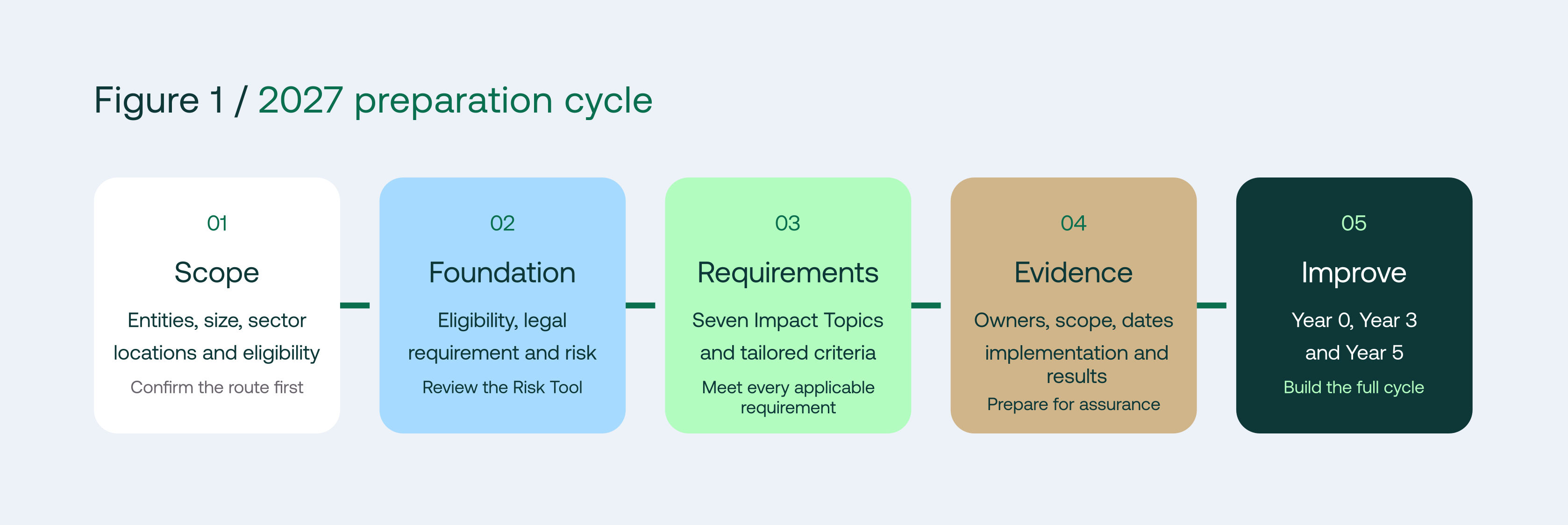
B Lab’s new standards have changed the structure of the certification process. Companies now need to understand their applicable requirements, complete Foundation Requirements, gather precise evidence and prepare for independent assurance.
The process requires more than completing a questionnaire. It asks companies to show how their policies operate, how risks are managed and how improvement is embedded across the business.
For sustainability leads managing this work alongside operations, human resources, procurement or compliance, the main challenge is prioritisation. The organisation needs to know which requirements apply, where the gaps are and which decisions need leadership support.
We support B Impact Assessment preparation, gap analysis, evidence development and action planning for mid- market organisations operating across European markets. Our current internal service profile records more than 600 sustainability projects completed since 2018 across 13 sectors.
B Lab’s current standards include seven Impact Topics:
• Purpose and Stakeholder Governance
• Climate Action
• Human Rights
• Fair Work
• Environmental Stewardship and Circularity
• Justice, Equity, Diversity and Inclusion
• Government Affairs and Collective Action
Companies must also meet Foundation Requirements covering eligibility, the legal requirement and risk profiling. The specific requirements depend on factors such as company size, sector, location, structure and risk profile. [1]
B Lab published the new standards, V2.0, in April 2025. V2.1 followed in August 2025, while V2.2 was published on 20 February 2026. [2]
Companies preparing for 2027 should confirm the requirements assigned to them directly in B Impact. Older assessment summaries may not reflect the requirements generated for the company’s current size, sector or risk profile.
The new model also changes how companies should think about performance.
The previous system relied on a cumulative score. Strong performance in one area could offset weaker performance elsewhere.
The current model is requirements based. Companies need to meet every applicable requirement assigned to them across the seven Impact Topics and Foundation Requirements.
Strong performance in one Impact Topic does not offset an unmet applicable requirement in another.
The Risk Tool forms part of Foundation Requirement FR3.
This is a 14 question risk profile for Small companies and larger. Micro companies are exempt, with further exemptions applying to companies without workers. [3]
The tool asks companies questions about potentially risky practices that may not be addressed elsewhere in the standards.
Depending on the responses, additional due diligence requirements may be added to the assessment. The risk profile may also be published on the company’s public B Corp profile. [3]
This creates an important preparation priority. Companies should review the Risk Tool early and gather the information needed to answer accurately.
The Foundation Requirements also cover eligibility and the legal requirement. Companies should check whether their governing documents reflect stakeholder governance and whether their activities create eligibility questions under FR1.
Begin by confirming the legal entities, locations, activities, company size, sector and risk profile included in the assessment.
Scope decisions influence the requirements generated for the company. They also affect the evidence needed for the assessment and the issues discussed during the audit.
The size category is based on both workforce and revenue. B Lab uses six size categories. Micro companies have 1–9 full-time equivalent (FTE) workers or under USD 2 million in annual revenue. Small companies have 10–49 FTE or USD 2 million to under 10 million. Medium companies have 50–249 FTE or USD 10 million to under 75 million. Large companies have 250–999 FTE or USD 75 million to under 350 million. X Large companies have 1,000–9,999 FTE or USD 350 million to under 1.5 billion. XX Large companies have 10,000 or more FTE or over USD 1.5 billion. A separate category also applies to companies without workers.
A company’s workforce and its revenue can point to different categories. When they do, the lower of the two determines the company’s track. For example, a company with 65 workers falls into the Medium category by workforce. With USD 100 million in revenue, it falls into the Large category by revenue. It is therefore assessed as Medium. Revenue thresholds are set in US dollars, so companies reporting in other currencies need to convert their figures.
Assign an owner to every applicable sub requirement.
Finance may own selected metrics. Human resources may own worker evidence. Procurement may own supplier practices. Legal and compliance may review governance, claims and risk controls.
The sustainability lead should coordinate the process without becoming the sole owner of every requirement.
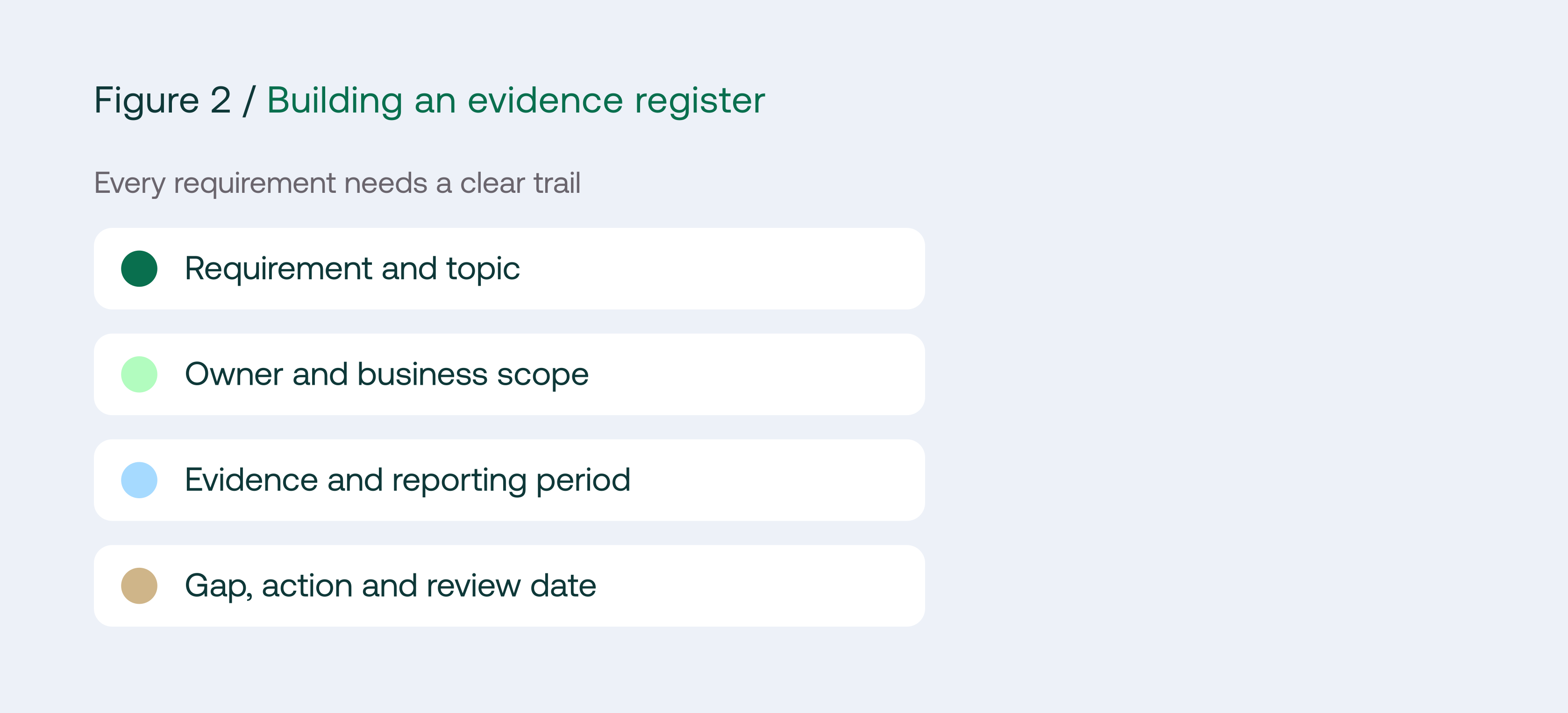
An evidence register should connect each requirement to:
• The responsible owner
• The relevant policy, process, record or report
• The entity, site or worker population covered
• The reporting period
• The approval or review date
• The exact page, section or data source
• The remaining action required
B Lab expects companies to provide evidence that demonstrates how they meet the applicable requirements and compliance criteria. [4]
A policy alone rarely explains how a practice operates.
Strong evidence should show implementation, responsibility, scope, review and results. It should also make clear whether the evidence applies across the entire assessment scope.
Our article, How to become a B Corp: A closer look at the B Impact Assessment, provides further context on assessment preparation and documentation.
An inaccurate scope can affect the requirements generated for the company.
It can also create inconsistencies between the assessment, evidence, legal entities, brands and audit discussions.
Review the scope before assigning work across the organisation. Escalate questions about acquisitions, operating locations, business activities and legal structures early.
The scoping decision also affects the company’s size category and the number of applicable requirements.
A company may have policies covering human rights, fair work, climate or responsible procurement.
The assessment still requires evidence that the processes mentioned in these policies operate in practice.
Look for training records, approval trails, performance data, internal reviews, corrective actions and examples of decisions influenced by the policy.
B Lab identifies missing information, irrelevant documents, weak mapping and practices that are not embedded in the business as common documentation problems. [4]
A general sustainability report may contain relevant information. It may still fail to address the specific compliance criteria.
Each document should explain why it has been submitted. Add a short note identifying the relevant page, section, metric, timeframe and scope.
This makes the evidence easier to review. It also helps the internal owner understand what remains incomplete.
Some gaps require funding, changes to incentives, revised governance, procurement decisions or product changes.
The sustainability team cannot resolve every gap independently.
Create an escalation route for decisions that affect policy, resources, risk or public claims. This protects the preparation timeline and improves accountability.
The new certification model includes audit findings and corrective actions.
A corrective action plan should address the immediate issue and the underlying cause. It should also identify an owner, timeframe, action and evidence of implementation.
A document created for the audit will have limited value if the underlying practice remains unchanged.
B Lab’s current guidance covers B Corps with recertification due dates in 2026 and 2027.
For B Corps that are not affected by the Empowering Consumers for the Green Transition Directive, B Lab states that the completed self- assessment should be submitted as soon as possible. The final submission date is the company’s current recertification due date. [5]
Companies affected by the Directive have additional considerations. B Lab’s guidance includes specific pathways and deadlines for companies using B Corp claims in business to consumer communications within the European Union.
Companies should review the latest B Lab guidance and obtain legal advice for questions about their own claims and markets.
The new certification model introduces a five year cycle:
• Year 0 supports initial certification.
• Year 3 introduces additional requirements and a further review.
• Year 5 leads into recertification and a new cycle.
• Surveillance audits may take place during the cycle, particularly for medium and larger companies.
B Lab describes the certification cycle as a process of continued improvement rather than a single assessment event. [6]
This changes the preparation mindset.
The objective is no longer to complete one assessment and then close the project. Companies should build management practices that support continued improvement throughout the certification cycle.
Internal teams can coordinate the assessment when they have clear ownership, reliable documentation and enough time for cross functional review.
External support becomes valuable when the preparation involves complexity or material gaps.
A consultant can help when the company:
• Has several legal entities, operating sites or business activities
• Needs an independent gap analysis before submission
• Has limited internal sustainability capacity
• Needs to coordinate evidence across several departments
• Has significant climate, human rights, fair work or environmental gaps
• Needs support with corrective action planning
• Faces a tight recertification or audit deadline
Our B Corp certification service supports organisations with readiness reviews, gap analysis, evidence collection, action planning, audit preparation and recertification.
The support should produce practical outputs. These may include an evidence register, prioritised roadmap, action owners, implementation support and audit preparation.
The value of external support is especially clear when the organisation needs to connect several workstreams.
The Butternut Box case study shows how a company used a gap analysis and roadmap to prepare against the new standards, close priority gaps and prepare for a full day certification audit.
The project mapped requirements across Year 0, Year 3 and Year 5. It also addressed priority gaps in materiality, human rights, JEDI and public sustainability communication.
A consultant cannot replace implementation or influence an independent assurance provider.
The value lies in helping the organisation understand the requirements, close genuine gaps and present evidence clearly.
Validate the scope, company size, risk profile, legal requirements and certification timing.
Check eligibility, the legal requirement and Risk Tool obligations before estimating the evidence workload.
Work from the requirements assigned to the company in B Impact.
Avoid relying on older checklists or generic summaries.
Create one evidence register covering all Impact Topics.
Classify each gap according to the action required: document, metric, process, operating change or leadership decision.
Ask whether the practice operates consistently across entities, sites, workers, suppliers and relevant business activities.
Review the evidence as an independent auditor would.
Focus first on gaps that affect several requirements or create significant stakeholder risk.
Climate data, human rights due diligence, fair work, stakeholder governance and environmental monitoring may require sustained implementation.
Plan beyond the initial submission.
Understand which improvements relate to Year 0, Year 3 and Year 5. This creates a practical roadmap for the full certification term.
Evidence prepared for the B Impact Assessment can also support wider sustainability work. Structured policies, actions, results and supporting documentation can strengthen preparation across reporting and rating processes.
The B Impact Assessment in 2027 will require preparation that connects standards with business practices.
Companies need accurate scope, accountable owners, precise evidence and management systems that operate beyond the assessment window.
The latest B Lab Standards introduce further requirements around risk, eligibility, implementation and continuous improvement. Companies preparing now should review the latest assigned requirements rather than carry forward assumptions from previous assessment cycles.
The strongest preparation supports more than certification. It can help organisations move from compliance to positive impact through clearer decisions, stronger accountability and sustained improvement.
Contact Nexio Projects experts for more information!
• The latest B Lab Standards version currently available is V2.2, published in February 2026.
• V2.0 was published in April 2025, followed by V2.1 in August 2025.
• Companies should confirm their scope, Foundation Requirements and Risk Tool obligations before planning the work.
• The current model requires companies to meet every applicable requirement assigned to them.
• Existing B Corps with 2027 recertification dates should follow B Lab’s current submission guidance.
• A five year certification cycle makes long term improvement planning more important.
• Consultant support is most useful when preparation involves complex structures, limited capacity or material gaps.
[1] B Lab. Explore the B Lab Standards. Accessed October 2026.
[2] B Lab Knowledge Hub. FAQs: Updates to B Lab Standards, Release of V2. Accessed October 2026.
[3] B Lab Knowledge Hub. Managing Negative Impacts through Foundation Requirement. Accessed October 2026.
[4] B Lab Knowledge Hub. What kind of evidence does my company need to share to verify on the new standards?. Accessed October 2026.
[5] B Lab Knowledge Hub. Guidance for all B Corps due to recertify in 2026 and 2027. Accessed October 2026.
[6] B Lab. Certifying on the New B Lab Standards: How Your Company Can Lead the Way in 2026. Accessed October 2026.
[7] Nexio Projects. How to become a B Corp: A closer look at the B Impact Assessment. Accessed October 2026.
[8] Nexio Projects. B Corp certification. Accessed October 2026.
[9] Nexio Projects. Butternut Box: B Corp assessment and a sustainability roadmap. Accessed October 2026.
[10] Nexio Projects. B Corp Lunch + Learn: B Corp Standards 2.1. Internal presentation, October 2026, slides 6 to 11 and 17.