 2022 Update on The New CSRD
January 13, 2022


Many organisations face sustainability information requests without a direct legal obligation to publish a report. Customers request ESG data during tenders. Banks and investors assess sustainability risks. Parent companies need information for group reporting.
Organisations may also have moved out of CSRD scope after regulatory changes. Others were never in scope, yet still face growing expectations from customers, investors, and lenders. The reporting decision therefore requires business judgement. [1][2]
The focus has shifted from understanding requirements to navigating context. Organisations increasingly ask whether a parent company’s report covers its subsidiaries. They also want to know whether one data set can support several stakeholder requests. [1]
Several market drivers continue to influence this decision.
And in a live poll during our recent webinar, 60% of participants named customer requests as their single biggest reason to report — a clear signal that, for most organisations, reporting begins because someone in the value chain asks for it. [1]
Voluntary sustainability reporting means publishing information about sustainability performance, impacts, risks, or opportunities against a recognised reporting standard without a direct legal reporting obligation. Quite often, people confuse reporting standards with other frameworks, ratings, and disclosure platforms.
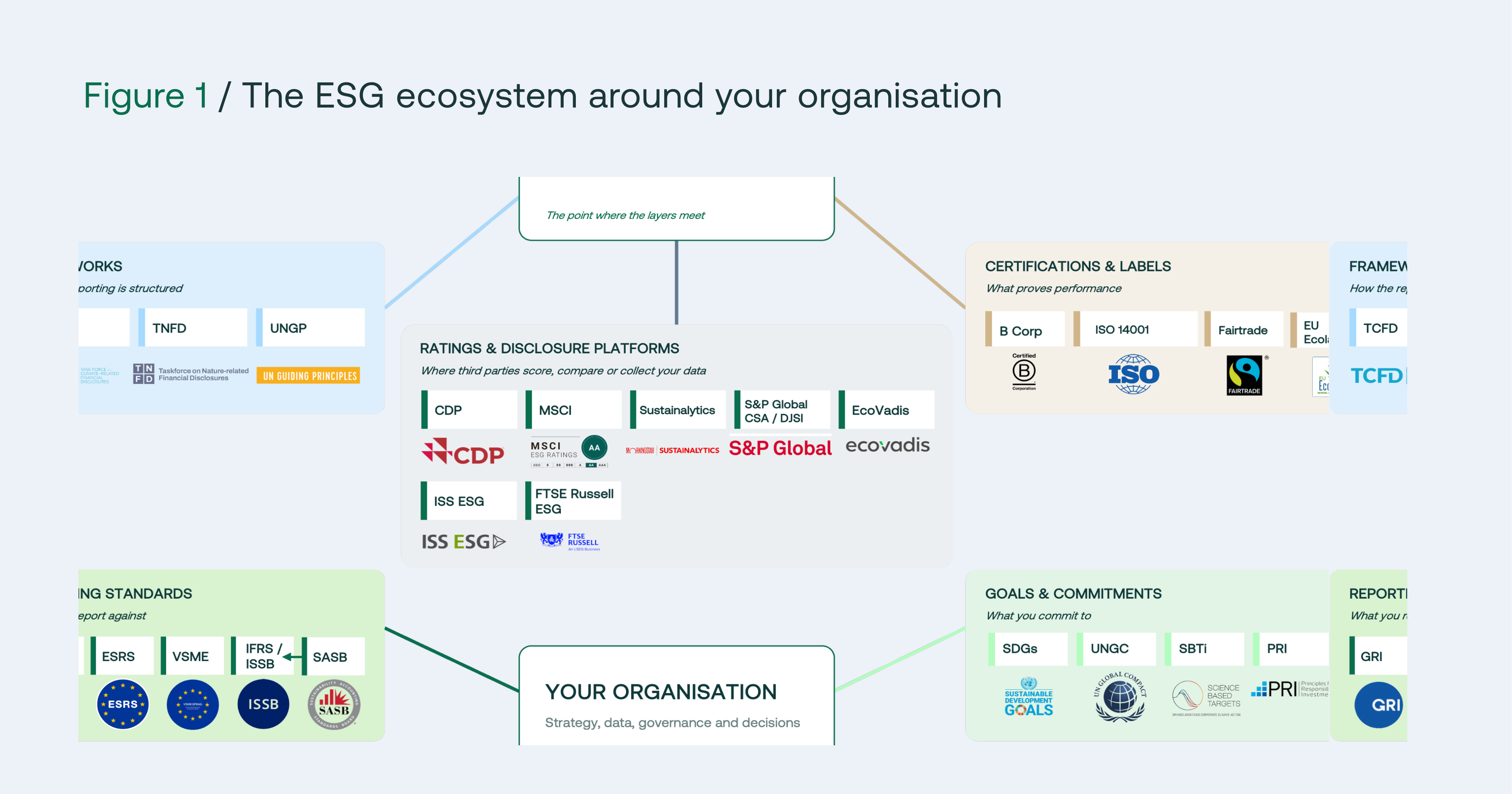
Standards define what an organisation reports. Frameworks provide the methodology and help shape how the reporting is structured. Ratings and disclosure platforms assess or collect information. Goals, commitments, certifications, and labels serve different purposes.
The organisation sits at the centre of these layers. The organisation’s strategy, governance, data, and decisions feed into all the layers of this ecosystem – reporting standards, ratings, commitments, and certifications. Get the centre right, and everything else becomes much easier.
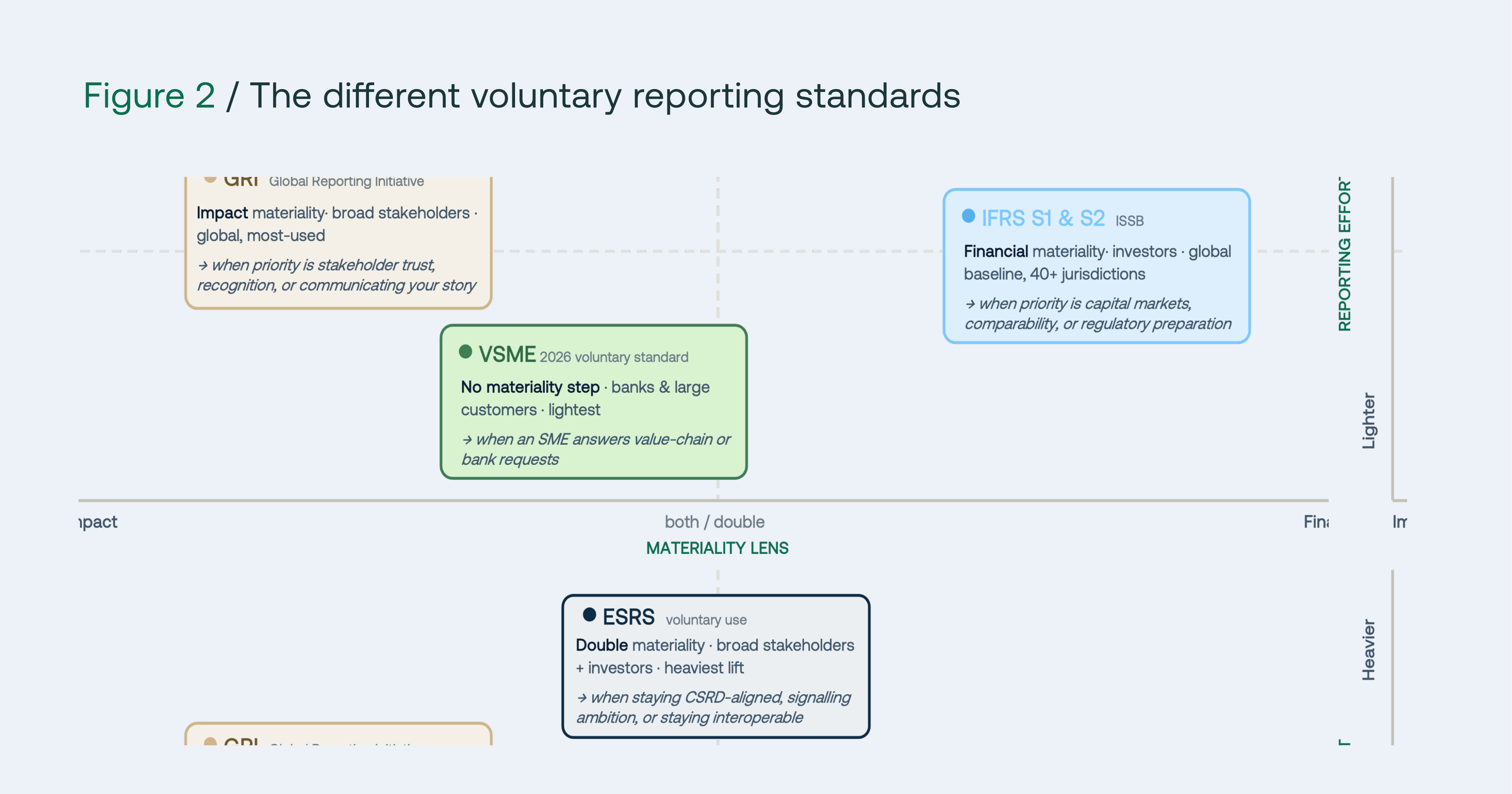
Four main standards provide different routes for voluntary sustainability reporting. Each has a different materiality lens, stakeholder focus, reporting effort, and strategic purpose. [1][2]
The Global Reporting Initiative focuses on an organisation’s impacts on people, the environment, and the economy.
GRI uses an impact materiality lens. It is designed for broad stakeholder communication, including employees, customers, investors, communities, and civil society.
The standard has universal, sector, and topic standards. Organisations can report “with reference to” GRI or “in accordance with” GRI. The second approach requires a more complete application of the relevant requirements. [1][2]
GRI is suitable when an organisation wants to explain its sustainability story, strengthen stakeholder trust, or communicate its impacts through a recognised global standard.
VSME was designed to help smaller organisations respond to sustainability information requests from customers, banks, and investors.
In 2026, the standard moved onto a firmer legal footing: alongside the revised ESRS, the European Commission adopted the SME as a revised voluntary standard (2026), embedding VSME in EU law through a Delegated Regulation while keeping its use entirely optional. The practical effect is a stronger shield rather than a heavier burden — under the Omnibus package, companies below the 1,000-employee mark can decline sustainability data requests that go beyond what VSME asks for.
The underlying architecture of the standards didn’t change. It still includes a Basic Module and a Comprehensive Module. The Basic Module applies to micro organisations with fewer than 10 employees. Organisations with more than 10 employees use the Comprehensive Module alongside the Basic Module. [1][2]
The standard contains 147 data points across both modules. It uses predefined disclosures and does not require a formal materiality assessment. [2]
VSME is suitable when an organisation needs a structured and credible answer at proportionate effort. It can reduce the work required for a specific stakeholder request.
The standard can also support a longer sustainability journey. Organisations can begin with available information, improve data quality, and expand reporting as expectations develop.
Our article on how VSME can support an ESG reporting strategy provides further context on proportionate reporting and future readiness.
The European Sustainability Reporting Standards use double materiality. Organisations consider both their impacts on people and the environment, and the financial risks and opportunities that sustainability matters create for the business.
The revised 2026 ESRS contains approximately 300 data points according to the presentation materials. The current version and applicability should be verified before publication. [2]
Organisations may use ESRS voluntarily when they want to remain closely aligned with CSRD. This might be relevant considering the current CSRD scope may change in the future, the organisations not in-scope now may grow in size and move closer to the scope threshold, or simply that the stakeholders expect more comprehensive information on both impacts and risks & opportunities.
For additional context, read our latest guide to the revised ESRS and our introduction to the ESRS framework.
IFRS S1 and S2 use a financial materiality lens. They focus on sustainability related risks and opportunities that may affect enterprise value, financial performance, and access to capital.
IFRS S1 covers general sustainability related risks and opportunities related to all ESG topics. IFRS S2 focuses specifically on climate related disclosures, including transition plans, climate risks, governance, strategy, and much more. [1][2]
More than 40 jurisdictions are moving towards adoption or implementation of IFRS S1 and S2. The precise status varies between jurisdictions – some have already made it mandatory, some are in the process of adopting them, while others have adopted them on a voluntary basis. [1][2]
IFRS S1 and S2 are more relevant to organisations with strong investor, lender, or capital market reporting needs.
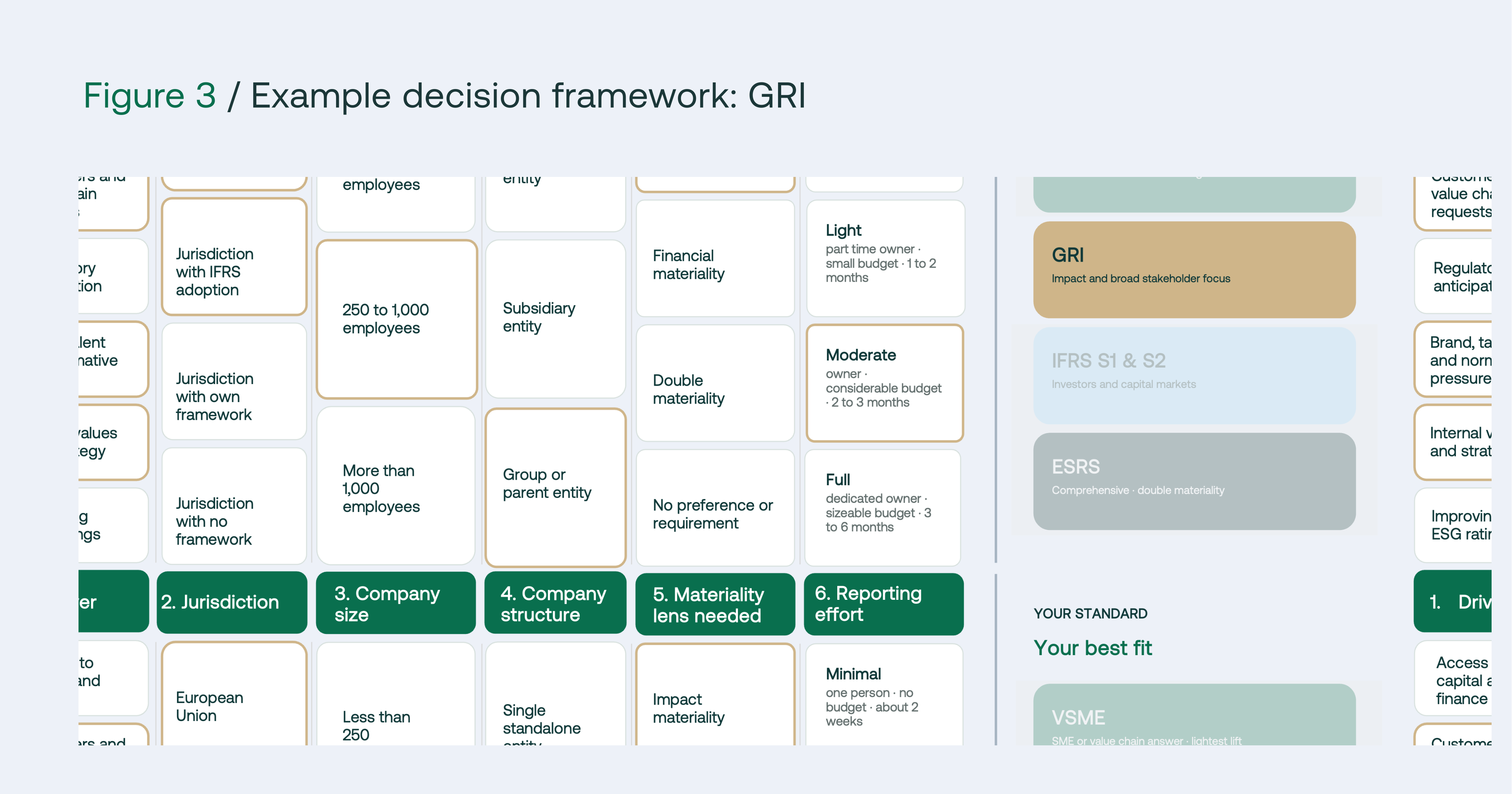
In practice, the decision to choose between the standards should consider these main 6 parameters:
VSME may suit a small organisation answering a customer or bank request. GRI may suit a company seeking broad stakeholder recognition. IFRS S1 and S2 may suit an organisation focused on investors and capital markets. ESRS may suit a company seeking comprehensive reporting and double materiality. [1][2]
What’s important to note is that these standards overlap with one another on several aspects so it doesn’t always have to be a choice between one or the other. GRI and ESRS share strong alignment as the impact side of ESRS was build on GRI foundations. Similarly, the financial side of ESRS share a great deal of alignment with IFRS S1 and S2 .
VSME is a proportionate subset of ESRS, which makes it a genuine stepping stone to ESRS reporting in the future. The same bridges run in the other direction: because VSME draws on the ESRS architecture, much of what you gather for a Basic or Comprehensive Module, governance, workforce metrics, energy and Scope 1–2 emissions, maps directly onto GRI’s topical standards and onto the climate and governance disclosures IFRS S1 and S2 expect.
The right reporting standard depends on the organisation’s circumstances. Company size, stakeholder expectations, group structure, reporting ambition, and available resources all shape the most effective route.
The examples below show how organisations can use different standards for different purposes. They also demonstrate how existing reporting foundations can support future requirements, even when regulatory scope changes. [1][2]
The first example involved a chemicals and polymer compounds company with approximately 570 employees and eight production sites.
The group reported under CSRD and ESRS. Two large subsidiaries chose to report under GRI at entity level.
The subsidiaries wanted to communicate their own progress, targets, and case studies to specific stakeholders. GRI provided a more engaging format for that purpose.
Key takeaway: When one stakeholder drives the request, the reporting framework should match the ask, with VSME often providing the most efficient route to a recognised answer. [1][2]
The second organisation was a Dutch manufacturer with approximately 150 employees and one production site.
The company received a specific investor request. The investor wanted defined ESG targets presented through an internationally recognised standard.
VSME provided a credible and structured answer at proportionate effort. A broader reporting standard would have required more work without adding value against that specific request.
Key takeaway: When one stakeholder drives the request, the reporting framework should match the ask, with VSME often providing the most efficient route to a recognised answer. [1][2]
The third organisation had approximately 200 employees and six sites across Europe.
Its reporting drivers included improving its EcoVadis performance, answering customer requests, and developing an internal ESG strategy. The organisation was also part of a larger group that reported under CSRD.
The company used VSME alongside an impact materiality assessment. The assessment helped identify relevant topics, strengthen the report, and support strategic decision making.
The approach supported the parent company’s CSRD reporting. It also contributed to an EcoVadis Gold result.
Key takeaway: An impact materiality assessment can make VSME more strategic and defensible, strengthen group reporting, and support stronger EcoVadis performance. [2]
The fourth organisation had approximately 700 employees and more than 10 entities across Europe and the United Kingdom.
The company had initially prepared for CSRD. It completed a materiality assessment, an ESRS gap analysis, and initial data collection before moving outside mandatory scope.
The organisation used its existing foundations to produce a GRI report. The double materiality assessment identified more impacts, risks, and opportunities than a VSME report could fully capture.
The organisation then planned to expand towards IFRS S1 and S2, preparing for the upcoming UK Sustainability Disclosure Standards. This reflected its international structure, investor needs, and interest in future reporting developments. [2]
Key takeaway: Completed CSRD preparation and a double materiality assessment retain value because interoperability allows organisations to build on their foundations and adapt their reporting route. [1][2]
Reporting standards define the disclosures an organisation reports. Frameworks provide the methodology and structure behind those disclosures.
For example, TCFD influences climate related reporting within ESRS and IFRS standards. Organisations should distinguish the reporting standard from the framework that supports its application. [1]
Yes. An organisation can publish a voluntary report, align it with a recognised standard, and include future goals without external validation.
External review can strengthen confidence in the information. It may also support ESG ratings or help substantiate sustainability claims.
Public claims require particular care. Consumer facing organisations may face increased scrutiny when communicating sustainability performance. [1]
A topic can be material for one subsidiary and less material at group level.
Entity level materiality assessments should feed into the group assessment. The group must still consider the topic within the context of its wider size, activities, risks, and financial position. [1]
A subsidiary can use a separate report to communicate its own sustainability story.
GRI can provide a suitable structure for entity specific impacts, targets, progress, and case studies. The parent company’s CSRD report can address consolidated reporting requirements. [1][2]
The subsidiary should begin by clarifying the stakeholder request. It should then assess the parent report, existing data, materiality work, and additional information needed for its own audience.
Voluntary reporting is becoming more contextual. The reporting decision must reflect the organisation’s stakeholders, structure, strategy, jurisdiction, and available resources.
As Cilia Keser, Managing Partner at Nexio Projects, stated:
“We’re really looking from a requirement perspective to more contextual perspective, which showcases also that increase of complexity that comes to play.”
We are an international sustainability consultancy dedicated to guiding organisations on their journey from compliance to positive impact. We support materiality assessments, reporting gap analyses, standard selection, report writing, and reporting implementation.
We have guided 400+ clients across more than 1,000 projects in over 20 countries. [2] Recognised as a boutique ESG and sustainability strategy leader by Verdantix and one of the best ESG consultancies in the Netherlands by Consultancy NL, we are here to help you choose a reporting route that fits your organisation and stakeholders.
Contact our team to discuss your reporting journey.
References
[1] Nexio Projects. Voluntary reporting unpacked: VSME, GRI and beyond. Transcript. August 2026.
[2] Nexio Projects. Voluntary reporting unpacked: VSME, GRI and beyond. Slide deck. August 2026.
[3] Nexio Projects. Unlocking VSME: Boost your ESG reporting edge. August 2025.
[4] Nexio Projects. Revised ESRS: The latest updates for CSRD reporting and beyond. August 2026.
[5] Nexio Projects. Understanding ESRS: A guide to companies’ reporting framework. January 2025.
[6] Nexio Projects. The strategic guide for sustainability reporting. September 2025.