

 Best CSRD consultants in Europe: Choose your best fit
April 23, 2026


“The biggest mistake mid-market teams make is waiting until they have a perfect process. A documented, consistent starting point is worth more than a sophisticated system that does not exist yet.”
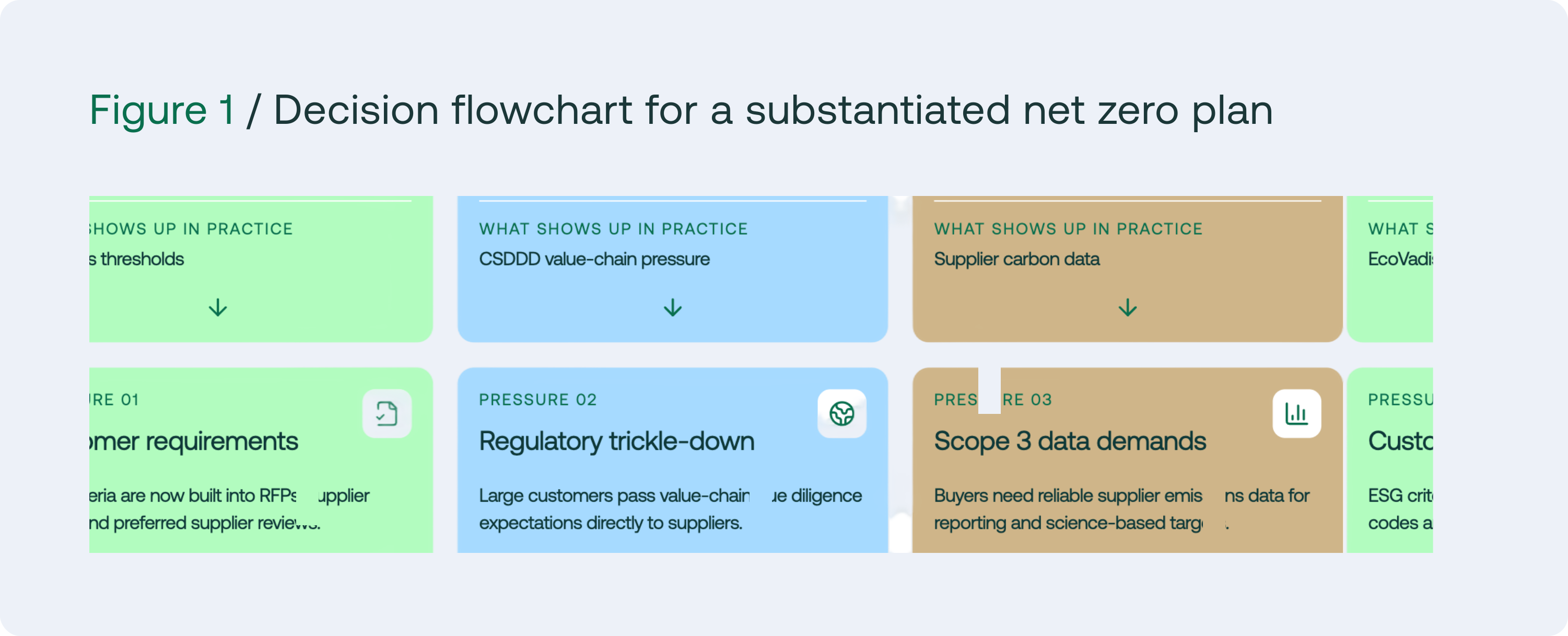
The pressure to address supplier sustainability is no longer confined to large multinationals. Mid-market companies, typically those with 200 to 2,000 employees, are now receiving sustainability requirements from their largest customers as a standard condition of doing business. RFPs include EcoVadis score thresholds. Contracts reference supplier codes of conduct. Scope 3 reporting questionnaires arrive from procurement teams upstream.
The challenge for many mid-market sustainability and procurement leaders is that these demands are arriving faster than their organisations can respond. Resources are limited. The sustainability function is often one person managing multiple roles. The question of where to start remains genuinely unanswered.
This article sets out a practical starting framework built for the reality of mid-market companies, with limited teams and real deadlines.
Three forces are converging to make sustainable procurement a priority for mid-market companies, regardless of sector.
The first and most important step in building a sustainable procurement programme is understanding which sustainability risks and impacts are actually material to your supply chain. Selecting a tool or writing a policy before completing this step produces activity without direction.
Every company purchases differently. A manufacturing business buying raw materials, chemicals, and logistics services faces different sustainability risks from a software company buying IT infrastructure and professional services. A company sourcing from high-risk geographies carries different labour and human rights exposure from one buying entirely from EU-based suppliers.
A basic materiality mapping exercise, covering your spend categories, your suppliers’ industries and geographies, and the sustainability risks associated with each, gives you the foundation for a proportionate programme. It tells you where to focus first and prevents limited resources from being spread across the entire supply base simultaneously.
This mapping does not need to be complex. A spend analysis by category, combined with a risk overlay using publicly available tools such as EcoVadis risk intelligence resources or sector-specific guidance, is enough to produce a working priority list [3].
Start with what you know. Pull your procurement data and segment suppliers by spend, category, and geography. Identify the top 20% by spend. This tier typically accounts for 80% of your procurement risk and impact.
For each supplier segment, ask three questions:
The intersection of high risk and high influence is where your programme starts. These are the suppliers you engage first, assess most carefully, and invest most in developing.
Mid-market companies rarely have the bandwidth to manage hundreds of supplier relationships with equal intensity. A tiered approach works well: deep engagement with the top 20% and a lighter-touch requirement for the rest. It is both realistic and defensible to customers and auditors.
Once you know which suppliers to prioritise, you need a clear picture of where they stand on sustainability. A supplier sustainability assessment builds that picture systematically across the four areas that matter most: environmental practices, labour and human rights, ethics and anti-corruption, and sustainable procurement.
For mid-market companies already receiving EcoVadis requests from their own customers, this is the moment to assess your suppliers using the same framework. EcoVadis covers the four themes that matter most for responsible sourcing, evaluating over 21 criteria tailored to each supplier’s specific industry, size, and geography [3]. Running your own buying programme through EcoVadis gives you verified data, a standardised framework, and the beginnings of a defensible programme record [4].
For suppliers not yet on EcoVadis, a structured self-assessment questionnaire covering the same four themes is a workable starting point. The goal at this stage is a consistent baseline you can act on and improve over time.
A sustainable procurement programme needs three policy documents to be credible:
Read more on supplier due diligence in our blog.
Making the requirements operational is what separates a policy from a programme. The governance, communication, and review cadence turn static documents into a working system.
For priority suppliers, this means sending the supplier code of conduct, requesting acknowledgement or signature, and initiating an assessment through EcoVadis or a comparable framework. For lower-priority suppliers, a simple declaration of compliance is a reasonable starting point.
Set a realistic target for year one: a completion rate across your top supplier tier, a baseline score distribution, and a list of suppliers where corrective action is needed. Review progress quarterly. Report results to leadership. Connect the data to your own EcoVadis assessment under the Sustainable Procurement theme, which is the area where companies most commonly score below their potential [3].
As Nexio Projects’ guide on supply chain emissions sets out, the supplier engagement data that feeds your sustainable procurement programme also feeds your Scope 3 Category 1 calculations. For companies also working on their carbon footprint, the investment delivers twice the value [5].
Sustainable procurement for mid-market companies is about building something documented, proportionate, consistently applied, and capable of improving over time. That shift, from having no programme to having a credible baseline, is the most impactful step any mid-market company can take on its sustainability journey.
The organisations that start now, ahead of the next major customer requirement and before the next tender includes a minimum EcoVadis threshold, build durable capability. Those that wait find themselves responding under pressure instead.
Nexio Projects is an international sustainability consultancy dedicated to guiding organisations on their journey from compliance to positive impact. Their mission is to provide expert support across strategy development, ESG ratings, climate solutions, and comprehensive sustainability reporting. Ultimately, Nexio Projects helps their clients achieve their sustainability goals with a pragmatic, step-by-step approach.
Recognised as the best ESG consultancy in the Netherlands in 2025 by Consultancy NL and as a Top Brand in sustainability by EUPD, we are here to help you build a sustainable procurement programme that fits your organisation’s reality.
Ready to take the first step? Book a discovery call with the Nexio Projects team to discuss where your programme stands and where to focus. And to go deeper on connecting supplier engagement to your Scope 3 targets, download the supply chain emissions guide.
[1] EcoVadis and Accenture. Sustainable Procurement Barometer 2026. https://ecovadis.com/insights/barometer/ Accessed May 2026.
[2] European Commission. Corporate sustainability due diligence — Directive 2024/1760, entered into force 25 July 2024. Omnibus simplification package (COM(2025)80, February 2025) proposes: transposition by 26 July 2027; first application from 26 July 2028; full application 26 July 2029. Subject to formal adoption by European Parliament and Council. https://commission.europa.eu/topics/business-and-industry/doing-business-eu/sustainability-due-diligence-responsible-business/corporate-sustainability-due-diligence_en Accessed May 2026.
[3] EcoVadis. Medals and badges: levels, criteria and meaning. https://ecovadis.com/suppliers/ecovadis-medals-and-badges/ Accessed May 2026.
[4] Nexio Projects. Improve supply chain transparency with EcoVadis. https://nexioprojects.com/improve-supply-chain-transparency-with-ecovadis/ Accessed May 2026.
[5] Nexio Projects. Supply chain emissions: Unlocking supplier engagement for net zero. https://nexioprojects.com/knowledge-centre/supply-chain-emissions-unlocking-supplier-engagement-for-net-zero/ Accessed May 2026.
[6] Nexio Projects. Strong supplier due diligence with EcoVadis IQ Plus and beyond. https://nexioprojects.com/strong-supplier-due-diligence-with-ecovadis-iq-plus-and-beyond/ Accessed May 2026.


