A guide to carbon offsetting
April 26, 2022


New data reveals a clear performance gap between procurement teams that engage suppliers on decarbonisation and those that delay.
Your suppliers emit, on average, 21 times what you do. New analysis from EcoVadis and BCG puts upstream Scope 3 emissions at 21x Scope 1 and 2 combined, based on 746 corporates with third-party-verified emissions data. For most manufacturers, distributors, and consumer goods businesses, Scope 3 Category 1 (purchased goods and services) accounts for 40 to 70% of the total carbon footprint. The implication for procurement teams is direct: decarbonisation targets cannot be met by managing internal operations alone.
The EcoVadis x BCG Carbon Action Report 2025, based on data from more than 133,000 carbon ratings across 83,000 companies worldwide, quantified the performance gap precisely. Companies that engage their suppliers on climate action are nine times more likely to hold a science-based Scope 3 target and be on track to deliver it than those that do not. Yet only one in three companies engages suppliers at all, only 11% collect primary emissions data, and just 4 in 100 have gone as far as partnering with suppliers on joint reduction activities. The highest-leverage action available is also the least contested.
For a supply chain director managing customer EcoVadis thresholds, CSDDD compliance timelines, and internal net-zero commitments simultaneously, this data carries a clear operational message. The action that moves the needle most is the one their competitors are least likely to have started.
The Carbon Action Report 2025 was produced by EcoVadis and Boston Consulting Group (BCG) and published in September 2025. It is the most comprehensive dataset available on supply chain decarbonisation performance.
The report identifies five levers that drive Scope 3 performance. Supplier engagement ranks first. Firms that engage suppliers on ambition and partner with them on joint reduction activities are 9.0 times more likely to hold a science-based Scope 3 target and be on track to deliver it. The next-strongest lever, emissions measurement, scores 4.3 times. Across the 52,467 medium and large firms in the report’s regression cohort, nothing else comes close, and the relationship holds at R² = 0.74 with all p values below 0.005.
The financial context reinforces the urgency. By 2030, unmanaged Scope 3 exposure could generate over $500 billion in annual liabilities globally, equivalent to 15 to 20% of EBIT for S&P 500 companies. The same report finds that half of supplier emissions can be abated at or below $76 per tonne of CO₂e, the EU ETS benchmark, and one-third for less than $12 per tonne. Every tonne left in place is a tonne exposed to carbon pricing by 2030. That exposure is where the 3–6x return comes from: not cash savings, but cost avoided.
The EcoVadis Sustainable Procurement Barometer 2026, produced with Accenture and published on 13 May 2026, reinforces this picture from the buyer side. Surveying 1,000 global multinationals and nearly 2,000 suppliers, it found that 54% of procurement leaders cite Scope 3 management as a top-three strategic priority today. Risk and compliance still anchor the business case for most organisations — but the leaders have already moved past it. Among the top 10% of performers, 80% now cite innovation rather than compliance as the primary driver of programme ROI, against just over half of other companies. The era of ambition is over. Execution is now the differentiator.
Despite the data, execution remains uneven. 30% of suppliers still provide no carbon emissions data whatsoever to their buyers. Only 48% of buying organisations have visibility into the ESG practices of the majority of their Tier 1 suppliers, and Tier 2 visibility drops sharply from there.
Three failure modes stand out in practice. Sending the same long questionnaire to every supplier regardless of risk tier generates survey fatigue and low-quality responses. Setting minimum EcoVadis score thresholds without capacity-building support produces a compliance box tick without underlying improvement. Running engagement as an annual exercise rather than a continuous management process creates gaps that accumulate silently.
The root cause is structural. Most procurement teams lack the internal capacity to engage dozens or hundreds of suppliers individually with personalised guidance on improvement priorities. For a practical guide on how supplier-side support connects to Scope 3 reduction commitments, see Nexio Projects’ guide on supply chain emissions and supplier engagement for net zero.
For procurement teams also managing supplier risk alongside decarbonisation, the structured supplier due diligence programme, using EcoVadis IQ Plus or other implementation programmes, provides a contactless risk mapping layer that integrates directly with engagement prioritisation.
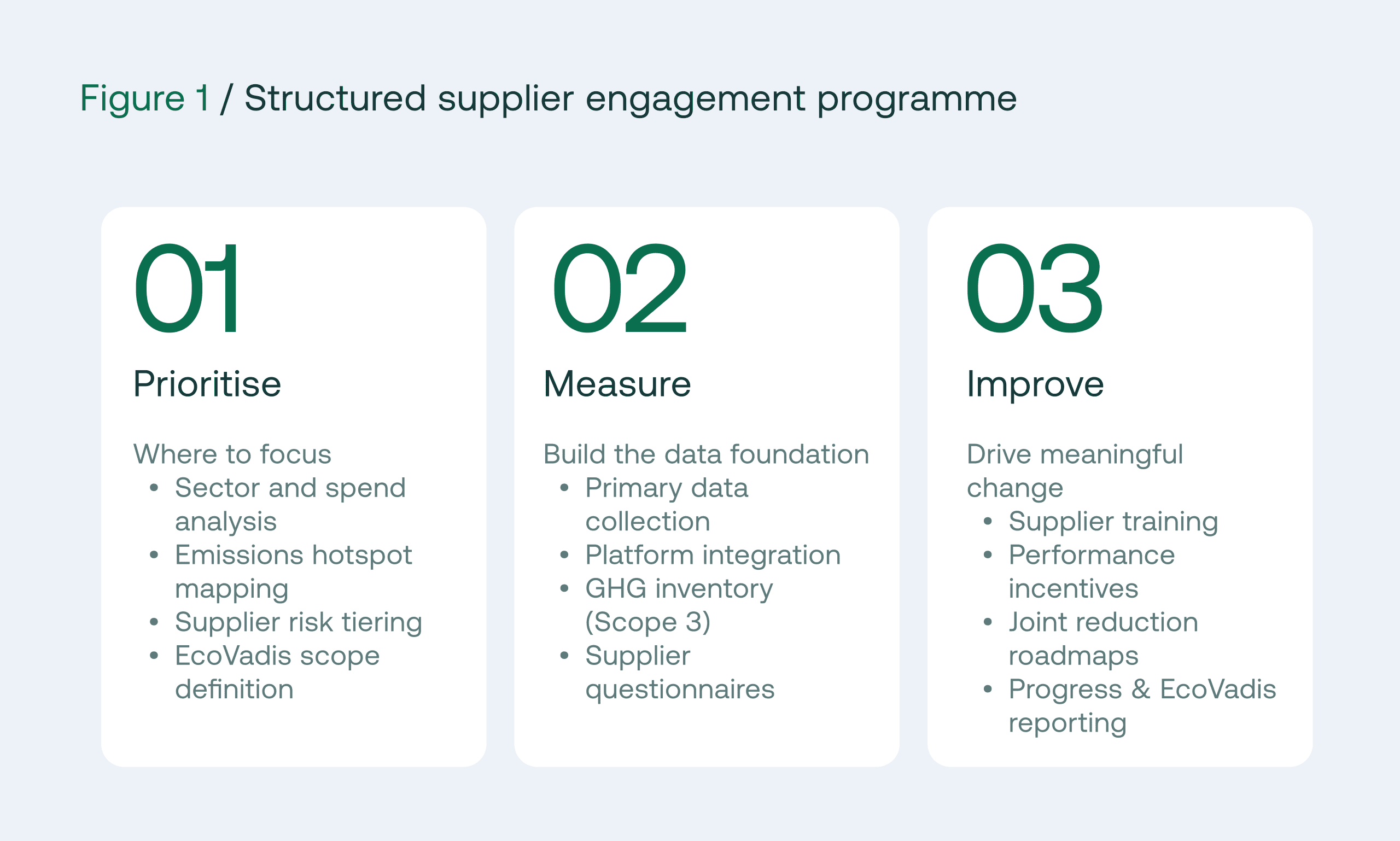
A structured supplier engagement programme for Scope 3 reduction has three components: prioritisation, measurement, and improvement.
This is where EcoVadis supplier engagement for buying organisations delivers structural value. EcoVadis ratings provide a consistent performance baseline across all suppliers, enabling buyers to segment by tier, target capacity-building where it matters most, and track improvement year on year.
CSDDD adds a compliance dimension that procurement teams cannot defer. The EU Corporate Sustainability Due Diligence Directive entered into force in May 2024 and was amended by the EU Omnibus I Directive, which took effect in March 2026. Following those amendments, member state transposition has been extended to 26 July 2028, with phased application of due diligence obligations beginning 26 July 2029.
The commercial pressure, however, is already active. Companies supplying to EU-regulated businesses are already receiving due diligence requests — for emissions data, human rights risk information, and corrective action evidence. Buyers with CSDDD obligations cascade those requirements upstream through contract terms, EcoVadis score thresholds, and Scope 3 data requests. A supplier that cannot provide verified emissions data, or that falls below a buyer’s minimum EcoVadis threshold, faces commercial consequences well before any formal regulatory deadline.
For a full overview of how CSDDD obligations flow through the supply chain, see Navigating the CSDDD: What businesses need to know. For a grounding in Scope 3 emissions measurement and what categories matter most, Nexio Projects’ explainer covers the practical starting points.
Supply chain directors building engagement capability now will have the data, the supplier relationships, and the documented improvement evidence ready when customers and regulators demand it. Those who wait will be building under pressure.
The 9x figure from the Carbon Action Report 2025 is not a projection. It describes what is already happening across the companies in EcoVadis’ global network. The performance gap between structured and unstructured engagement is measurable today, and it widens with every year of inaction.
For procurement teams, the operational path is clear: build the prioritisation framework, shift from spend-based to primary data collection, and pair performance expectations with supplier capability support. Design engagement as a management system with continuous improvement built in — not a one-off annual survey. The companies that act now will retain strategic contracts, meet CSDDD obligations with evidence in hand, and deliver on Scope 3 targets that the rest of the market is still postponing.
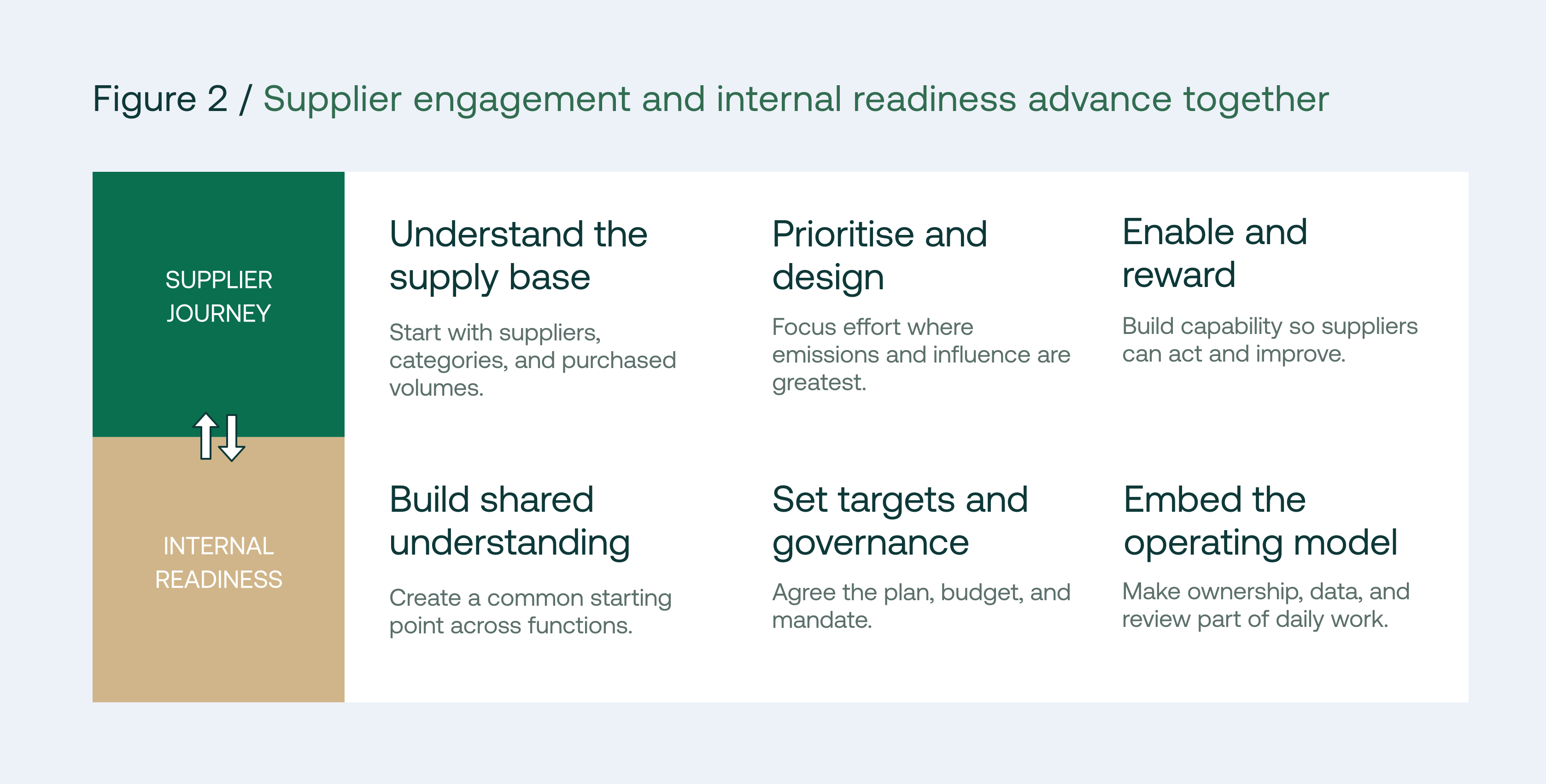
Nexio Projects is an international sustainability consultancy guiding organisations from compliance to positive impact across supply chain due diligence, EcoVadis buying programmes, Scope 3 measurement, and supplier engagement programme design. Recognised as a top European sustainability consultancy by Consultancy EU and among the leading sustainability advisory firms by MT/Sprout’s SD400, Nexio Projects is here to help. Our supplier engagement programme design goes in parallel with your internal readiness, in one coherent process that leaves no gaps as steps move forward.
As the number one global EcoVadis strategic partner with 600+ projects completed, 87% of clients improving their EcoVadis score, and an average improvement of 13.8 points since 2018, Nexio Projects brings proven operational expertise to every supplier engagement programme it designs.
Book a free 30-minute supplier engagement call with one of our procurement specialists. We will review your current supply base coverage, identify your highest-priority Scope 3 categories, and outline what a programme would look like for your sector.
A supplier engagement programme is a structured process through which a buying organisation identifies, measures, and works to reduce its supply chain (Scope 3) emissions in collaboration with its suppliers. It typically includes supplier prioritisation by emissions intensity and spend, primary carbon data collection, training and capacity-building, and defined improvement targets with consistent tracking.
Scope 3 upstream emissions are, on average, 21 times larger than a company’s direct Scope 1 and 2 output. Reducing them requires active supplier collaboration: requesting and validating emissions data, setting minimum performance standards, providing improvement support, and tracking progress over time.
The CSDDD creates due diligence obligations for EU-regulated companies, which cascade requirements upstream through supply chains. Formal application begins 26 July 2029 following member state transposition by 26 July 2028. Commercial requests from buyers are already active today.
Start with your highest Scope 3 categories by spend and emissions intensity, typically Category 1 (purchased goods) and Category 4 (upstream transportation) for manufacturing and FMCG businesses. Cross-reference with spend volume and strategic importance to produce a focused engagement list.
The appropriate threshold depends on your customers’ requirements and your own sustainability commitments. Many large buyers currently set Silver (top 25%) as a minimum for strategic suppliers. Gold (top 5%) is increasingly common for Tier 1 suppliers with high emissions exposure.
[1] EcoVadis and Boston Consulting Group. Scope 3: From Unmanaged Risk to Untapped Opportunity — Carbon Action Report 2025. https://resources.ecovadis.com/whitepapers/carbon-action-report-2025. September 2025.
[2] EcoVadis and Accenture. Sustainable Procurement Barometer 2026: The Era of Execution Has Arrived. https://ecovadis.com/blog/sustainable-procurement-barometer-2026/. 13 May 2026.
[3] McKinsey. Tackling Scope 3 Emissions Through Supplier Collaboration.
[4] DLA Piper / EU Commission. CSDDD Omnibus I amendments. https://commission.europa.eu/topics/business-and-industry/doing-business-eu/sustainability-due-diligence-responsible-business/corporate-sustainability-due-diligence_en