

 How Stolthaven Terminals achieved EcoVadis Gold: Learnings for sustainability leaders
July 7, 2025


“The next reporting cycle will reward organisations that make decisions early and document how those decisions were reached.”
Welcome back to Sustainability in Motion. In this edition, we cover:

EcoVadis questions often look straightforward. The difficult part is understanding what the answer needs to prove.
A policy demonstrates intent. An implemented action shows how that intent works in practice. A result shows whether the approach is producing measurable progress.
EcoVadis describes these as three management pillars: policies, actions and results. Its methodology also considers factors such as activity, size and location. [1] That distinction explains why a signed policy rarely provides a complete answer.
A sustainable procurement policy becomes stronger when supported by supplier coverage data, training records, assigned responsibilities, targets and monitoring results.
A certificate can support evidence when its scope matches the organisation and activities being assessed. A site certificate cannot automatically support group wide claims. [2]
The age of evidence also requires judgement. An older audit report may remain relevant when the system is still in use and the evidence remains representative. It should not be treated as proof of current performance without further context. The assessment rewards connections between commitments, implementation and results.
Our article, EcoVadis assessment: the goalposts have moved, explores these distinctions in greater detail.

The Science Based Targets initiative is moving from Version 1.3.1 towards the Corporate Net Zero Standard Version 2.0. The timing of a submission is central to the decision.
Companies can submit targets under Version 1.3.1 before 1 February 2027. Between 1 February 2027 and 31 January 2028, companies can choose between Version 1.3.1 and Version 2.0. Version 2.0 becomes mandatory for new submissions from 1 February 2028. [3]
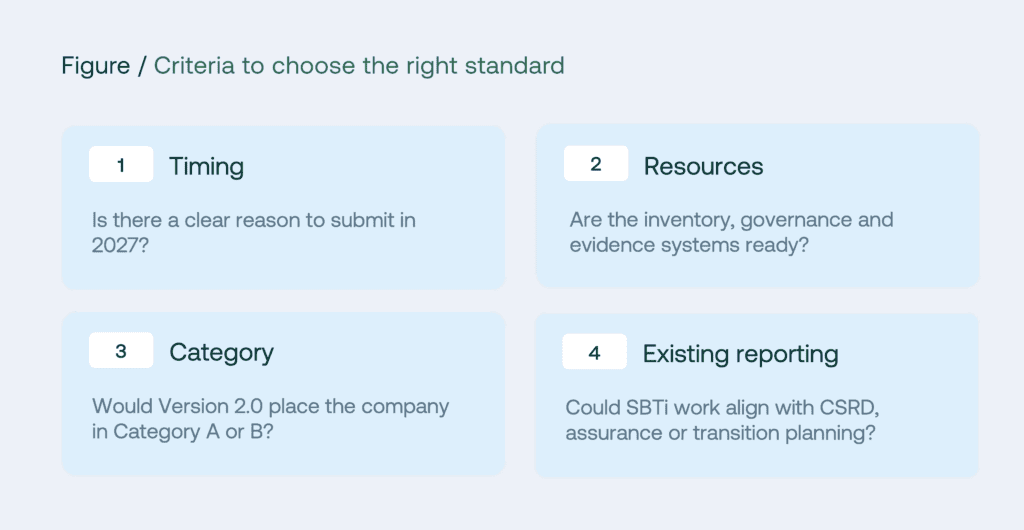
A submission under Version 1.3.1 may be appropriate when the target boundary, base year, emissions data and supporting evidence are ready.
The decision should reflect the actual readiness of the organisation. A rushed submission creates risks that remain after validation.
The applicable submission window should shape the preparation plan.
Companies should review the Version 2.0 requirements early. This reduces the risk of building a data package that requires extensive rework later.
An existing target does not automatically require immediate resubmission.
The organisation should review its target validity, recalculation cycle and changes to its structure or emissions profile.
A major acquisition, divestment or boundary change may create a need to reassess the target.
Internal commitments, public targets and validated science based targets serve different purposes.
The wording should reflect the status of the target. Communication should also explain the boundary, timeframe, reduction pathway and validation position.
The right question is not simply which standard is newest. The decision depends on submission timing, target type, data readiness and governance.
Our SBTi strategy article provides a practical starting point for that decision.
“A climate target becomes credible when the organisation can explain who owns it, how progress is measured and what happens when delivery falls behind.”

Autumn events create useful opportunities for sustainability and procurement leaders to compare approaches.
The conversations are increasingly practical. Organisations want to understand how ESG data supports procurement, resilience, reporting, supplier engagement and commercial decisions.
Nexio Projects will contribute to discussions at Produrable, CPHI Milan and EcoVadis World Tour events in London, Paris, Chicago and Amsterdam.
The themes vary by event. They include supplier sustainability, sustainable procurement, Scope 3, CSRD, CSDDD, ESG data and the return on investment from supplier engagement.
These conversations matter because sustainability performance is increasingly connected with procurement and operational resilience.
A reporting team may own the disclosure. Procurement, finance, operations and commercial teams often own the information and decisions that make the disclosure credible.
The strongest sustainability programmes create shared ownership across those functions.

The revised ESRS delegated regulation has a date of effect of 10 November 2026. It applies to financial years beginning on or after 1 January 2027. [4]
The final standards provide greater certainty for companies preparing future reporting cycles. They also create a practical priority list:
• Confirm whether the organisation remains in scope.
• Confirm the relevant reporting period.
• Review the double materiality assessment.
• Map disclosures to data owners and systems.
• Identify gaps in policies, targets, metrics and governance.
• Build an audit trail for reported information.
The reporting dataset is changing. The underlying management discipline still matters. EFRAG describes the voluntary standard as a proportionate framework for undertakings with fewer than 1,000 employees. It can support organisations responding to customer, lender, investor and value chain requests. [5]
A voluntary framework should still be selected with care. The right choice depends on the reporting audience, materiality lens, available resources and decisions the information needs to support.
Our revised ESRS article explains the practical implications for organisations preparing for the next reporting cycle.
The September agenda points to a wider shift in sustainability work. Assessments, targets and reporting are becoming connected management processes. Companies that organise evidence early will have more flexibility when expectations change.
“The best preparation creates options. It gives teams enough clarity to choose the right standard, improve the right evidence and communicate with confidence.”

We help organisations connect ESG data with reporting, procurement, climate targets and business decisions. Recognised in the top European sustainability consultancy rankings by Consultancy EU and included among the top sustainability advisory firms in the MT/Sprout SD400, we are here to help you prepare for the next reporting and target setting cycle.
[1] EcoVadis. What is the EcoVadis methodology?. Accessed October 2026.
[2] EcoVadis. Understanding your scope of assessment. Accessed October 2026.
[3] Science Based Targets initiative. The Corporate Net Zero Standard Version 1.3.1. Accessed October 2026.
[4] European Union. Commission Delegated Regulation (EU) 2026/1563. Accessed October 2026.
[5] EFRAG. European Commission adopts revised ESRS and Voluntary Sustainability Reporting Standard. Accessed October 2026.
[6] Nexio Projects. EcoVadis assessment: the goalposts have moved. Accessed October 2026.
[7] Nexio Projects. SBTi strategy: which standard to submit in 2027?. Accessed October 2026.
[8] Nexio Projects. Revised ESRS: The latest updates for CSRD reporting and beyond. Accessed October 2026.


