

 Partnering for health: Nexio Projects’ role in EcoVadis’ Sector Initiatives
November 10, 2025


As Romina Coral Andrade, Sustainability Consultant at Nexio Projects states: “There are principle based changes which shift the whole purpose and the whole goal of ESRS aligned reporting more from a compliance angle to a more decision usefulness perspective.”
The revised ESRS changes the way companies need to think about CSRD reporting. The reporting burden may reduce, yet the decisions behind the sustainability statement become more important. [1]
Companies must determine which rulebook applies, which impacts are material, and how their data can support a fair and faithful representation. These decisions affect reporting scope, governance, systems, and assurance readiness. [1]
In this article, we are summarising the key points from our recent webinar, “The new ESRS: First look at the latest updates.”
For wider context, read our article on CSRD updates, timelines, the legislative process, and what comes next.
The post Omnibus reporting landscape has changed. Companies need clarity on who reports, when reporting begins, and which reporting standard applies. [1]
Wave 2 companies are large EU companies with more than 1,000 employees and more than €450 million in EU turnover. These companies are expected to report in 2028 for financial year 2027. [1]
Wave 3 covers third country undertakings with a significant EU presence. The relevant thresholds are more than €450 million in EU turnover and a subsidiary or branch with more than €200 million. The requirement of more than €450 million in EU turnover must be applied for two consecutive years. [1]
The revised ESRS is a simplified version of ESRS Set 1. It reduces the data set from more than 1,000 data points to approximately 350. This represents an approximate 60% reduction. [1]
The reduction does not remove the need for disciplined reporting. The revised ESRS introduces principles related to fair presentation, faithful representation, decision usefulness, materiality, comparability, verifiability, and understandability. [1]
These principles raise the bar for data collection and audit trails. Companies must document definitions, methodologies, controls, and decisions supporting the final sustainability statement. [1]
Our guide on making sense of sustainability reporting in the Omnibus era provides a broader overview of applicability, alignment, and preparation.
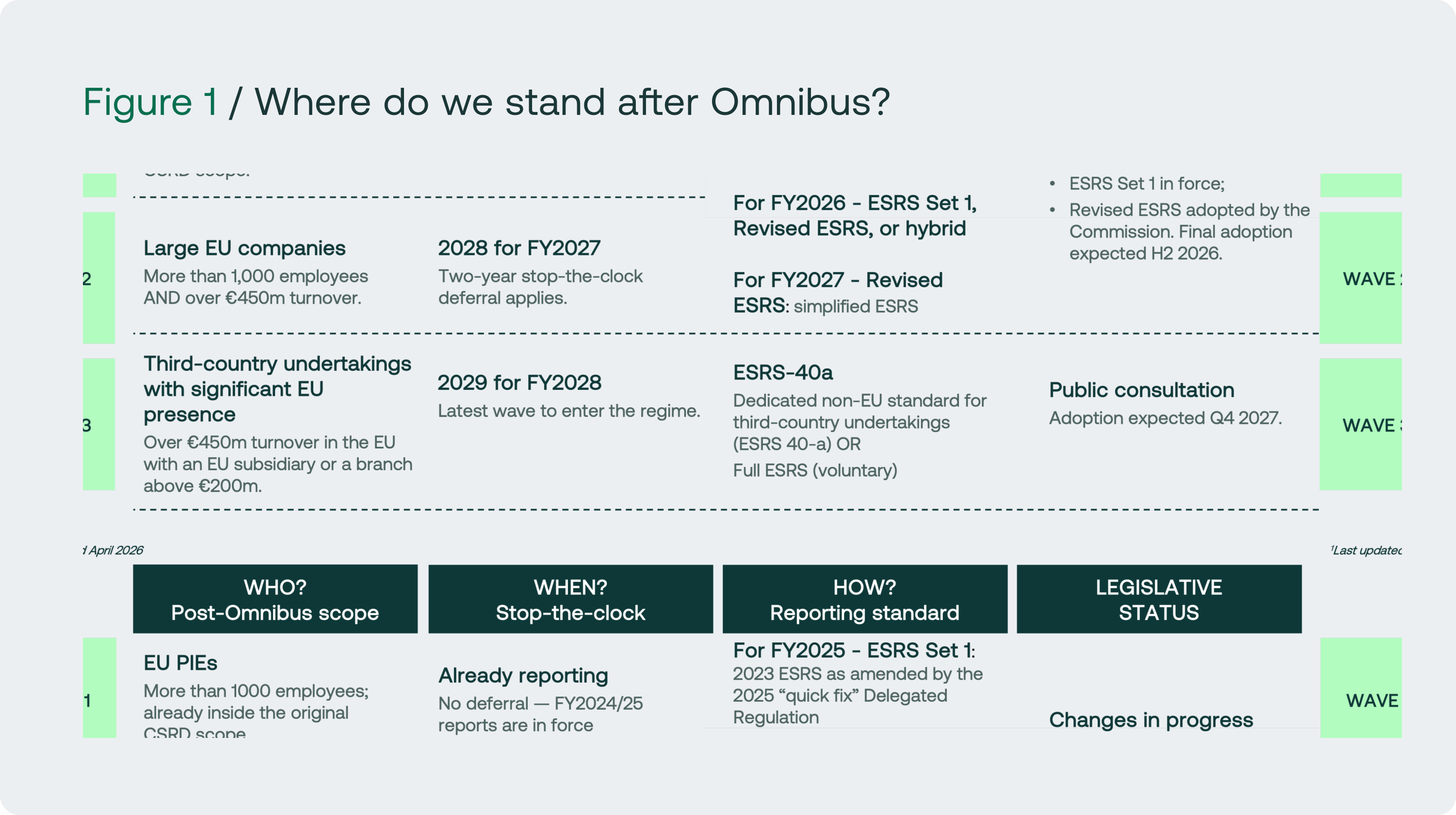
The revised ESRS and ESRS-40a are connected, but they are not interchangeable. [1]
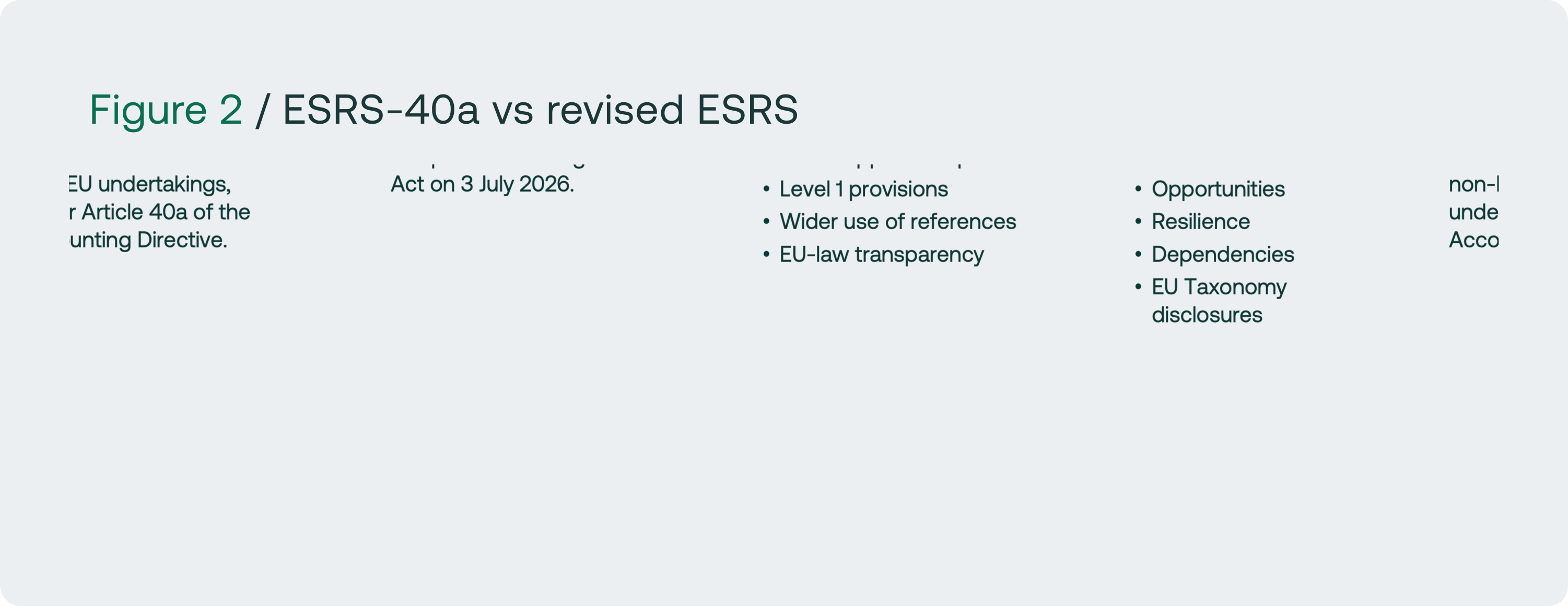
While the revised ESRS applies to companies reporting under the main CSRD framework, ESRS-40a applies to third country groups with a significant EU presence. It provides a proportionate reporting route for groups with substantial EU activities. [1]
ESRS-40a follows the same 12-standard architecture as the revised ESRS, with several simplifications.
The standard focuses on material impacts at the level of the ultimate third country parent. Some elements, including risks, opportunities, resilience, dependencies, and certain EU Taxonomy disclosures, are removed or treated differently. [1]
Three possible approaches are available for groups in scope of ESRS-40a.
The first option is a global ESRS-40a approach. Material impacts are reported globally across the relevant topics.
The second option is a mixed approach. Climate impacts are assessed globally, while other topics may focus on EU related impacts. This approach requires caution because it could undermine fair presentation. [1]
The third option is voluntary adoption of the full revised ESRS. This can create a consistent reporting basis across the group. It may also support subsidiary exemptions when the relevant conditions are met. [1]
The decision concerns the group structure, the parent company location, the scale of EU operations, and the reporting duties of individual subsidiaries.
As Romina Coral Andrade, Sustainability Consultant at Nexio Projects stated: “At this point, it is not just a choice between more or less reporting, it is also a choice about consistency, data architecture, future reporting efforts, and whether the group wants to establish one reporting language across all entities.” [1]
For a plain language introduction to the framework, read Understanding ESRS: A guide to the companies’ reporting framework.
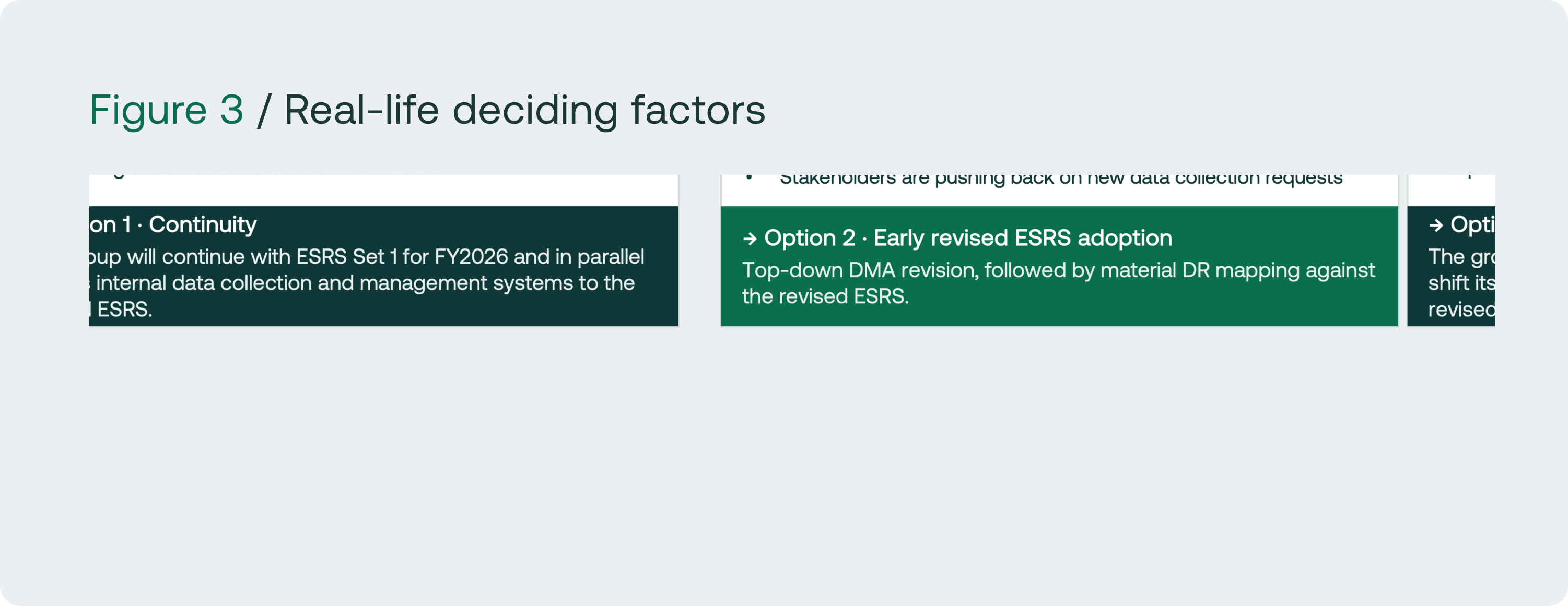
The revised ESRS provides several options for organisations preparing a full ESRS aligned report for FY2026. [1]
Companies can continue with ESRS Set 1, as amended by the 2025 Quick Fix provisions. This may suit groups that have already invested in reporting systems, governance, software, and data collection under the earlier framework. [1]
Continuity can provide time to transition towards the revised ESRS structure during later reporting years.
Companies can adopt the revised ESRS in full for FY2026. This may be appropriate where preparation is still at an early stage and the organisation wants to benefit from the reduced data set and available reliefs. [1]
Early adoption may also suit companies preparing a mock report before their first mandatory reporting year.
The hybrid approach combines ESRS Set 1 with selected reliefs, clarifications, and simplifications from the revised ESRS. The selected approach must be disclosed in the sustainability statement. [1]
The right route depends on the existing reporting infrastructure, data collection maturity, the quality of the Double Materiality Assessment, and the organisation’s group structure.
A company with established systems and two years of data collection may prefer continuity. A company without legacy infrastructure may find early adoption more efficient. [1]
The choice also affects broader ESG reporting processes. Organisations should assess how each route will influence data ownership, internal controls, reporting software, and future assurance work.
The road to full CSRD compliance follows a clear sequence from Double Materiality to reporting.
Double materiality remains the foundation of the CSRD journey. An earlier assessment should be reviewed when it no longer reflects the organisation’s strategy, value chain, or stakeholder expectations. [1]
The revised ESRS supports a top down approach. This starts with the organisation’s sustainability management system, value chain, known hotspots, and strategic direction.
The process then identifies relevant impacts, risks, and opportunities. This approach can reduce unnecessary scoring work while keeping attention on material matters. [1]
Once material topics are confirmed, companies should filter the relevant ESRS disclosure requirements. A topic may contain many data points, while only a proportion applies to the organisation’s material impacts. [1]
Existing metrics collected under ESRS Set 1 must be mapped against the revised ESRS data set. The gap analysis should cover quantitative data, qualitative information, policies, actions, targets, and supplier information.
The next step is operational implementation. Companies need clear data owners, collection processes, controls, and systems. These may include specialised software, spreadsheets, or other internal tools. [1]
A reporting manual can record assumptions, definitions, methodologies, processes, and the reasons behind reporting decisions.
A reporting manual is not an explicit requirement. However, it may become increasingly important for assurance because auditors need evidence supporting fair presentation, faithful representation, and verifiability. [1]
The final output is a sustainability statement within the integrated management report. Any reliefs, omissions, or proportionality mechanisms must be documented and reassessed annually. [1]
Yes, they will need to do that. However, the general consensus is that there is less political pushback and less controversy around the revised ESRS than around the CSRD scoping question.
We do not expect any major changes, but ESRS-40a is still in draft. [1]
EFRAG has published an overview of the ESRS in its knowledge hub. It is a useful interactive resource for understanding the standards.
The approximately 350 data points are based on the ESRS annex that has been published. The exact number may vary depending on terminology, technical interpretation, and the counting method used.
That is why the figure is presented as an approximate 60% reduction and approximately 350 data points. [1]
Yes, the parent is from outside the EU. The requirements also state that the group must have more than €450 million in turnover from activities in the EU at consolidated level.
The group must also have at least one subsidiary or branch with more than €200 million in turnover. These conditions must apply for two consecutive years. [1]
The earlier approach involved a very detailed review of potential impacts, risks, and opportunities. It created a burdensome methodology that relied on extensive interpretation and subjectivity.
The revised ESRS introduces what is referred to as a top down methodology. This starts from a broader strategic perspective and the organisation’s sustainability management system.
Companies can assess whether a matter is relevant from an impact or financial perspective. They can then use a more quantitative approach where uncertainty remains.
If a company understands its value chain, stakeholders, and value chain hotspots, it can identify which matters are relevant to report. This reduces the need to score every possible impact, risk, and opportunity in equal detail. [1]
Yes, the focus is on reporting only what is relevant.
The relevance aspect of the post Omnibus ESRS is strongly emphasised. A sustainability statement should not be filled with information that affected stakeholders or users will not materially use.
There is no need to report information that is not material in the sustainability statement. The work is not necessarily lost, because the information may still be shared publicly.
It should not, however, overshadow the sustainability statement’s information on material impacts, risks, and opportunities. [1]
The revised ESRS changes the practical choices available to companies preparing for CSRD reporting. It also changes the quality expectations attached to the final sustainability statement.
Organisations should assess their reporting route carefully. The right approach depends on the rulebook, group structure, material impacts, existing data systems, and assurance needs.
A reduced data set can support efficiency. It does not remove the need for relevant, accurate, comparable, verifiable, and understandable information.
Dora Cristian, Principal Sustainability Consultant states:
“Each step of the journey builds on the last. If the DMA is weak, everything downstream inherits that problem. That’s the single most common failure we’re asked to fix.”
We are an international sustainability consultancy dedicated to guiding organisations from compliance to positive impact. We support Double Materiality Assessments, ESRS gap analysis, CSRD implementation, and audit ready reporting.
Recognised as the best ESG consultancy in the Netherlands in 2025 by Consultancy NL and a Top Brand in sustainability by EUPD, we are here to connect the needs of business and the planet through a practical sustainability journey. [8][9]
Book a consultation with our team to review your reporting route, Double Materiality Assessment, and next implementation steps.
Subscribe to our newsletter for more updates on ESRS, CSRD and reporting frameworks.
[1] Nexio Projects. The new ESRS: First look at the latest updates. Webinar transcript, 18 August 2026. https://nexioprojects.com/webinars/the-new-esrs-first-look-at-the-latest-updates/. Accessed August 2026.
[2] Nexio Projects. The new ESRS: First look at the latest updates. Webinar slide deck, August 2026. https://nexioprojects.com/webinars/the-new-esrs-first-look-at-the-latest-updates/. Accessed August 2026.
[3] Nexio Projects. CSRD updates: Timelines, legislative process, and what’s next. https://nexioprojects.com/csrd-updates-timelines-legislative-process-and-whats-next/. Accessed August 2026.
[4] Nexio Projects. Understanding the Omnibus package and its potential impact. https://nexioprojects.com/navigating-the-evolving-eu-esg-landscape-understanding-the-omnibus-package-and-its-potential-impact/. Accessed August 2026.
[5] Nexio Projects. Making sense of sustainability reporting in the Omnibus era. https://nexioprojects.com/knowledge-centre/making-sense-of-sustainability-reporting-in-the-omnibus-era/. Accessed August 2026.
[6] Nexio Projects. Understanding ESRS: A guide to the companies’ reporting framework. https://nexioprojects.com/understanding-esrs-a-guide-to-companies-reporting-framework/. Accessed August 2026.
[7] Nexio Projects. DMA in practice: Best practices and common pitfalls. https://nexioprojects.com/dma-learnings-and-best-practices/. Accessed August 2026.
[8] Consultancy NL. Best ESG consultancy in the Netherlands, 2025. https://www.consultancy.nl/rankings/2025/beste-adviesbureaus-van-nederland-per-vakgebied-2025/esg. Accessed August 2026.
[9] EUPD. Nexio Projects: Top Brand in sustainability. https://eupd-group.com/top-brand/nexio-projects/. Accessed August 2026.


