What CDP’s commercial split means for your disclosure and score
June 25, 2026


is how Zuzana Struharova opened the session on 16 June 2026, a live EcoVadis help desk session with practitioners from across Europe and beyond. Ahead of the session, we published answers to every pre-submitted question. But during the session itself, participants raised a second wave of questions. We organised the questions based on your assessment journey once again, which goes:
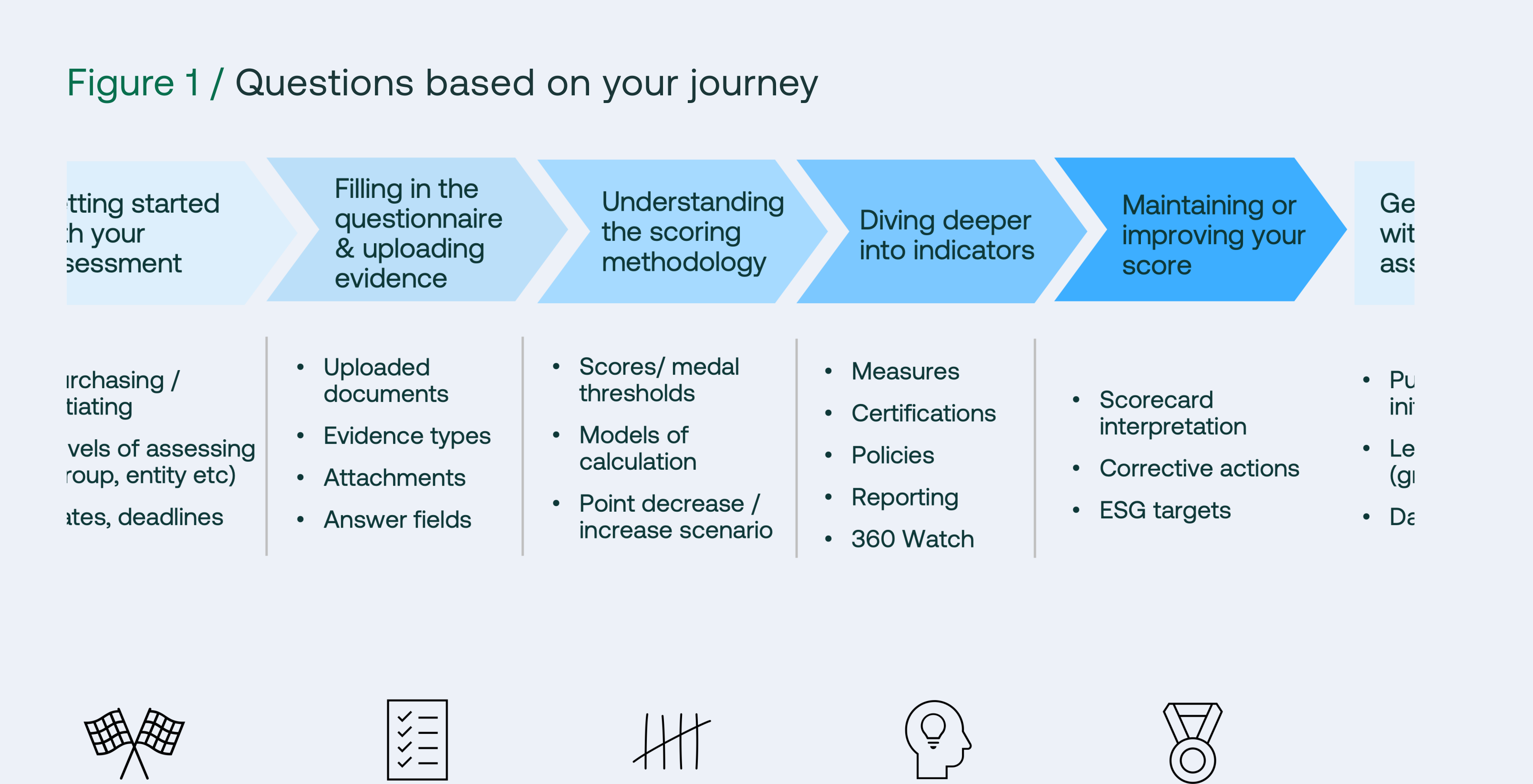
This article addresses those. Each answer draws on Nexio Projects’ experience supporting companies through 600+ EcoVadis assessments across sectors and medal levels.
The anniversary date is not your submission deadline. It is the date your current medal ceases to be valid [1].
The medal is valid for exactly one year from the date EcoVadis published your scorecard. If your scorecard was published on 18 June 2025, your medal remains valid until 18 June 2026 and expires thereafter. Your submission deadline (if you want to have an up-to-date medal) sits several weeks earlier, not on that date.
How far in advance depends on your situation. If you always need a valid medal for customer or tender purposes, aim to submit the new questionnaire one to two months before the anniversary. During busy periods, the review process can take up to three months. Factoring in that window is the safer approach.
The key question to ask yourself is: what happens if there is a gap between your old medal expiring and a new one being issued? If the answer is that a customer contract or tender qualification is at risk, then submit early. If a short gap is tolerable, there is more flexibility. Plan backwards from the outcome you need.
There is no straightforward way to prevent EcoVadis from updating your company’s size, and it happens automatically. EcoVadis determines company size based on the total number of full-time employees, using both publicly available information and the data you provide during account setup [1]. If you cross a threshold, for example from XS to S, the platform will place you into the new bracket.
The practical impact of moving from XS to S is significant. Extra-small companies benefit from a more streamlined questionnaire: fewer questions, a different weighting system, and certain topics that are simply not present. When you move into the S bracket, the questionnaire becomes more comprehensive, and expectations for management system maturity increase. Companies that were comfortably performing at XS level often find the transition to S a genuine shift in scope.
If your employee numbers have genuinely changed, this will be reflected in your next assessment. The best way to manage this is to prepare for the expanded questionnaire requirements in advance rather than being caught off guard when you open the new cycle. If you believe EcoVadis has applied an incorrect employee count, raise this through the support portal before opening the questionnaire.
You can check document age and validity directly in your EcoVadis platform. When you open your assessment and navigate to the Document Library, each document shows its age and how long it remains valid. This is a useful first step before any reassessment.
EcoVadis applies different validity periods depending on the document type:
Beyond age, every document must meet two baseline requirements: it must carry the company name or logo, and it must carry a date so EcoVadis can verify the validity period [2]. A document missing either of these can be rejected regardless of its content.
There is a third requirement that practitioners often underestimate: documents must be genuinely integrated into the company’s sustainability management system and must be issued more than 1 month before the questionnaire submission date. A document created specifically to satisfy the EcoVadis assessment will not work. EcoVadis wants to see evidence of practices that are actually in place.
For the Measures indicator, this means primary evidence of implementation rather than a written description of what was done. If a company ran an energy conservation training, for example, the right documents are the training slides and a participation list showing who attended. If sustainability credits were purchased, an invoice serves as evidence. Standard operating procedures and other materials already used internally day-to-day are exactly what EcoVadis is looking for.
For the Policies indicator, a strong policy document covers four elements: the scope (which entity or group level it applies to), a governance and responsibility mechanism (who within the company owns and reviews the policy), a review mechanism (how often the policy is revisited), and the actual sustainability commitments, both qualitative and, where relevant, quantitative SMART targets.
Creating a new version of a policy is not automatically beneficial. If the existing policy is structurally sound and regularly reviewed, updating the review date is sufficient. Rewriting a policy for the sake of freshness is not necessary.
EcoVadis requires every document to carry an affiliation with the assessed company. This means either a company name or a logo must appear on the document. Without one of these, the document will be rejected. There is no exception to this rule, and our experience at Nexio Projects confirms it: whenever a document carried neither the company name nor the logo, it was rejected.
Internal day-to-day documents, training records, and procedural materials often do not carry the company logo by default. For EcoVadis, that affiliation must be added. The simplest solution is to ensure all internally generated documents are produced on branded templates. Where an external provider issues a certificate or training record, ask them to include the company name in the document. Where that is not possible, a brief cover sheet on company letterhead that names the employee, the company, the training attended, and the date is sufficient to establish the required link between document and entity.
The 55-document limit applies per assessment cycle, not cumulatively [2]. Each time a new questionnaire is opened, the company receives a fresh 55-document allowance for newly uploaded documents.
All documents submitted in previous assessments remain accessible in the Document Library and do not count against the new limit. Previously accepted documents can be reattached to questions in the new cycle without consuming any of the 55-document quota. Only documents uploaded fresh in the new cycle count toward it.
The practical implication is significant: where strong evidence already exists from the previous assessment, reattaching it is almost always the right approach. New uploads should be reserved for cases where evidence has changed or improved, or is being submitted for the first time.
Previously rejected documents are not flagged automatically in the questionnaire interface. However, two tools within the platform help practitioners work through this systematically.
The first is the Corrective Action Plan from the previous scorecard, which identifies improvement areas and signals where evidence fell short or was missing entirely. Working through the CAP before opening a new questionnaire provides a clear initial list of priorities.
The second is the Analysis of Your Answers section, accessible by scrolling down in your published scorecard on the EcoVadis website. This section shows the status of each submitted document for each question, including whether it was accepted. Reviewing this before the reassessment removes the need to open the old questionnaire manually and quickly reveals which questions carried rejected documents, which carried no evidence at all, and which can simply be resubmitted with the same documents.
Combining both tools: the CAP for high-level priorities and the Analysis of Your Answers for document-level detail, gives the most complete picture of where to focus in the new cycle.
Unanswered questions (excluding questions for which you answered negatively e.g. “No” “Don’t know”) are flagged directly in the questionnaire.
We guide you in moving from:
for more details on the process.
The free-text comment field does not interact with the 55-document limit. It sits separately and can be used regardless of how many documents have been uploaded.
Its purpose is narrow but useful: to direct the EcoVadis analyst to specific sections within a document. For policy questions that require a quantitative target, for example, the comment field can point to the exact page or clause where that target appears. For questions about corruption risk assessment involving a confidentiality clause, the comment can indicate where the clause is documented. The analyst uses these contextual references to guide their evaluation.
What the comment field cannot do is provide standalone evidence. Everything material must be in the uploaded documents. The comment should give context to what is already there, not introduce new information. If a claim appears only in the comment box and is not substantiated by a document, it will not be credited.
Keep comments as brief as possible. A precise reference to the relevant section or clause in the document is more useful than a lengthy explanation. The document itself carries the weight of the submission.
A measurable CO₂ reduction, for example a 28% decrease in electricity-related emissions compared to the prior year, can support performance across several sections of the EcoVadis questionnaire.
For the Reporting indicator: the reduction should appear in your sustainability report or annual report as a quantified KPI, expressed as an absolute or percentage figure with a clear reference year and scope boundary (Scope 1, Scope 2 location-based or market-based).
For the Measures indicator: the reduction evidences an implemented action. The document to upload here should describe what action was taken, for example renewable energy procurement, an efficiency investment, or a process change, rather than just the outcome. A project summary, energy audit report, or internal management document describing the implemented measure, with dates and scope, is appropriate.
For the Coverage indicator: the reduction and the underlying action need to demonstrate what percentage of the company’s operations they apply to. A 28% reduction affecting 100% of the company’s electricity consumption is very different from a reduction at one site. Specify the coverage boundary explicitly.
An internally created KPI dashboard for the EcoVadis submission works well here, provided it carries the company name, is dated, and clearly covers the reporting period [2].
Important: the Coverage indicator is only applicable to large companies with 1,000 or more employees.
This is one of the most technically precise questions raised during the session, and it reflects genuine experience with the system. The observation is correct: adding a new KPI with low coverage can lower the Coverage score even as the Reporting score improves.
Here is why. The Coverage score serves as a multiplying factor for both the Measures and Certifications indicator scores, with a minimum threshold of 25. [1]. Coverage measures the extent to which a company’s sustainability practices are deployed across its operations, expressed as a percentage. When a company reports a KPI for, say, 20% of its sites, for example environmental training carried out only at headquarters, that 20% figure enters the Coverage calculation and pulls the average down.
The Reporting indicator evaluates what you have declared and measured. The Coverage indicator evaluates how widely those actions and systems are deployed. They reward different things.
The strategic implication: before adding a new KPI to the questionnaire, confirm the actual coverage figure. If the action or system currently applies to fewer than 50% of the company’s relevant scope, the Coverage benefit will be limited or negative. The better approach is to increase the actual deployment of the action before declaring it, or to focus first on expanding coverage of already-reported KPIs to above 50%, where the scoring mechanics begin to reward the declaration. As long as you have other KPIs per each key sustainability issue, you can take time to increase the coverage of relevant actions.
For companies that have reported KPIs with high coverage and had them externally verified, the maximum coverage score per pillar can reach 100/100. Specifically, if two proxy KPIs both exceed 50% coverage and are assured, they can combine with the bonus provision to reach 100/100 in that pillar [1]. Broad deployment of fewer, well-covered KPIs consistently outperforms a long list of metrics with narrow reach.
Yes, this is a legitimate and commonly used approach, provided the two documents work together coherently.
EcoVadis distinguishes between qualitative objectives (statements of commitment or direction, without a specific numerical deadline) and targets (quantitative goals with an absolute or percentage value and a defined future deadline) [1]. Both contribute to the Policies indicator score. The targets do not need to appear in the policy document itself. They can be in a sustainability report, a standalone climate action plan, or another dedicated document.
What matters is that when EcoVadis analysts review your submission for a given criterion, the combination of documents provides all required elements: the commitment (policy), the governance (who is responsible and what process is in place), and the targets (specific, time-bound, measurable goals). Each document should be uploaded where relevant. Do not assume the analyst will read across documents unprompted. The comment field can help signal that the two documents are meant to be read together.
One important condition: targets must cover at least 80% of the company’s operations to be credited [1]. A sustainability report that includes targets for headquarters only, in a company with significant operations across multiple sites, will not satisfy this threshold.
The VSME (Voluntary SME standard, based on ESRS) is fully recognised by EcoVadis as a valid reporting framework [1].
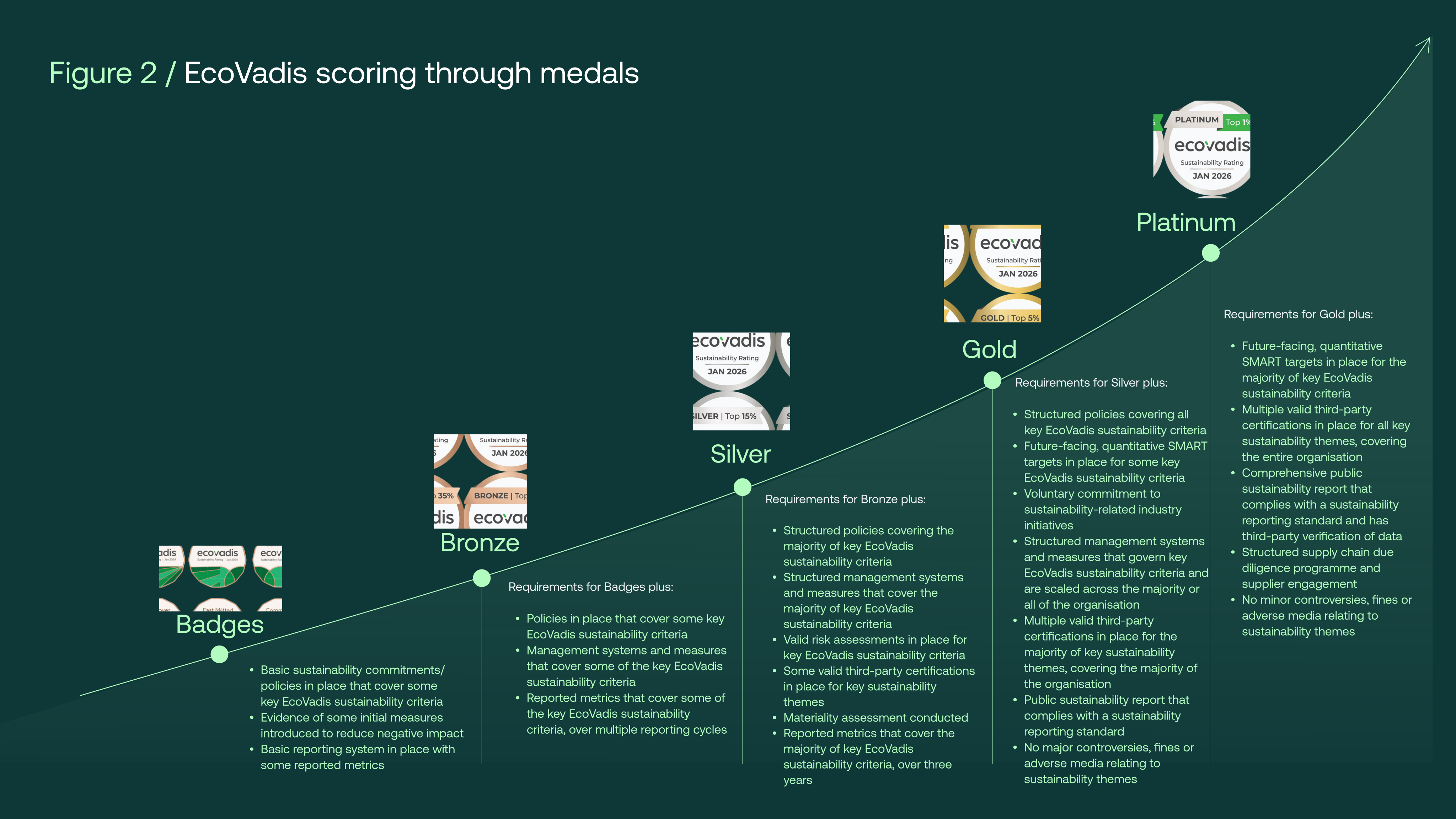
However, the maximum score achievable depends on which module of VSME is used:
VSME being less rigorous than CSRD in terms of disclosure requirements is a fair observation, but EcoVadis does not assess whether your VSME report meets VSME’s own standards. It assesses whether the report includes the specific disclosures and KPIs required by EcoVadis for each scoring level. The conditions to unlock the top reporting score are: a sustainability or annual report, declaration of alignment with a recognised standard (VSME counts), a (Double) Materiality Analysis, and third-party verification of the report [1].
If your organisation is using VSME Basic as its reporting framework and does not yet have external assurance, a maximum of 75/100 is achievable on the Reporting indicator. To reach 100/100, assurance is required regardless of which reporting framework is used. For further context on the reporting standards landscape and CSRD interaction, see the EcoVadis 2026: Your questions answered guide.
The 360° Watch indicator operates primarily as a modifier rather than a direct scoring component. Its neutral position is 75/100 per pillar, meaning that companies with no relevant findings (positive or negative) start at 75/100, and findings adjust that figure up or down [1].
Positive 360° Watch points, scores above 75/100 in a pillar, are possible but rare. EcoVadis monitors external public sources including news media, NGO reports, certifications recognised by their scoring system, and industry endorsements. For the score to move positively, multiple, credible, and independent sources confirming positive ESG outcomes are typically required. A single article or a company-issued press release is unlikely to trigger an upward adjustment.
Concrete activities that can contribute to positive 360° Watch recognition include: receipt of widely recognised sector sustainability awards confirmed in independent media; independently verified ESG certifications outside the standard EcoVadis criteria set; and sustained positive media coverage of specific sustainability initiatives across multiple independent outlets.
EcoVadis does not publish explicit criteria for positive 360° Watch scoring. For this reason, Nexio Projects does not advise companies to actively plan or invest in improving their 360° Watch score as a primary lever. The more reliable path to score improvement remains strengthening the Policies, Measures, and Reporting indicators.
The duration of a 360° Watch finding in your score depends on the type of event, and the rules differ significantly between negative and positive cases.
For negative findings, EcoVadis applies tiered retention periods based on theme and severity [1]:
Once a finding reaches the end of its retention period, it is removed from the score calculation. The clock runs from the date of the underlying event, not the date EcoVadis identified or published it. If a negative corruption event occurred in 2022, it will be cleared from your score by 2029 under the standard 7-year rule, regardless of when it appeared on your radar.
For positive findings, the picture is less transparent. EcoVadis does not publish explicit retention periods for positive 360° Watch events, and the criteria for what triggers a positive adjustment are deliberately opaque. In practice, positive events are treated as current: they contribute to the score as long as the underlying evidence (award recognition, media coverage, or positive certification event) remains recent and independently verifiable. Once that evidence ages or becomes less relevant in EcoVadis’ monitoring sources, the positive effect fades without a defined cut-off date.
The practical takeaway: plan your improvement strategy around the negative clearing timeline if you are carrying a past event, and do not rely on positive 360° Watch adjustments as a predictable score lever. The Policies, Measures, and Reporting indicators offer a far more controllable path to score improvement.
External assurance on a sustainability report is an independent verification process in which a qualified third party reviews your sustainability data, checks it against source records, interviews key personnel, and issues an assurance statement confirming the reliability of the reported information.
The process typically involves three phases: a planning phase (scoping the areas to be assured and the level of assurance to be obtained), a fieldwork phase (document review, data sampling, and interviews), and a reporting phase (the issuance of an assurance statement). For a limited assurance engagement, which is the standard level required for EcoVadis, the full process typically takes between three and six months, depending on the size and complexity of the organisation and the number of indicators being covered [2].
Any independent, qualified third party with relevant expertise in sustainability assurance can provide this. This includes specialist sustainability assurance providers, accredited verification bodies, and mid-tier audit firms with a recognised sustainability practice. The critical requirement is independence: an internal audit does not satisfy the assurance criterion, and a management consultant engagement does not constitute third-party verification.
For KPI-level verification, for example, confirming that 85% of employees completed ethics training, the assurance can be more targeted and does not need to cover the entire sustainability report. A focused, scoped verification of specific KPIs, issued by a qualified independent party, can satisfy EcoVadis’ requirements for the relevant criteria [1].
For reporting questions, external verification must cover all four themes if the company seeks the top reporting score. An assurance statement covering only GHG emissions applies only to the Environment pillar [1].
The Corrective Action Plan (CAP) generated by EcoVadis at the time of scorecard publication is an automated summary of the most significant improvement opportunities identified in the assessment. It is a useful starting point. It is not a comprehensive action roadmap.
The CAP shows the improvements EcoVadis considers most impactful for the current score, but it does not provide granular detail for each finding, nor does it map the full range of actions available across every sub-criterion. Companies that rely solely on the CAP for their improvement strategy often address the visible priority items and overlook a cluster of lower-priority actions that, together, would meaningfully improve the score.
Nexio Projects’ approach builds on the CAP but does not stop there. The Insights Report service conducts a full, criterion-by-criterion review of the scorecard, mapping each scored element to the current methodology requirements. This reveals improvement actions that the CAP does not surface.
For companies working independently: use the CAP as a triage guide to identify the highest-priority items, but supplement it with a methodical review of every activated criterion in the scorecard. For each criterion, ask: what is the maximum score available, what score was achieved, and what specific evidence is missing? This analysis, done systematically, is what drives material score movement. For practical guidance, see How to improve your EcoVadis score quickly.
The CAP is part of the scorecard and is visible to any buyer or partner who has been granted access to your scorecard. Companies cannot selectively hide the CAP while sharing the scorecard.
This is worth managing actively for two reasons. First, buyers who see an open CAP with many unaddressed items may draw their own conclusions about the company’s commitment to improvement, even when those items are already being worked on. Second, the CAP is a point-in-time snapshot from the scorecard publication. It does not update as a company implements changes.
The practical approach: treat the CAP as a communication asset rather than a document shared reluctantly. When a buyer asks about your EcoVadis score, frame the CAP as your live improvement agenda, showing that you know where your gaps are and have a plan to address them. This converts a potential vulnerability into a demonstration of sustainability management maturity.
From a timing perspective, if your company has made significant improvements since your last scorecard, consider aligning your reassessment submission tightly with those improvements so that the new scorecard, when published, already reflects them. The faster you can move from an open CAP item to a resolved one in the next scorecard, the shorter the window in which buyers see an unaddressed gap.
Want to hear the answers in real time? Watch the session on demand!

Nexio Projects is an international sustainability consultancy dedicated to guiding organisations on their journey from compliance to purpose. Our services span EcoVadis assessment support, sustainability strategy development, ESG ratings management, and full-scope sustainability reporting.
With a pragmatic, step-by-step approach, our expert team helps clients move further and faster on their sustainability journey than they would alone. Recognised as a top ESG consultancy in the Netherlands by Consultancy NL and listed in the SD400 2025 top sustainability advisory firms by MT/Sprout, we are here to help you make the most of every EcoVadis assessment cycle.
If your assessment is approaching and these questions resonate with where you are stuck, book a discovery call with our EcoVadis team. We will work through your specific situation and give you a clear view of where to focus.
[1] EcoVadis. EcoVadis CSR Rating Methodology: Scoring Principles. April 2026. Available via official EcoVadis documentation (access through the EcoVadis portal or Accredited Partner support).
[2] EcoVadis. Complete Document Guide for Document Submission. Q1 2026. Available via official EcoVadis documentation.
[3] Nexio Projects. EcoVadis help desk: Your questions answered. https://nexioprojects.com/ecovadis-help-desk-your-questions-answered/
[4] Nexio Projects. EcoVadis 2026: Your questions answered. https://nexioprojects.com/ecovadis-2026-your-questions-answered/
[5] Nexio Projects. How to move from EcoVadis Bronze to Silver in 2026. https://nexioprojects.com/how-to-move-from-ecovadis-bronze-to-silver-in-2026/
[6] Nexio Projects. How to move from EcoVadis Silver to Gold in 2026. https://nexioprojects.com/how-to-move-from-ecovadis-silver-to-gold-in-2026/
[7] Nexio Projects. How to improve your EcoVadis score quickly. https://nexioprojects.com/how-to-improve-your-ecovadis-score-quickly-practical-steps-that-work/