Why you should pay attention to the biodiversity crisis
April 14, 2022


Consider three questions your CFO might ask you tonight. How much is your organisation paying for energy in total, and what will that cost in 2027? What happens to your Scope 2 footprint if GHG Protocol rules tighten? If you are planning new sites, do you already know where they will be powered from?
If any of these is difficult to answer, your organisation is carrying unmanaged risk. And increasingly, that risk sits not just on the sustainability team’s agenda but on the finance director’s.
Energy has moved. Rising electricity prices, AI-driven competition for grid capacity, and an approaching revision to GHG reporting standards are combining to make energy a financial, operational, and regulatory issue simultaneously. David Vázquez, Principal Climate Consultant at Nexio Projects, recently had the opportunity to discuss this with John Powers, who has over 20 years of experience in renewables and advises large corporate and industrial clients on energy strategy globally. Their session produced a clear picture of what is driving the urgency in 2026, and what organisations can do about it.
The question most organisations face is not whether to act on energy. It is where to start. In practice, the companies coming out ahead are doing four things.
They are taking control of long-term price exposure. Short-term hedging in gas and power markets covers one to three years at most. For genuine multi-year certainty, the only viable instrument is a contract with a fixed cost of input. That is the core logic behind renewable energy: wind and solar carry no fuel cost.
They are generating power on site where the economics support it. On-site solar and storage work well for many facility types, but they rarely cover 100% of load for high-density operations such as manufacturing or large distribution facilities.
They are buying clean power early, before competition (e.g. from data centres) makes access significantly harder. The window to secure favourable clean energy contracts is open now, particularly in European markets. It will not remain so.
And they are treating energy procurement as a board-level strategic decision, with executive ownership, early involvement from finance and legal teams, and a clear plan for each operating market. Energy is not a utilities renewal. It is a strategic investment with financial consequences.
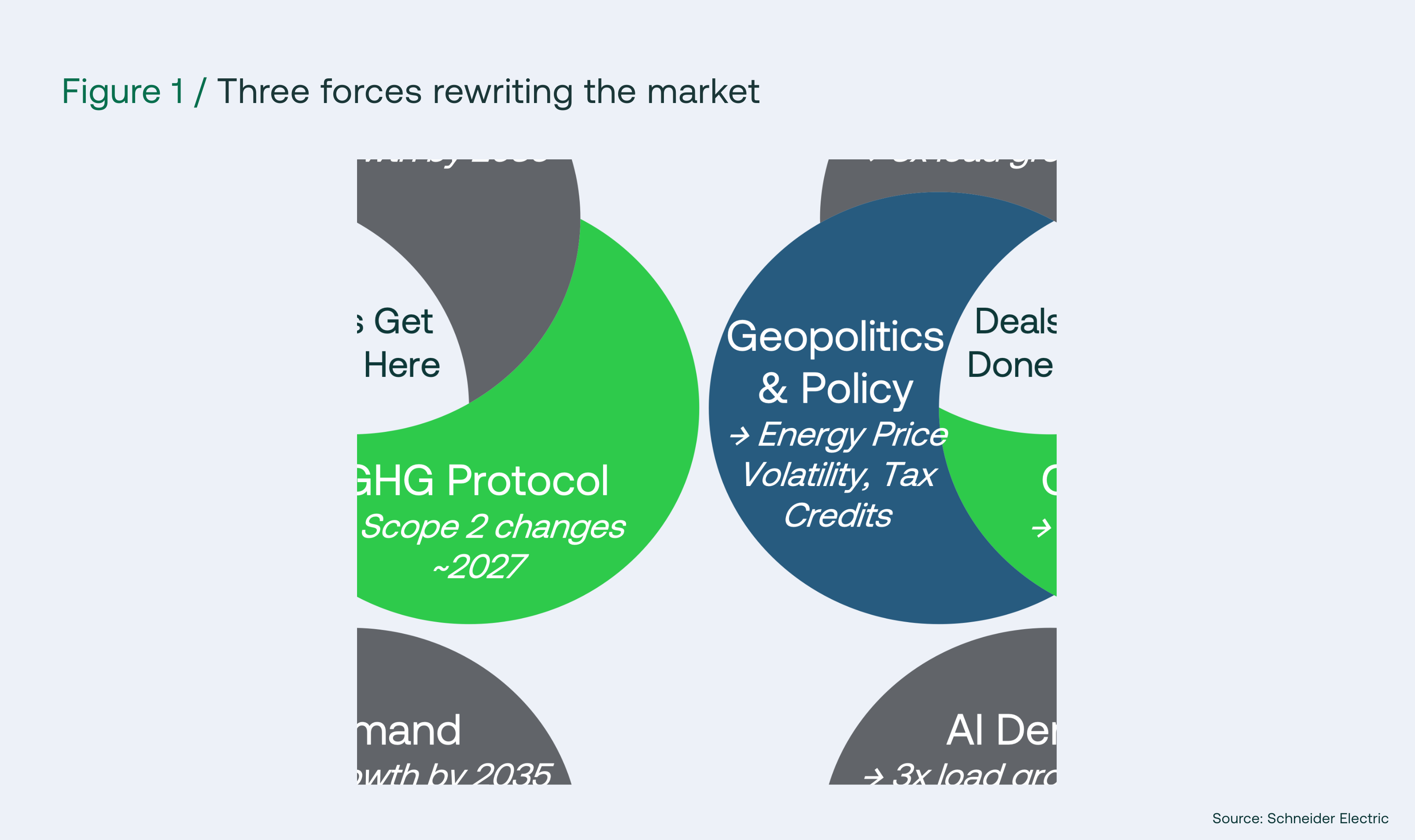
Energy price volatility has always been cyclical. What makes 2026 different is that three distinct forces are amplifying it at the same time.
Geopolitics and policy. Geopolitical conflicts continue to disrupt gas and power pricing across markets. Political uncertainty, in multiple directions, creates price signals that are difficult to plan around on a multi-year basis.
AI demand growth. Data centres are now competing aggressively for electricity in key grid markets. Data centre operators are willing to pay a high price per megawatt hour to stay online, and they are largely price insensitive [1]. That level of demand pushes electricity costs upward for everyone sharing those markets. In 2025, approximately 70% of corporate power purchase agreements signed in the United States were attributed to the data centre sector [1]. Europe is tracking the same trajectory, running roughly two years behind.
GHG Protocol changes. The GHG Protocol is revising its Scope 2 accounting guidance, with final publication expected by end of 2027 [2]. Among the changes under discussion: renewable energy certificates may need to be matched to electricity consumption on an hourly basis and within the same geographic market. Under current rules, a single pan-European power purchase agreement generates certificates applicable across multiple countries. That flexibility may be significantly narrowed. As John Powers noted during the session: “There is a window of opportunity now to execute transactions ahead of the main thrust of the AI demand and GHG Protocol changes” [1].
For organisations ready to act, the main instruments are well established.
PPAs are long-term offtake contracts, typically 10 to 15 years, at a fixed price with a wind or solar project. Where the contract price sits below the traded forward price for power, the buyer locks in a saving. The developer uses the offtake to secure project financing, meaning the organisation’s contract directly enables new renewable capacity to be built. That additionality claim matters for companies reporting against science-based targets.
The European PPA market is currently favourable for buyers. A period of lower power prices has created supply from developers, and competition from hyperscalers has not yet reached the intensity seen in the United States. Active markets include Germany, Spain, Italy, Eastern Europe, Finland, and the Nordics [1]. John Powers was direct on this point: “We are at a really key golden moment right now where there are a lot of good projects at really attractive prices in a variety of different markets.” That moment will not persist as European data centre demand matures.
For organisations that lack the load volume or credit rating to sign a PPA individually, aggregated procurement programmes allow companies to pool demand, accessing utility-scale contracts that would otherwise be out of reach [1].
These offer a different trade-off. They do not hedge electricity price exposure, but they lock in Scope 2 reduction claims ahead of potential GHG Protocol changes. For organisations whose primary concern is compliance certainty rather than price hedging, this is a lower-complexity starting point.
These remain the logical first action for most operations. The economics are strong in many markets, and the installation pathway is well established. The practical limitation is coverage: on-site generation works best as a complement to off-site procurement rather than a substitute for it.
Selecting the right combination depends on load profile, geography, credit position, and risk appetite. It is rarely an either/or decision — and getting that combination right is exactly where structured advisory support makes the difference between a well-designed strategy and an expensive misstep.
For most organisations, the largest share of energy-related emissions does not sit within their own operations. As a general benchmark, 70 to 90% of an organisation’s carbon emissions footprint is shaped by its suppliers [1]. For companies that have assessed their full Scope 1, 2 and 3 emissions, the dominance of Scope 3 is rarely a surprise.
Addressing energy in your own operations is the right place to start. But supplier engagement is essential to meaningful progress at scale. Organisations that build clean energy requirements into procurement contracts, and actively support their suppliers to meet them, reduce their own Scope 3 exposure and build supply chain resilience at the same time.
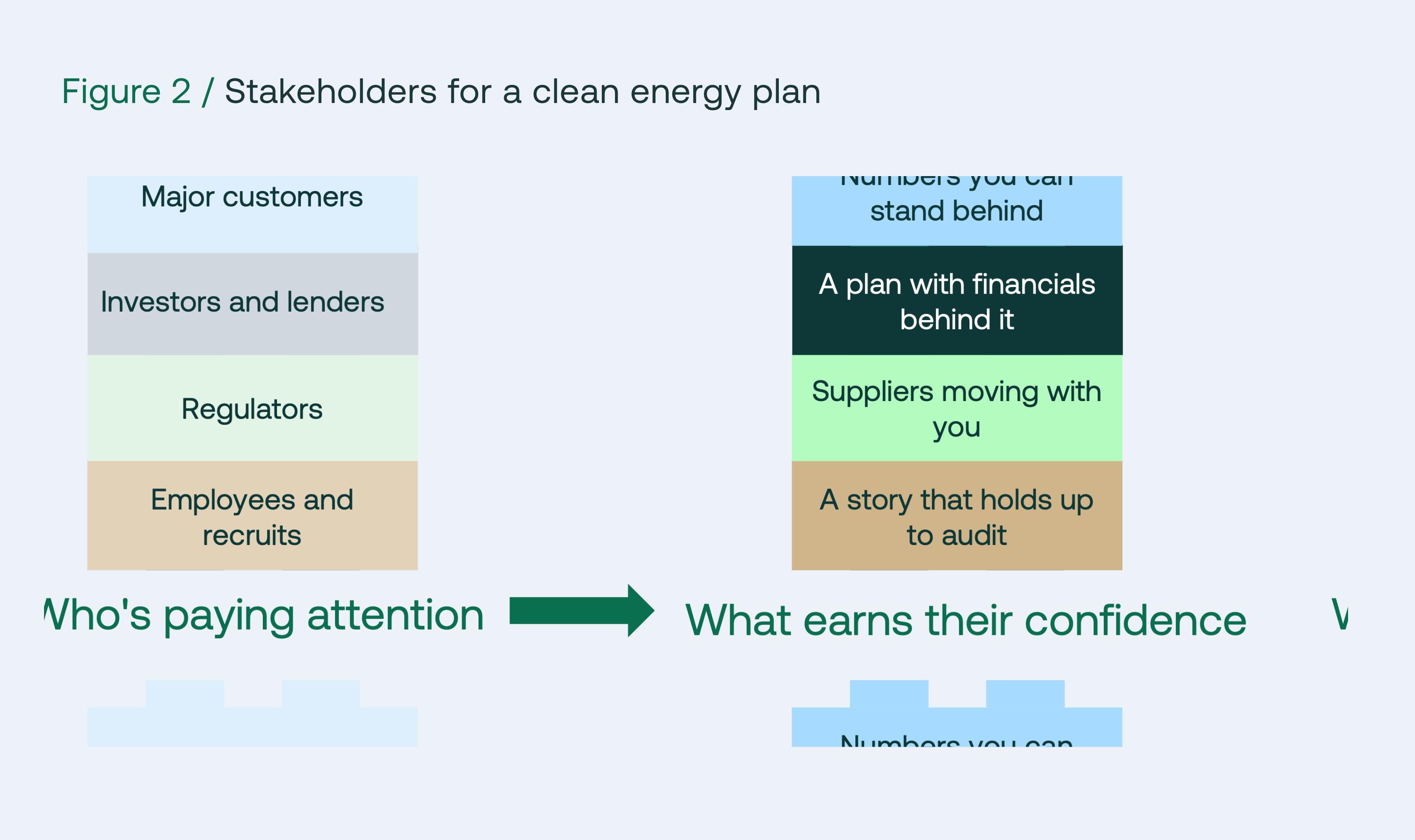
The pressure to act is coming from multiple directions. Regulators require a credible Scope 3 footprint. Customers with their own validated science-based targets are requesting supplier emissions data and setting minimum thresholds. Investors assess supply chain climate risk as standard. This is not a future scenario.
At Nexio Projects, we see this directly. Many organisations understand the urgency but face a common challenge: building internal buy-in. Getting the C-suite and operations teams to understand what is expected of them, and why, is the governance step that unlocks everything else. Nexio Projects supports this through structured supplier engagement programmes and internal governance and change management, helping organisations move from awareness to structured action across their value chain.
None of the above is possible without solid measurement foundations.
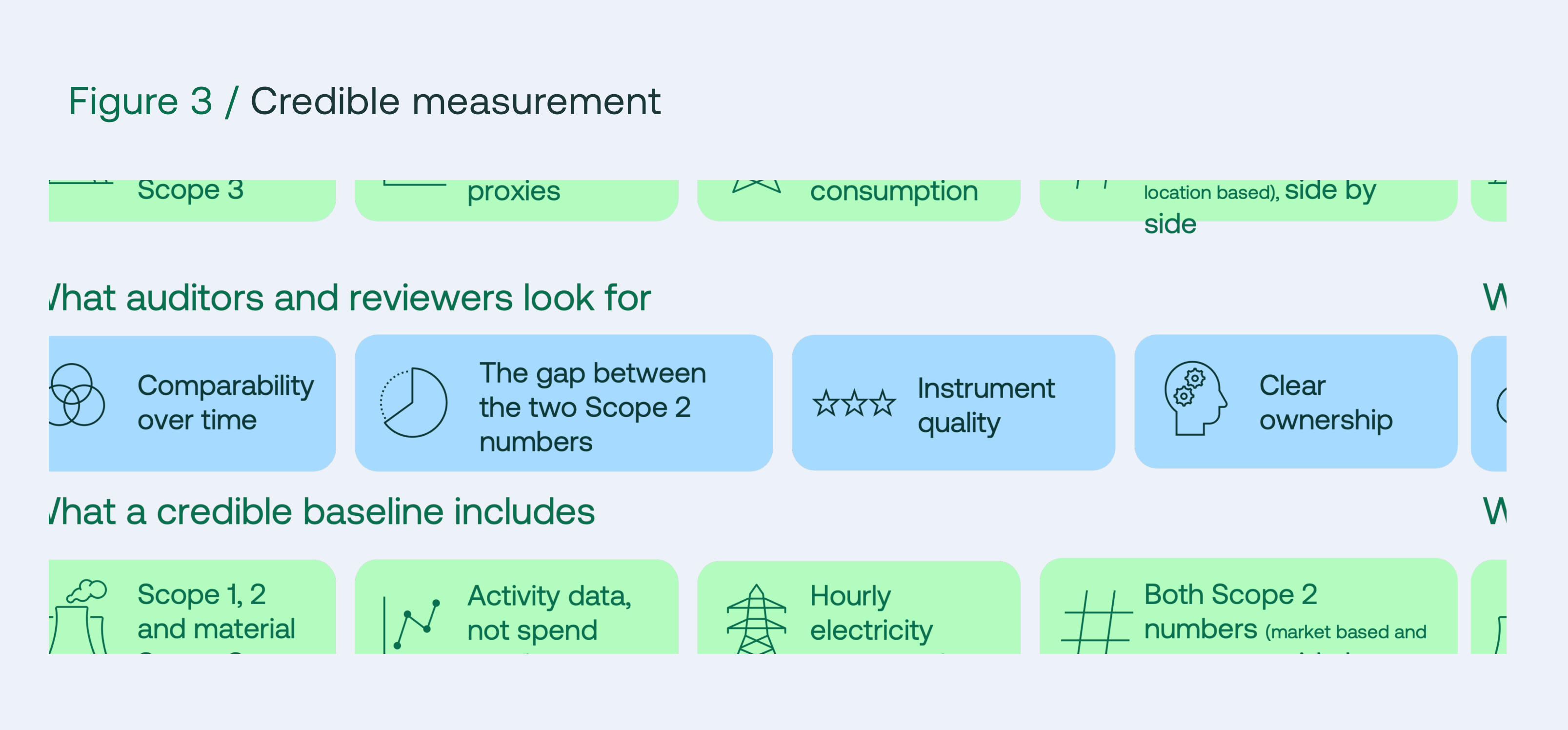
A credible baseline means a Scope 1, 2 and 3 inventory covering every relevant emissions category, built on activity data rather than spend-based estimates wherever possible. The first inventory will not be perfect. The goal is completeness: identifying the largest emission sources, then improving data quality progressively. Nexio Projects has supported numerous organisations through this process, from initial spend-based estimates to audit-ready inventories grounded in primary activity data.
On Scope 2, reporting both market-based and location-based emissions side by side is important. The gap between the two reveals the difference between your local grid average and the effect of your renewable energy decisions. A large gap in the wrong direction signals a procurement problem worth addressing.
Given the proposed GHG Protocol changes, beginning to track electricity consumption at an hourly level now is a practical step [2]. Hourly data takes time to build, and will be required if proposed matching rules come into force.
Clear executive ownership is the element most often deferred. Assigning a named executive who understands both the financial and sustainability dimensions of this agenda, with the authority to act on both, is the difference between a strategy that moves forward and one that stalls.
“Energy carries direct financial consequences for margins, compliance, and operations. It needs a named executive who understands both dimensions and has the authority to act on them. Delegating it to whoever has availability is how organisations end up carrying unmanaged risk.”
Energy dependency is simultaneously a financial risk, a regulatory exposure, and a climate issue. The organisations managing it well are treating all three dimensions together, not sequentially.
The conditions in 2026 offer a genuine window to act. The European PPA market favours buyers. The GHG Protocol revision has not yet closed. The organisations that build a structured energy strategy now, grounded in a solid emissions baseline, will be better placed on cost, compliance, and credibility when the window narrows.
“A structured energy strategy addresses financial exposure, Scope 2 compliance, and supply chain resilience in a single programme. The organisations building that foundation now, grounded in a credible emissions baseline, will be measurably stronger on cost, compliance, and credibility when market conditions shift.”
Nexio Projects supports organisations at every stage of this journey. That includes developing comprehensive carbon footprints covering Scope 1, 2 and 3 emissions, building decarbonisation strategies and roadmaps, setting and submitting science-based targets through SBTi, supporting the SBTi validation process, and designing supplier engagement programmes. For organisations that need to build internal alignment first, Nexio Projects also provides governance support and change management to ensure this agenda has the right ownership at the right level.
Nexio Projects is an international sustainability consultancy dedicated to guiding organisations on their journey from compliance to purpose. Their mission is to provide expert support across strategy development, ESG ratings, climate solutions, and comprehensive sustainability reporting. Ultimately, Nexio Projects helps clients achieve their sustainability goals with a pragmatic, step-by-step approach.
Recognised among the the Verdantix best boutique ESG consultancies and named among the top sustainability advisory firms in the MT/Sprout SD400 2025, we are here to help organisations turn energy risk into a structured, measurable decarbonisation strategy.
Ready to understand your energy exposure and build a credible response? Book a free discovery call with Nexio Projects’ climate team.
Subscribe to our newsletter to stay up-to-date about current news, ESG insights and best practices.
[1] John Powers, VP Global Renewable Energy and Carbon Advisory, Schneider Electric. Discussion on the cost of energy dependency to business and how to act, 5 May 2026.
[2] GHG Protocol. Scope 2 Guidance. Available at: https://ghgprotocol.org/scope-2-guidance. Accessed May 2026.