How to move from EcoVadis Commited Badge to Bronze in 2026
June 8, 2026


“The right product assessment depends on the decision it needs to support. Suppliers should define the customer request before choosing a methodology or commissioning a study.”
Francesc Romero, Senior Climate Consultant
The UK’s National Health Service (NHS) suppliers may use several terms when discussing product sustainability. A customer may request a carbon footprint, LCA, environmental profile, product declaration, or verified product data.
These terms do not describe the same output.
A product carbon footprint focuses on greenhouse gas emissions. A life cycle assessment examines several environmental impacts across a product’s life cycle. An Environmental Product Declaration presents standardised and verified life cycle information for a defined product category.
NHS England has announced product carbon footprinting requirements for individual products supplied to the NHS from April 2028. The final methodology, product categories, system boundaries, and evidence requirements have not yet been published. [1]
NHS England has therefore not yet confirmed whether a specific PCF, full LCA, or EPD route will satisfy every future product level request. Suppliers should avoid presenting one assessment as a universal NHS requirement.
The first question should be simple: What decision will the assessment support?
The answer will help determine the appropriate scope, data, method, review, and output.
A product carbon footprint measures greenhouse gas emissions associated with a defined product and selected life cycle stages.
ISO 14067 defines principles, requirements, and guidelines for quantifying and reporting the carbon footprint of products. [3]
A PCF can cover different stages depending on the intended purpose. Possible boundaries include:
The result is generally expressed against a functional unit. Examples include one product, one kilogram of material, one package, or one defined service output.
A PCF is appropriate when a customer wants to understand climate impact specifically. It can help suppliers:
A PCF does not automatically provide information about water use, land use, acidification, eutrophication, particulate matter, or resource depletion.
The PACT Methodology provides a relevant reference for product carbon footprint data and exchange. Version 3 was published in 2026. [4] The GHG Protocol Product Standard also provides a reference for product life cycle greenhouse gas accounting. [5]
A life cycle assessment examines the environmental impacts associated with a product, service, or process across defined life cycle stages.
A full LCA can include climate change and several other impact categories. Depending on the study, these may include, among others:
The assessment can cover the same life cycle stages as a PCF. Its scope is broader because it can evaluate more than greenhouse gas emissions.
An LCA may be appropriate when a supplier needs to:
A full LCA can require more data, time, review, and interpretation than a PCF. The additional work may be appropriate when the decision requires a broader environmental perspective.
It may be disproportionate when the customer only needs greenhouse gas emissions for one product.
An Environmental Product Declaration is a standardised document presenting information about a product’s environmental impacts across its life cycle.
EPDs are developed according to Product Category Rules. PCRs define the calculation and reporting rules for a specific product category. EPD International explains that PCRs provide the rules and guidelines for developing an EPD for a defined category. [6]
EPDs are designed to support transparent and comparable communication. Comparability depends on using the same relevant product category rules, functional unit, system boundary, and calculation requirements.
An EPD may be appropriate when a supplier needs:
An EPD is not simply a designed version of a PCF. It requires a defined programme, applicable PCRs, documentation, and verification.
Nexio Projects is registered as an official LCA practitioner under the International EPD System and supports organisations through scoping, data collection, documentation, and verification. [7]
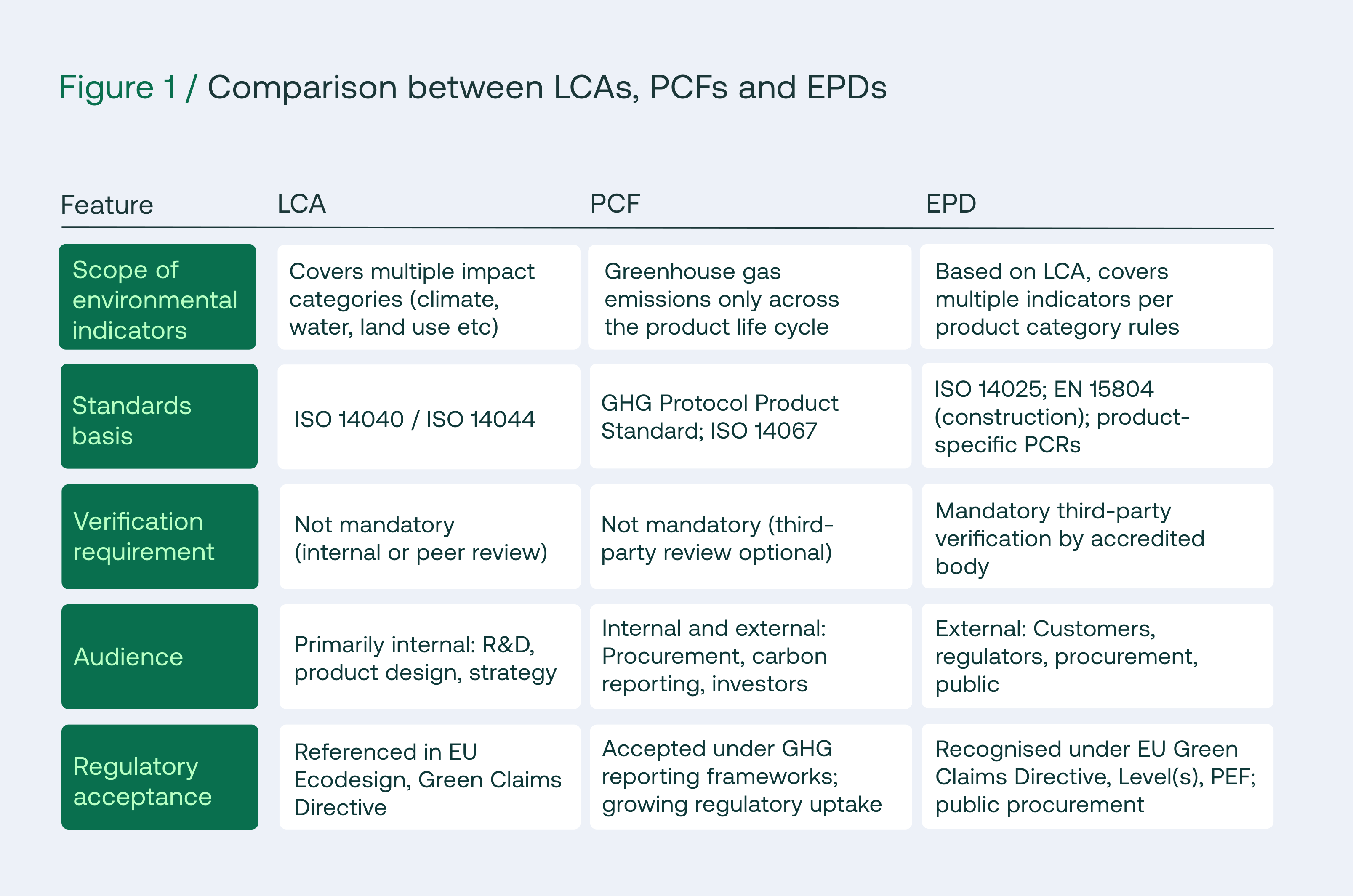
The answer depends on the request.
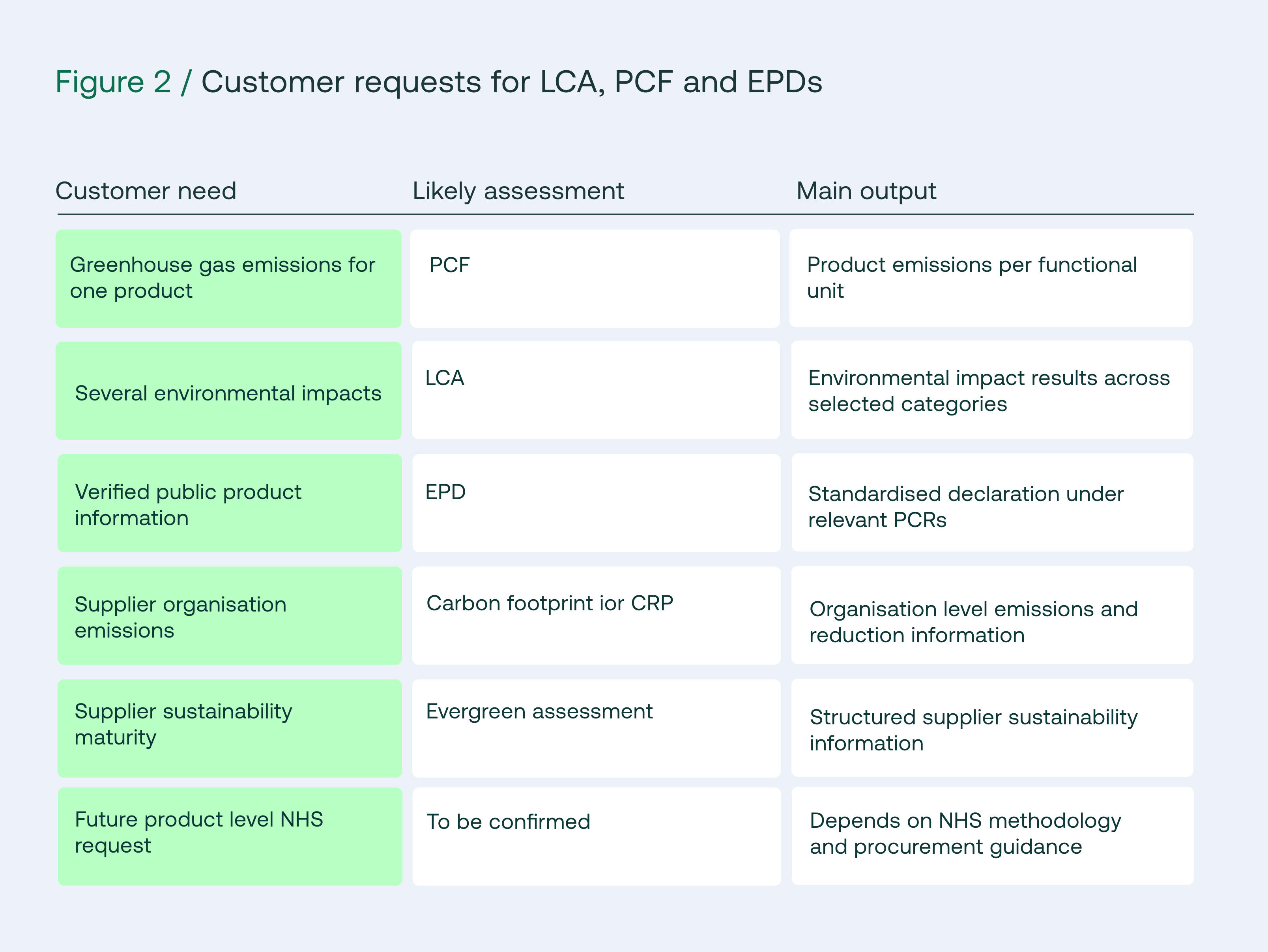
These categories should guide an initial discussion. They should not replace the customer’s written requirements.
A PCF is usually the most proportionate option when the customer wants greenhouse gas emissions for a defined product.
It can provide an efficient starting point for suppliers that need to identify carbon hotspots, improve product data, or prepare for future product level requests.
An LCA may be more suitable when a product decision involves several environmental impacts.
For example, replacing a material may lower greenhouse gas emissions while increasing water use or another impact category. A broader LCA can help the product team understand those trade offs.
An EPD may be appropriate when the customer needs a standardised and verified environmental document for a defined product category.
The supplier should first confirm that relevant PCRs exist and that the intended audience values an EPD. The required investment may be unnecessary if the customer only needs a climate result for an internal decision.
Suppliers should clarify the request before selecting the assessment.
Ask the customer:
Suppliers should also ask whether the customer is using “LCA” as a general term for environmental data. Some requests use technical terminology loosely.
A short scoping discussion can prevent a supplier from commissioning a study that produces the wrong output.
The right assessment will vary across supplier industries.
A medical device manufacturer may need a PCF for a product carbon request, an LCA for material and design trade offs, or an EPD for formal environmental communication.
The calculation may need to consider materials, components, sterilisation, packaging, transport, maintenance, and end of life.
Nexio Projects has published a case study on a global medical device manufacturer’s consistent sustainability improvement programme. [9]
A pharmaceutical or healthcare packaging supplier may need product carbon information covering polymers, paperboard, aluminium, coatings, production, packaging, and distribution.
A PCF may be sufficient for a climate focused customer request. An EPD may be relevant where a customer needs verified product information across several impact categories.
A chemical supplier may receive requests for LCA data because customers use the information in their own product assessments and Scope 3 reporting.
Nexio Projects has published a case study on a specialty chemicals company responding to customer requests for LCA data. [10]
A manufacturer may need to decide whether to calculate a PCF for a high volume product, develop a broader LCA for design choices, or create an EPD for customer communication.
The choice should reflect the customer request, product category, data availability, and commercial purpose.
A NHS supplier manufactures reusable clinical equipment.
The customer asks for “an environmental footprint” before a tender submission. The supplier considers commissioning an EPD immediately.
A better process would clarify the request first. If the tender asks only for greenhouse gas emissions, a PCF may be the appropriate starting point. If the tender evaluates water, resource use, and other impacts, an LCA may be more suitable. If the tender requires a verified public declaration, the supplier may need an EPD.
The supplier should also check whether the tender documents specify a standard, functional unit, reporting period, or verification requirement.
NHS England has announced product carbon footprinting requirements for individual products from April 2028. The final NHS methodology has not yet confirmed whether suppliers will need a specific PCF format, full LCA, EPD, or another form of product information. [1]
The public NHS roadmap also does not currently provide a specific date for publication of the final technical method.
Suppliers should therefore avoid commissioning an expensive assessment solely because they assume it will become mandatory. They should choose work that supports current customer requests, product decisions, data improvement, and future adaptation.
A proportionate preparation plan could include:
Nexio Projects can help suppliers identify the right route through:
Our published LCA, PCF, and EPD guidance provides a useful technical reference for suppliers comparing these routes. [2]
NHS suppliers should choose a product sustainability assessment based on the customer’s decision, required impact categories, intended audience, and evidence expectations.
A PCF is usually the most direct route when greenhouse gas emissions are the focus. An LCA is more suitable when several environmental impacts or design trade offs matter. An EPD is appropriate when a supplier needs a standardised and verified declaration under relevant product category rules.
NHS England has announced a product carbon footprinting milestone for April 2028, but the final methodology remains open. Suppliers can prepare with focused scoping, data reviews, and pilot work that supports current commercial needs. Francesc Romero adds:
We are an international sustainability consultancy dedicated to guiding organisations on their journey from compliance to positive impact. We support suppliers with product carbon footprints, life cycle assessments, EPDs, supplier engagement, and product sustainability strategy.
Recognised by Consultancy NL as a leading ESG consultancy in the Netherlands and named a Top Brand in sustainability by EUPD, we are here to help suppliers choose the right assessment for their products and customers.
[1] NHS England. Suppliers and the NHS net zero supplier roadmap. https://www.england.nhs.uk/greenernhs/get-involved/suppliers/. Accessed September 2026.
[2] Nexio Projects. LCA, PCF or EPD: Which verification route is right for you? https://nexioprojects.com/lca-pcf-or-epd-which-verification-route-is-right-for-you/. Accessed September 2026.
[3] International Organization for Standardization. ISO 14067:2018, Greenhouse gases: Carbon footprint of products. https://www.iso.org/standard/71206.html. Accessed September 2026.
[4] Carbon Transparency Partnership. PACT Methodology Version 3. https://www.carbon-transparency.org/initiatives/pact-methodology-v3. Accessed September 2026.
[5] Greenhouse Gas Protocol. Product Life Cycle Accounting and Reporting Standard. https://ghgprotocol.org/product-standard. Accessed September 2026.
[6] EPD International. Product Category Rules. https://www.environdec.com/services/what-is-pcr. Accessed September 2026.
[7] Nexio Projects. Product sustainability consultancy. https://nexioprojects.com/solutions/product-sustainability/. Accessed September 2026.
[8] International Organization for Standardization. ISO 14040:2006, Environmental management: Life cycle assessment, principles and framework. https://www.iso.org/standard/37456.html. Accessed September 2026.
[9] Nexio Projects. EcoVadis Gold: How a global medical device manufacturer built a consistent improvement programme. https://nexioprojects.com/cases/ecovadis-gold-how-a-global-medical-device-manufacturer-built-a-consistent-improvement-programme/. Accessed September 2026.
[10] Nexio Projects. When your customers start asking for LCA data, here is what the right answer looks like. https://nexioprojects.com/cases/when-your-customers-start-asking-for-lca-data-heres-what-the-right-answer-looks-like/. Accessed September 2026.