Counting what counts: Scope 3
September 27, 2023


Climate Consultant, Emile Catillon’s take:
Your CDP score just gained a new owner. On 11 June 2026, CDP, which grades more than 22,000 companies on climate, water, and forest performance, confirmed a major restructuring backed by private equity firm Permira [1][2]. If your finance team files an annual CDP questionnaire, here’s what this means for your score, your data requirements, and your advisory relationships.
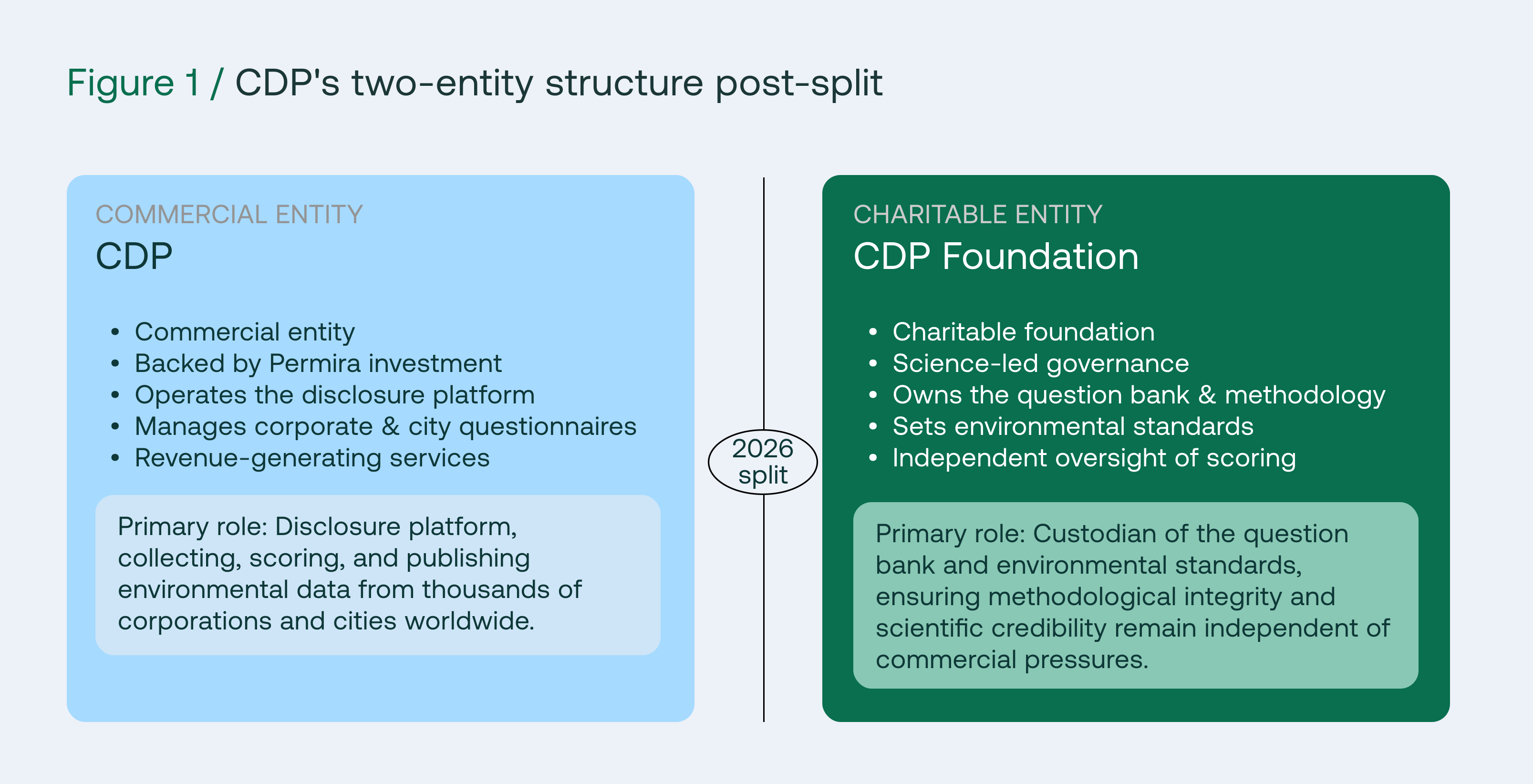
CDP has split into two separate organisations. First, there’s CDP, a standalone commercial business backed by Permira, focused on running the global disclosure platform and delivering data products to investors and buyers. Second, there’s CDP Foundation, an independent charitable entity focused on science-led environmental disclosure and developing new frameworks for emerging areas such as ocean health, plastics, and biodiversity.
Permira describes this investment as the first from its dedicated Energy Transition strategy. The firm states that “as environmental risk reshapes global supply chains and investment decisions, the need for trusted data has never been greater” [2]. CDP Foundation will retain a board seat in the commercial entity. Its work will continue to shape the evolution of the question bank. The scientific rigour underpinning your questionnaire is not being handed over to commercial interests alone.
The CDP scoring methodology operates across four tiers. At the Disclosure tier (D and D-), your organisation has completed the questionnaire and provided basic data. At the Awareness tier (C and C-), you’ve identified and assessed environmental risks and opportunities. At the Management tier (B and B-), you’re actively managing your environmental impacts through targets, policies, and internal governance. At the Leadership tier (A and A-), you’re taking best-practice action and influencing others across your value chain.
This four-tier framework is not changing because of the split. CDP Foundation retains responsibility for methodology and questionnaire content [3]. Your path to an A score runs through the same criteria it always has.
Need a refresher on the scoring and methodology? Watch our on-demand video for a deep dive.

This is where Permira’s backing matters directly to your reporting team. The firm has committed to “meaningful enhancements to the disclosure experience for corporates” and “material improvements to the insights drawn from the data.”
In practice, this means better technology. The commercial CDP will invest in the disclosure platform. An early signal of this direction: for the 2026 cycle, CDP has partnered with AI firm Briink to introduce an AI-powered pre-filling tool that allows companies to upload existing documents, such as annual reports and sustainability materials, and have the relevant data extracted and mapped automatically into the CDP questionnaire [4]. Finance teams currently managing CDP responses across multiple spreadsheets and email chains should expect more sophisticated tooling of this kind. It also means richer benchmarking data. Greater investment in data infrastructure means companies will gain access to more granular peer comparisons. If your CFO asks why your Scope 3 Category 11 figure looks different from a sector peer, future CDP data products may help you answer that question with precision.
It also means commercial dynamics that are worth tracking. PE-backed organisations have return expectations. How CDP prices its premium data products and advisory services may shift over time. If your team has relied on CDP’s guidance as a neutral non-profit resource, it’s worth monitoring how that changes.
CDP is no longer a voluntary ratings exercise for most mid-market European companies. It’s tied directly to three financial realities. First, bank covenants and investor mandates: asset managers and banks increasingly screen CDP scores in due diligence. A D score in a 2026 filing can appear in 2027 credit conversations. Second, CSRD alignment: the EU Corporate Sustainability Reporting Directive requires disclosure on Scope 1, 2, and material Scope 3 emissions. CDP’s questionnaire covers much of the same ground. Companies building their CSRD data architecture gain meaningful efficiency by aligning CDP and CSRD workflows. Third, supplier screening: buyers with CDP-linked procurement programmes may use your score as a qualification filter.
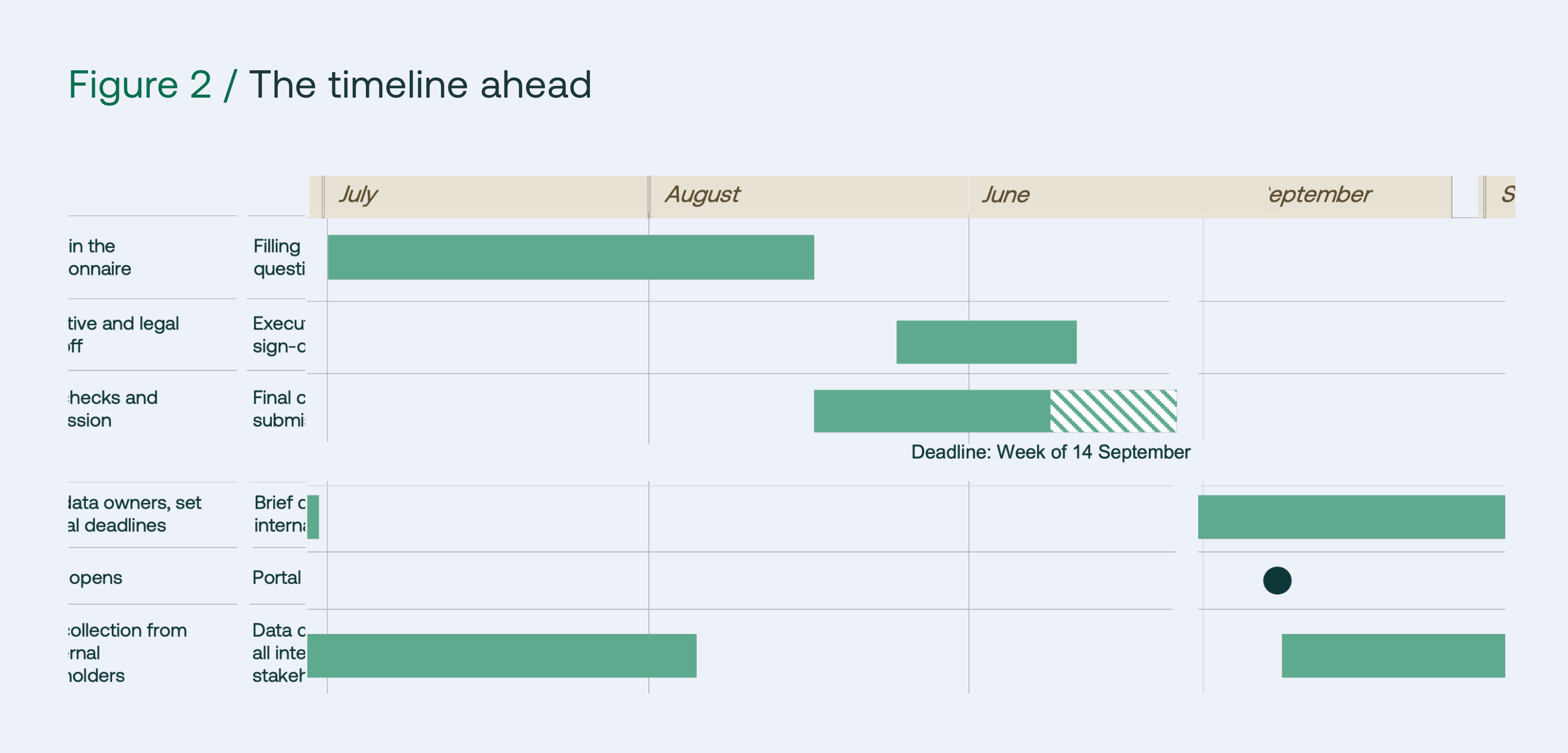
The 2026 CDP questionnaire cycle is underway. The split does not affect this cycle’s scoring methodology. However, it has three near-term implications your team should act on now.
CDP’s commercial investment in technology will raise expectations for data quality and traceability. Companies that build structured, auditable data processes now will adapt more easily when new tooling arrives.
If you engage with CDP’s methodology team on questionnaire interpretation, that relationship now sits with CDP Foundation. If you engage on platform access or data products, that’s the commercial entity.
The Leadership tier criteria haven’t changed. The pathway to achieving them is increasingly tied to the quality of your internal data and governance systems. CDP Foundation will continue to tighten what constitutes best practice. CDP’s 2025 Corporate A List represents 4% of the companies scored with 877 companies achieving this [4].
Despite the structural change at CDP, the route to Leadership status is unchanged. The climate questionnaire A score requires setting science-based targets, disclosing Scope 1, 2, and 3 emissions, demonstrating board-level climate governance, engaging your supply chain on emissions, and verifying your data with third-party assurance.
As the number one global EcoVadis strategic partner since 2018, Nexio Projects brings the same structured, evidence-backed approach to CDP preparation. Our 600+ completed projects and average 13.8-point improvement in EcoVadis scores reflect a discipline that applies equally to CDP Advisory: structured responses, clear working papers, and no surprises at submission.
“Finance teams that have been treating CDP as a compliance box-tick are going to find this split uncomfortable. Teams that see it as a data quality discipline will benefit from the commercial investment coming their way.”
Not for the 2026 cycle. CDP Foundation retains responsibility for the question bank and scoring methodology. The commercial entity focuses on the disclosure platform and data products. Your scoring criteria are unchanged.
CDP Foundation is the charitable, independent arm. It focuses on science-led environmental disclosure, develops new frameworks for emerging areas such as ocean health and plastics, and retains a board seat in the commercial entity to safeguard methodology integrity.
This is a legitimate question your board may raise. CDP Foundation’s board representation in the commercial entity and its continued ownership of the science and methodology are structural safeguards. It’s worth monitoring how commercial incentives shape data product development over the next 12 to 24 months.
CDP and CSRD cover overlapping ground on Scope 1, 2, and 3 disclosures. Building a dual-purpose data architecture reduces duplication and improves consistency. Nexio’s advisory practice supports both workstreams in parallel.
A D score confirms that you’ve completed the questionnaire. It doesn’t confirm active climate management. Most investor and buyer screening thresholds now require at least a C score. If your goal is to protect commercial relationships, a C or B score should be your near-term target.
Start planning for the 2026 submission now, not in September. CDP’s commercial evolution will raise the bar for data quality and disclosure rigour. The companies that benefit most are those that have already built clean data structures and governance processes. If your team is preparing for the 2026 submission or planning a score improvement programme, request a 30-minute CDP score review with our reporting team to identify your highest-impact improvement actions.
[1] ESG Today (2026) ‘CDP splits into 2 entities, announces significant investment by Permira’. ESG Today, 11 June. Available at: https://www.esgtoday.com/cdp-splits-into-2-entities-announces-significant-investment-by-permira/ (Accessed: 18 June 2026).
[2] Permira (2026) ‘Permira to make strategic investment in environmental disclosure leader CDP’. Permira News & Insights, 11 June. Available at: https://www.permira.com/news-and-insights/announcements/permira-to-make-strategic-investment-in-environmental-disclosure-leader-cdp/ (Accessed: 18 June 2026).
[3] CDP Help Center (n.d.) ‘Scoring introduction’. CDP Help Center. Available at: https://help.cdp.net/en-us/knowledgebase/article/KA-01160 (Accessed: 18 June 2026).
[4] CDP / KPMG / Briink. CDP Disclosures with KPMG & Briink. https://cdn.prod.website-files.com/69d79542b63aaa60bd883833/6a340a8ec23185df4881034d_CDP%20disclosures%20with%20KPMG%20%26%20Briink.pdf. Accessed June 2026.
[5] CDP (2026) CDP A List 2025: Global Momentum for Environmental Transparency Remains Strong as Markets Demand Actionable Data. CDP Press Release. Available at: https://www.cdp.net/en/press-releases/cdp-a-list-2025 (Accessed: 18 June 2026).