ESG insights from November 2025: Sustainability in motion
November 30, 2025


When a customer, auditor, or procurement team asks for verified environmental data on your product, the acronyms that follow can quickly become disorientating. LCA. PCF. EPD. PACT. Each represents a legitimate approach to measuring and communicating product environmental impact and each comes with different scope, rigour, and credibility in the eyes of the people asking. Choosing the wrong output means investing in a document that does not satisfy the request. Choosing the right one means having a single asset that works across regulatory, commercial, and internal purposes simultaneously.
This pressure is real in 2026. For sustainability and ESG directors navigating CSRD’s Scope 3 disclosure obligations, the question is which level of product environmental analysis is actually required and what will hold up under assurance. For supply chain and procurement leaders, the question is more immediate: one enterprise customer is requesting PCF data aligned to PACT; another wants a verified EPD. The procurement team is not sure whether these are the same thing.
They are not. Let’s see why.
A Life Cycle Assessment (LCA) is the analytical methodology that underpins all product environmental measurement. Governed by ISO 14040 and ISO 14044, an LCA systematically maps every input and output across a product’s life — from raw material extraction through manufacturing, transport, use, and end-of-life [1].
The outputs of an LCA can include greenhouse gas emissions, water consumption, land use, resource depletion, acidification, and toxicity. This breadth is both its strength and its source of complexity: an LCA is a technical study, not a public-facing document. It is the engine. A PCF and an EPD are both built from that engine — but what you choose to build determines how useful and credible the data becomes when someone external scrutinises it.
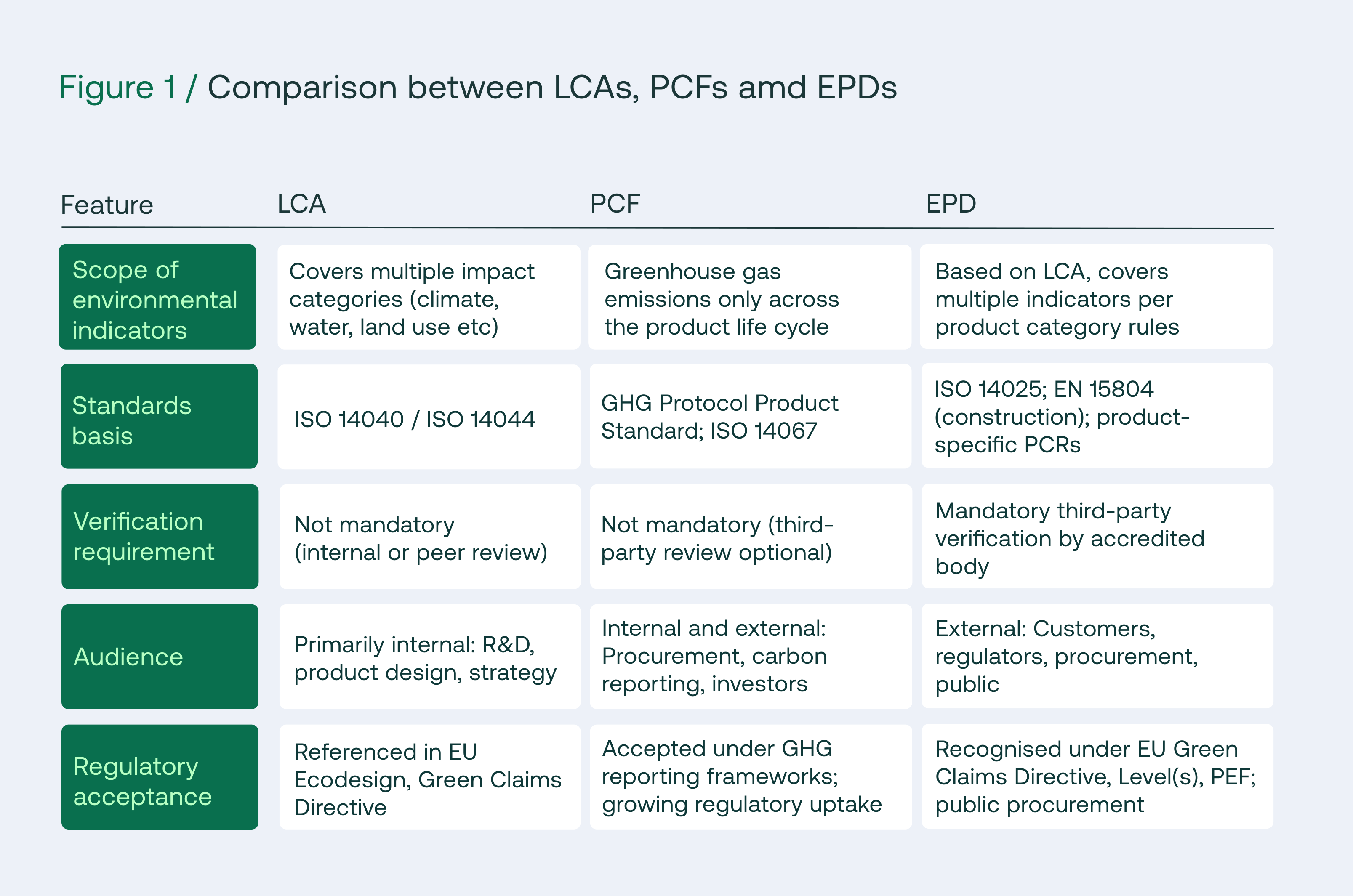
A Product Carbon Footprint (PCF) is a targeted version of an LCA. Where a full LCA covers a spectrum of environmental impacts, a PCF focuses on greenhouse gas emissions. Measured in kilograms or tonnes of CO₂ equivalent, it’s typically from raw material extraction to the factory gate (cradle-to-gate). It is faster to produce than a full LCA.
PCFs follow established standards. ISO 14067 is the primary international reference for product carbon footprints; the GHG Protocol Product Standard and PAS 2050 are also widely used [2][3]. Independent verification against these standards is possible, but in most commercial contexts, it is not required.
Download our PCF factsheet to learn more.
This is where PACT enters the picture. The Partnership for Carbon Transparency, operated by WBCSD, provides a cross-industry methodology for calculating and exchanging cradle-to-gate PCFs in a consistent and comparable format [4]. Adopted by companies including BASF, Unilever, Schneider Electric, and P&G, PACT aligns calculation across standards and enables automated data exchange between supply chain partners. Its Version 3 methodology is currently in force; Version 2 was deprecated in April 2026 [5].
PACT addresses a genuine problem: without a common framework, PCF data from different suppliers calculated under different assumptions is essentially incomparable. PACT’s data reliability metrics give the receiving company visibility into how the number was produced. For a supply chain director responding to enterprise customers’ CSRD Scope 3 Category 1 data requests, a PACT-aligned PCF is an appropriate and credible response.
What PACT is not, and does not claim to be, is an independent verification system. The PACT documentation acknowledges that third-party verification of PCF calculation models is a further enhancement that the ecosystem is working towards, not one that is currently standard practice [4]. This distinction matters when the output needs to withstand external scrutiny rather than facilitate internal data exchange.
Our case study shows how we collaborate with PACT for product footprint management of Unilever. Read now.
An Environmental Product Declaration (EPD) is what results when LCA data is subjected to mandatory independent verification and published in a standardised format under a recognised Programme Operator. Governed by ISO 14025, EPDs must also follow Product Category Rules (PCRs), which is a methodology-specific guidance developed for each product category [6].
This output has three consequences that a PCF alone cannot match.
An EPD covers multiple environmental impact categories, not just greenhouse gas emissions. A procurement team comparing two products using EPDs can assess climate impact, water scarcity, eutrophication, resource depletion, and acidification among others in a single document.
Every EPD undergoes mandatory third-party verification before publication. The verifier must be independent and accredited and confirms that the LCA behind the declaration meets the technical requirements of the applicable standard [7]. This is not optional. By contrast, a PCF is not independently verified by default, as verification only happens when a specific client or regulatory framework requires it.
EPDs are embedded in a growing number of regulatory and procurement instruments. The Carbon Border Adjustment Mechanism (CBAM), now being implemented, requires verified environmental data for certain products entering the EU market [8]. Several EU member states have integrated EPDs into green public procurement criteria for construction and infrastructure. The Empowering Consumers for the Green Transition Directive (ECGT), which entered EU law in 2024, requires that environmental claims be substantiated using methods recognised by competent national authorities, with EPDs representing the clearest, most tested route to compliance from September 2026 [9].
The EU Green Claims Directive, which had proposed more expansive claim substantiation requirements, was withdrawn by the European Commission in mid-2025 and its future remains uncertain as of the date of this article [10]. ECGT obligations are, however, in force.
Understanding the tools is one challenge. Understanding the verification landscape that governs them is another, and this is where companies most commonly lose time and budget.
For EPDs, four sources of complexity recur in practice.
EPDs are published under recognised Programme Operators, including the International EPD System (Environdec), Institut Bauen und Umwelt (IBU), EPD Denmark, and others. The choice of operator depends on the product category, the PCR in force, and the target market. A Programme Operator suited to construction materials in Germany may not be the right choice for a manufacturer exporting to North America or Southeast Asia [11].
Product Category Rules determine system boundaries, allocation methods, and data quality requirements for a given product type. Two EPDs for comparable products built under different PCRs are technically not comparable, even if both reference ISO 14025. This is a nuance that many procurement teams overlook, and one that reduces the apparent comparability that EPDs were designed to deliver.
Third-party verifiers must be independent and qualified. The pool of accredited verifiers is limited relative to growing demand, and timelines for verification commonly run between four and twelve weeks, depending on verifier availability and study complexity. Planning the EPD process without accounting for verification lead time is a common cause of deadline overruns.
EPDs carry a standard validity period of five years with updates if there are substantial changes that may lead to big changes in the results. An expired EPD does not simply become neutral, it actively undermines the commercial and regulatory claims built around it. EPD International introduced mandatory annual internal follow-up requirements from December 2025, reflecting the shift from EPD as a one-time credential to EPD as an ongoing compliance instrument [11].
For PCFs, the complexity is different but equally real. Without a mandated verification framework, PCF quality varies considerably across the market. A PACT-aligned PCF with documented primary data and data quality metrics is a credible document. A PCF calculated using only secondary data, with no independent review, carries the same acronym but a fraction of the evidential weight. The methodology matters as much as the label.
This is a standard mode article. Here are the two quotes, each in a separate block for easy copying.
“The decision between a PCF and an EPD is fundamentally about who will examine the data. If a regulator, procurement body, or auditor is the audience, the EPD is the appropriate output. Planning the process toward independent verification from the start costs considerably less than converting a PCF into an EPD after the fact.”
No single output is universally correct. The right choice depends on what the data needs to do and who will scrutinise it.
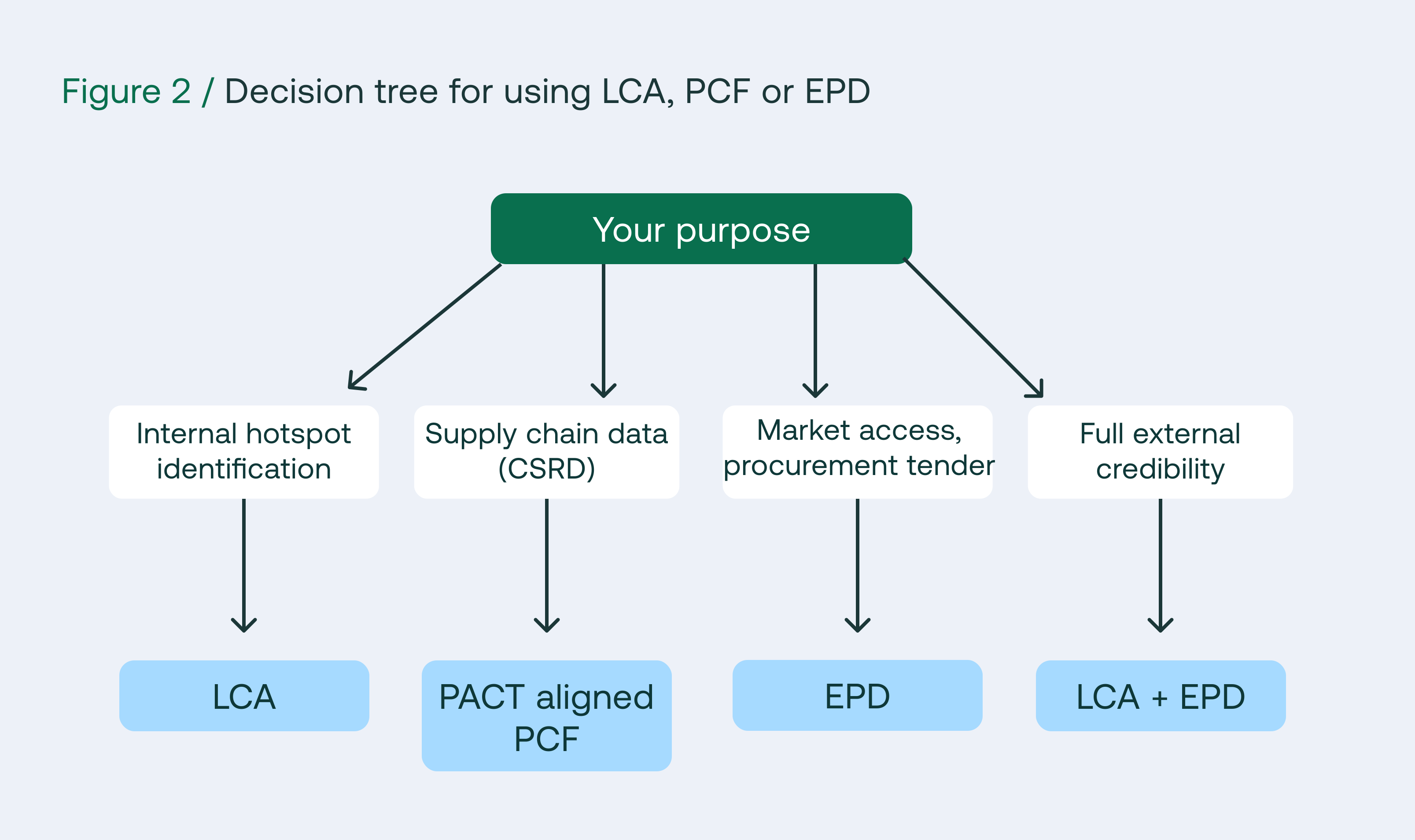
The practical implication: If an LCA investment is going to be used externally, an EPD converts that investment into a document with independent credibility. The cost difference between stopping at a PCF and completing a full EPD narrows considerably when the underlying LCA study is already in place.
Nexio Projects is a registered LCA practitioner under the International EPD System. This means Nexio can take a product from initial scoping through third-party verification to publication under a recognised Programme Operator, without the handoffs to external subcontractors that frequently extend timelines and fragment accountability.
The acronyms are not the problem. The problem is deploying the wrong output for the context and discovering the mismatch after a regulatory review, a procurement rejection, or a customer escalation.
For organisations operating in regulated markets or facing enterprise customer demands for product environmental data, a third-party verified EPD is not a premium. It is the baseline. The LCA provides the analytical foundation. The EPD provides the independent credibility that allows that data to work commercially, regulatorily, and reputationally.
The verification landscape is complex. But the decision logic is not. Know what your output needs to do, and build the process around that goal from the start.
“The LCA is the engine. The PCF and the EPD are the vehicles you build from it. Getting the vehicle right from the start means knowing, before scoping begins, where the data will travel and who will need to trust it when it arrives.”
Nexio Projects is an international sustainability consultancy dedicated to guiding organisations on their journey from compliance to positive impact. Their services span sustainability strategy, ESG ratings, climate solutions, LCA, and EPD development, supporting clients from scoping through to verified publication as a registered LCA practitioner under the International EPD System and other POs such as INIES (France), IBU (Germany), GlobalEPD (Spain) and more.
Recognised as a top boutique ESG and sustainability strategy consultancy by Verdantix and as the best ESG consultancy in the Netherlands by Consultancy NL in 2025, Nexio Projects helps clients get the right output for their purpose,without overspending on complexity they do not need.
If you are navigating the LCA, PCF, or EPD decision for your products, book a discovery call to discuss what the right route looks like for your sector and your stakeholders.
[1] International Organisation for Standardisation. ISO 14040:2006 — Environmental management: Life cycle assessment — Principles and framework; ISO 14044:2006 — Requirements and guidelines. https://www.iso.org/standard/37456.html. Accessed April 2026.
[2] International Organisation for Standardisation. ISO 14067:2018 — Greenhouse gases: Carbon footprint of products — Requirements and guidelines for quantification. https://www.iso.org/standard/71206.html. Accessed April 2026.
[3] World Resources Institute / WBCSD. GHG Protocol Product Life Cycle Accounting and Reporting Standard. https://ghgprotocol.org/product-standard. Accessed April 2026.
[4] WBCSD. PACT Methodology V3: Methodology for Calculating and Exchanging Cradle-to-Gate Product Carbon Footprints. https://www.carbon-transparency.org/resources/pact-methodology-v3. Accessed April 2026.
[5] PACT / WBCSD. PACT Technical Specifications Version 2 Deprecation Ahead. https://www.carbon-transparency.org/news/pact-technical-specifications-version-2-deprecation. Accessed April 2026.
[6] International Organisation for Standardisation. ISO 14025:2006 — Environmental labels and declarations: Type III environmental declarations — Principles and procedures. https://www.iso.org/standard/38131.html. Accessed April 2026.
[7] One Click LCA. Third-party verification — why does it matter for EPDs. https://oneclicklca.com/en/resources/articles/en-gb/resources/articles/why-third-party-verified-epds-matter-for-construction-manufacturers. Accessed April 2026.
[8] European Parliament and Council. Regulation (EU) 2023/956 — Carbon Border Adjustment Mechanism (CBAM). https://eur-lex.europa.eu/legal-content/EN/TXT/?uri=CELEX:32023R0956. Accessed April 2026.
[9] European Parliament and Council. Directive (EU) 2024/825 — Empowering Consumers for the Green Transition (ECGT). https://eur-lex.europa.eu/legal-content/EN/TXT/PDF/?uri=OJ:L_202400825. Accessed April 2026.
[10] European Commission. Announcement of withdrawal of Green Claims Directive proposal, June 2025. See: https://www.usetappr.com/regulation/green-claims-directive. Accessed April 2026.
[11] EPD International. EPD Development in 2025: Growth, Reach, and Sectoral Trends; Introduction to EPD. https://www.environdec.com/all-about-epd/introduction-to-epd. Accessed April 2026.