LCA, PCF or EPD: Which verification route is right for you?
May 4, 2026


“EcoVadis Platinum is defended between assessments, through the decisions, data, and improvements that happen during the year.”
Achieving EcoVadis Platinum creates commercial credibility. Customers, procurement teams, and business partners often view the medal as evidence of mature sustainability management.
The challenge begins after publication. EcoVadis medals are valid for 12 months, and the Platinum threshold is based on relative performance. It is awarded to companies in the top 1% of assessed organisations. [1]
A company can therefore lose its position when its evidence becomes outdated, performance stagnates, or the assessment methodology changes.
Maintaining Platinum requires a shift in mindset. The assessment should become an annual management cycle that connects sustainability performance, evidence, ownership, and business priorities.
EcoVadis determines medal eligibility through percentile ranking. Fixed score thresholds are not published because the required score can change with the performance of other assessed companies.[1]
This has a direct consequence for Platinum rated companies. A previous score does not guarantee the same medal at the next assessment.
A company needs to keep three areas active throughout the year:
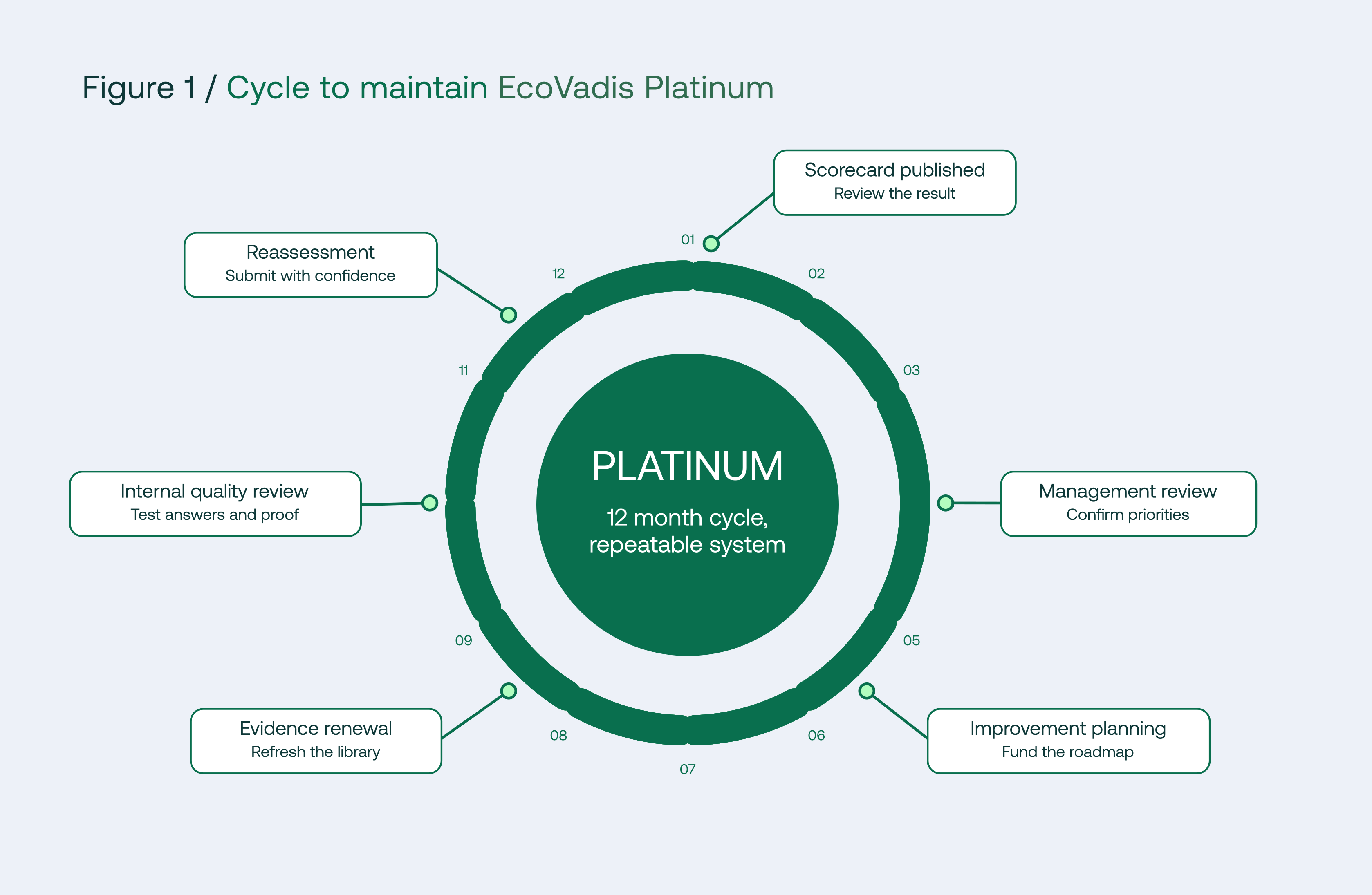
The annual cycle should begin when the scorecard is published. Management should review the result, confirm the highest priority gaps, and assign actions before the next assessment window approaches.
The review should also consider changes to the company’s business profile. New sites, suppliers, products, markets, acquisitions, and customer expectations can change the sustainability risks that require attention.
The EcoVadis assessment process reviews documented evidence of a company’s material sustainability impacts. Its analysts use questionnaire answers, supporting documents, and other available information to develop the scorecard.[3]
Companies should monitor EcoVadis methodology updates throughout the year. The Q3 methodology updates given by EcoVadis can be found in our article.
Making sure you have the correct rules at hand is the first crucial step.
The scorecard review should identify what is preventing the company from achieving the maximum available points in each applicable theme. Management should distinguish between missing evidence, weaknesses in the management system and underlying performance gaps.
That process creates a clear standard for maintaining Platinum. Evidence must remain accurate, relevant, and connected to current business activity.
Platinum performance requires balance. A high overall result can become vulnerable when one theme falls behind.
EcoVadis assesses four themes:
A company that focuses only on its strongest-scoring theme can miss gaps in other highly weighted activated criteria most relevant to its business.
Each theme owner should analyse the gaps in the questionnaire associated with their relevant criteria prioritise evidence collection for these. The evidence should demonstrate:
• the policy or commitment that governs the issue
• the measures used to implement the policy
• the targets and KPIs used to monitor progress
• the reporting or results that demonstrate performance
• the coverage of the relevant sites, employees, suppliers or business activities
Platinum-level performance requires broad and consistent evidence across the majority of the activated criteria. In many cases, Platinum evidence needs to cover all relevant activated criteria, from biodiversity to employee health and safety. [5][6]
EcoVadis also considers relevant external information through its 360° Watch process. Cases can affect medal eligibility and may remain relevant for several years, depending on the theme and issue.[1]
Platinum rated companies should monitor public information related to environmental incidents, labour concerns, business ethics, and supply chain controversies. They should assess which incidents, controversies or other developments could appear in a future 360° Watch review and consider how these issues could affect medal eligibility. Addressing an issue may not remove its relevance from the assessment, particularly where the case remains visible in public sources or falls within the relevant review period.
Companies should therefore continue improving performance and evidence across the other assessment themes, with particular attention to areas where further progress could strengthen the overall score. They should also make material sustainability achievements visible through credible public channels. New developments, recognised good practice and measurable improvements may be identified by third-party sources and contribute to a more complete external view of the company.
Learn more about 360 Watch and more in our EcoVadis guide!

“The most resilient Platinum programmes treat every theme as a living system with an owner, a review rhythm, and a clear evidence trail.”
For Platinum, the volume of documentation matters less than its quality. EcoVadis allows a maximum of 55 supporting documents and credits only those referenced against the relevant questions [3], so each document has to earn its place. The strongest evidence covers the full management cycle: the policy, how it is implemented, how performance is measured against quantitative targets, and how management reviews the results [6]. A gap anywhere in that chain weakens the response. A target without results, a training policy without participation data, or a supplier code without engagement records says little about implementation [6].
A central evidence library makes this manageable. Each item in it, whether a policy, procedure, training record, KPI dataset, audit finding, supplier engagement record or set of management review minutes, should have an owner, an approval date, a review date and a link to the assessment questions it supports.
Evidence also has to be current. EcoVadis reviews the validity period of information at reassessment, so evidence from a previous cycle may no longer demonstrate current performance [2]. Companies should therefore avoid rebuilding the evidence library shortly before submission. A quarterly review can identify expired policies, missing results, and actions that have not been completed.
The best evidence library supports more than EcoVadis. It can also support customer questionnaires, sustainability reporting, supplier reviews, and internal management decisions.
This creates a stronger business case for evidence governance. The system reduces repeated requests and gives teams a shared source of sustainability information.
Evidence should also explain the company’s progress. A target without results is incomplete. A training policy without participation data is difficult to assess. A supplier code without supplier engagement records provides limited insight into implementation.
Maintaining Platinum requires an annual rhythm that begins well before the next questionnaire.
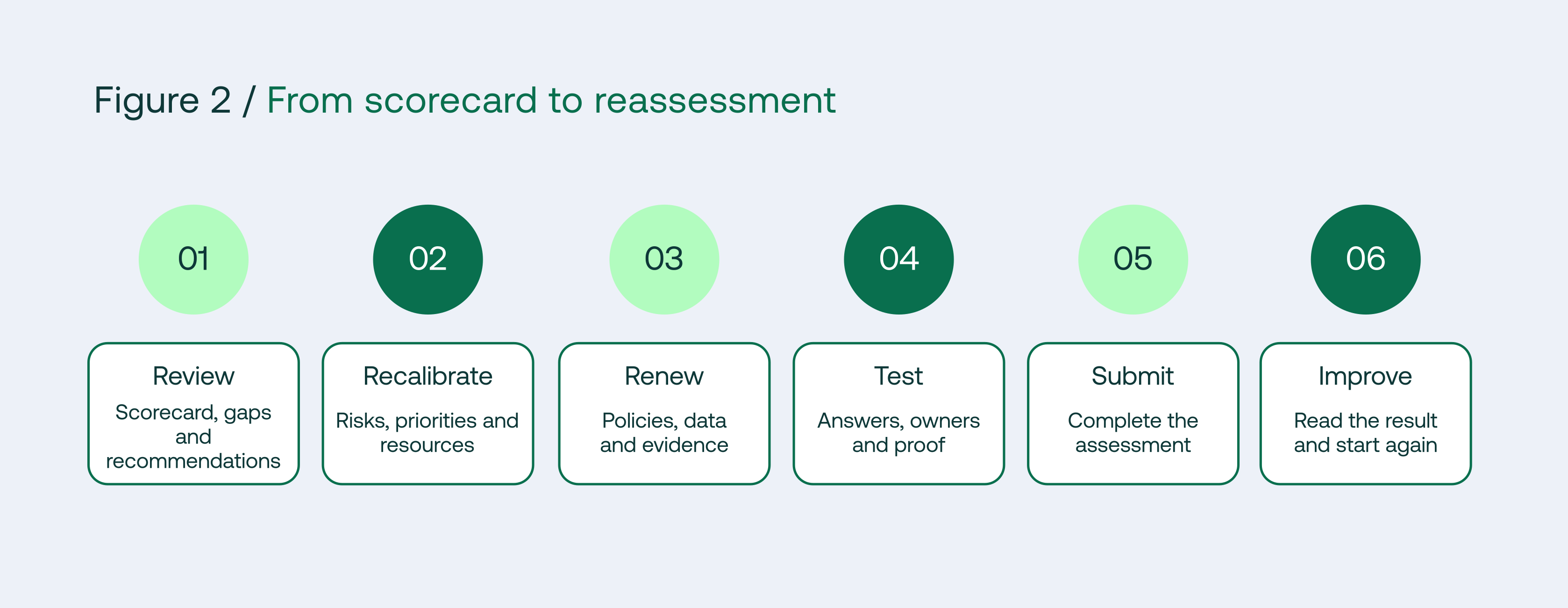
Start with the previous scorecard. Identify the lowest theme, the most material improvement areas, and any recommendations that have not yet been completed.
The team should distinguish between actions that improve score potential and actions that reduce business risk. Both matter, but they may require different owners and timeframes.
Methodology updates, business changes, customer expectations, and new risks can change the priority order.
A reassessment roadmap should include:
A mock assessment can reveal whether the evidence supports the intended answers. It can also show where different departments describe the same process inconsistently.
Internal testing should challenge three questions:
Nexio Projects’ EcoVadis support service helps organisations connect gap analysis, implementation, reassessment preparation, and scorecard review.[7]
EcoVadis Platinum is a strong signal of sustainability management maturity. Its value depends on the systems that sustain the result after publication.
Companies should maintain clear ownership across all four themes, monitor external risks, review evidence throughout the year, and convert each scorecard into a practical improvement roadmap.
The most resilient approach connects EcoVadis to daily management. Policies, actions, and results should support the business throughout the year. The assessment then becomes a reflection of performance rather than a separate annual exercise.
“Platinum becomes durable when the assessment reflects how the company operates every day.”
Nexio Projects has supported more than 600 companies across 30+ countries. Our public EcoVadis profile reports that 87% of clients improve their score after working with us.[4]
We are an international sustainability consultancy helping organisations protect their EcoVadis performance through practical governance, evidence management, and continuous improvement.
Recognised as one of the best ESG consultancies in the Netherlands by Consultancy NL and included among leading sustainability advisory firms by MT/Sprout, we are here to help you turn EcoVadis Platinum into a repeatable sustainability management advantage.
Contact our EcoVadis team to review your scorecard, evidence system, and readiness for the next assessment cycle.
[1] EcoVadis (2026) Understanding EcoVadis Medals and Badges. Available at: https://support.ecovadis.com/hc/en-us/articles/210460227-Understanding-EcoVadis-Medals-and-Badges (Accessed: 9 October 2026).
[2] EcoVadis (2026) EcoVadis Sustainability Rating: Methodology disclosure document for the public, rating users and rated items. Available at: https://ecovadis.com/wp-content/uploads/2026/04/EcoVadis-Sustainability-Rating-Methodology-disclosure-document-for-the-public-rating-users-and-rated-items.pdf (Accessed: 9 October 2026).
[3] EcoVadis (n.d.) What is the EcoVadis assessment process? Available at: https://support.ecovadis.com/hc/en-us/articles/115002653188-What-is-the-EcoVadis-assessment-process (Accessed: 9 October 2026).
[4] EcoVadis (2026) Methodology Updates Q1 2026. Available at: https://support.ecovadis.com/hc/en-us/articles/34621845310994-Methodology-Updates-Q1-2026 (Accessed: 9 October 2026).
[5] Nexio Projects (2024) EcoVadis Platinum: From ambition to reality. Available at: https://nexioprojects.com/ecovadis-platinum-from-ambition-to-reality/ (Accessed: 9 October 2026).
[6] Nexio Projects (2024) Going for Gold: What does it take to be an EcoVadis top performer? Available at: https://nexioprojects.com/going-for-gold-what-does-it-take-to-be-an-ecovadis-top-performer/ (Accessed: 9 October 2026).
[7] Nexio Projects (n.d.) EcoVadis assessment. Available at: https://nexioprojects.com/solutions/ecovadis-assessment/ (Accessed: 9 October 2026).