

 Unveiling the true cost of greenwashing
April 4, 2024


As Anna Ma, Climate Director at Nexio Projects explains:
“One of the most common question sustainability directors ask us right now is whether they are legally required to have a net zero plan. The honest answer depends on what you claim publicly, which reporting frameworks govern your business, and what certifications you hold.”
“Net zero by 2040.” “Carbon neutral by 2035.” “We are on a path to climate neutrality.” These statements appear on company websites, product packaging, annual reports, and investor presentations across Europe. Many were written before anyone seriously asked whether they required substantiation. From 27 September 2026, that question has legal consequences.
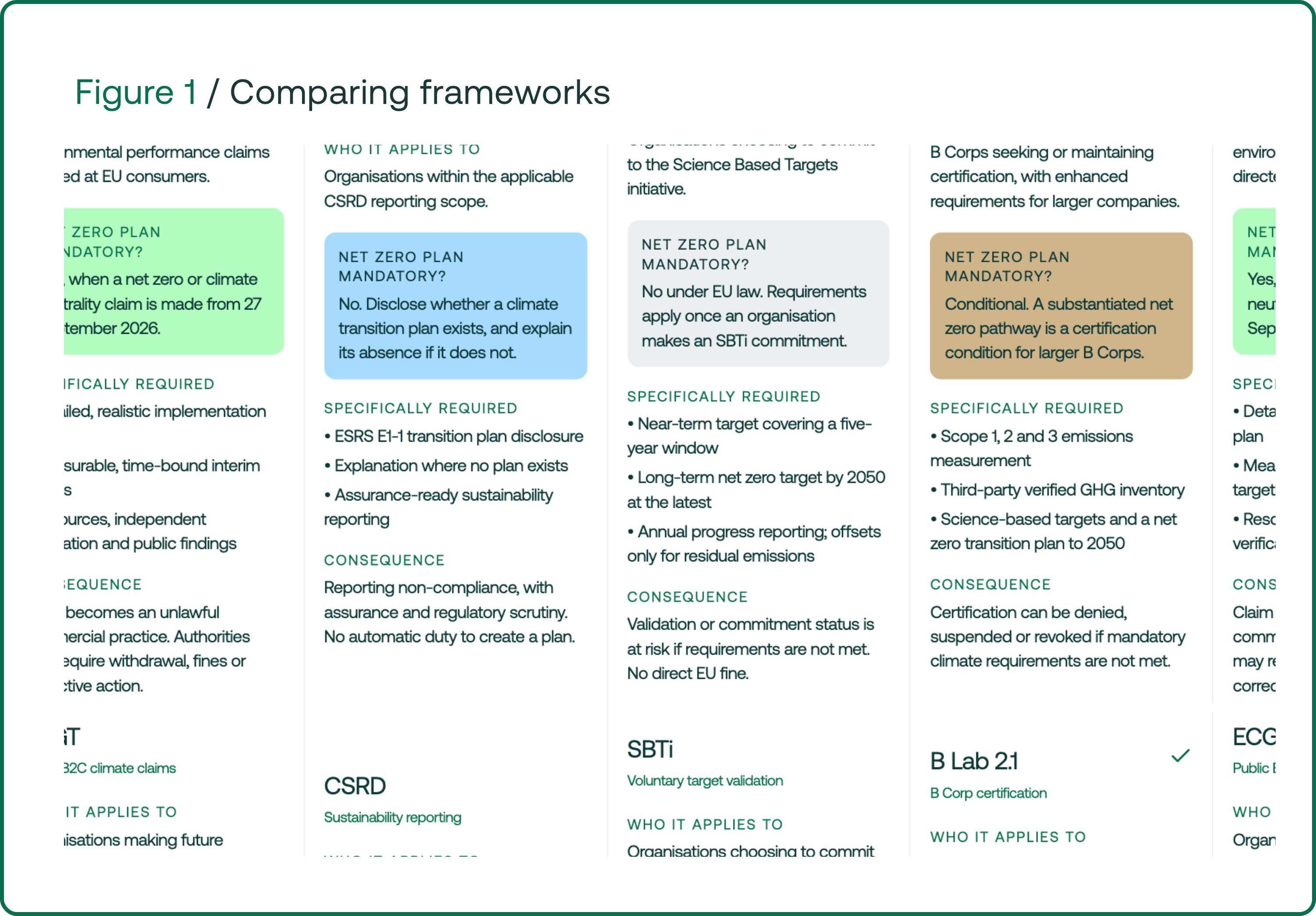
The answer to “is it mandatory” is conditional. Four frameworks create four different obligations, each triggered by a different circumstance: whether you make public climate claims, whether you fall within CSRD scope, whether you hold a B Corp certification, and whether you have made a voluntary SBTi commitment.
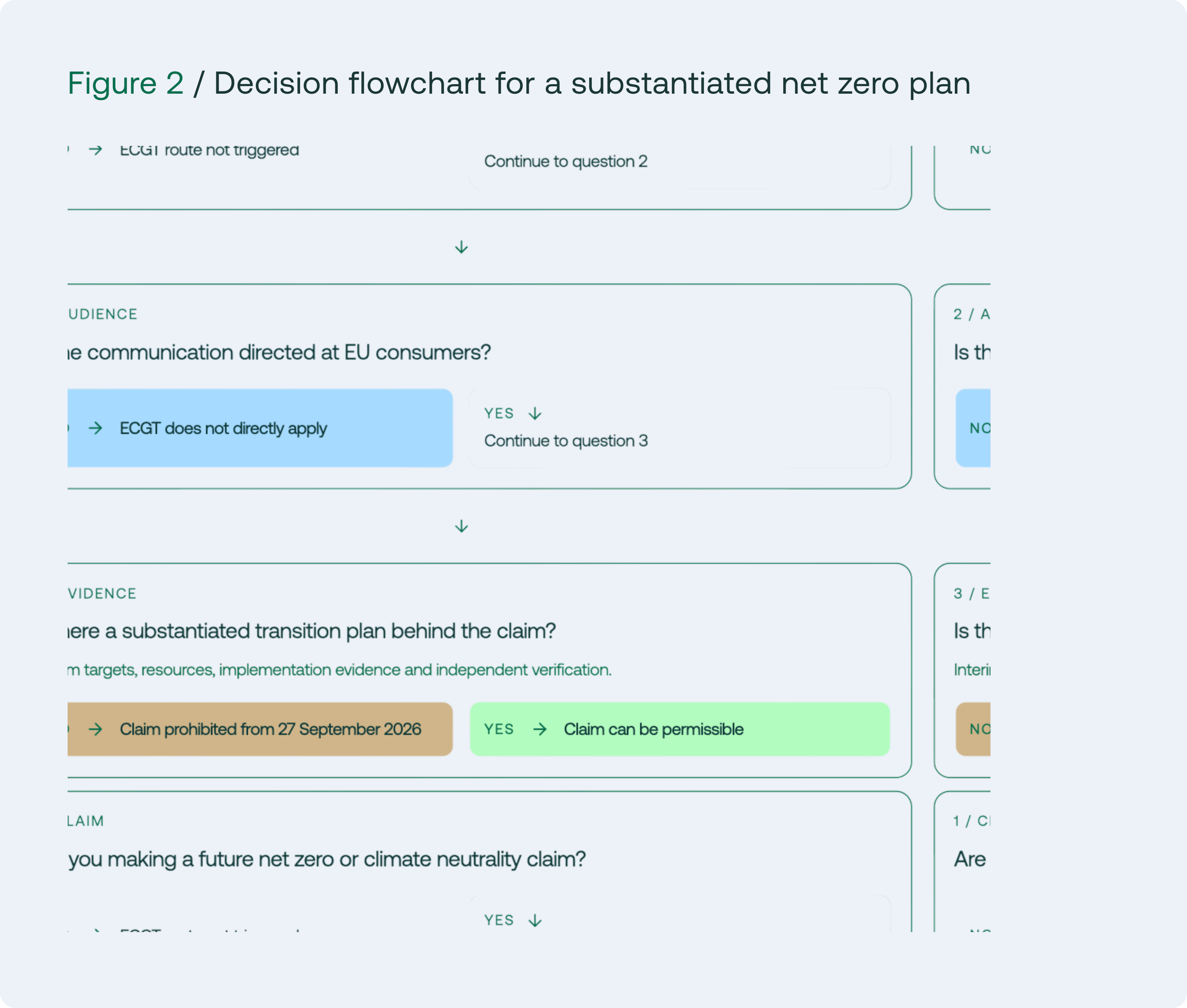
“Substantiated” has a specific legal meaning under ECGT. The European Commission’s FAQ, published June 2026, defines the requirements for future environmental performance claims: a detailed and realistic implementation plan with clear, objective, and publicly available commitments; measurable and time-bound interim targets; resource allocation to support implementation; and regular verification by an independent third-party expert, with findings made publicly available [1].
The gap between a pledge and a substantiated plan is that combination of documentation, verification, and accountability. The pledge states a destination. The substantiated plan proves there is a credible route to reach it. \
ECGT (Directive (EU) 2024/825) becomes enforceable on 27 September 2026 [1]. It formally applies to business-to-consumer commercial practices across the EU.
Claims about future environmental performance are prohibited without substantiation under the directive’s amendments to the Unfair Commercial Practices Directive [1]. These include “net zero by 2040”, “on our way to climate neutrality”, and “we aim to be carbon neutral by 2035”, whether made at product level or company level.
The prohibited claim does not need to appear on a physical product. A statement on a company website, in a marketing campaign, or in brand communications directed at consumers triggers the requirement [1].
ECGT separately bans offset-based neutrality claims under Annex I of the amended UCPD. Claims that a product is “carbon neutral” or “climate net zero” based on purchasing carbon credits outside the product’s value chain are prohibited without exception [1].
One important scope clarification: ECGT applies to B2C commercial practices. B2B-only communications are outside the directive’s formal scope per the EC FAQ [1]. Seek legal advice on your specific position.
For a full breakdown of all claim categories prohibited under ECGT, see ECGT green claims regulation: what changes on 27 September 2026.
ESRS E1-1 of the CSRD framework requires disclosure of a company’s climate transition plan, if one exists [2]. Companies without a transition plan must explain why not. CSRD does not require you to create a plan or set net zero targets.
Climate change is treated uniquely under CSRD. Unlike other sustainability topics, a company that assesses climate change as non-material must provide a substantive explanation in its sustainability statement. The direction of travel is clear, even where the legal mandate falls short of requiring action.
For CSRD-in-scope companies, the practical pressure from assurance providers and investors is significant. A company demonstrating a credible, documented transition plan is materially better positioned for assurance and stakeholder scrutiny than one that cannot. The factsheet Omnibus finalised: the updated CSRD and next steps for companies covers how the revised scope affects transition plan obligations.
As Anna Ma, Climate Director at Nexio Projects summarises:
“Comply-or-explain can read as though not having a transition plan is an acceptable position. It is a permissible one, but only if you can explain why. In practice that explanation comes straight back to your double materiality assessment. If climate is material, it is very hard to argue you do not need a plan.”
The Science Based Targets initiative’s Corporate Net-Zero Standard is a voluntary framework. No EU regulation currently mandates SBTi validation.
Once a company commits to SBTi, the standard’s requirements apply in full [3]. These include: near-term targets covering a five-year window; a long-term net zero target by 2050 at the latest; and annual progress reporting. Carbon offsets cannot be used to meet the targets themselves; their role is limited to neutralising residual emissions once net zero is reached.
Under V2.0, published June 2026, transition plan disclosure and third-party assurance obligations also apply to larger companies.
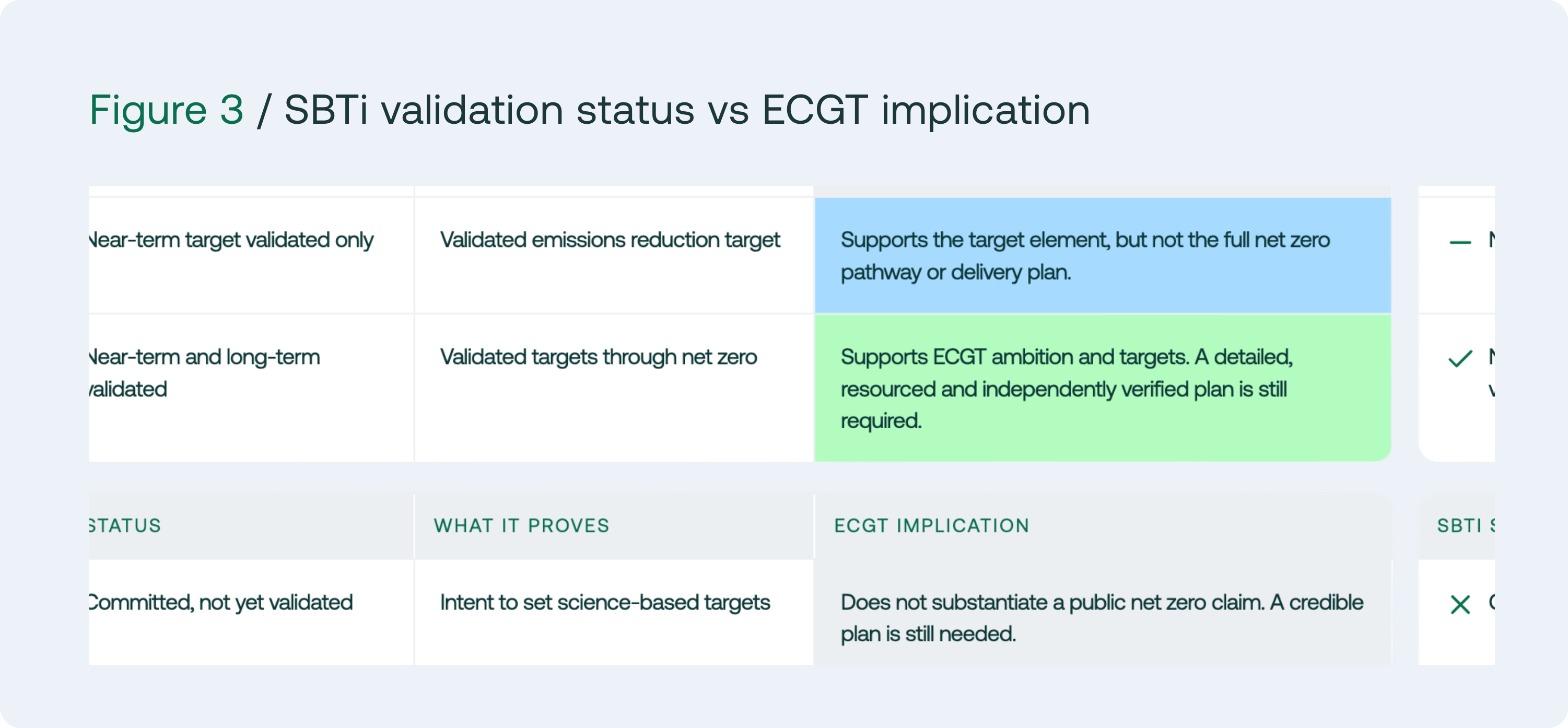
For public climate claims, SBTi validation substantiates the targets themselves, but not the reduction plan behind them, which SBTi does not review.
For a detailed explanation of what V2.0 requires at different company sizes and categories, see SBTi Corporate Net-Zero Standard V2.0: what you need to know today.
Under B Lab Standard 2.1, launched in 2025, climate performance is no longer a tradeable component of the B Corp assessment [4]. It is a mandatory requirement. [VERIFY: confirm exact launch date before publication]
For larger B Corps, typically those with 250+ employees or USD 75m+ revenue, the requirements are: Scope 1, 2, and 3 emissions measurement; a third-party verified GHG inventory; science-based targets validated by SBTi or independently verified; and a climate transition plan to net zero by 2050 [4]. For smaller B Corps: a published, Paris-aligned climate action plan with measurable targets, tracked and updated annually.
A substantiated net zero plan is a condition of maintaining B Corp certification for larger companies. For broader guidance on what the decarbonisation pathway looks like in practice, see SBTi V2.0 and beyond: your path to decarbonisation in our Knowledge Centre.
The legal or conditional obligation is triggered by four circumstances:
Even without these direct triggers, investor requirements, bank ESG covenants, and enterprise procurement teams are making a substantiated plan practically unavoidable for most organisations with 250+ employees and significant stakeholder relationships.
The frameworks do not yet converge on a single mandatory standard for all organisations. What they converge on is this: if you claim it, you must be able to prove it. ECGT makes that principle legally enforceable from September 27 in consumer-facing communications. CSRD embeds it in assurance-ready disclosure. B Lab and SBTi make it a condition of commitments organisations have already made.
The companies best positioned going into September 2026 assessed their obligations early, documented their evidence, and built their sustainability claims on a foundation that holds up to scrutiny.
As Anna Ma, Climate Director at Nexio Projects mentions:
“The frameworks converge on the same outcome. Whether ECGT triggers the legal requirement, CSRD triggers the disclosure obligation, SBTi triggers the validation criteria, or B Lab triggers the certification condition, the companies best positioned are those that treated a verified transition plan as a strategic decision, not a compliance response.”
Nexio Projects is an international sustainability consultancy guiding organisations on their journey from compliance to positive impact. We provide expert support across net zero strategy, SBTi target-setting, CSRD transition plan development, and ECGT compliance reviews, with a pragmatic, step-by-step approach.
Recognised as a top brand in sustainability by EUPD and as a leading boutique ESG consultancy by Verdantix, we work with sustainability directors and CFOs to map exactly which obligations apply to their situation and what a legally defensible transition plan requires.
If your organisation is navigating which framework creates a substantiated net zero plan obligation, speak with our Net Zero Transformation team. We will map the obligations that apply to your specific circumstances and clarify what an independently verified, legally defensible transition plan requires.
No. CSRD requires disclosure of whether you have a climate transition plan and an explanation if you do not.
If the claim is in a consumer-facing communication within ECGT’s scope, it is an automatically unlawful commercial practice. National enforcement authorities can require withdrawal, impose fines, and mandate corrective action.
Partially. SBTi validation substantiates the target, which is one element of ECGT’s requirement. It does not substantiate the plan to deliver it, because SBTi does not mandate or review a transition plan. To meet ECGT, companies also need a detailed, resourced implementation plan verified by an independent third-party expert.
For product-level carbon neutral claims directed at consumers, these are banned outright under ECGT. Companies can communicate transparently about carbon credit investments as supplementary information, but cannot use them to substantiate carbon neutral product claims.
Yes. CSRD compliance does not require setting net zero targets. A company without a transition plan must explain its absence in its ESRS E1-1 disclosure. Full CSRD compliance is achievable through robust disclosure rather than mandatory target-setting.
[1] EUR-Lex. Directive (EU) 2024/825. https://eur-lex.europa.eu/legal-content/EN/TXT/?uri=CELEX%3A32024L0825. Accessed July 2026. See also: European Commission. Q&A: ECGT Directive. [VERIFY URL — June 2026; locate at ec.europa.eu before publication.]
[2] EFRAG. ESRS E1 Climate Change, ESRS E1-1. [VERIFY: confirm currently in-force URL at efrag.org or eur-lex.europa.eu post-Omnibus revision before publication.]
[3] SBTi. Corporate Net-Zero Standard V2.0. [VERIFY: full URL for V2.0 June 2026 document at sciencebasedtargets.org before publication.]
[4] B Lab. B Corp Standards: Standard 2.1 Climate Requirements. https://www.bcorporation.net/en-us/standards/ [VERIFY: confirm Standard 2.1 exact launch date and specific climate requirements URL before publication.]
[5] Nexio Projects. ECGT green claims regulation: what changes on 27 September 2026. https://nexioprojects.com/ecgt-green-claims-regulation-september-2026/. Accessed July 2026.
[6] Nexio Projects. Omnibus finalised: the updated CSRD and next steps for companies. https://nexioprojects.com/knowledge-centre/omnibus-finalised-the-updated-csrd-and-next-steps-for-companies/. Accessed July 2026.
[7] Nexio Projects. SBTi Corporate Net-Zero Standard V2.0: what you need to know today. https://nexioprojects.com/sbti-corporate-net-zero-standard-v2-0-what-you-need-to-know-today/. Accessed July 2026.
[8] Nexio Projects. SBTi V2.0 and beyond: your path to decarbonisation. https://nexioprojects.com/knowledge-centre/sbti-v2-0-and-beyond-your-path-to-decarbonisation/. Accessed July 2026.


