ESG insights from November 2025: Sustainability in motion
November 30, 2025


• Companies in scope of the CSRD publish greenhouse gas (GHG) emissions every year, with comparative figures for the previous period.
• The revised ESRS E1 requires yearly updates of significant Scope 3 categories and a full Scope 3 refresh at least every three years.
• Acquisitions, divestments and method changes can trigger recalculation of earlier figures under the GHG Protocol.
• Major emission factor sources, such as the UK Government conversion factors and the IEA emission factors, publish new editions every year.
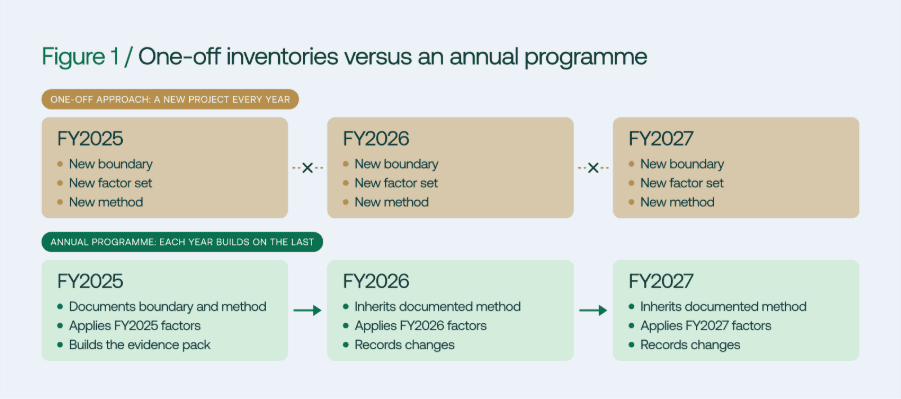
• A GHG inventory annual programme keeps boundaries, methods and evidence consistent, so each reporting cycle builds on the last.
“A GHG inventory proves its value in the second year, when last year’s decisions are documented and this year’s numbers can be compared.”
Most companies that remain in scope of the Corporate Sustainability Reporting Directive (CSRD) now report greenhouse gas emissions every year. Many still build each inventory as a separate project, with a new spreadsheet and a fresh set of assumptions. A GHG inventory annual programme is the more reliable route to consistent figures.
Anyone preparing a second or third sustainability statement will recognise the result. Last year’s boundary decisions are hard to trace. Emission factors come from different database versions. Prior-year figures no longer match this year’s method.
The 2026 simplification of EU reporting has narrowed who reports, without lowering the bar for those who do. From financial year 2027, the CSRD applies to EU undertakings with more than 1,000 employees and more than €450 million in net turnover [1]. For these companies, limited assurance remains the required level of assurance [2].
At Nexio Projects, we are a Rotterdam-based sustainability consultancy that has delivered 600+ sustainability projects across 30+ countries since 2018. Our CarbonCount programme maintains corporate GHG inventories year on year, combining GHG Protocol and ISO 14064-1 methodology with a dedicated data platform [3]. In this article, we explore the added value of GHG inventory as a continuous programme, as opposed to a one-off task.
The European Commission adopted the revised European Sustainability Reporting Standards (ESRS) on 3 July 2026. They are mandatory for financial years beginning on or after 1 January 2027 [4]. For financial year 2026, companies may keep the original ESRS, apply the revised standards early, or use the original set with selected reliefs [4].
Two parts of the standards shape how a GHG inventory must behave over time.
The first is comparability. ESRS 1 requires comparative information for the previous period [5]. Metrics must be consistent over time. When a company redefines a metric or revises a prior estimate, it must explain the change. It must also revise the comparative, unless that is impracticable [5].
The second is the content of disclosure requirement E1-8 in the revised ESRS E1. It covers gross Scope 1, Scope 2 and Scope 3 emissions, with Scope 2 reported on both a location-based and a market-based basis [6]. Financial control is the default reporting boundary, with equity share or operational control permitted as alternatives [6].
A consistent inventory is therefore a reporting requirement in its own right. Each year’s figures must stand next to last year’s and make sense.
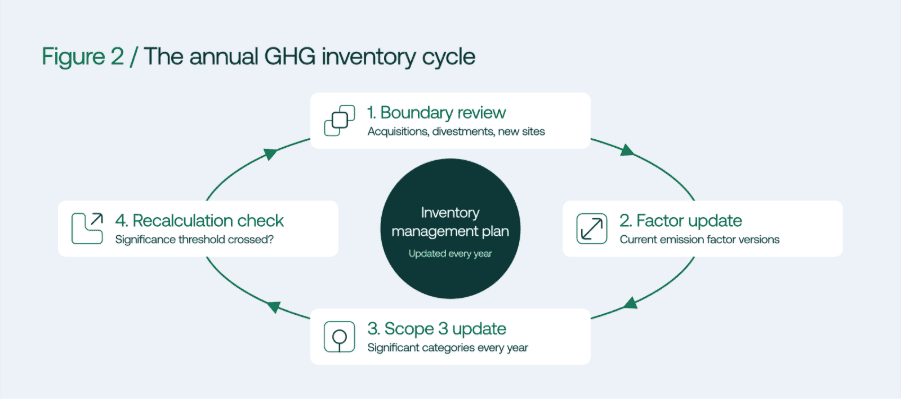
A GHG inventory reflects one organisational boundary at one point in time. Acquisitions, divestments, new sites and closures all move that boundary.
The GHG Protocol requires base year emissions to be recalculated when structural changes, such as acquisitions or divestments, change the inventory boundary [7]. Companies are expected to set a recalculation policy and a significance threshold, and apply it consistently [8]. The revised ESRS follow similar logic: when figures are revised, companies must explain the change and its effect on comparability [5].
A rebuilt inventory has no record of these decisions. A maintained inventory carries them forward.
Emission factors are published in versions, and those versions change. The UK Government conversion factors for company reporting are published annually, normally in the first half of June [9]. The IEA released its 2026 edition of electricity and heat emission factors on 25 September 2026 [10]. The ecoinvent database’s version 3.12 updated datasets for electricity, chemicals, metals and transport [11].
The GHG Protocol asks for inventories that are accurate, consistent and transparent [8]. In practice, that means recording which factor version applies to which year and documenting why it changed. The revised ESRS E1 also requires the most recent IPCC global warming potential values, based on a 100-year time horizon [6].
The revised ESRS E1 sets a clear rhythm for Scope 3 emissions. Companies screen their total Scope 3 emissions against the 15 GHG Protocol categories [6]. They then update each significant category every year with current activity data [6]. The full Scope 3 inventory must be updated at least every three years, or sooner after a significant event or change in circumstances [6].
A one-off approach cannot track this cycle. Our guide to measuring and reducing Scope 3 emissions explains how to prioritise the categories that matter most [12].
Repeating the inventory every year creates the opportunity to improve data quality and refine underlying assumptions. Over time, this builds a documented record of decarbonisation efforts. Year-on-year results show which interventions are delivering reductions, so companies can adjust their decarbonisation plans accordingly.
The sooner data for material emission sources reaches activity-data quality, the sooner its collection can be automated. From that point, the inventory starts working for the company, rather than the other way round.
“In a second-year inventory, the hardest question is usually why last year’s number was calculated the way it was.”
An annual programme treats carbon accounting as a ledger that runs alongside the financial accounts. Our article on understanding carbon accounting sets out this principle in more detail [13].
In practice, the programme rests on four elements:
This structure also protects against restatement surprises. Under ESRS 1, material errors in prior periods must be corrected by restating comparative amounts, unless this is impracticable [5]. A documented method makes errors easier to spot early and explain clearly.
CarbonCount is our annual GHG inventory programme. It combines GHG Protocol and ISO 14064-1 methodology with a dedicated platform [3].
The programme covers Scope 1, Scope 2 and all 15 Scope 3 categories [3]. Emission factor databases, including DEFRA, ADEME and IEA, are embedded in the platform, with full methodology documentation and traceable calculations [3]. Assurance providers can access the platform directly [3].
Each annual update starts from the previous year’s documented method. New factors are applied, organisational changes are recorded, and any recalculation is explained. Comparability is built into the process from the first year.
A GHG inventory that is rebuilt every year struggles to show the consistency that ESRS E1 and assurance providers look for. Boundaries move, factors change and Scope 3 categories follow their own cycle. Each of these needs a documented decision that carries into the next year.
An annual programme turns those decisions into a lasting asset. It is how emissions reporting moves from a compliance exercise to a reliable basis for decarbonisation, and from compliance to positive impact.
“Consistent emissions data is what lets a company prove progress, and progress is what stakeholders are really asking to see.”
We are an international sustainability consultancy that helps organisations move from compliance to positive impact. We support clients across climate solutions, ESG ratings, strategy and sustainability reporting.
Recognised as a boutique ESG strategy provider by Verdantix and among the top sustainability advisory firms in the SD400 2025 by MT/Sprout, we are here to make your emissions data consistent and assurance-ready every year.
Preparing your GHG inventory? Book a CarbonCount scoping call with our climate team. We will map the gaps between your current approach and ESRS E1. Then we will show you what an annual cycle could look like for your business.
[1] White & Case. Simplified, not abandoned: EU corporate sustainability after the Omnibus I package. https://www.whitecase.com/insight-alert/simplified-not-abandoned-eu-corporate-sustainability-after-omnibus-i-package. Accessed November 2026.
[2] AKD. Changes to the CSRD: Omnibus Directive enters into force on 18 March 2026. https://www.akd.eu/insights/provisional-agreement-on-omnibus-i-changes-to-the-scope-and-reporting-obligations-under-the-csrd. Accessed November 2026.
[3] Nexio Projects. Corporate GHG inventory. https://nexioprojects.com/solutions/ghg-inventory/
[4] EY. EU sustainability developments: European Commission adopts revised ESRS Delegated Act (July 2026). https://www.ey.com/content/dam/ey-unified-site/ey-com/en-gl/technical/csrd-technical-resources/documents/ey-gl-eu-sustainability-developments-v2-07-2026.pdf. Accessed November 2026.
[5] EFRAG. ESRS Knowledge Hub: 2026 Revised ESRS, ESRS 1 General requirements (Commission delegated act of 3 July 2026), chapter 7. https://knowledgehub.efrag.org/eng/interactive/simplified-esrs/esrs-1/delegated-act. Accessed November 2026.
[6] EFRAG. ESRS Knowledge Hub: 2026 Revised ESRS, ESRS E1 Climate change (Official Journal version, 21 September 2026), para 30 and AR 19, 20 and 24. https://knowledgehub.efrag.org/eng/interactive/simplified-esrs/esrs-e1/2026-09-21-official-journal. Accessed November 2026.
[7] GHG Protocol (WRI and WBCSD). Base year recalculation methodologies for structural changes, Appendix E to the Corporate Accounting and Reporting Standard. https://ghgprotocol.org/sites/default/files/2022-12/Base%20Year%20Adjustments.pdf. Accessed November 2026.
[8] GHG Protocol (WRI and WBCSD). A Corporate Accounting and Reporting Standard, Revised Edition, chapters 1 and 5. https://ghgprotocol.org/corporate-standard. Accessed November 2026.
[9] UK Department for Energy Security and Net Zero. Greenhouse gas reporting: conversion factors 2026 (published 11 June 2026). https://www.gov.uk/government/publications/greenhouse-gas-reporting-conversion-factors-2026. Accessed November 2026.
[10] International Energy Agency. Emissions Factors 2026. https://www.iea.org/data-and-statistics/data-product/emissions-factors-2026. Accessed November 2026.
[11] ecoinvent. ecoinvent version 3.12. https://support.ecoinvent.org/ecoinvent-version-3.12. Accessed November 2026.
[12] Nexio Projects. Scope 3 emissions: Measurement and reduction strategies. https://nexioprojects.com/scope-3-emissions-measurement-reduction-strategies/
[13] Nexio Projects. Decarbonisation 101 Part 1: Understanding carbon accounting and its importance. https://nexioprojects.com/decarbonisation-101-part-1-understanding-carbon-accounting-and-its-importance/