

 B Corp or EcoVadis, what’s the best choice for your company?
September 2, 2024


For a Sustainability Director managing B Corp recertification alongside a board ESG mandate or investor sustainability requirement, September 2026 brings two linked deadlines. Both ask the same question: can you prove what you are claiming?
ECGT (EmpCo – Empowering Consumers for the Green Transition Directive), or Directive (EU) 2024/825, applies across the European Union from 27 September 2026 [1][2]. B Lab Standards V2.2 is the current revision of the certification framework, following the broader shift toward mandatory minimum requirements and independent assurance [3].
Nexio Projects provides B Corp certification and recertification support, ECGT claims reviews, climate strategy and sustainability reporting. We have guided more than 400 clients across over 1,000 projects in more than 20 countries. The evidence behind what a B Corp company says publicly about its environmental performance requires careful review.
B Lab Standards V2.2 is the current revision of the V2 framework. The Climate Action impact topic did not change in this update [3][4].
The main V2.2 updates concern Foundation Requirements. The climate requirements below therefore remain relevant current requirements. They should not be presented as new Climate Action changes introduced by V2.2.
This distinction matters because ECGT focuses attention on the evidence behind public claims. Companies should connect existing climate documentation to the language used across their public channels.
According to Nadia Scheepens, Sustainability Expert at Nexio Projects,
“V2.2 did not change the Climate Action impact topic. The priority is to connect existing climate evidence to every public claim made about it.”
Under current B Lab Standards V2.2, climate remains a mandatory requirement for certified companies, regardless of size or sector [4].
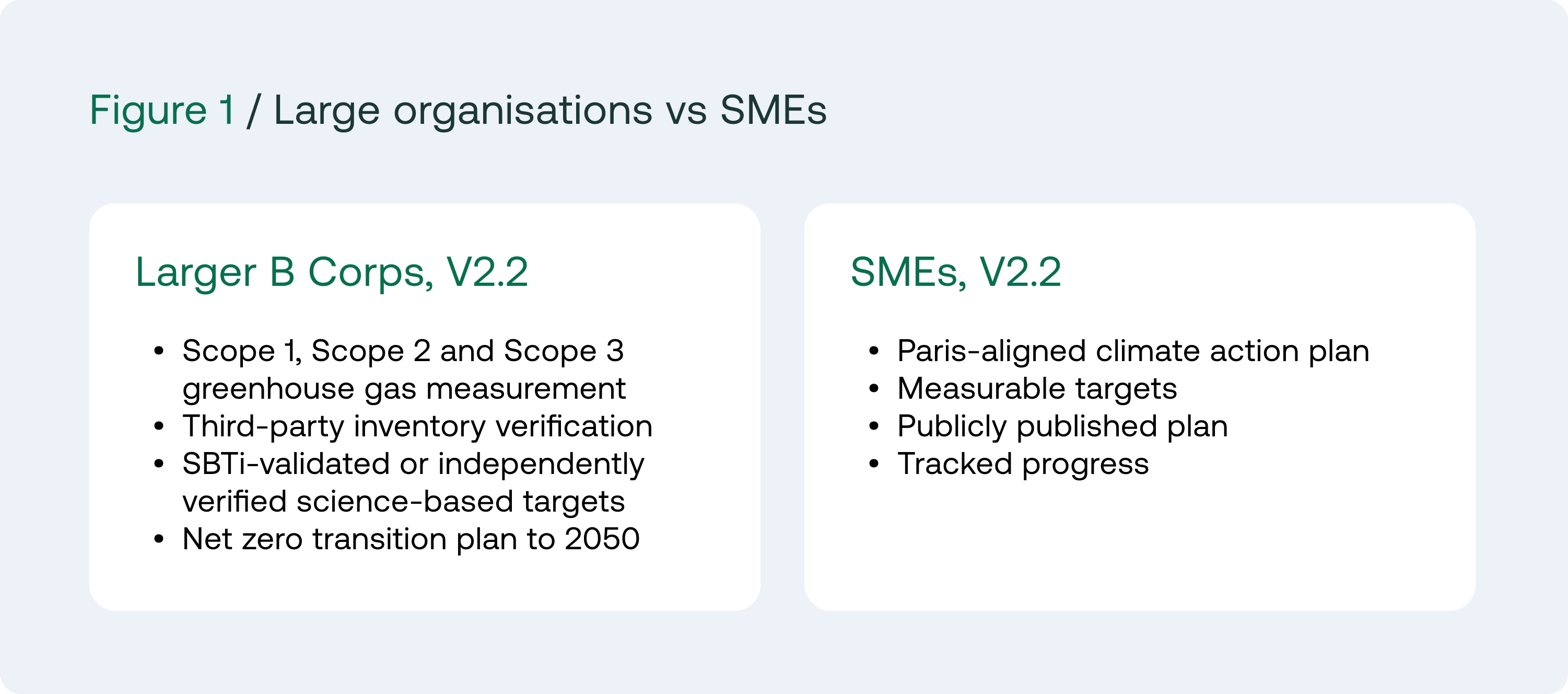
For larger organisations, the standards require measurement of Scope 1, Scope 2 and Scope 3 greenhouse gas emissions. The inventory must undergo third-party verification. Companies must also set science-based targets validated by the Science Based Targets initiative, or independently verified by an equivalent third party [4].
A climate transition plan aligned with net zero by 2050 is also required. Our article on the SBTi Corporate Net-Zero Standard V2.0 explains the current methodology for target setting and validation [7].
For smaller certified companies, current B Lab Standards V2.2 require a publicly available climate action plan. The plan must contain measurable targets aligned with the Paris Agreement. Companies must track progress over time [4].
SBTi validation is not mandatory for SMEs under these requirements. A credible, documented and publicly available plan is required. An internal plan that has not been published does not meet the public disclosure expectation.
All B Corps must publish their climate plans and progress. That public visibility creates the clearest connection with ECGT [1][4].
The European Commission’s FAQ confirms that ECGT primarily concerns business-to-consumer commercial practices [1]. It does not create a general business-to-business sustainability reporting regime.
For B Corp companies that sell or market to EU consumers, the direct consumer-facing scope applies. Companies operating primarily business to business can still face indirect exposure through public websites, product packaging, investor communications and sustainability reports accessible to consumers.
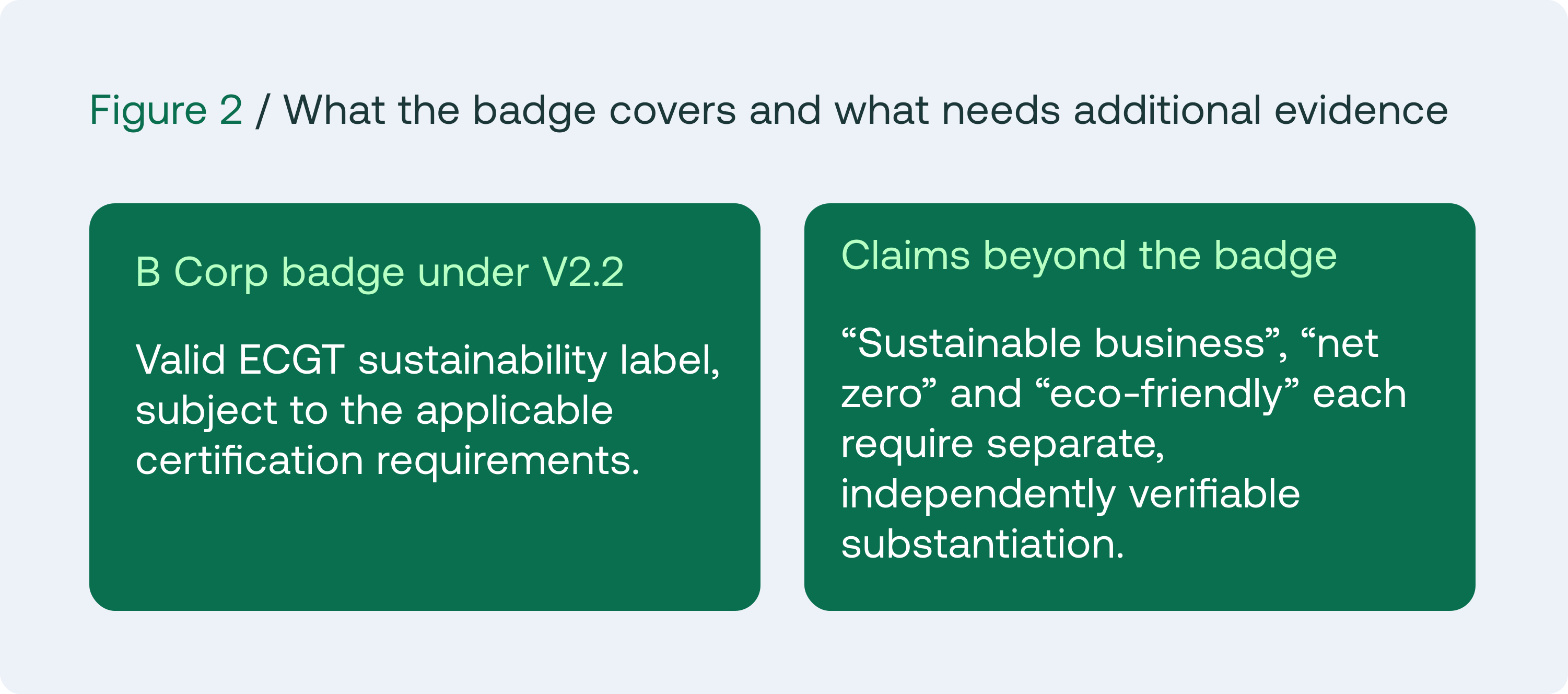
B Lab’s guidance confirms that B Corp certification under the current V2.2 framework and assurance model can meet the requirements for a valid sustainability label under ECGT [5]. B Corp Europe’s recertification guidance states: “Under the new certification model, B Corp certification will meet the legal requirements for a valid sustainability label in the EU.” [6]
Displaying the badge with the statement “Certified B Corporation” can therefore provide a recognised certification claim from 27 September 2026, subject to the company meeting the applicable B Lab requirements [5][6].
The badge and the language built around it require separate analysis. Generic statements such as “we are a sustainable business”, “committed to the environment” or “our operations are net zero” require their own evidence under ECGT [1].
The certification provides a defined evidence base. Each additional environmental claim requires a separate assessment against the evidence supporting it. As Anna Ma, Climate Director at Nexio Projects, stated:
“The certification is not the risk. The language marketing teams have been building around it for years requires separate evidence.”
Companies can also review substantiated net zero plans under ECGT before publishing forward-looking climate claims [8].
Three areas require attention before the application date. Each area has a different evidence requirement.
Companies that have not recertified under the current V2.2 requirements should verify their position with B Lab. B Lab has confirmed that certification under the current framework and assurance model is relevant to recognised sustainability label status under ECGT [5][6].
Companies operating under an earlier certification position should confirm their recertification timeline without delay.
If certification cannot be maintained under the current framework, the B Corp logo may need to be withdrawn from relevant materials. Companies should confirm the applicable requirements and deadlines directly with B Lab.
Our article on the 2026 B Corp recertification changes covers the transition in greater detail [9].
Current B Lab Standards V2.2 require a publicly available climate plan. For larger companies, the plan must connect to SBTi-validated or independently verified science-based targets. For SMEs, it must contain measurable, Paris-aligned targets and publicly disclosed progress [4].
The climate plan supports climate-related marketing claims when the claim accurately reflects the evidence. “On our path to net zero” requires a published and credible transition plan. A company should not publish this statement without documentation that supports the commitment [1][8].
Companies reviewing terminology can also consult our article on carbon neutral versus net zero [10].
For companies that have not established their climate commitment, our knowledge centre guide, SBTi V2.0 and beyond: your path to decarbonisation, outlines current options [11].
Companies can also review using EPDs to substantiate environmental claims where product-level evidence is relevant [12].
Claims that cannot be supported should be corrected, qualified or removed before 27 September.
This audit does not require external support to begin. It requires one person, a complete list of customer-facing channels and a clear substantiation brief.
Current B Lab Standards V2.2 and ECGT place greater emphasis on evidence behind public sustainability claims. The Climate Action impact topic did not change in V2.2. Its existing requirements remain relevant because companies must connect climate commitments with the claims they publish.
The current framework establishes the certification baseline. ECGT adds scrutiny to the wider language used across websites, packaging, reports and other consumer-facing channels.
A three-part review can be completed within days. Confirm V2.2 certification status, check the climate commitment documentation and map every public claim to supporting evidence. Acting before 27 September gives companies time to correct unclear or unsupported communications.
“A credible sustainability claim should lead directly to the evidence that supports it. That evidence needs to be clear enough for a customer, board member or regulator to understand.”
We are an international sustainability consultancy dedicated to guiding organisations on their journey from compliance to positive impact. We provide expert support across B Corp certification and recertification, ECGT claims reviews, climate strategy and comprehensive sustainability reporting.
Recognised as the best ESG consultancy in the Netherlands by Consultancy NL and as a top sustainability advisory firm in Europe by MT/Sprout SD400, we are here to make your sustainability credentials as defensible as your sustainability ambition.
If you are navigating B Corp Standards V2.2 alongside the ECGT application date, book a scoping call with our team. We will review your certification status, climate documentation and public claims inventory in one focused session.
No. The B Corp badge can qualify as a recognised sustainability label under the current B Lab framework [5]. Environmental claims made beyond the badge require their own substantiation.
“We are a sustainable business” is not automatically supported by B Corp certification alone.
An SME needs a publicly available climate action plan with measurable targets aligned with the Paris Agreement. The company must track progress over time [4].
SBTi validation is not mandatory for SMEs under the current Climate Action requirements.
ECGT primarily concerns consumer-facing commercial practices [1]. Business-to-business companies can still face indirect exposure through public websites, product packaging, investor communications, tender materials and customer requirements.
Legal review is recommended for each company’s specific communications and market context.
Companies should confirm their current certification position and recertification deadline with B Lab. Certification under the current framework is relevant to the recognised sustainability label treatment described in B Lab’s ECGT guidance [5][6].
Companies should also review the use of the B Corp logo and certification wording across all public materials.
An SBTi-validated target provides an independently assessed, time-bound basis for a forward-looking climate commitment. It can help demonstrate that a net zero claim is supported by a credible implementation plan and evidence trail [1][7][8].
The claim must still accurately reflect the scope, timeframe and evidence behind the target.
[1] European Commission. FAQ: Empowering Consumers for the Green Transition Directive. https://commission.europa.eu/document/download/3c257883-bb2a-4dd9-a6dc-501d587bb34f_en?filename=faq-empowerting-consumers-gtd.pdf. Published June 2026. Accessed August 2026.
[2] European Union. Directive (EU) 2024/825 of the European Parliament and of the Council. https://eur-lex.europa.eu/eli/dir/2024/825/oj/eng. Published March 2024. Accessed August 2026.
[3] B Lab Knowledge Base. FAQs: Updates to B Lab Standards, Release of V2. https://kb.bimpactassessment.net/en/support/solutions/articles/43000761432-faqs-updates-to-b-lab-standards-release-of-v2. Updated February 2026. Accessed August 2026.
[4] B Lab Knowledge Base. Impact Topic Summary for Climate Action. https://kb.bimpactassessment.net/en/support/solutions/articles/43000760406-impact-topic-summary-for-climate-action. Accessed August 2026.
[5] B Lab Knowledge Base. B Lab Standards and EU Empowering Consumers for the Green Transition Directive. https://kb.bimpactassessment.net/en/support/solutions/articles/43000764829-b-lab-standards-eu-empowering-consumers-for-the-green-transition-ecgt-directive. Accessed August 2026.
[6] B Corp Europe. Recertification for B Corps. https://bcorporation.eu/resources/for-b-corps/recertification/. Accessed August 2026.
[7] Nexio Projects. SBTi Corporate Net-Zero Standard V2.0: What you need to know today. https://nexioprojects.com/sbti-corporate-net-zero-standard-v2-0-what-you-need-to-know-today/. Published July 2026. Accessed August 2026.
[8] Nexio Projects. Is a substantiated net zero plan mandatory for your targets? https://nexioprojects.com/is-a-substantiated-net-zero-plan-mandatory-for-your-targets/. Published July 2026. Accessed August 2026.
[9] Nexio Projects. Navigating the 2026 B Corp recertification: What has changed and why it matters. https://nexioprojects.com/navigating-the-new-b-corp-certification-what-has-changed-and-why-it-matters/. Accessed August 2026.
[10] Nexio Projects. Carbon neutral versus net zero: What is the difference and why it matters. https://nexioprojects.com/carbon-neutral-vs-net-zero-whats-the-difference-and-why-it-matters/. Published May 2026. Accessed August 2026.
[11] Nexio Projects. SBTi V2.0 and beyond: Your path to decarbonisation. https://nexioprojects.com/knowledge-centre/sbti-v2-0-and-beyond-your-path-to-decarbonisation/. Published July 2026. Accessed August 2026.
[12] Nexio Projects. How to use your EPD to communicate your environmental impact. https://nexioprojects.com/how-to-use-your-epd-to-communicate-your-environmental-impact/. Published April 2026. Accessed August 2026.
[13] Nexio Projects. Nexio Projects information pack 2025. Internal SharePoint source. https://nexioprojects.sharepoint.com/sites/MarketingTeam/_layouts/15/Doc.aspx?sourcedoc=%7BA6DAFCDC-7E7C-4060-B20B-F2123B776029%7D&file=Nexio%20Projects_info%20pack%202025.pptx&action=edit&mobileredirect=true. Accessed August 2026.
[14] Nexio Projects. 2025 Verification checklist A, B and C for EPDs. Internal Operations SharePoint source. https://nexioprojects.sharepoint.com/sites/OperationsTeam/_layouts/15/Doc.aspx?sourcedoc=%7BDCDC5F9D-1445-4CD3-87AF-2EA434363899%7D&file=2025%20Verification%20checklist%20A%20B%20and%20C%20for%20EPDs_V8%20(1).docx&action=default&mobileredirect=true. Accessed August 2026.
[15] Consultancy NL. Best ESG consultancy in the Netherlands, 2025. https://www.consultancy.nl/rankings/2025/beste-adviesbureaus-van-nederland-per-vakgebied-2025/esg. Accessed August 2026.
[16] MT/Sprout. SD400 2025: Sustainability advisory firms. https://mtsprout.nl/ranking/sd400-2025/categorie/adviesbureaus-in-sustainability. Accessed August 2026.


