The Omnibus shift: Key implications for ESG reporting
January 19, 2026


states Stephanie Pragastis, Senior Sustainability Consultant at Nexio Projects, to open up the topic of sustainable supply chain pressure in North America.
Procurement teams are being asked to move faster, source more flexibly, and cut costs, while simultaneously demonstrating that their supply chain meets rising ESG standards. Those two demands used to feel separate. They no longer are.
On 23 June 2026, Nexio Projects and EcoVadis co-hosted a webinar on supply chain resilience for North American organisations: Supply chains under pressure: Sustainability resilience with EcoVadis. Stephanie Pragastis, Senior Sustainability Consultant at Nexio Projects, and Ross Regen, Senior Enterprise Account Executive at EcoVadis, brought together data, real-world examples, and practical frameworks for teams that are already stretched. What follows draws directly from that session.
Before addressing resilience, it helps to understand the scale of what procurement teams are actually responsible for. More than 80% of an organisation’s sustainability footprint sits within its supply chain [1]. Scope 3 emissions account for approximately 90% of total corporate GHG emissions [2]. 75% of cases of child and forced labour are found in supply chains, often multiple tiers deep[3]. The implication is direct: internal policies alone cannot close these exposures.
The financial stakes are equally significant. EcoVadis and Accenture’s 2026 Business Sustainability Barometer, drawing on over 1,000 multinational organisations with revenues above $1 billion, found that supply chain disruptions cost companies $1.6 trillion in annual revenue growth potential [4]. Some 52% of executives reported losing the equivalent of a month of operating capacity every year due to disruptions [4]. The same research identified a 3.6% revenue growth advantage for companies with more resilient supply chains [4].
For North American organisations specifically, four operational pressures are compounding at the same time [5]:
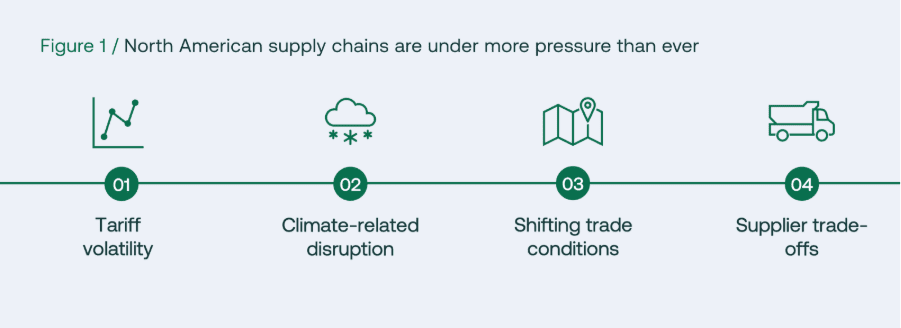
These four pressures collapse into three specific tensions that procurement teams navigate daily.
The first is cost versus sustainability investment. When tariffs raise input costs or margin pressure intensifies, sourcing from cheaper suppliers feels like the rational response. But that trade-off carries a deferred cost.
“Cutting corners on supplier standards is also a cost. It just gets paid later. And usually at a higher price.” [6]
The second is new supply geographies versus environmental trade-offs. Diversifying away from high-tariff countries often means moving into geographies with weaker environmental standards and regulations. The commercial decision may make sense in the short term, but it frequently increases Scope 3 emissions through longer logistics routes and raises labour-risk exposure.
The third is supplier vetting versus operational speed. Every new supplier onboarded under time pressure is a supplier whose ESG profile has not been properly mapped. The due diligence gap that results does not stay invisible. It surfaces later, in an audit, a customer questionnaire, or a public incident.
Supply chain due diligence laws are now adding legal liability to what was previously a reputational risk. The regulatory landscape reaching North American companies includes the US Uyghur Forced Labor Prevention Act (UFLPA), California’s Climate Accountability Package (SB 253 and SB 261), the EU Corporate Sustainability Due Diligence Directive (CSDDD), the EU Corporate Sustainability Reporting Directive (CSRD), the EU Carbon Border Adjustment Mechanism (CBAM), the Canadian Fighting Against Forced Labour and Child Labour in Supply Chains Act, and the UK Modern Slavery Act, among others [5]. This list is non-exhaustive and continues to grow.
A common assumption among North American companies is that European legislation does not apply to them. The indirect effect, however, is already arriving. European companies are required to understand and document the risks in their upstream supply chains. To do that, they need information from their suppliers, including those based in the US, Canada, and Mexico. North American companies are beginning to see more contractual clauses, codes of conduct, and formal requests for evidence of sustainability standards. Failing to meet these requirements can mean losing preferred supplier status, facing contract exclusions, or being deprioritised in sourcing decisions [6].
The question has reached board level. As Ross Regen noted in the webinar: “Your CFO and General Counsel are asking a different but related question: what is our exposure, who owns it, and how are we going to manage it?” [7] Much of the risk is not insurable. The day-to-day management of supplier standards is an operational responsibility — and it sits with procurement.
For more on how climate-related and ESG regulations are shaping supply chain financial exposure, Nexio Projects’ article on climate risk integration covers the financial integration gap in detail.
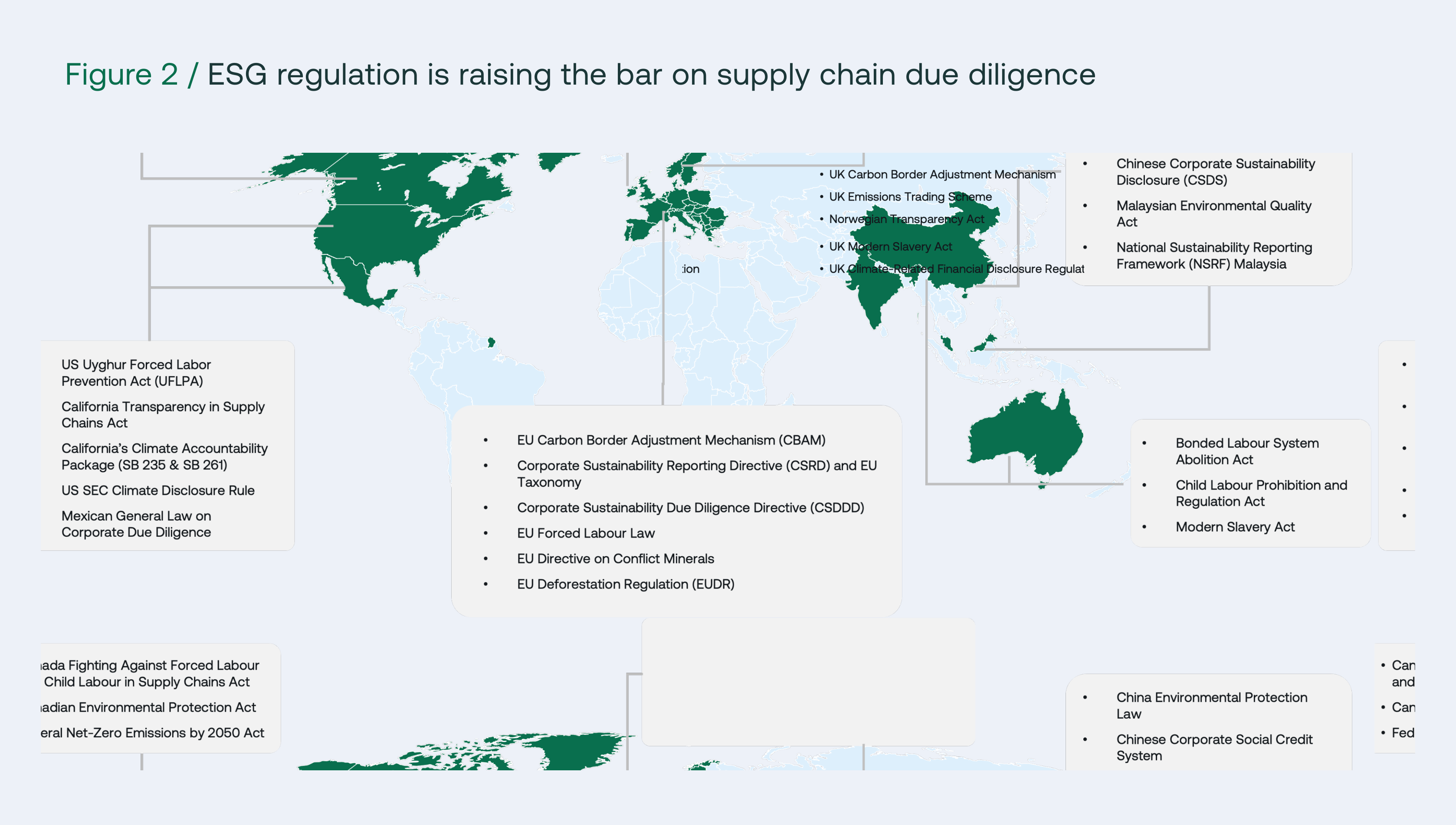
Beneath CSDDD, UFLPA, CSRD, and every other regulation in scope sits one common requirement: a structured due diligence process. Rather than building a separate response to each regulatory instrument, building a robust due diligence system once creates the foundation that meets multiple requirements simultaneously.
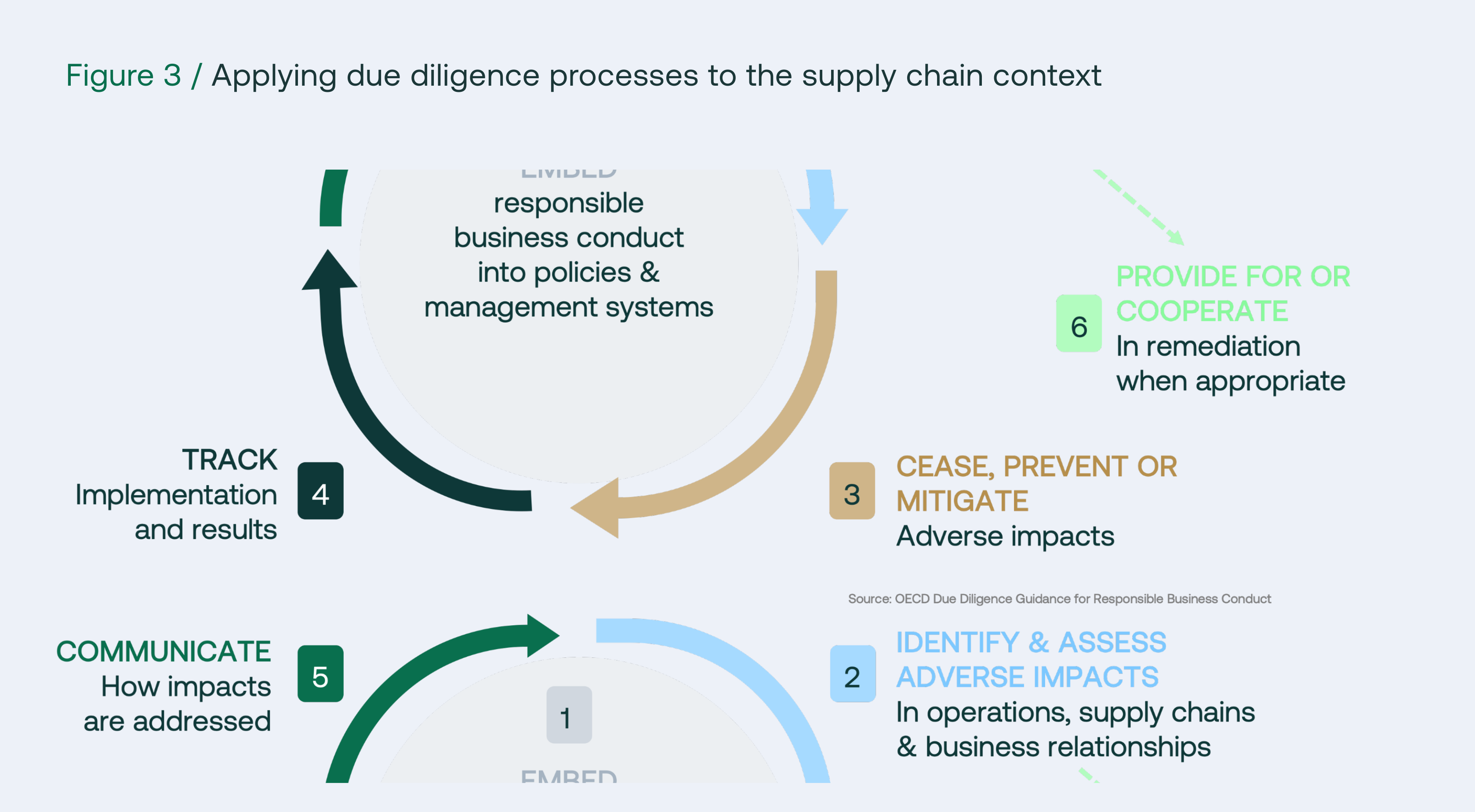
The OECD Due Diligence Guidance for Responsible Business Conduct provides that foundation. It defines supply chain due diligence as “the process enterprises should carry out to identify, prevent, mitigate and account for how they address actual and potential adverse impacts in their value chain” [9]. The six steps of the OECD model are [9]:
The value of this model is that it loops. Risk is dynamic, supplier bases change, and geographies shift. A due diligence process that runs once and is not revisited creates a false sense of assurance: compliant on paper, exposed in practice.
This is also the approach underpinning major legislative frameworks. CSRD, CSDDD, UFLPA, and the Canadian Forced Labour Act all align to OECD due diligence logic. Companies that build their programme around this foundation are positioned well regardless of which specific regulation comes into scope next.
Understanding the framework is one thing. Applying it consistently, at scale, with a stretched team is another. The webinar identified five common pitfalls that prevent programmes from delivering real improvement [5]:
1. Treating due diligence as a one-off checkbox. A supplier assessed once and never revisited creates a snapshot, not a programme. Risk changes; the assessment needs to keep pace.
2. Over-surveying suppliers instead of applying risk-based focus. Long, generic questionnaires sent to every supplier drive low response rates and superficial answers. Teams end up chasing data rather than managing risk. The practical shift is to calibrate the depth of assessment to the risk profile of the supplier: sector, geography, spend level, and spend category.
3. Weak corrective action plans. Identifying an issue is only half the work. Corrective actions with no named owner, no timeline, and no evidence requirement produce repeat findings. Holding every action to a clear standard — root cause, owner, due date, evidence of closure — is what turns “we found something” into “we fixed it.”
4. No link to procurement decisions. If sustainability findings do not influence sourcing outcomes, suppliers learn quickly that there are no consequences. High-risk issues persist. The data needs to feed into the sourcing workflow itself.
5. Poor change management. Unclear ownership and an absence of internal communication on why due diligence matters leads to resistance. Supplier due diligence is treated as administration, not risk management. Adoption breaks down.
Nexio Projects’ guide to improving supply chain transparency with EcoVadis covers the practical steps for procurement teams building a supplier engagement programme from the buying-organisation perspective.
The OECD framework sets the architecture. EcoVadis provides the operational infrastructure to run it at scale. The EcoVadis 2026 Barometer identified five pillars of supply chain sustainability resilience [4]:
The starting point is being able to put a financial figure on supply chain sustainability risk, so that procurement conversations move from sustainability language to business language. Moving from spend-based emission estimates to primary supplier data, for example, can significantly reduce the cost basis of Scope 3 reporting while improving accuracy.
Approximately 71% of US companies have visibility into their Tier 1 supplier base [4]. Only around one third have any visibility into Tier 2 [4]. EcoVadis does not claim to map every supplier at every tier, but it does enable management systems that give procurement teams the confidence to stand behind their Tier 1 disclosures and extend structured oversight into Tier 2.
Fewer than one in three US companies have fully integrated sustainability into their procurement systems [4]. EcoVadis integrates with procurement platforms including SAP Ariba, Coupa, Ivalua, and Zip, making sustainability data available at the point of sourcing decisions rather than in a separate sustainability report.
Meeting suppliers where they are, rather than sending a compliance document and waiting for a response, drives better outcomes. The engagement model, which includes training, corrective action plan support, and Academy access for suppliers, builds capacity rather than just measuring gaps.
The clearest signal of this is co-innovation. When buyers and suppliers work together on lower-footprint solutions, the benefits frequently compound: lower unit costs, reduced carbon footprint, and stronger commercial relationships.
The network effect behind these results is substantial. EcoVadis monitors more than 175,000 rated companies, works with over 44,000 active buyers, and has 500+ in-house analysts verifying that submitted documents are authentic and complete [4]. Independent research backs the commercial case: 65% of US executives say supply chain sustainability is a competitive advantage that helps them grow faster and reduce costs [10]. Advanced sustainable procurement has been linked to a three-percentage-point improvement in EBITDA margins [9].
For practical guidance on managing EcoVadis as a rated company, the EcoVadis Help Desk: Your questions answered article addresses the most common assessment questions by journey step.
Tariff volatility, climate-driven disruption, shifting trade routes, and ESG regulation are not separate problems landing on procurement at different times. They are converging simultaneously, and the organisations that have built structured supply chain sustainability resilience strategies are absorbing these pressures rather than being destabilised by them.
The path forward does not require unlimited capacity or a perfect data set from day one. It requires a structured process, applied consistently, built on a foundation that meets the regulatory requirements of today and the ones that are coming. The OECD due diligence cycle provides that foundation. EcoVadis provides the intelligence and coverage infrastructure to run it at scale. And the right external support ensures that the process is proportionate, practical, and embedded — not a one-off checkbox that will surface the same gaps next year.
You can watch the full webinar on demand for more details on the topic: Supply chains under pressure: Sustainability resilience with EcoVadis. We’re an international sustainability consultancy dedicated to guiding organisations on their journey from compliance to purpose. Our experts can support you across supply chain due diligence, supplier engagement programmes, EcoVadis support for both buying organisations and rated companies, and Scope 3 data collection. Ultimately, Nexio Projects helps clients build sustainable procurement systems that are scalable, practical, and built for the regulatory landscape ahead.
Recognised as a leading boutique ESG and sustainability strategy consultancy by Verdantix and as the best ESG consultancy in the Netherlands for 2025 by Consultancy NL, we are here to help you turn supply chain risk into supply chain resilience.
Interested in support? Talk to our experts directly!
[1] EcoVadis. 5-Step Guide to Building a Business Case for Sustainable Procurement. https://resources.ecovadis.com/whitepapers/5-step-guide-to-building-a-business-case-for-sustainable-procurement. Accessed June 2026.
[2] McKinsey & Company. Tackling Scope 3 Emissions Through Supplier Collaboration. https://www.mckinsey.com/capabilities/sustainability/our-insights/sustainability-blog/tackling-scope-3-emissions-through-supplier-collaboration. Accessed June 2026.
[3] The Sustainability Consortium and McKinsey. Greening Global Supply Chains: From Blindspots to Hotspots to Action. https://sustainabilityconsortium.org/download/greening-global-supply-chains-from-blindspots-to-hotspots-to-action/. Accessed June 2026.
[4] EcoVadis and Accenture. The Business Impact of Sustainable Procurement: 2026 Barometer Report. Published April 2026. Internal reference from webinar slide deck: “(Slides) Supply chains under pressure — Sustainability resilience with EcoVadis (North America)”, Slide 9, Slide 28. Nexio Projects SharePoint, June 2026.
[5] Nexio Projects and EcoVadis. Supply chains under pressure: Sustainability resilience with EcoVadis (North America) — webinar slide deck, Slides 10–15. Presented 23 June 2026.
[6] Pragastis, S. Supply chains under pressure webinar transcript, 23 June 2026. Minutes 12:20–12:25 and 17:24–17:48. Internal recording, Nexio Projects.
[7] Regen, R. Supply chains under pressure webinar transcript, 23 June 2026. Minutes 20:17–20:35. Internal recording, Nexio Projects.
[8] OECD. OECD Guidance for Multinational Enterprises on Responsible Business Conduct. https://www.oecd.org/investment/due-diligence-guidance-for-responsible-business-conduct.htm. Accessed June 2026.
[9] Bain & Company. Do ESG Efforts Create Value? https://www.bain.com/insights/do-esg-efforts-create-value/. Accessed June 2026. (Note: confirm this is the most current Bain publication on this topic before publishing.)