The Omnibus shift: Key implications for ESG reporting
January 19, 2026


Welcome to the July edition of Sustainability in Motion, our monthly roundup of ESG trends, practical insights and moments from across Nexio Projects.
This month focused on clarity. We looked at how organisations can scale Scope 3 work across large supplier bases, what it takes to move through each EcoVadis medal level, and what the revised European Sustainability Reporting Standards mean for reporting teams.
Here is what we have been up to:

Supply chain emissions account for between 60% and 90% of total corporate greenhouse gas emissions for many manufacturing and consumer goods companies. [1]
Reducing these emissions requires more than sending data requests to suppliers. It requires a structured programme that connects sustainability, procurement and commercial decision making.

We recently looked back at several projects involving product carbon footprints and supplier engagement at scale. Five lessons stood out:
Our article on reducing Scope 3 emissions at scale explores these lessons in more detail.
We also spoke with Sai Gadamsetty from Unilever about the decisions, challenges and lessons from a project involving reduction plans across more than 60 suppliers. Watch Voices from the field to hear the practical story behind the work.

EcoVadis medals are based on percentile rankings across the global assessment database. Platinum represents the top 1%, Gold the top 5%, Silver the top 15% and Bronze the top 35%. [2] Each level reflects a different stage of sustainability management maturity.
Moving from the Committed Badge to Bronze requires a basic management structure. This includes written policies, initial measures and evidence that a system is operating.
Moving from Bronze to Silver requires greater consistency across the organisation. Common gaps include limited KPI reporting, incomplete coverage of activated criteria and weak multi year data.
At Gold level, organisations need to show that their systems work in practice. Strong submissions typically include quantitative targets, public reporting aligned with a recognised standard and documented measures for every activated criterion.
Platinum reflects deeper integration. Organisations need broader policy coverage, multiple actions across activated criteria and externally verified reporting over several consecutive years.
The score ranges referenced in our July newsletter are based on Nexio Projects’ benchmarking data. They should not be treated as fixed EcoVadis thresholds, because official medal eligibility depends on percentile ranking and other criteria.
Read our guide to EcoVadis activated criteria by sector to understand how the assessment can differ between manufacturing, FMCG and chemicals organisations.
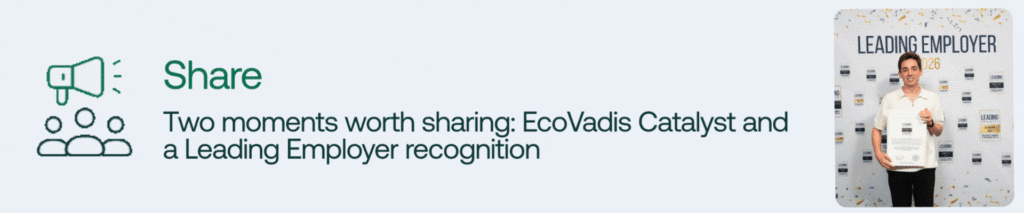
On 7 July, our Co CEO Marc Roodhuyzen de Vries joined a panel at EcoVadis Catalyst 2026.
The virtual event brought together EcoVadis strategic partners and organisations working through the practical challenges of sustainability assessments. Marc shared guidance on where to start, how to align internal stakeholders and how to connect assessment work with business value. [1]
The discussion reflected an important point. An EcoVadis assessment should help organisations understand their management system and prioritise improvements. It should also support better decisions across procurement, operations and leadership.
We were also recognised as a Leading Employer Netherlands 2026. Our People Specialist, Can Yoruk, accepted the recognition on behalf of the team.
The recognition places us among the top 1% of employers in the Netherlands, according to the July newsletter. It reflects the care and intention that our team brings to building a culture where people feel supported, trusted and empowered to grow. [1]

On 3 July 2026, the European Commission adopted revised European Sustainability Reporting Standards. The delegated act then entered a scrutiny period for the European Parliament and Council, which may last two months and be extended by a further two months. The revised standards are therefore subject to finalisation before they enter into force. [3]
The main changes include:
The revised standards are intended to apply from financial year 2027, with a voluntary option for financial year 2026. [1] [3]
Fewer datapoints do not remove the need for reliable information. Reporting teams still need clear ownership, robust data collection, internal controls and audit trails.
EFRAG’s 2026 State of Play report provides further context. The analysis covered 905 assured sustainability statements for financial year 2025. It found that 82% of companies had updated their Double Materiality Assessment, while Climate Transition Plan disclosures increased from 55% to 69%. Only 57% of companies reported decarbonisation targets aligned with a 1.5°C pathway. [4]
The findings show that reporting practices are becoming more established. They also show that the quality and depth of implementation still varies between organisations.
Our supply chain emissions guide provides a practical starting point for organisations strengthening their climate data and supplier engagement processes.
25 August 2026, 4:00 PM CEST | 9:00 AM EDT | 6:00 AM PDT | Sign up
See the full webinars and events page for what is coming up.
Are you in need of support in any of these ESG topics? Nexio Projects experts are ready to talk. Book a discovery call now!
[1] Nexio Projects. July newsletter. https://app.notion.com/p/July-newsletter-3a307ef851ca80bfa482c5bba50d9c35. Accessed August 2026.
[2] EcoVadis. Understanding EcoVadis Medals and Badges. https://support.ecovadis.com/hc/en-us/articles/210460227-Understanding-EcoVadis-Medals-and-Badges. Accessed August 2026.
[3] European Commission. Commission adopts revised sustainability reporting standards to reduce administrative burdens for EU businesses while maintaining high-quality disclosures. https://finance.ec.europa.eu/news/commission-adopts-revised-sustainability-reporting-standards-reduce-administrative-burdens-eu-2026-07-03_en. Accessed August 2026.
[4] EFRAG. EFRAG State of Play 2026 Report Now Available. https://www.efrag.org/en/news-and-calendar/news/efrag-state-of-play-2026-report-now-available. Accessed August 2026.