 How Nexio Projects helps you master your EcoVadis assessment
June 20, 2025


The EPD is registered. The third party verification is complete. The background report is filed. Many supply chain directors stop there. In doing so, they leave most of the EPD commercial and compliance value unused.
A registered Environmental Product Declaration is one of the most useful documents a manufacturer or supplier can hold. Enterprise customers use it for Scope 3 reporting. Procurement teams use it for tender qualification. Legal teams use it to substantiate environmental claims against ECGT and CBAM obligations. Product engineers use the underlying LCA data to identify where environmental impact is concentrated in the supply chain, then reduce it.
GWP is usually the figure that gets all the attention, and for good reason. It is directly tied to corporate climate targets and carbon reporting. However, an EPD includes more than GHG. Depending on the PCR and standard applied, it can also report indicators such as acidification, eutrophication, photochemical ozone formation, ozone depletion, resource use, and other impact categories. Mentioning and using the broader indicator set signals technical credibility, and it helps customers who need more than a single carbon number.
Unlocking EPD value requires more than registration. It requires a communication strategy, a clear understanding of what each audience needs, and a deliberate plan for using the LCA data to drive supply chain improvement. This article sets out both.
Upload the full EPD and a one page plain language summary to your website and product pages. Key figures like GWP per functional unit, programme operator, PCR applied, and validity date should be visible without opening the full document. If your EPD reports additional indicators that your customers care about, make those easy to find too. Many procurement and sustainability teams want the full impact profile, not only climate.
When a customer procurement team requests environmental data as part of a supplier qualification, the answer should be retrievable in under two minutes. In most organisations, it is not.
Raw numbers carry limited meaning without a reference point. This is true for GWP and it is also true for other indicators. Compare your product performance against the product category average or a published industry benchmark. Where performance is above average, state that specifically and cite the benchmark source. If a previous EPD version exists, use the comparison to demonstrate a measurable improvement trajectory. This signals that environmental performance is actively managed rather than periodically reported.
The EU ECGT Directive applies to businesses from 27 September 2026. It prohibits generic environmental claims without verifiable, recognised evidence. (2) Eco friendly, sustainable, green, low carbon. Without substantiation, these become legal liabilities. An EPD provides the recognised evidence ECGT requires, provided claims are specific and traceable to declared results.
Every product level environmental claim on packaging, in customer facing materials, or in tender responses should trace directly to EPD data. Where relevant, claims should reference the correct life cycle stage and functional unit. Where the EPD includes multiple indicators, ensure claims do not imply broader benefits than the data supports. For example, a lower GWP result does not automatically mean lower impacts in every other category.
The UK Competition and Markets Authority guidance from January 2026 extends accountability through the supply chain. Businesses placing products on the UK market are responsible for the accuracy of environmental claims made by upstream suppliers, not only their own. (6) For supply chain directors managing multiple supplier relationships, the EPD data received from suppliers is now part of compliance exposure.
EPDs carry a standard validity period of five years. An expired EPD is not a neutral position. It actively weakens every commercial and compliance claim built around it. EPD International introduced mandatory annual internal follow up requirements from December 2025. This signals a shift from EPD as credential to EPD as a living compliance instrument. (1)
Build renewal into product lifecycle planning. Treat the EPD as a managed product asset. Ensure responsibility is clear for annual follow up, data updates, supplier data refresh, and re verification where needed.
The most strategically valuable use of an EPD is rarely discussed. It is using the life cycle assessment data it contains to identify where environmental impact is concentrated, then taking targeted action to reduce it.
Every EPD is the published output of an LCA. That LCA contains a hotspot analysis. This is a component level or process level breakdown of where the largest impacts occur. Hotspots can be identified for climate, and they can also be identified for other impact categories when relevant. For supply chain directors, hotspot results have direct commercial application. When analysis shows that most impacts originate in purchased materials or upstream manufacturing, the LCA provides the specific evidence based foundation for supplier conversations that generic ESG questionnaires cannot deliver.
In a product LCA conducted by Nexio Projects for an electronics sector manufacturer, analysis revealed that the printed circuit board alone accounted for 45 percent of total manufacturing phase GHG emissions. It represented less than 4 percent of the product total weight. That single finding redirected procurement priorities and upstream supplier engagement entirely. (Anonymous client. Sector detail withheld.)
Hotspot analysis typically translates into three practical levers.
“Every EPD contains a hotspot analysis. That analysis identifies which supplier, which material, and which process to target first. Acting on it is where the environmental and commercial return on LCA investment actually comes from.”
A second Nexio engagement illustrates the market access dimension. A North American producer of ferrocromium faced urgent requests from European customers. Those requests were backed by CBAM reporting requirements. The ask was for a verified EPD aligned to ISO 14025 and EN 15804. Working as a registered LCA practitioner under the International EPD System, Nexio developed the full life cycle assessment and registered the EPD. This enabled the client to retain and grow EU market access under tightening regulatory conditions. (Anonymous client. Sector detail retained.)
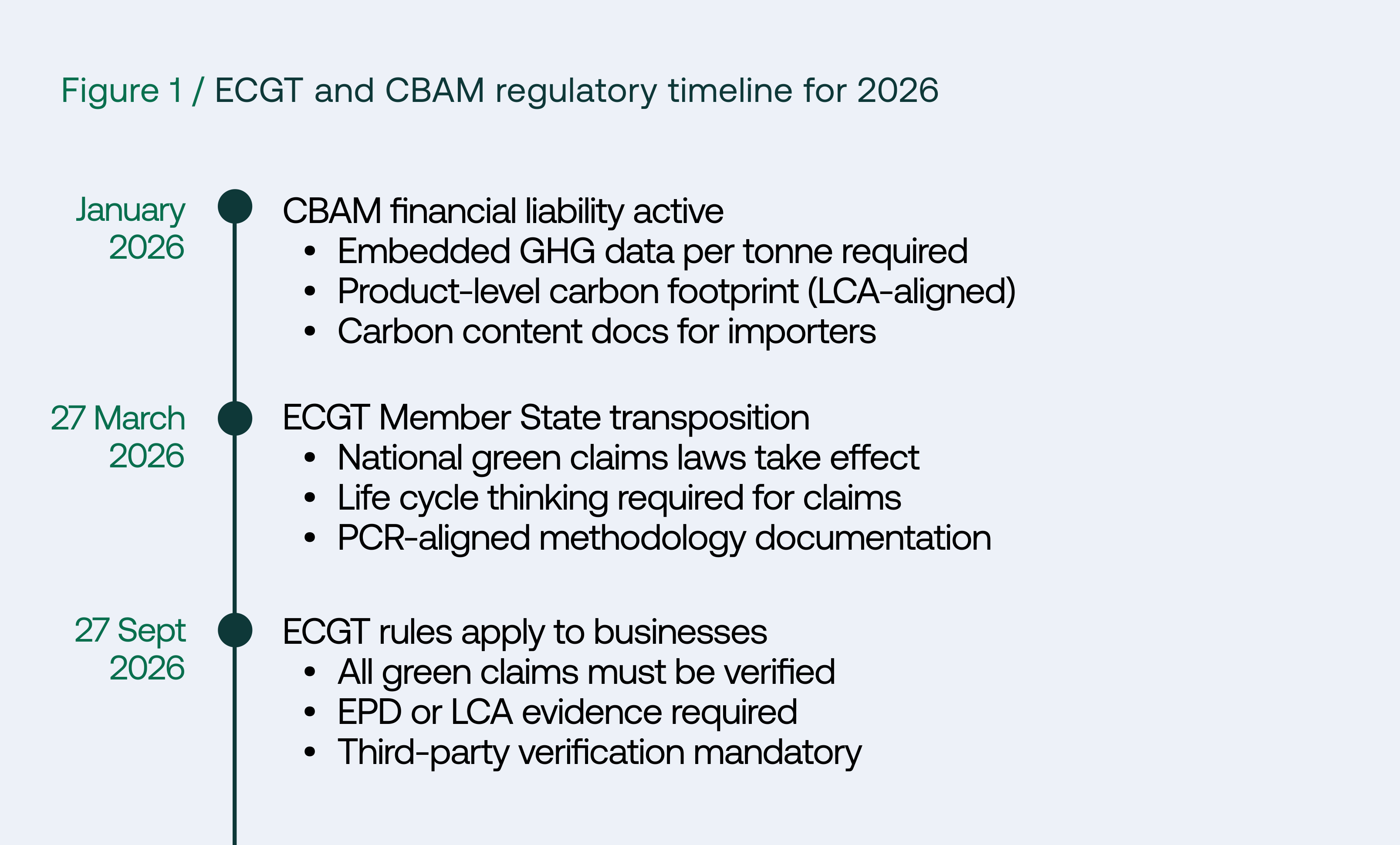
Two regulatory obligations are now active or imminent for supply chain directors managing products with existing environmental marketing claims or EU export relationships.
CBAM financial liability for EU importers of steel, aluminium, cement, and other regulated categories has been in force since January 2026. (10) Suppliers in these categories that cannot provide verified embedded carbon data create direct cost exposure for EU customers. That exposure flows directly into procurement decisions.
The ECGT Directive claim substantiation requirements apply to all businesses selling into EU markets from 27 September 2026. The UK equivalent enforcement framework under the Digital Markets, Competition and Consumers Act 2024 gives the CMA powers to impose fines of up to 10 percent of global group turnover for non compliant environmental claims. (6) The time to audit every product level environmental claim against available EPD evidence is now. It is not when enforcement begins.
An EPD that sits on a server is a cost. An EPD that is communicated, contextualised, and connected to supply chain improvement decisions is a commercial asset. It is also a compliance instrument and a supplier engagement tool operating simultaneously.
Nexio Projects supports supply chain operators and manufacturers across the full journey. This includes EPD communication strategy, LCA hotspot driven supplier engagement, and circular economy integration. As a registered LCA practitioner under the International EPD System, Nexio Projects brings technical rigour and supply chain understanding to every engagement. The goal is not to stop at compliance. It is to move from compliance to positive impact.
“The September 2026 ECGT deadline and active CBAM liability make the audit straightforward: every product-level environmental claim in current use should be traceable to EPD data, and that trace should be documented now. An EPD programme that is current, communicated, and connected to supply chain action is both the compliance position and the commercial advantage.”
If three or more boxes remain unchecked, the EPD is underperforming as a commercial and compliance asset.
Nexio Projects supports supply chain directors and manufacturers from EPD registration through communication strategy, LCA hotspot driven supplier engagement, and circular economy integration. Recognised as a top boutique ESG and sustainability strategy consultancy by Verdantix and awarded Platinum status by Consultancy.nl, we’re here to help organisations move from compliance to purpose, pragmatically and step by step. Contact the product sustainability team to review your EPD programme.
(1) EPD International. (2025). EPD Development in 2025: Growth, Reach, and Sectoral Trends. Available at: https://www.environdec.com/news/epd-development-2025 (Accessed: March 2026).
(2) European Parliament and Council. (2024). Directive (EU) 2024/825 — Empowering Consumers for the Green Transition (ECGT). Available at: https://eur-lex.europa.eu/legal-content/EN/TXT/PDF/?uri=OJ:L_202400825 (Accessed: March 2026).
(4) International EPD® System. (2024). Introduction to EPD. Available at: https://www.environdec.com/all-about-epd/introduction-to-epd (Accessed: March 2026).
(6) Competition and Markets Authority. (2026, January 22). Making green claims: Getting it right, across the supply chain. Available at: https://www.gov.uk/government/publications/making-green-claims-getting-it-right-across-the-supply-chain (Accessed: March 2026).
(9) European Parliament and Council. (2024). Directive (EU) 2024/1760 — CSDDD. Available at: https://eur-lex.europa.eu/legal-content/EN/TXT/?uri=CELEX:32024L1760 (Accessed: March 2026).
(10) European Parliament and Council. (2023). Regulation (EU) 2023/956 — CBAM. Available at: https://eur-lex.europa.eu/legal-content/EN/TXT/?uri=CELEX:32023R0956 (Accessed: March 2026).