Improve supply chain transparency with EcoVadis
October 22, 2024


Suppliers to the UK’s National Health Service (NHS) are preparing for a new type of sustainability request. Product carbon footprint data may become part of how individual products are assessed in future NHS procurement. [1]
NHS England has announced that new requirements will oversee carbon footprinting for individual products supplied to the NHS from April 2028. The announcement creates a clear direction for suppliers, even though several technical details remain open. [1]
Suppliers therefore need to prepare without waiting for every detail to be published. The most useful first steps involve data, governance, product selection, and a clear understanding of the current NHS supplier roadmap.
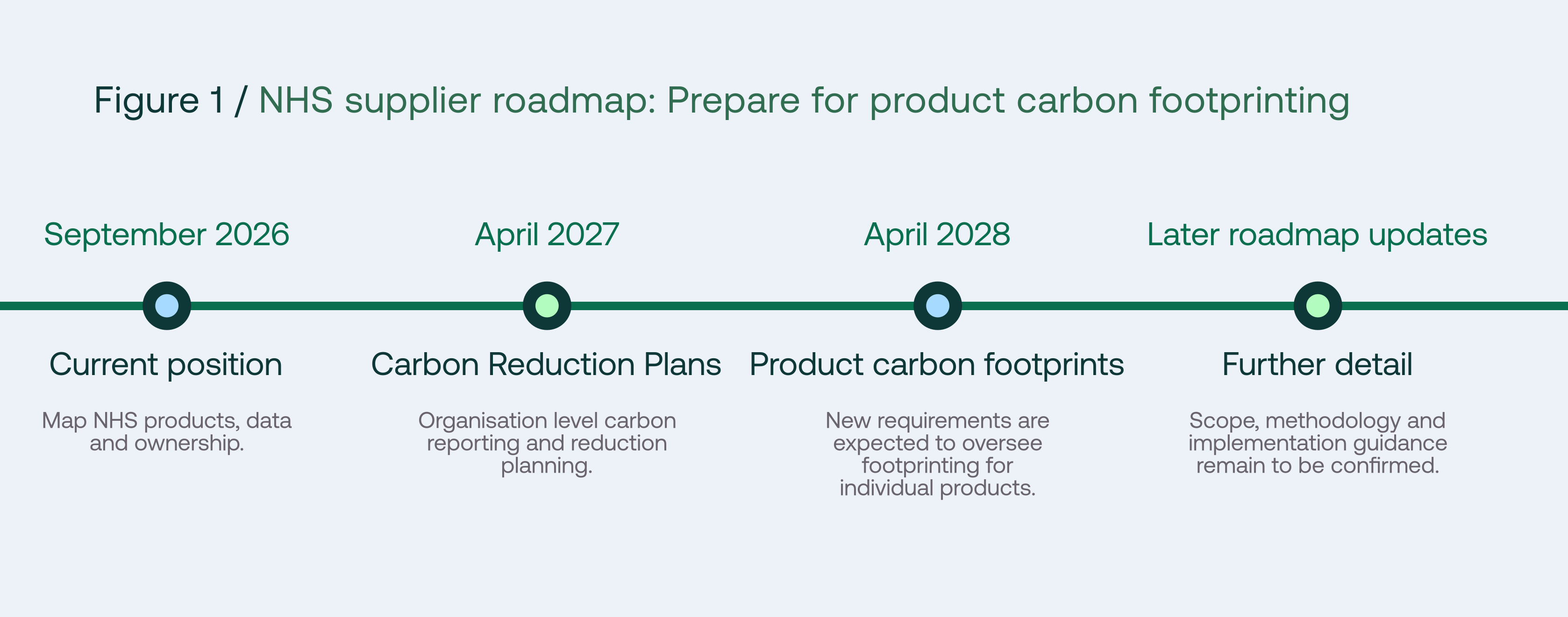
The NHS supplier roadmap sets out a phased approach to sustainability requirements. It includes organisation level emissions reporting, supplier progress, and future product level carbon information. [1]
The most relevant milestone for PCFs is April 2028. NHS England describes this milestone as new requirements overseeing the provision of carbon footprinting for individual products supplied to the NHS. [1]
This wording matters because a product carbon footprint is different from an organisation level carbon footprint. A corporate assessment measures emissions associated with a company or group. A PCF measures emissions associated with a defined product and its chosen life cycle stages.
The announcement does not provide a final list of affected product categories. It also does not yet define the final system boundaries, calculation rules, evidence requirements, verification expectations, or procurement consequences.
The April 2028 milestone should therefore be treated as a preparation deadline. It is not a reason to claim that every NHS supplier must already produce a PCF under one universal NHS method.
The roadmap also sits alongside the April 2027 Carbon Reduction Plan requirements. NHS England’s published guidance sets out different requirements based on procurement value and framework status. Higher value procurements of £5 million or more per year, including VAT, and all new frameworks are covered by the more detailed 2027 tier. [2]
The 2027 requirements concern organisational carbon reporting and reduction planning. They should not be confused with the later product level carbon footprinting milestone.
“The most effective preparation begins with clarity. Suppliers should understand which emissions information they already hold, which products matter most, and which assumptions need stronger evidence.”
Francesc Romero, Senior Climate Consultant at Nexio Projects
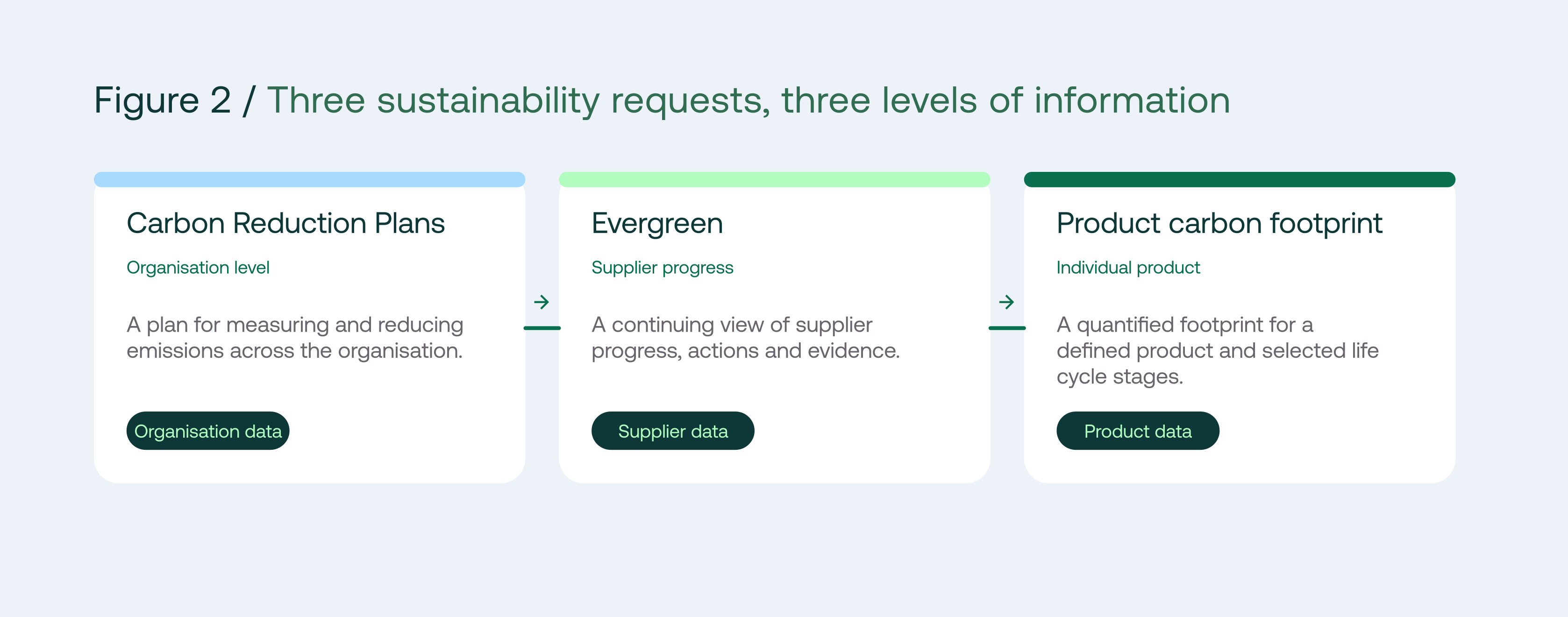
NHS England has not yet published a final product carbon footprinting methodology. The public supplier information states that the NHS will work with suppliers and regulators to determine the scope and methodology. [1]
As of 17 September 2026, the public NHS supplier roadmap does not provide a specific date for publication of the final PCF methodology or detailed implementation guidance. Suppliers should monitor NHS England’s supplier sustainability updates, commercial guidance, webinars, and related communications rather than relying on a single fixed publication date.
This uncertainty affects several questions that suppliers may already be asking:
The current announcement refers to individual products supplied to the NHS. It does not yet publish a definitive list of product categories, contract types, or supplier thresholds for the PCF requirement.
A supplier should therefore avoid assessing its entire portfolio immediately. A better approach is to identify products that are strategically important, frequently supplied to the NHS, emissions intensive, or likely to receive customer sustainability requests.
A PCF may cover different life cycle stages depending on the purpose of the calculation. The relevant boundary could include raw materials, manufacturing, packaging, distribution, use, and end of life.
Suppliers should document the boundary used for every assessment. This will make future updates easier if NHS England introduces a specific boundary or reporting template.
The current NHS supplier announcement does not establish a universal verification requirement for PCFs. Suppliers should avoid presenting third party verification as an NHS obligation unless future guidance confirms it.
They should still maintain evidence for activity data, emission factors, assumptions, allocation rules, and calculation decisions. Good documentation will support future assurance, customer review, and internal updates.
ISO 14067:2018 provides principles, requirements, and guidelines for quantifying and reporting the carbon footprint of a product. [3]
The PACT Methodology provides a framework for product carbon footprint data and exchange. Version 3 was published in 2026. [4]
The GHG Protocol Product Standard also remains a relevant reference for product life cycle greenhouse gas accounting. [5]
These standards can support preparation. They should not be described as the final NHS method unless NHS England formally adopts or references them for the relevant procurement requirement.
The most useful preparation work is practical and proportionate.
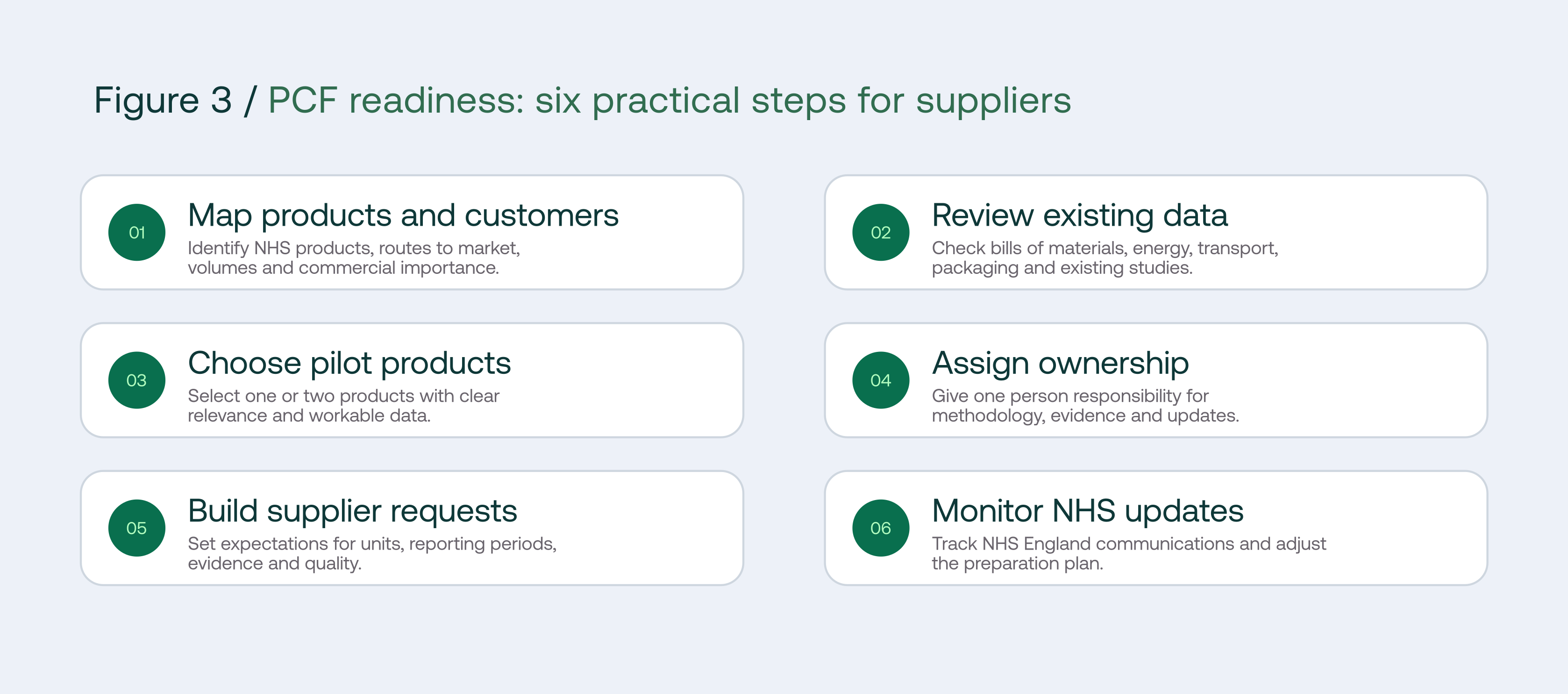
List the products supplied to NHS organisations, NHS Supply Chain, distributors, framework providers, and healthcare manufacturers. Record product volumes, manufacturing locations, customer importance, and existing environmental data.
This map will help identify where a PCF could support future procurement activity.
Check whether the business already holds:
This review often reveals that the main challenge is data structure rather than the absence of data.
Choose products that have clear commercial relevance and sufficient data availability. A pilot can test the calculation process, expose data gaps, and help teams understand the likely effort required across the wider portfolio.
The pilot should include a documented functional unit, system boundary, reporting period, allocation approach, and data quality assessment.
A PCF can involve sustainability, procurement, product development, operations, finance, quality, regulatory, and commercial teams.
One person should own the methodology and evidence trail. Commercial teams should also understand how the output may be used in bids, customer discussions, and product improvement decisions.
Many product emissions sit upstream in raw materials, components, packaging, and contract manufacturing. Suppliers should create a consistent request process that explains the required data, reporting period, units, evidence, and expected quality.
This is particularly important for sectors where product specifications are tightly controlled. A Nexio Projects case study involving a healthcare packaging manufacturer shows how customer specifications, polymer choices, packaging dimensions, and regulatory sign off can influence sustainability work.
Suppliers should assign responsibility for monitoring future NHS England updates. The business should record each update, assess its relevance, and identify any change to the preparation plan.
The absence of a published PCF methodology does not justify delaying all preparation. It does mean that suppliers should retain flexibility and avoid locking themselves into unsupported assumptions.
The practical challenges will vary by product and industry.
Healthcare packaging suppliers may need to manage polymer specifications, customer approvals, multiple manufacturing sites, and product dimensions. Pharmaceutical and medical device suppliers may also need to coordinate product data with regulatory and quality teams.
Chemical manufacturers may need detailed feedstock, energy, process, and allocation data. Plastic and packaging manufacturers may need to assess material content, recycled content, production energy, transport, and end of life assumptions.
Electronics suppliers may need component data from complex global supply chains. Medical consumables suppliers may need to manage high product volumes, packaging formats, sterilisation processes, and use phase assumptions.
Nexio Projects has supported organisations across healthcare packaging, pharmaceuticals and medical device supply chains, plastics, flexible packaging, printing, manufacturing, electronics, logistics, chemicals, and consumer products. Our experience includes corporate carbon footprints, product carbon footprints, life cycle assessments, supplier data collection, and decarbonisation planning.
These industry examples demonstrate why suppliers need a method that reflects their business model. A single generic data request will not work equally well for a medical device component, a pharmaceutical package, a chemical input, and an electronic product.
Product carbon footprint preparation can support more than future compliance.
Suppliers that understand their product emissions will be better placed to respond when customers request product level data. They can also identify materials, processes, and suppliers that create the greatest reduction opportunities.
A documented PCF process can support:
This is where product carbon footprinting connects the needs of business and the planet. A useful PCF should help an organisation meet a customer request and decide what to improve next.
The strongest commercial approach is to build a repeatable capability rather than commission a single isolated number. A repeatable process can be updated when better data becomes available and adapted when NHS England publishes further guidance.
NHS England has provided a clear direction of travel for product carbon footprinting from April 2028. The final PCF scope and methodology remain open, and the public roadmap does not currently provide a specific date for further detailed communication.
Suppliers can still make meaningful progress. Product mapping, data review, pilot assessments, supplier engagement, and methodology governance will reduce future pressure and strengthen commercial readiness.
According to Francesc Romero, Senior Climate Consultant at Nexio Projects,
“A product carbon footprint becomes commercially valuable when teams can trust it, explain it, update it, and use it to guide action”.
We are an international sustainability consultancy dedicated to guiding organisations on their journey from compliance to positive impact. We support suppliers with product carbon footprints, life cycle assessments, carbon data, supplier engagement, and sustainability strategy.
Recognised in the Verdantix buyer’s guide for boutique ESG and sustainability strategy services and named a Top Brand in sustainability by EUPD, we are here to help NHS suppliers turn emerging requirements into credible preparation and practical progress.
Contact Nexio Projects to discuss a PCF readiness assessment for your NHS product portfolio.
[1] NHS England. Suppliers and the NHS net zero supplier roadmap. https://www.england.nhs.uk/greenernhs/get-involved/suppliers/. Accessed September 2026.
[2] NHS England. 2027 NHS Carbon Reduction Plan requirements for the procurement of NHS goods, services and works. https://www.england.nhs.uk/long-read/2027-nhs-carbon-reduction-plan-requirements-for-the-procurement-of-nhs-goods-services-and-works/. Accessed September 2026.
[3] International Organization for Standardization. ISO 14067:2018, Greenhouse gases: Carbon footprint of products. https://www.iso.org/standard/71206.html. Accessed September 2026.
[4] Carbon Transparency Partnership. PACT Methodology Version 3. https://www.carbon-transparency.org/initiatives/pact-methodology-v3. Accessed September 2026.
[5] Greenhouse Gas Protocol. Product Life Cycle Accounting and Reporting Standard. https://ghgprotocol.org/product-standard. Accessed September 2026.
[6] Nexio Projects. 26Q2 Tier 1 case studies. Internal source. https://nexioprojects.sharepoint.com/sites/MarketingTeam/_layouts/15/Doc.aspx?sourcedoc=%7B9E897BD9-75E8-4D56-BDF6-C999ED66FB09%7D&file=26Q2%20-%20Tier%201%20case%20studies.pptx&action=edit&mobileredirect=true. Accessed September 2026.
[7] Nexio Projects. Vanderlande 2023 reference projects. Internal source. https://nexioprojects.sharepoint.com/sites/NexioSalesTeam/_layouts/15/Doc.aspx?sourcedoc=%7BE2919CB7-6B45-4AD0-9F59-89F84F064AFD%7D&file=Vanderlande_2023_RFP_NexioProjects.pptx&action=edit&mobileredirect=true. Accessed September 2026.
[8] Nexio Projects. Product carbon footprint and life cycle assessment service material. Internal source. https://nexioprojects.sharepoint.com/sites/MarketingTeam/_layouts/15/Doc.aspx?sourcedoc=%7BC5A5249A-47F7-4BB4-B78A-8972C0D6230E%7D&file=Nexio%20Projects_Climate%20Strategy_2020.pptx&action=edit&mobileredirect=true. Accessed September 2026.