Voluntary reporting unpacked: GRI, VSME and beyond
August 28, 2026


Welcome back to ‘Sustainability in motion’. In this edition, we cover:

Swapfiets has built its entire business model around circularity: subscribe, maintain, repair, and recover. With more than 1,300 employees across Europe, the company is one of the most recognisable names in sustainable mobility. As Science Based Target requirements and investor expectations intensified, the team needed more than principles. They needed a structured, evidence-based plan.
Swapfiets wanted a clear, science-based emission reduction pathway that would deepen its circular model through the process, with decarbonisation and circularity working as a unified strategy from the start.
By combining SBT-aligned emissions modelling with a circularity lens:
What stands out is the integration. Each reduction lever also extends product life, reduces resource use, and tightens the loop. The result is one unified strategy.
Read the full case study: Accelerating climate action and circularity at Swapfiets

There is a line that captures the problem precisely: “Climate risk assessment without integration is just expensive storytelling.” Most EU organisations are producing exactly that. Climate risk disclosure has tripled in five years. Financial integration lags behind by 30 to 40 percentage points. The gap between the two is where real risk accumulates, and where real value sits.
In May 2026, Nexio Projects’ Principal Sustainability Consultant Liliia Kalimullina and Managing Partner Cilia Keser hosted a webinar on how to close that gap. Here are the key takeaways.
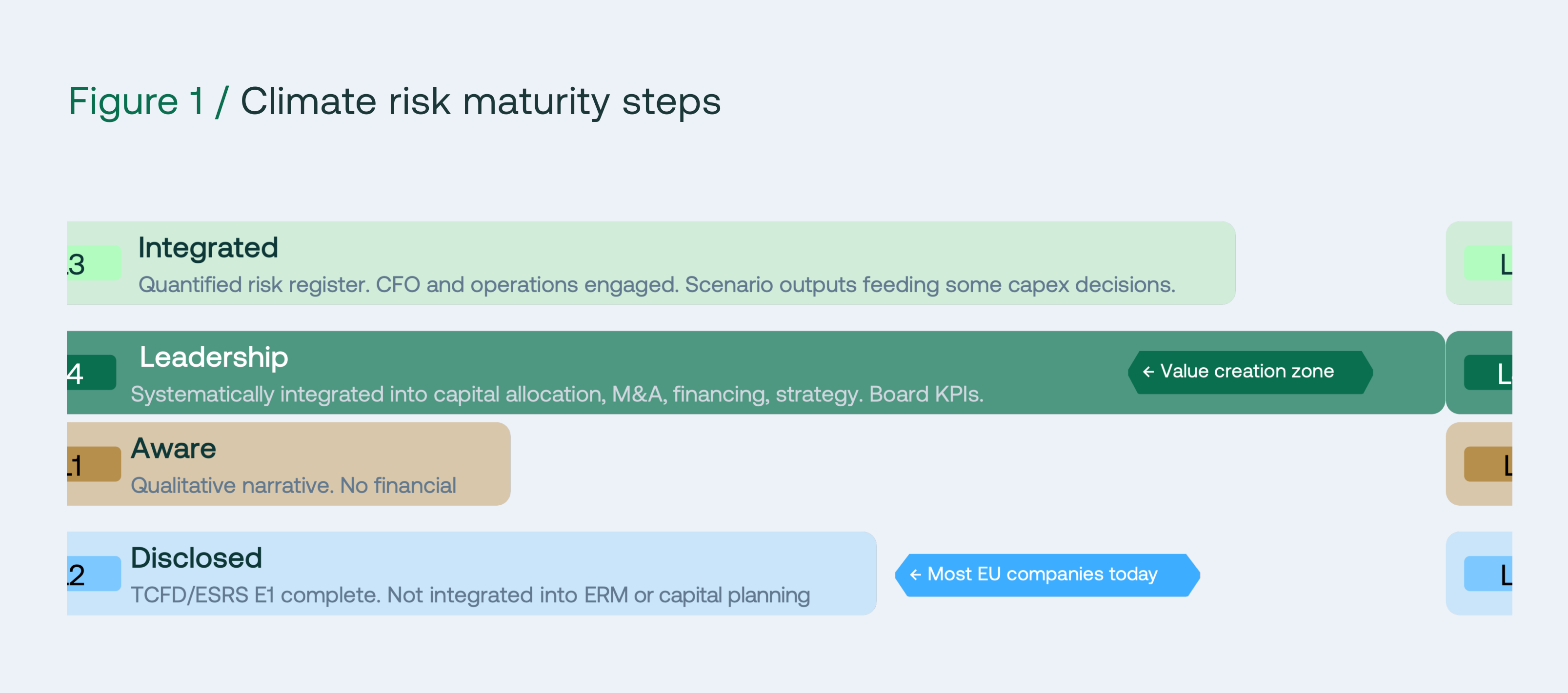
The session mapped four maturity levels for climate risk management:
The sprint from Level 2 to Level 4 is a governance and methodology challenge. For organisations that commit to it, 12 to 18 months is a realistic timeline.
An EU chemicals company evaluated a €200M gas-based expansion with a base IRR of 14%. Climate scenario modelling revealed an IRR of 6.5% under a delayed transition scenario, below the 8% hurdle rate, and a negative return by 2032 under a net zero pathway. €40M was redirected to alternatives with positive returns across all four NGFS scenarios.
A 45-asset EMEA industrial portfolio faced a 35% premium increase at renewal. Asset-by-asset physical risk quantification reversed 12 percentage points of that proposed increase, saving more than €2M annually. Green bond integration delivered an additional 22 basis points of spread tightening.
A consumer goods company had no visibility below Tier 1. IPCC AR6 mapping identified a single Tier 2 packaging supplier representing €15M in annual revenue exposure. Dual-sourcing cost: €1.2M. Return on risk investment: 13 times.
ESRS E1 and IFRS S2 now require quantified financial impacts. Qualitative narratives will not pass audit. EU ETS sits at €60 to €75 per tonne of CO₂ today. CBAM is live. Insurance repricing is already under way across Southern Europe. The market is moving, regardless of whether organisations have modelled the risk.
For a deeper dive into the methodology, the frameworks, and the board questions to pre-arm yourself against, watch the full session: Climate risk: Building the business case for action

After more than a year of meet-ups, workshops, and shared ambition, it is official. B Local South Holland has been founded, and Nexio Projects is proud to have built it from the very first gathering.
The community began with a simple question: what happens when purpose-driven companies in the same region decide to move together? What followed were four meet-ups, a growing network of certified B Corps across South Holland, and a formal structure anchored in close collaboration with B Lab Benelux. Read the full story in B Corps in South Holland: Building a community for collective impact.
The launch celebration takes place on June 25 at the Verstegen offices in Rotterdam, from 14:00 to 17:00. You will hear from Cilia Keser, Managing Partner at Nexio Projects, Jozien Ripping from No Dodos, and Monique Boon from Verstegen.

Whether you are a certified B Corp, exploring what the certification journey looks like, or simply want to connect with a community that takes purpose seriously, this afternoon is open to all.

On May 7, the EU Commission published the proposed revised ESRS and a new Voluntary Standard. This is the most significant CSRD development since the Omnibus vote, and the public consultation window closes on June 3.
As currently proposed, the key changes are:
• A 70%+ reduction in data points compared to the original ESRS • A new mandatory reporting threshold: companies above €450M in revenue and 1,000 employees • A Voluntary Standard introduced for companies that fall below the threshold
• Review the proposed revised standard against your current reporting setup • Submit feedback through the official EU consultation before June 3, 2026 if relevant for your organisation • Brief your board and reporting team on what the proposed changes mean for your 2026 reporting cycle
Organisations that engage now will be better prepared when the final standard is confirmed.
Read the full factsheet: Omnibus finalised: The updated CSRD and next steps for companies


If you want to check out the rest of our webinars, see our webinars and events page.
If any of these topics are in your radar, and you’d like support from our experts, contact us now!