

 EcoVadis Sustain highlights: Building resilient supply chains
March 17, 2026


Wave 2 companies preparing for FY2027 CSRD reporting are navigating an unusual situation. The regulatory framework they started building towards has shifted significantly. The Omnibus Simplification Package has revised scope thresholds, deferred timelines, and triggered a comprehensive overhaul of the European Sustainability Reporting Standards (ESRS). Yet the clock has not stopped entirely. Companies reporting on financial year 2027 must have their data collection and monitoring in place from 1 January 2027: a deadline now less than seven months away.
The practical question is not whether to continue. It is how to move forward with confidence when the final version of the revised ESRS has not yet been formally adopted.
In April 2026, Nexio Projects and Salacia Solutions co-hosted a webinar to address this directly. What follows draws from the key arguments and practical guidance presented by Dora Cristian, Principal Sustainability Consultant at Nexio Projects, and Kees Kerstens, Co-Founder at Salacia Solutions. The content maps the regulatory changes, what they mean for your double materiality assessment, and the three CSRD implementation routes available to you now.
The Omnibus Simplification Package followed two parallel tracks, both of which are now confirmed [1].
The first is the stop-the-clock directive, which granted a two-year deferral to Wave 2 and Wave 3 companies. This has been adopted and is to be transposed into member state legislation by 31 December 2026 [1].
The second is the content proposal, which significantly raised reporting thresholds. The original CSRD thresholds of 250 employees, €25 million in total assets, and €50 million in revenue have been replaced. CSRD scope now applies to companies with more than 1,000 employees and more than €450 million in annual net turnover. The EU Taxonomy scope has been aligned with CSRD. For the Corporate Sustainability Due Diligence Directive (CSDDD), the threshold rises to 5,000 employees and €1.5 billion in turnover [1].
The revised CSRD reporting timelines are as follows:
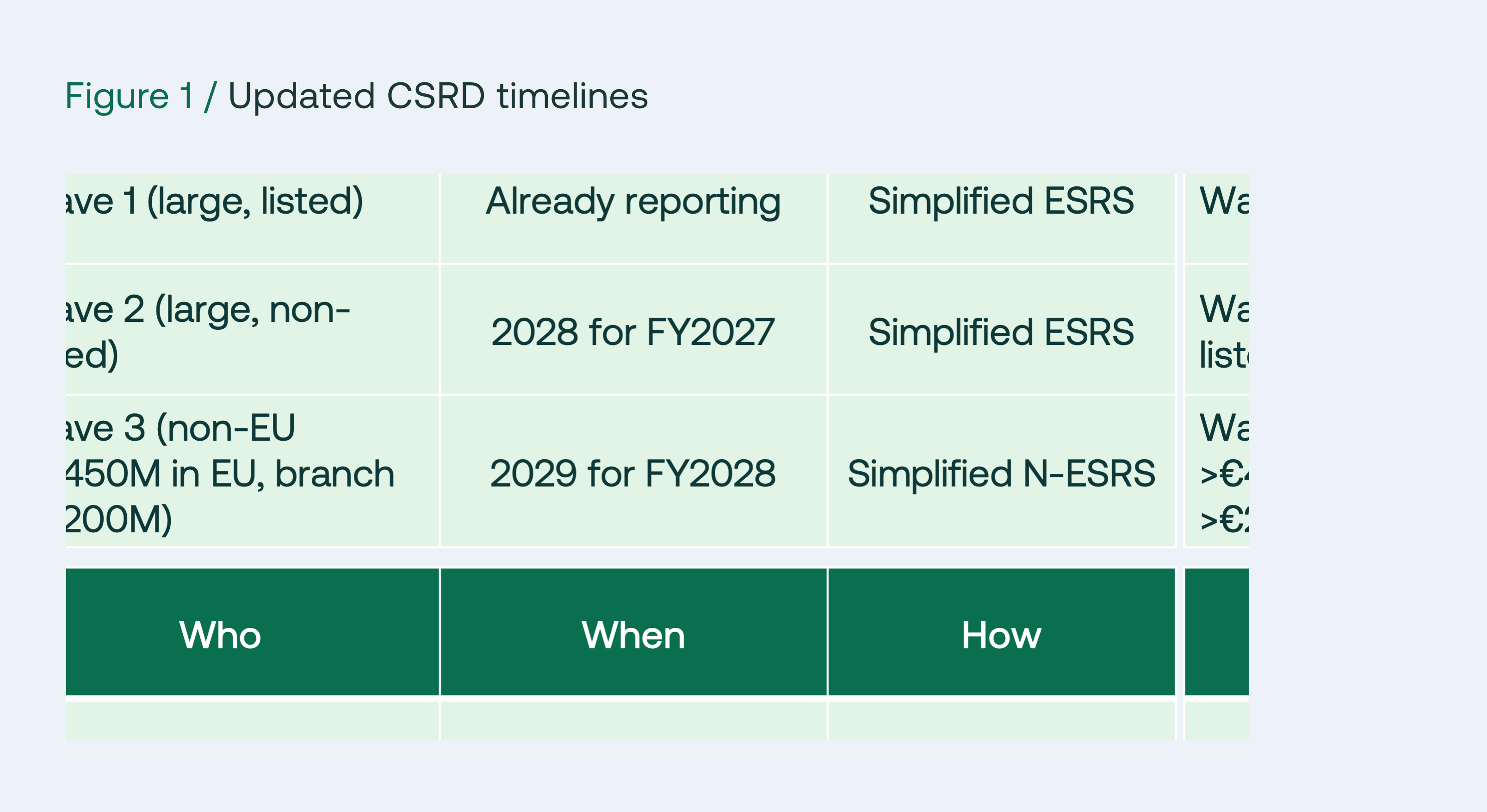
Separately, the revised ESRS, as currently proposed in the Revised ESRS Proposal would reduce the total number of data points by more than 60%, subject to materiality of information.
This draft has not yet been formally adopted. Final adoption is expected in H2 2026, as currently proposed. Until adoption, companies must make strategic decisions against a standard that remains subject to change.

The revised ESRS draft proposes six simplification levers that together reshape the structure, scope, and content of CSRD reporting [2].
“The changes reframe the basis on which materiality decisions are made. Companies that treat this as a minor update will find themselves managing a much larger recalibration in the next reporting cycle.”
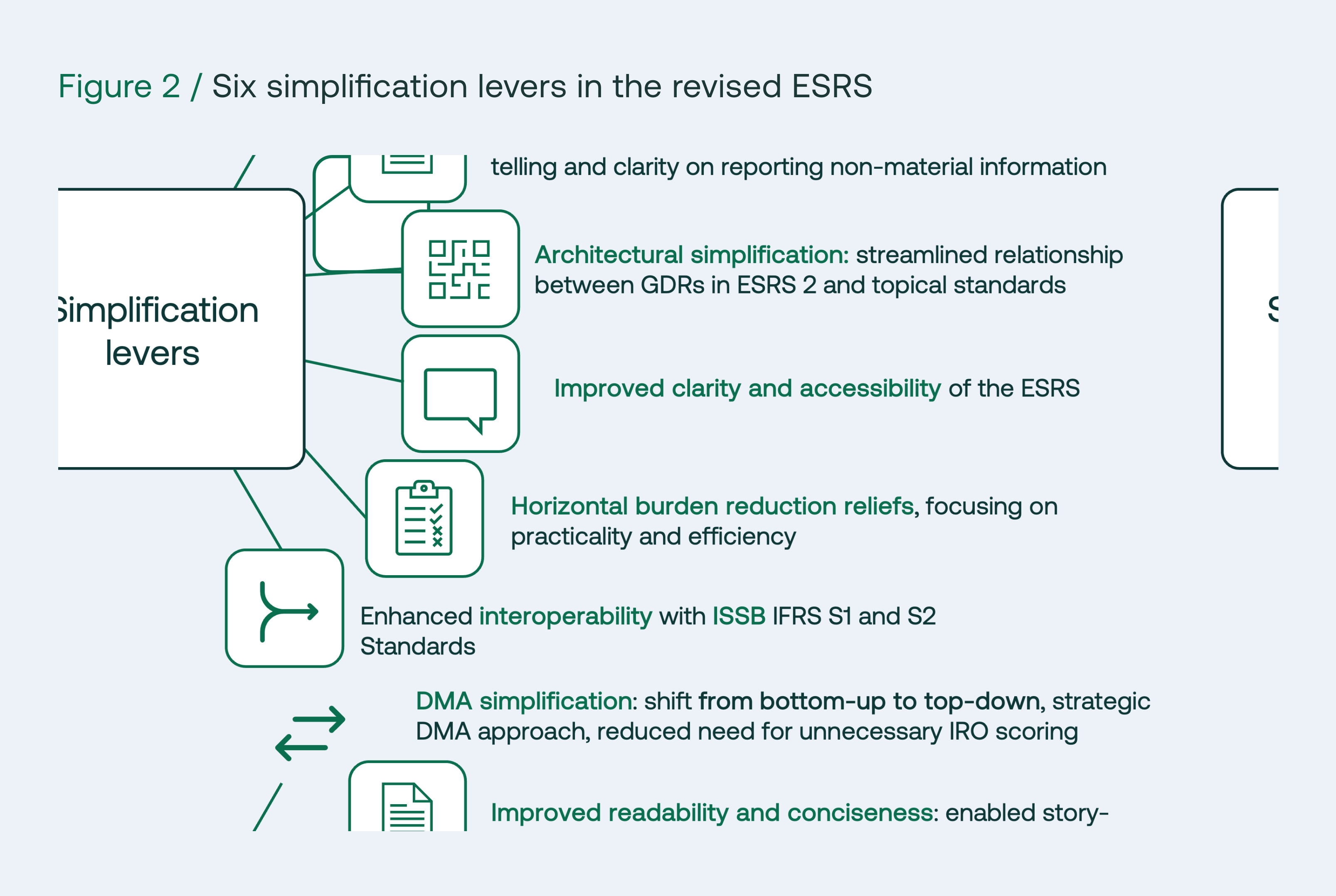
The most consequential change. The revised approach shifts from a bottom-up process, in which every potential impact, risk, and opportunity from a prescribed list must be scored, to a top-down, strategy-led approach. Companies can now reason from their business context and sector to reach materiality determinations, without going through unnecessary IRO scoring exercises.
The revised draft introduces an executive summary section that enables companies to tell a coherent sustainability story, rather than producing a disclosure checklist. Appendix sections will separate mandatory from voluntary disclosures. The layered terminology of the 2023 ESRS: topics, subtopics, sub-subtopics, material matters, has been stripped back to topics and subtopics only.
Certain data points previously located in topical standards have been moved to ESRS 2, becoming cross-cutting disclosure requirements. This streamlines the structure and reduces repetition across different sections of the sustainability statement.
Voluntary data points have been eliminated entirely. Mandatory content is clearly separated from non-mandatory content, reducing ambiguity about what is required.
The revised draft introduces principle-based reliefs: undue cost and effort, metrics relief due to a lack of quality data, and flexibility in reporting anticipated financial effects. Companies may omit certain data points with appropriate justification. This does not remove the obligation of fair presentation. Relief from disclosure does not mean relief from the underlying principle.
The revised ESRS aligns terminology, shared principles, and certain burden reliefs with IFRS S1 and S2. Full alignment has not been achieved, and some ESRS reliefs go beyond what ISSB currently provides [2]. The direction of travel is toward greater convergence, but the two frameworks remain distinct in material ways.
(Note: the extent of final interoperability will only be confirmed once the revised ESRS is formally adopted. Verify before publication.)
The central practical question is how to get from where you are today to where the revised standard requires you to be. Kees Kerstens mapped three routes in the webinar, each with distinct cost, risk, and timeline implications. Which suits your organisation depends entirely on your starting point.
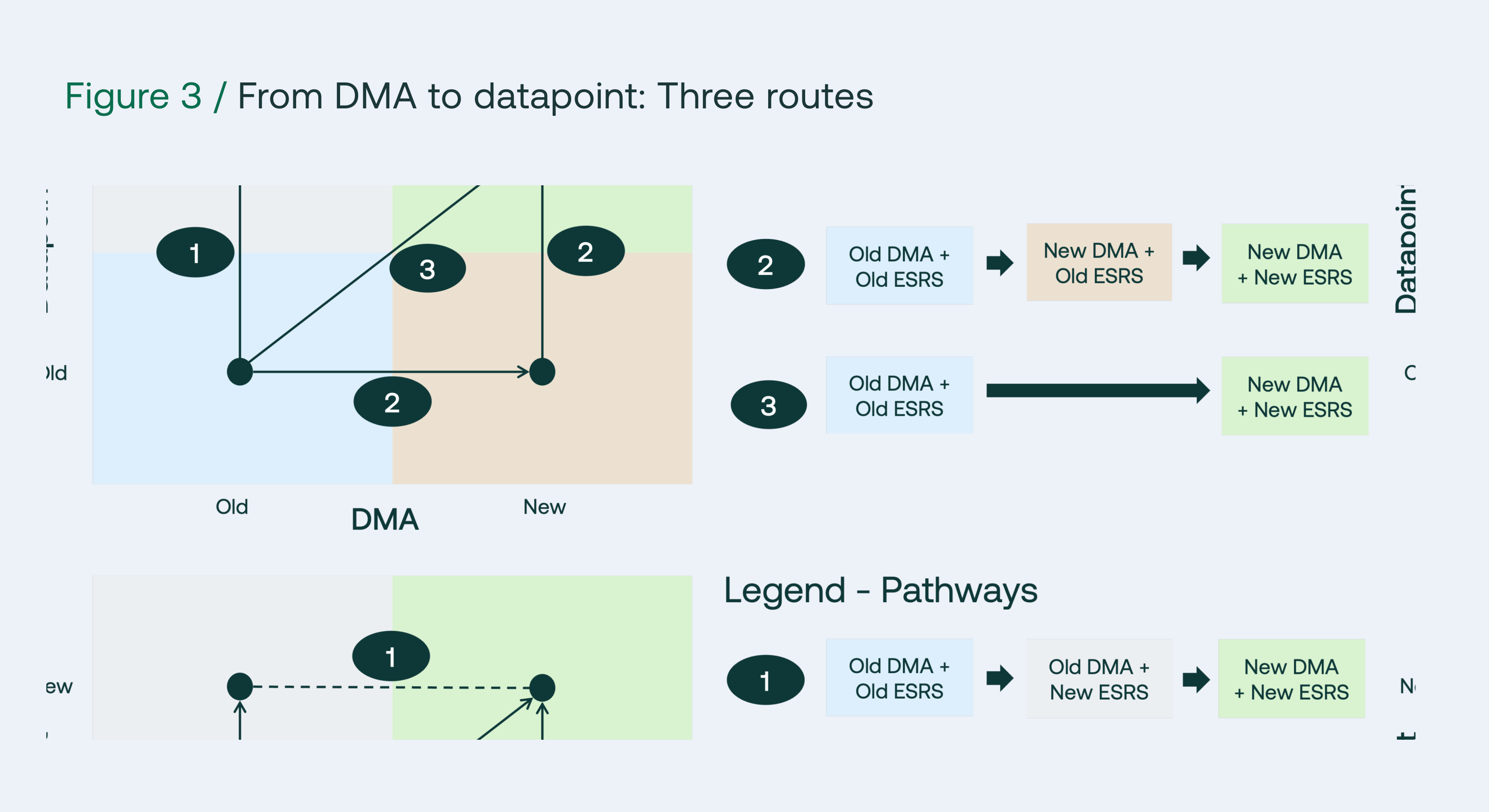
For companies that have already completed a double materiality assessment under the current ESRS and potentially had it reviewed by an auditor, this route preserves that investment by keeping the DMA in place and shifting the focus to a data point gap analysis.
Pros:
Cons:
“If you foresee that a top-down approach might lead to fewer material topics and fewer material disclosure requirements, then this route might be less suitable for you,” Kerstens noted.
Companies that expect a meaningful reduction in material topics under the new top-down approach, or whose business model has changed significantly since the original double materiality assessment was conducted, may benefit from refreshing the DMA before addressing data points.
Pros:
Cons:
This route suits companies willing to invest now to avoid a more disruptive transition in subsequent reporting cycles.
The third option is to move from the old DMA and old data points to the new DMA and new data points in a single, consolidated programme.
Pros:
Cons:
This route is most naturally suited to companies starting their CSRD journey for the first time. For companies with an established programme under the old standard, Routes 1 or 2 are generally more realistic.
The three routes are not entirely exclusive. As Dora Cristian observed, the revised ESRS draft itself allows for a mixed approach: top-down reasoning in areas where materiality is well understood, and a more systematic method in areas of genuine uncertainty. “You get the best of both worlds if you do it right,” as Kerstens put it.

The absence of a formally adopted revised ESRS creates a real dilemma for Wave 2 companies. Programme decisions made in the coming months will determine what can be collected, monitored, and reported by the time FY2027 begins.
Does your current DMA accurately reflect your organisation’s sustainability ambition and strategy? Or do you need to revise your DMA to strategically shift from a bottom-up to a dop-down or hybrid approach?
Two practical points from the webinar apply regardless of which route a company takes.
A gap analysis of data points is unavoidable.
Whether a company retains its current DMA or adopts a new one, the data points it reports against will change. The revised ESRS deletes some, merges others, renumbers others, and moves some from topical standards to ESRS 2. As Dora Cristian noted: “We do advise reviewing your gap assessment once the new ESRS officially comes into force.” For companies that have done extensive work under the old standard, this is calibration, not a rebuild. But it requires dedicated attention.
Narrative data points have changed more than numerical ones.
The shift from 1,073 to 347 data points reflects primarily the removal and consolidation of narrative disclosures. Many numerical data points like the greenhouse gas emissions metrics, energy, water, remain largely in place, though some disaggregation has been removed.
The significant simplification is in the text-based disclosures that form the sustainability statement. This is also where AI-assisted drafting tools are becoming increasingly practical. Platforms can now use existing company documents such as HR policies, climate transition plans, past sustainability reports, as source inputs for narrative data points under both the old and revised frameworks. For a detailed data-point-level breakdown, read our article on how to decode the revised ESRS data points.
The companies best positioned to respond quickly when the final standard is adopted will be those that have already run their gap analysis, mapped their data collection gaps, and defined clear internal ownership for each metric. That groundwork does not depend on the final text, it can begin now.
Redoing the DMA is not mandatory. If the assessment reflects your organisation’s material sustainability issues adequately and has already gone through an audit review, it can be retained. That said, a review of your data points will be needed once the revised ESRS is formally adopted. Many data points have been removed, modified, moved between standards, or renumbered and the impact on narrative data points is considerably greater than on numerical ones. The DMA may stand; the reporting programme built on top of it will need updating regardless of which route you take.
It depends on the company. Analysis of early CSRD reports, covering financial years 2024 and 2025, show that many organisations took a highly process-intensive approach to their double materiality assessments, which in a number of cases led to lengthy sustainability statements with a large number of material topics and disclosure requirements.
If your organisation expects that a top-down approach would result in significantly fewer material topics, revisiting the DMA may reduce the reporting burden and produce a cleaner assurance story. If the DMA is robust, has been through full audit scrutiny, and there have been no significant business changes since it was completed, retaining it and focusing on the data point gap analysis is likely the more pragmatic choice. It is a strategic decision, not a regulatory requirement.
The bottom-up approach starts from a comprehensive list of potential impacts, risks, and opportunities, drawn from the prescribed list in the ESRS, and works through a scoring and threshold exercise to determine which topics are material. It is systematic but resource-intensive, and it can produce results that are more process-driven than business-driven. The top-down approach starts from business strategy and sector context.
A company looks at how comparable organisations in its industry have assessed materiality, considers its value chain, and reasons outward to reach conclusions without scoring every potential topic on a list. The revised ESRS draft also allows for a hybrid: top-down where materiality is well understood, and a more structured approach in areas where there is genuine uncertainty about whether a topic is material.
The VSME standard itself is not affected by the revised ESRS. It is a separate framework. However, there is an important alignment worth noting. CSRD companies cannot request more information from a VSME company than what the VSME standard prescribes, where that information is being sought for CSRD reporting purposes.
In practice, VSME companies may still receive requests for data beyond VSME scope, from customers pursuing decarbonisation targets or buyers requiring EcoVadis-related information, and those obligations remain. One further development to track: the Omnibus Directive includes a provision for new voluntary reporting standards to be developed for companies that now sit between 250 and 1,000 employees, those who fall outside the revised CSRD thresholds but are increasingly expected to provide sustainability data by their value chain partners.
The Omnibus has given many companies more time. But the Wave 2 deadline is real, and the data infrastructure for FY2027 reporting needs to be in place from January. The choice of route through the revised ESRS is not a minor administrative decision. It shapes cost, assurance readiness, and the long-term sustainability management system.
Uncertainty around the final standard is genuine — but it is not a reason to pause. Progress made against the December 2025 EFRAG draft will need calibrating once the final text is adopted. The alternative — waiting for certainty before acting — leaves a narrowing window to build what FY2027 reporting will depend on.
Nexio Projects is an international sustainability consultancy dedicated to guiding organisations on their journey from compliance to purpose. Their mission is to provide expert support across CSRD implementation, double materiality assessment, ESRS gap analysis, and decarbonisation strategy, helping clients become audit-ready with a pragmatic, step-by-step approach. Recognised as a top European sustainability consultancy by Consultancy EU and a top sustainability advisory firm by MT/Sprout SD400 2025, Nexio Projects helps organisations at every stage of their CSRD journey.
Book a free discovery call to discuss your CSRD programme, your DMA position, and which route forward fits your timeline and budget.
[1] European Commission. Omnibus Simplification Package — CSRD, CSDDD and EU Taxonomy amendments (Omnibus I). https://finance.ec.europa.eu/publications/omnibus-simplification-package_en. Accessed May 2026.
[2] EFRAG. Draft Delegated Regulation amending the European Sustainability Reporting Standards (Revised ESRS). Published 4 December 2025. https://www.efrag.org/activities/esrs-review. Accessed May 2026.
[3] Nexio Projects & Salacia Solutions. Strategise your CSRD journey — Webinar recording and slides. April 2026. Internal.


