

 What we’ve been up to in February 2026: Sustainability in motion
February 28, 2026

On 10 November 2026, the EcoVadis World Tour Benelux brought procurement and sustainability professionals to Felix Meritis in Amsterdam. It was the first World Tour stop EcoVadis has ever co-hosted with a partner. One theme ran through every session: large organisations are building capability faster than their supply base can follow. The day’s question was how to stop that gap from widening.
As Marc Roodhuyzen de Vries, Co-CEO and Co-Founder of Nexio Projects, stated:
“The law got lighter, yet your exposure did not. Your customers, your capital and your claims still depend on evidence from your suppliers.”
Large buyers have moved fast. 68% have deployed AI in their sustainable procurement programmes, and 98% have started building sustainability intelligence into procurement [1]. Only 32% of suppliers use AI today, and 30% provide no carbon data at all [2]. Buyers are becoming more digital, automated and data hungry. Their supply chains are developing at a very different pace.
That gap set the agenda in Amsterdam. Speakers from EcoVadis, Achmea, Solvay, BESTSELLER and Air France-KLM (ex-CPO) joined procurement and sustainability teams from across the Benelux. Sessions ranged from new EcoVadis enablements to business resilience and climate risk.
As co-host, Nexio Projects brought six people to the day. Marc Roodhuyzen de Vries (Co-CEO and Co-Founder) and Liliia Kalimullina (Principal Sustainability Consultant) spoke on stage. Zuzana Struharova (Principal Sustainability Consultant) and Nadia Scheepens (Sustainability Analyst) hosted supply chain roundtables. Cilia Keser (Chief Marketing Officer and Managing Partner) and Nicholas Biehl (Customer Success Lead) spent the day in conversation with attendees. This article explores our biggest takeaways from those conversations, signaling where the sustainability and procurement agenda is going in the Benelux area.
Marc opened the plenary with Monica Visconti Patel, Chief Marketing Officer at EcoVadis, presenting the EcoVadis research keynote. Their message was uncomfortable on purpose. Geopolitics, climate disruption, regulation and AI are all real pressures, but none of them is new. What is new is that ambition has overtaken the capability to deliver it.
On the buyer side, 85% of sustainable procurement leaders already collect product-level carbon data [1]. On the supplier side, 36% have no plans to adopt AI [2]. AI can process and validate sustainability data at a speed no procurement team could match manually. It cannot create evidence that does not exist.
The research also put part of the responsibility on buyers. Only 41% of suppliers say their customers are highly committed and actively engaged. Almost half say customers are committed in principle but inconsistent in practice. Just 17% feel genuinely incentivised by customer sustainability programmes [2]. Buyers are raising expectations without always building the engagement model suppliers need to meet them.
Investment is the bottleneck. 67% of sustainable procurement leaders cite unclear ROI as a barrier to further investment [3]. The keynote closed on five questions for every buyer in the room. Can your suppliers provide decision-grade information? Can your technology trust it? Can procurement act on it, and prove the value? Can you help the suppliers that matter most improve?
EcoVadis also shared its latest product updates, which focus on reducing friction for both buyers and suppliers. Buyers get simpler supplier onboarding and programme tracking. Suppliers get AI support with the assessment questionnaire, backed by analyst verification.
For full details, see the EcoVadis website!
After the break, Marc and Liliia took the stage for a fireside chat on climate risk in action. They started close to home. 26% of the Netherlands lies below sea level, and 59% of its land area is prone to flooding [4]. This September, the Kaub gauge on the Rhine fell to 20 centimetres, and upper Rhine destinations neared a de facto shutdown for barge traffic [5]. For anyone whose goods move through Rotterdam, low water becomes a supply question.
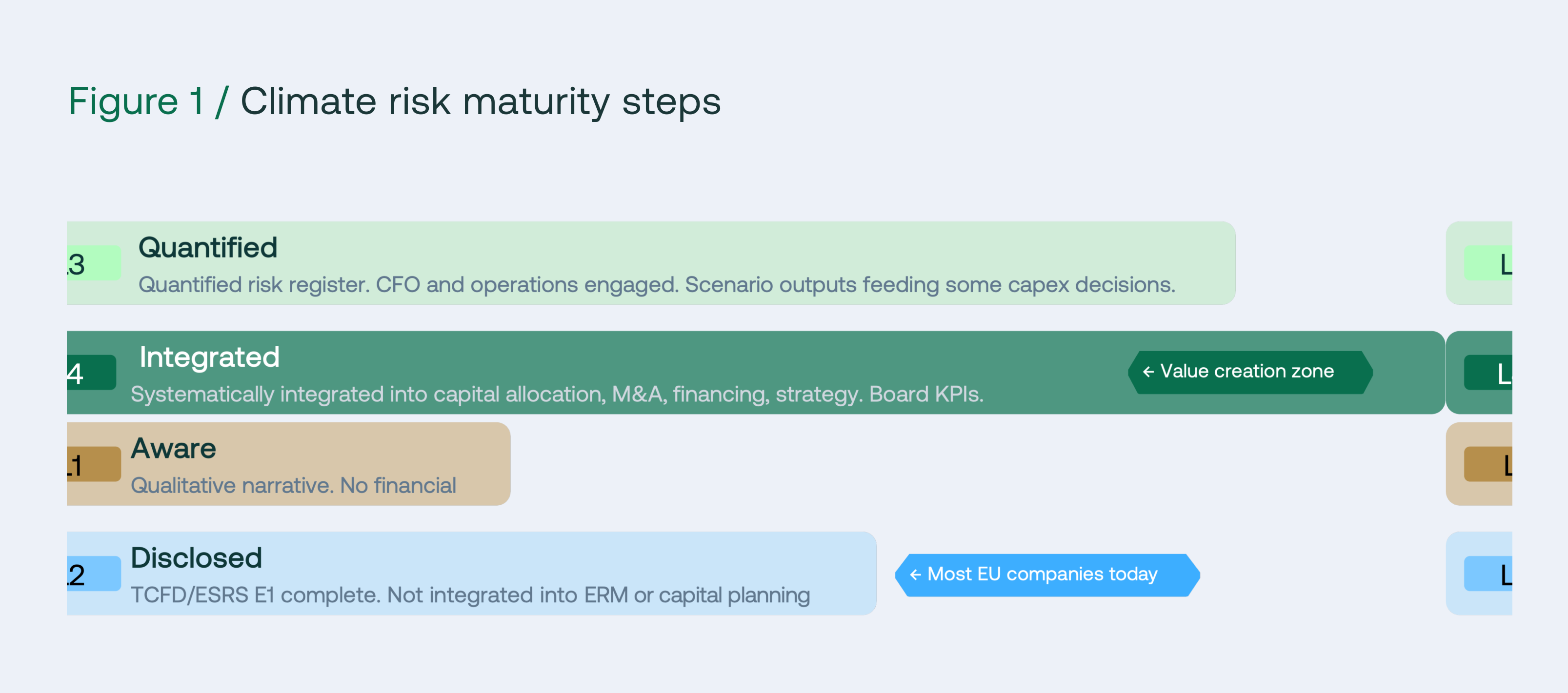
Liliia described a maturity ladder from awareness to full integration. Most organisations are stuck at disclosure: a qualitative, TCFD-style report that sits apart from enterprise risk management. Few have quantified their key risks in euros under different scenarios. Fewer still let financial impact drive capex, M&A or financing decisions.
The way forward is three practical moves. First, prioritise the few suppliers where climate exposure meets business criticality. Second, build evidence by combining external hazard data and scenarios with your own spend data and what buyers and site teams already know. Third, act: give every risk group a supplier response, an owner and a trigger.
As Liliia Kalimullina, Principal Sustainability Consultant at Nexio Projects, stated:
“Missing evidence counts as risk. Treat a supplier without data as highly exposed until it shows you otherwise.”
A food manufacturer case study showed what this looks like in practice. Its biggest exposure sat in the supply chain, not its factories. The response combined index-linked contracts with climate review triggers, origin data from tier-one traders, a cap on volume from any single region and a budgeted buffer stock. The session closed with a simple challenge: run this triage on your top three suppliers this quarter.
The customer panel brought the theme into day-to-day procurement. Menno van Steenwijk, Manager Business Support and Development Procurement at Achmea, described sustainability coming back to procurement as shared ownership. He also argued it should reach beyond Achmea’s own direct suppliers. His advice for keeping programmes alive was to keep them fun, keep the human side in, and celebrate progress.
Galina Benson, Head of Procurement Sustainability at Solvay, said change starts with culture and behaviour. Solvay co-founded Together for Sustainability (TfS) to reduce sustainability request fatigue across the chemical sector. Her rule of thumb was one buyer, one project. She called reducing supplier emissions the goal for the years ahead.
Andrei Vasiliev, Social Impact Manager at BESTSELLER, showed how worker surveys complement supplier data in human rights due diligence. His closing point applies well beyond garments: ask workers directly, design with them and show them what changed.
At the peer-to-peer roundtables, Zuzana and Nadia hosted discussions on four gaps: engagement, data, capability and implementation. The numbers framing each table were sobering. Only 12% of buyers see more than half of their Tier 2 suppliers. Training and hands-on support still reach less than half of spend for most companies. Only 15% of organisations consider their sustainable procurement programmes advanced [1].
According to Zuzana Struharova, Principal Sustainability Consultant at Nexio Projects,
“Every table came back to the same shift: from asking suppliers for information to working with them, with commitment and benefits on both sides.”
The gap between large organisations and their supply base in capacity, knowledge and tools will not close by itself. Closing it needs effort from both directions.
For buyers, that means capacity building. Prioritise the suppliers that matter most. Fund training and practical support where it changes outcomes. Link supplier progress to real commercial decisions such as preferred-supplier status and contract renewals. A questionnaire alone is not an engagement model.
For suppliers, it means upskilling. Many smaller companies fall outside the scope of the latest regulation, yet their customers, lenders and investors still ask for evidence. Marc’s elevator pitch put it plainly: being out of scope does not mean being out of the question. AI can speed up data collection, Scope 3 estimates and first drafts of policies. Expert judgement still decides what is material and what an EcoVadis analyst will accept.
The organisations that move together will build the most resilient supply chains. That means pairing buyer investment with supplier capability, and data with real decisions.
As Marc Roodhuyzen de Vries, Co-CEO and Co-Founder of Nexio Projects, stated:
“AI speeds up the work. Evidence still earns the score.”
We are an international sustainability consultancy that helps organisations move from compliance to positive impact, with support across EcoVadis ratings, supplier engagement, climate risk and reporting. Recognised as one of Europe’s top sustainability consultancies by Consultancy EU and a Top Brand in sustainability by EUPD, we are here to help buyers and suppliers close the capability gap together.
Missed the raffle in Amsterdam? Book a 20-minute call with our experts on your EcoVadis assessment or supplier engagement programme.
[1] EcoVadis and Accenture. Sustainable Procurement Barometer 2026. https://resources.ecovadis.com/whitepapers/sustainable-procurement-barometer-2026-04. Accessed November 2026.
[2] EcoVadis. Supplier Intelligence Report 2026. https://resources.ecovadis.com/whitepapers/supplier-intelligence-report-2026. Accessed November 2026.
[3] EcoVadis. What Our Barometer Report Reveals About Sustainable Procurement ROI. https://ecovadis.com/blog/what-the-barometer-report-reveals-about-sustainable-procurement-roi/. Accessed November 2026.
[4] PBL Netherlands Environmental Assessment Agency. Correction wording flood risks for the Netherlands in IPCC report. https://www.pbl.nl/correctie-formulering-over-overstromingsrisico. Accessed November 2026.
[5] S&P Global Commodity Insights. Rhine water levels approach zero, threaten barge transport.


