

 ESG business case: Why sustainability drives profit, resilience, and growth
August 18, 2025


Climate risk reaches most businesses through their suppliers and routes, yet most organisations are still stuck at disclosure. At the EcoVadis World Tour in Amsterdam, our panel set out three moves to turn climate risk insight into supplier decisions: prioritise, evidence and act.
Climate risk in supply chains was one of the most popular topics discussed at the EcoVadis World Tour in Amsterdam. Our Principal Sustainability Consultant Liliia Kalimullina and Co-CEO Marc Roodhuyzen de Vries gave a panel on the subject. Here are the highlights of that panel.
The Netherlands knows its exposure well. Some 26% of the country lies below sea level and 59% of the land is susceptible to flooding [1].
A less familiar risk hit in September. The Rhine reached record lows, and only small barges, or barges loaded to about a fifth of their capacity, could pass the upper and middle river [2].
That matters because the Rhine links Rotterdam and Antwerp to the rest of Europe. Rotterdam handles 14.2 million containers a year and Antwerp 13.6 million [2].
Much of the exposure also sits upstream. About half of what the Netherlands exports was made somewhere else: around €320 billion of €655 billion in 2025 [3]. If your feedstock or finished goods move through Rotterdam, low water on the Rhine is a supply question for your business.
Climate risk reaches every link in the value chain. Some links face physical risk, some face transition risk, and some face both. Our guide to mastering climate risk explains the two categories in more detail [4].
Raw materials are exposed to both physical and transition risks. Supplier sites, routes and ports are exposed to physical risk.
Manufacturing facilities face both physical and transition risks. Distribution centres and employees face physical risk.
Customers are exposed to transition risk. Markets and pricing face both physical and transition risks, and outbound logistics face physical risk.
We see four levels of maturity in how organisations assess climate risk:
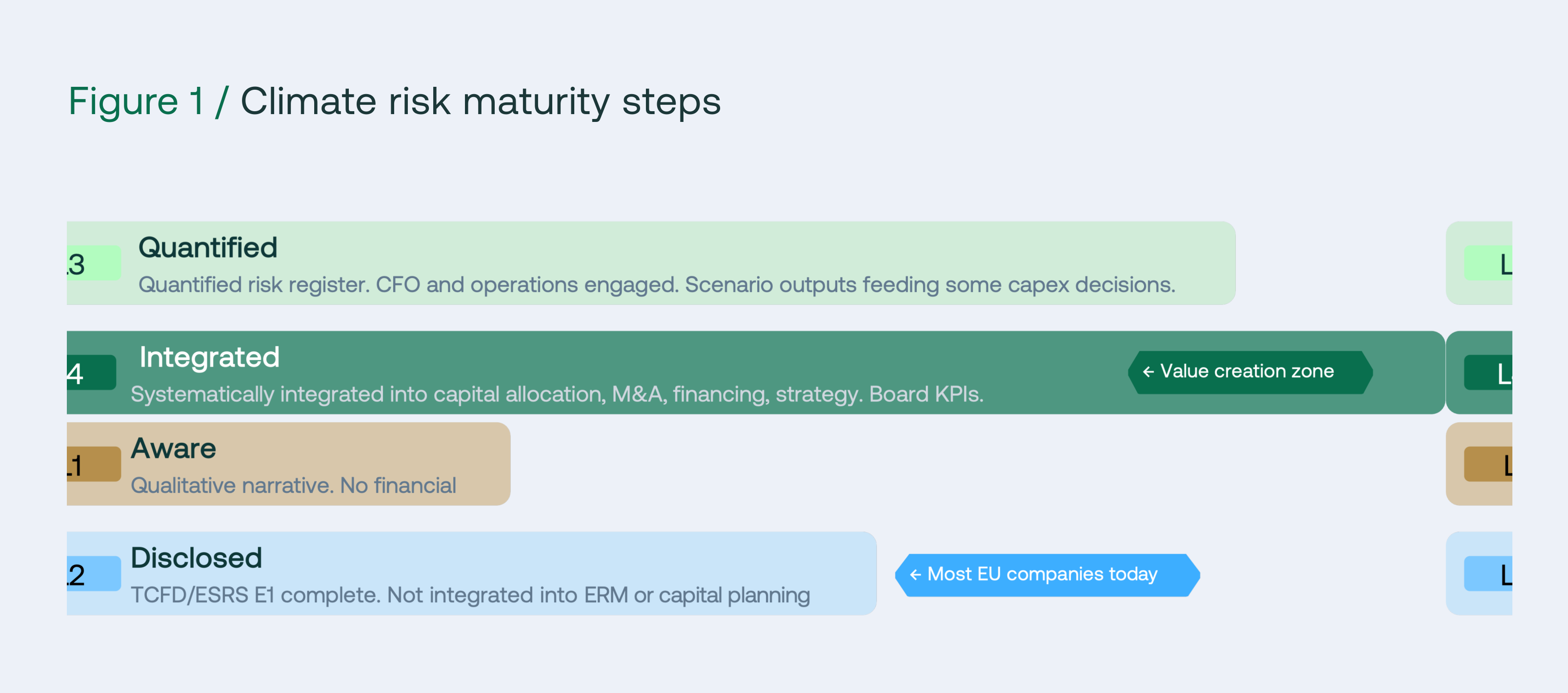
In our experience with clients, most companies stop at the disclosure level. The steps that create value are quantification and integration. We explore that shift further in our article on climate risk, from disclosure to financial decision-making [5].
A practical starting point is a simple question: do you know where your biggest climate risk drivers sit? For most companies, the answer starts with their top three suppliers.
Many supplier programmes stop at the scorecard. The data comes in and a dashboard gets built, yet a year later the supplier base looks the same. Three moves turn that data into decisions:
Triage starts with two questions. First, how critical is the supplier to your business? Consider spend, single or sole sourcing, how long it would take to qualify an alternative, and which customers depend on it.
Second, how exposed is the supplier? Look at country and category risk, the gaps in its evidence, and how quickly it answers when you ask for data.
The answers place each supplier in one of four groups:
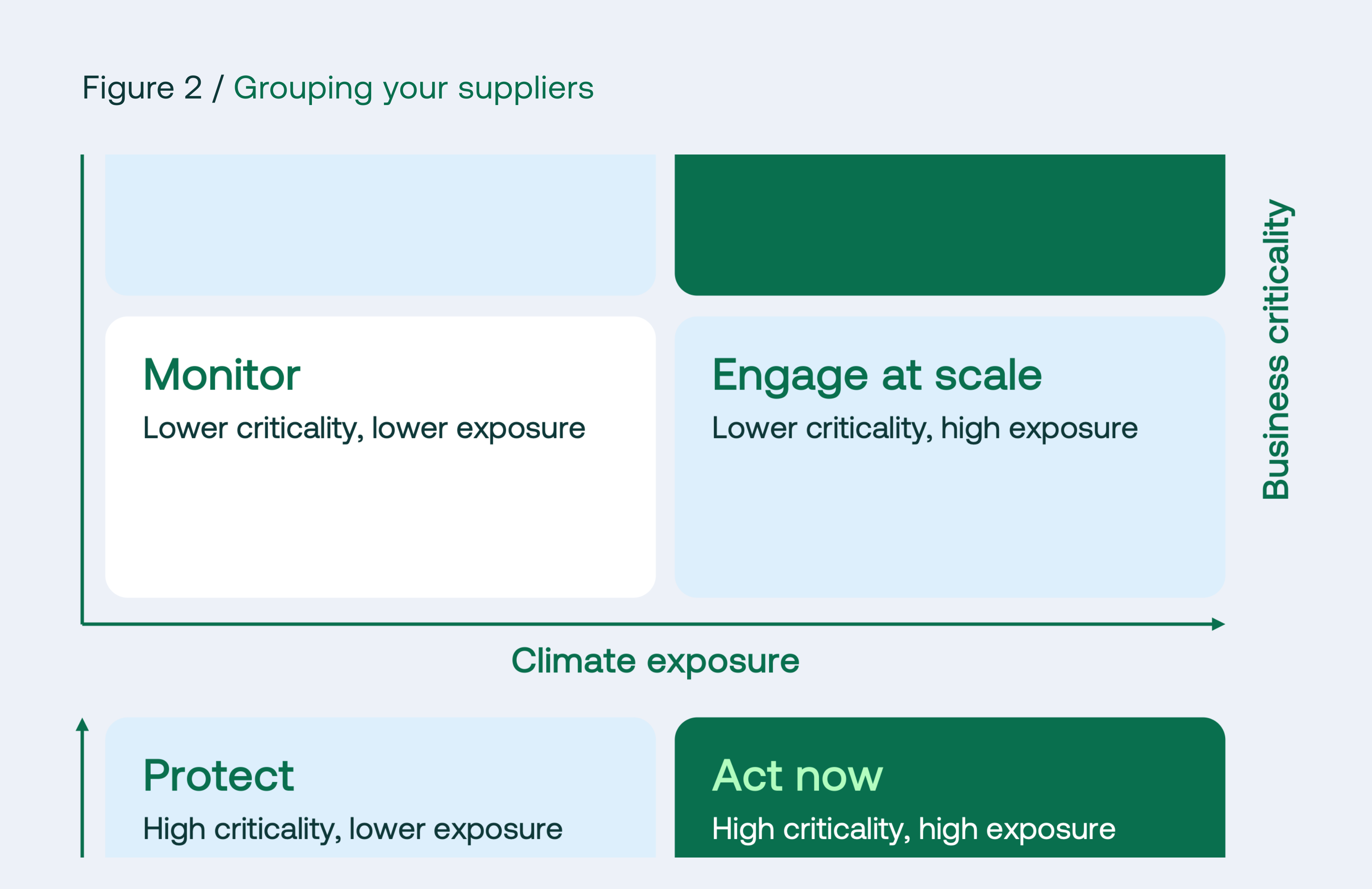
Two rules apply on top of this grid. Missing evidence counts as risk, so treat a supplier without data as highly exposed until shown otherwise. Maturity also matters. Governance, data quality and existing ratings show how mature a supplier is. Within each quadrant, less mature suppliers need more engagement.
No single dataset is enough, so each axis needs evidence you can defend.
The exposure axis draws on external sources. Climate scenarios show how hazards and policy could shift. External risk indicators include hazard maps, country risk and supplier ratings.
The criticality axis draws on internal sources. Sourcing data covers spend, single sourcing and time to requalify a supplier. Stakeholder knowledge captures what buyers and site teams already know.
For scenarios, we use the IPCC SSPs for physical risk, and IEA and NGFS scenarios for transition risk [6, 7, 8]. One lesson from our work applies here: a scenario creates value when it changes an assumption in a real plan.
Every priority risk needs a decision, an owner and a trigger. Once a supplier sits in a group, that group decides the response.
The response for the act now group comes from three teams working together:
These happen at the same time. You help the supplier improve while keeping your options open.
The climate ask also depends on maturity. A less mature supplier calculates its emissions first. A supplier that already has its emissions data sets a reduction plan.
The other groups get a lighter touch:
The panel shared an anonymised example from the food sector. Cocoa prices in 2023/24 rose 123% on the previous year, based on the ICCO indicator price measured as an annual average. That season’s deficit of 494,000 tonnes was the largest supply deficit in over 60 years [9, 10].
The manufacturer assessed five commodity categories. The biggest exposure sat in its supply chain, outside its own factories. It responded with four measures.
The company moved from reactive spot-market purchasing to index-linked, multi-year contracts. These include price caps, origin diversification clauses and climate review triggers.
The company requested origin data and climate risk documentation from its tier-1 traders. It is moving toward supplier scorecards that assess three things:
West Africa was capped at 65% of cocoa volume, with Brazil and Ecuador qualified as supplementary origins.
The company budgeted a buffer stock for its most volatile ingredients.
The key question for any procurement team is simple: which supplier or route would stop you delivering if the weather turned?
Run the triage on your top three suppliers this quarter. Place each one by exposure and criticality, gather evidence for both axes, and give each a response, an owner and a trigger. Read why climate risk is financial risk to see what is at stake for the business [11].
We are an international sustainability consultancy that guides organisations on their journey from compliance to positive impact. Our work covers strategy development, ESG ratings, climate solutions and sustainability reporting.
Recognised as a leading European sustainability consultancy by Consultancy EU and as a Top Brand in sustainability by EUPD, we are here to help you build supplier decisions on climate evidence you can defend. Speak with our climate risk team to get your supplier triage started [12].


