

 Private Equity and sustainability strategy: Three forces shaping every portfolio in 2026
May 8, 2026


“An EcoVadis score is useful evidence when the claim stays within the boundaries of the assessment.”
EcoVadis reports a network of more than 130,000 rated companies worldwide. Its scorecard can provide useful evidence about sustainability management practices, subject to the scope of the assessment. [1] Empowering Consumers for the Green Transition Directive (ECGT, or EmpCo), formally Directive (EU) 2024/825, applies from 27 September 2026. It strengthens the rules against misleading environmental claims and unsupported sustainability labels in consumer facing commercial communications. [2][3]
The key question is precise: which claims can your EcoVadis score support, and which claims need separate evidence? Your scorecard may support statements about policies, management systems, and assessed practices. It does not automatically support claims about a specific product, carbon neutrality, decarbonisation, or future net zero performance.
For a broader overview, read ECGT green claims regulation: what changes on 27 September 2026.
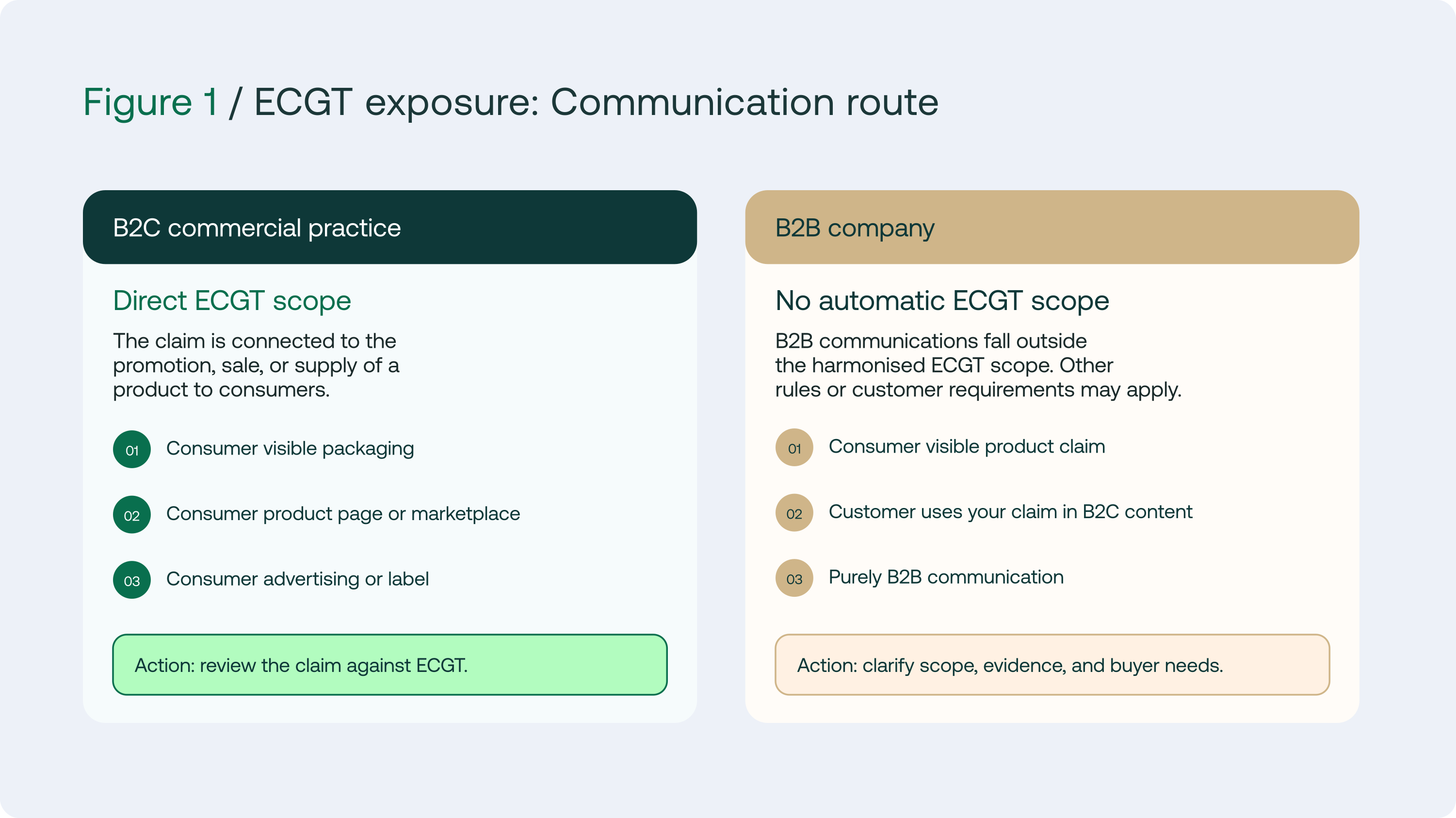
ECGT applies to business to consumer commercial practices. The European Commission’s June 2026 FAQ confirms that business to business practices fall outside the harmonised ECGT scope. [3]
This means a customer procurement request does not automatically create an ECGT obligation for every B2B supplier.
The practical position becomes more complex when:
A purely corporate sustainability statement is not automatically within ECGT. The communication must be directly connected with promoting, selling, or supplying a product to consumers. [3] Customer requests for evidence remain commercially important. They may arise from procurement policies, customer marketing rules, contractual requirements, or a buyer’s own legal exposure. These requests should be managed separately from the question of direct ECGT scope.
“An EcoVadis score is strong evidence of a well managed sustainability programme. It becomes a liability the moment it is used to support a claim it has never measured.”
EcoVadis assesses the quality of a company’s sustainability management system across four themes:
The assessment considers policies, actions, and supporting evidence for the assessed entity. [4] This scope allows an EcoVadis score to support carefully worded management system claims. For example: “Our sustainability management system has been assessed by EcoVadis.”
You can also refer to the medal tier, score, assessment year, and assessed entity. These details should remain accurate and current. A scorecard may include evidence about environmental policies, emissions management, supplier engagement, or climate related actions. That evidence does not automatically certify the environmental performance of every product, facility, subsidiary, or business activity.
Read Stay ahead of the rising standards: EcoVadis 2026 unlocked for more detail on assessment evidence and changing expectations.
The wording of each claim must match the assessment evidence.
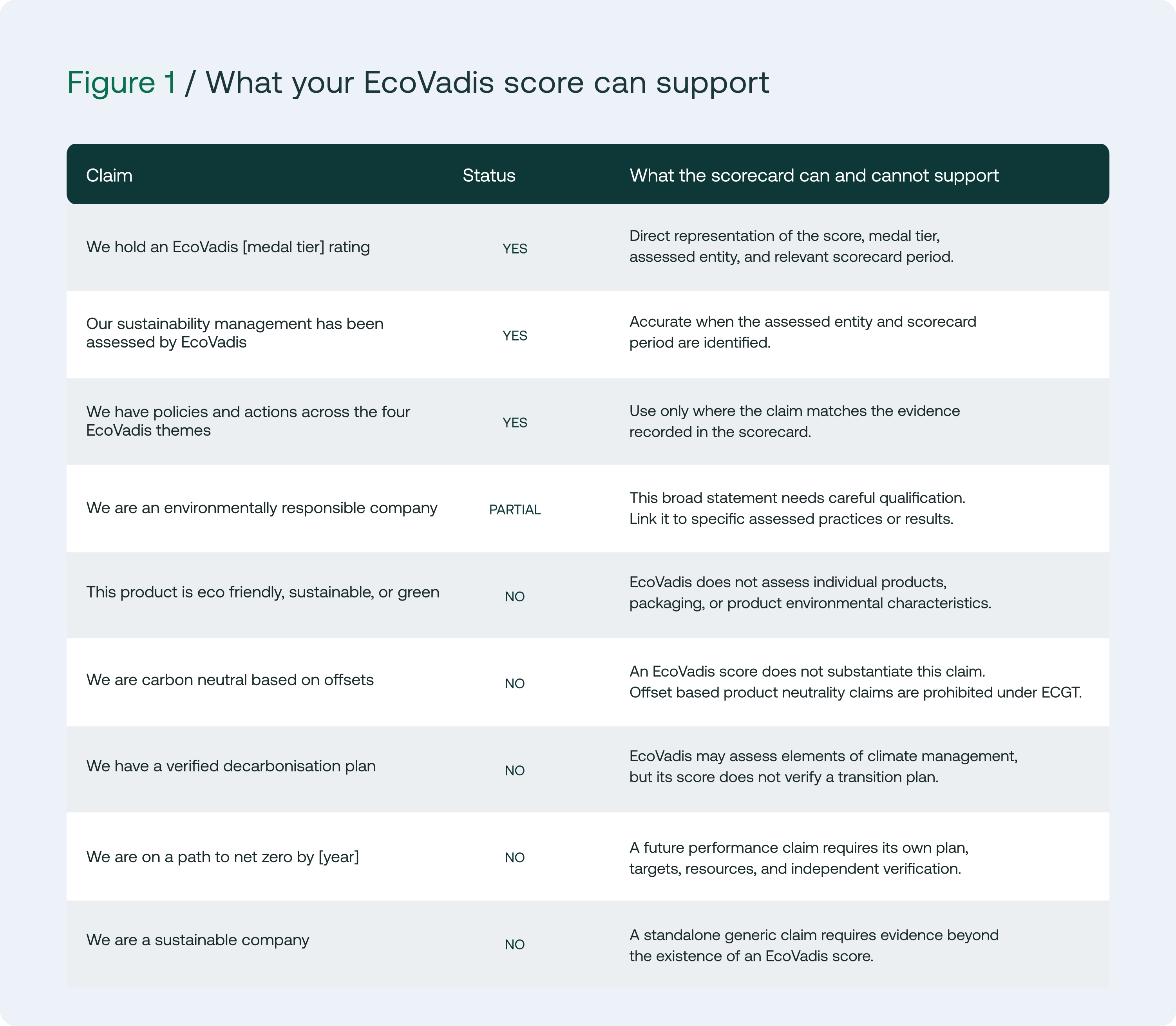
EcoVadis assesses sustainability management systems. It does not assess individual products, production processes, packaging, or product environmental characteristics. [4] A company with an EcoVadis Platinum rating cannot use that rating alone to claim that a specific product is sustainably made. Product claims may require a life cycle assessment, product environmental footprint evidence, an accredited certification, or another product specific verification method. The relevant evidence may sit with a supplier, manufacturer, or product development team. Product claim substantiation therefore often requires supplier engagement as well as internal review.
Read Why get support with your EcoVadis assessment? for guidance on assessment scope and evidence quality.
ECGT prohibits claims that a product has a neutral, reduced, or positive impact on greenhouse gas emissions when the claim relies on offsetting outside the product’s value chain. [2][3]
This can affect claims such as:
The quality of the offset does not change the prohibition. An EcoVadis score, carbon credit certificate, or offset verification document does not make a prohibited product claim compliant.
Claims such as “net zero by 2035” concern future environmental performance. The European Commission’s FAQ explains that these claims require a detailed and realistic implementation plan, measurable interim targets, allocated resources, and independent verification. [3] An EcoVadis score records the quality of the assessed sustainability management system. It does not independently verify a company’s future transition plan.
A company may refer to an EcoVadis assessment alongside a net zero commitment. The wording must make clear that the score supports the management system statement, not the future performance claim.
ECGT does not create one fixed fine for every breach across the EU. National competent authorities enforce the amended consumer protection rules under national procedures and sanctions. [2][3]
Potential consequences include:
Existing national regimes show the range of possible exposure.
In Italy, the Italian Competition Authority fined Eni €5 million in 2020 for misleading environmental advertising linked to Eni Diesel+. The case concerned claims about “Green Diesel”, emissions reductions, and environmental benefits. [5]
In France, a 2025 settlement involving SHEIN resulted in a €40 million penalty for misleading commercial practices, including greenwashing related concerns. French sanctions can also be linked to advertising expenditure and turnover, depending on the offence. [6]
In the Netherlands, relevant consumer protection cases can attract fines of up to €900,000 or 1% of turnover. Higher turnover based ceilings may apply to widespread infringements or infringements with an EU dimension. [7]
In Belgium, reported sanctions for misleading commercial practices range from €208 to €80,000 or up to 4% of annual turnover. Criminal sanctions may also apply. [8]
These examples come from existing national regimes. They are not standardised ECGT fines. Companies operating across several markets should confirm the applicable national rules before relying on a penalty figure.
Review claims across your website, product pages, packaging, labels, marketing materials, social media, tender responses, procurement questionnaires, and investor communications.
Include claims about:
For every claim, record the relevant evidence, entity, product, period, methodology, owner, and verification status.
If the claim refers to your sustainability management system, identify the EcoVadis Scorecard section that supports it.
If the claim refers to a product, identify the product specific evidence. If the claim refers to future performance, identify the transition plan and verification record.
Remove claims that cannot be supported.
Narrow broad language where more precise wording is accurate. For example, replace “sustainable company” with a statement about a specific policy, assessment, or measured result.
Substantiate claims where the evidence exists but is not currently connected to the communication.
Create a short approval process for new environmental claims. Assign responsibility across marketing, sustainability, legal, procurement, and product teams.
Archive each approved claim with its supporting evidence. Add a review date and update the file when the product, scorecard, methodology, target, or evidence changes.
For practical support, use the EcoVadis help desk to review common assessment and substantiation questions.
An EcoVadis score can provide credible evidence about a company’s sustainability management system. Its value depends on using the assessment accurately.
The score does not automatically substantiate a product’s environmental characteristics, an offset based carbon neutral claim, a decarbonisation plan, or a future net zero commitment.
Companies should review every claim against its evidence, audience, product, entity, and applicable national rules. This approach supports stronger green claims compliance and more reliable customer communications.
“Good claims governance connects every sustainability statement to evidence that can withstand scrutiny.”
We are an international sustainability consultancy dedicated to guiding organisations from compliance to positive impact. We support EcoVadis assessment preparation, green claims reviews, evidence mapping, climate strategy, and sustainability reporting.
Recognised as the best ESG consultancy in the Netherlands in 2025 by Consultancy NL and among the top European sustainability consultancies by Consultancy EU, we are here to connect the needs of business and the planet through practical sustainability solutions. [14][15]
Request a claims audit with our EcoVadis and ECGT team to map your current claims against your Scorecard evidence and identify any remaining gaps before 27 September 2026.
No. ECGT regulates commercial claims, not the possession of a sustainability credential.
An EcoVadis rating can support factual statements about the rating, medal tier, assessed entity, and scorecard period. It does not automatically substantiate product claims, carbon neutrality claims, or future net zero commitments.
A company can refer to its EcoVadis rating and badge, provided the information is accurate, current, and linked to the assessed entity.
The badge should not be presented as proof that a product is sustainable or carbon neutral. Generic environmental wording placed next to the badge may create a separate substantiation issue.
EcoVadis may assess climate related policies and actions within its Environment theme. Its scorecard does not independently verify a transition plan or future environmental performance claim.
A public statement about a decarbonisation plan or net zero target requires separate evidence that matches the wording of the claim.
Product level claims may require a life cycle assessment, product environmental footprint evidence, accredited certification, or product specific third party verification.
The appropriate evidence depends on the claim, product, market, and applicable sector rules.
[1] EcoVadis. EcoVadis platform and network overview. https://ecovadis.com/. Accessed August 2026.
[2] European Parliament and Council. Directive (EU) 2024/825 of 28 February 2024 amending Directives 2005/29/EC and 2011/83/EU as regards empowering consumers for the green transition through better protection against unfair practices and better information. https://eur-lex.europa.eu/eli/dir/2024/825/oj/eng. Accessed August 2026.
[3] European Commission. Questions and Answers: Empowering Consumers for the Green Transition Directive. June 2026. https://commission.europa.eu/document/download/3c257883-bb2a-4dd9-a6dc-501d587bb34f_en?filename=faq-empowerting-consumers-gtd.pdf. Accessed August 2026.
[4] EcoVadis. Understanding EcoVadis Medals and Badges. https://support.ecovadis.com/hc/en-us/articles/210460227-Understanding-EcoVadis-Medals-and-Badges. Accessed August 2026.
[5] Italian Competition Authority. ICA: Eni fined 5 million euros for misleading advertising in its Eni Diesel+ campaign. 15 January 2020. https://en.agcm.it/en/media/press-releases/2020/1/PS11400. Accessed August 2026.
[6] CMS. The Green Claims Directive: a legal update on developments, evolving enforcement, and overview of local regulations and judgments in selected jurisdictions. https://www.cms.law/en/che/publication/the-green-claims-directive-a-legal-update-on-developments-evolving-enforcement-and-overview-of-local-regulations-and-judgments-in-selected-juri. Accessed August 2026.
[7] Bird & Bird. Netherlands: Omnibus Directive. https://www.twobirds.com/en/trending-topics/omnibus-directive/omnibus-directive-countries/netherlands. Accessed August 2026.
[8] Bird & Bird. Belgium: Green Claims Tracker. https://www.twobirds.com/en/trending-topics/green-claims/belgium. Accessed August 2026.
[9] Nexio Projects. ECGT green claims regulation: what changes on 27 September 2026. https://nexioprojects.com/ecgt-green-claims-regulation-september-2026/. Accessed August 2026.
[10] Nexio Projects. Stay ahead of the rising standards: EcoVadis 2026 unlocked. https://nexioprojects.com/knowledge-centre/stay-ahead-of-the-rising-standards-ecovadis-2026-unlocked/. Accessed August 2026.
[11] Nexio Projects. Why get support with your EcoVadis assessment? https://nexioprojects.com/why-get-support-with-your-ecovadis-assessment/. Accessed August 2026.
[12] Nexio Projects. EcoVadis help desk: Your questions answered. https://nexioprojects.com/ecovadis-help-desk-your-questions-answered/. Accessed August 2026.
[13] Nexio Projects. Improve supply chain transparency with EcoVadis. https://nexioprojects.com/improve-supply-chain-transparency-with-ecovadis/. Accessed August 2026.
[14] Consultancy NL. Best ESG consultancy in the Netherlands, 2025. https://www.consultancy.nl/rankings/2025/beste-adviesbureaus-van-nederland-per-vakgebied-2025/esg. Accessed August 2026.
[15] Consultancy EU. Nexio Projects rankings. https://www.consultancy.eu/firms/nexio-projects/rankings. Accessed August 2026.


