Strategic ESG budgeting: A step-by-step for 2025 & 2026
August 13, 2025


Your EcoVadis score is not built from a single universal questionnaire. It’s shaped by your sector, your company size, and where you operate. Two companies submitting their EcoVadis assessments in the same week can receive entirely different scorecards, because different criteria are activated for each.
This matters far more than most sustainability managers realise. Focus on the wrong areas and you’ll spend months preparing evidence for criteria that carry minimal weight in your scorecard. Understand your sector’s activation pattern, and every hour of preparation becomes more targeted and more effective.
This article breaks down how activated criteria work, and what specifically changes across manufacturing, FMCG and chemicals.
EcoVadis assesses companies across 21 sustainability criteria, grouped into four themes: Environment, Labour and Human Rights, Ethics, and Sustainable Procurement [1]. Not all 21 criteria apply to every company.
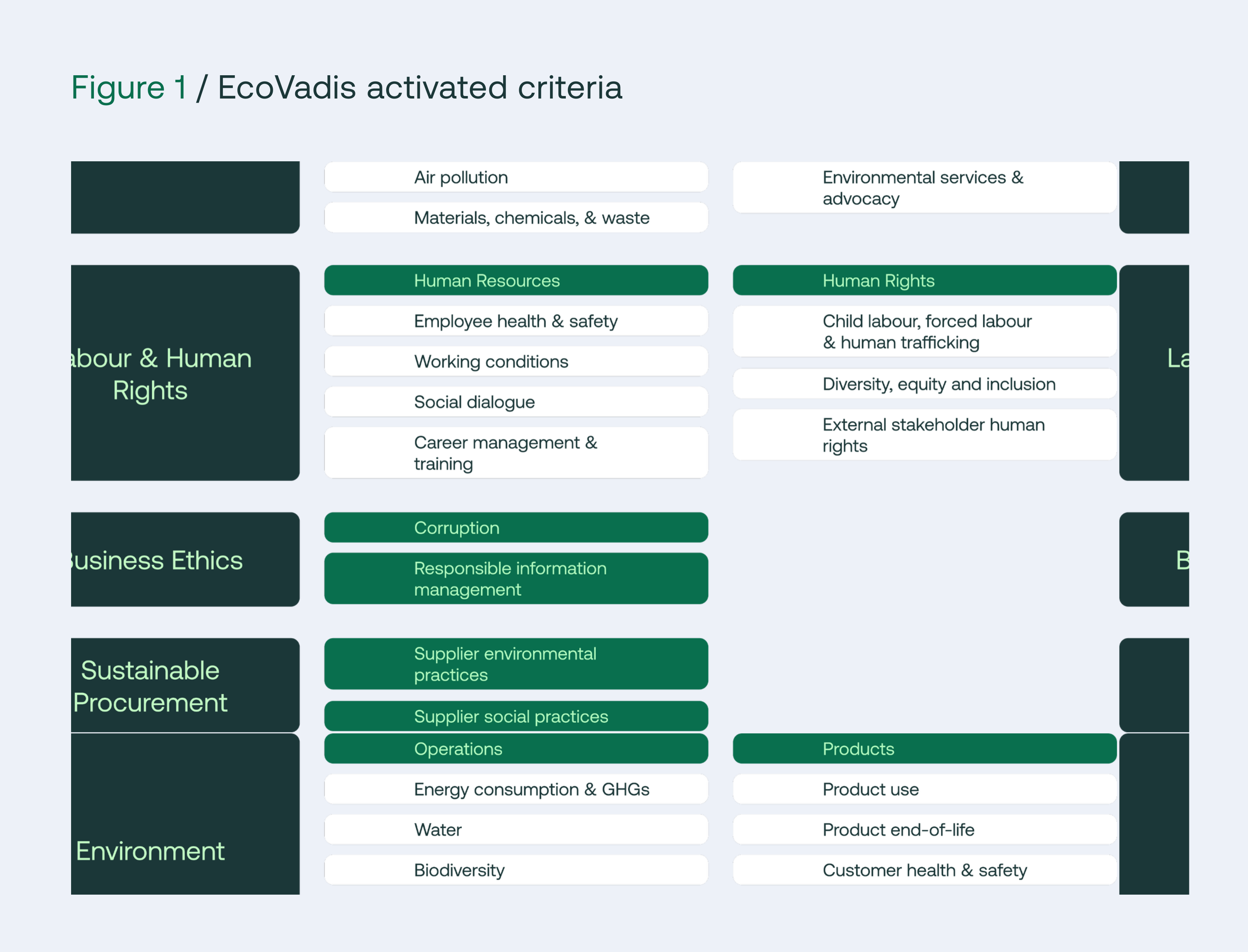
When you register on the EcoVadis platform, you provide your industry classification (using the International Standard Industrial Classification, or ISIC code), your company size, and your operational locations. EcoVadis uses these inputs to determine which criteria are material to your business [1]. Criteria rated as high importance carry greater weight in your final score. Medium importance criteria contribute less. Non-activated criteria don’t count at all [2].
This is the activated criteria system in practice. A software company won’t face questions on hazardous substance management. A chemicals manufacturer will, and it’ll carry significant weight in the scoring.
The overall score is a weighted average of the four theme scores. The weight assigned to each theme also shifts by sector, size and country risk profile [1]. Two companies can have identical raw theme scores but different overall results, simply because the theme weightings differ.
For manufacturers, whether machinery, components, plastics or industrial equipment, the Environment and Labour themes typically carry the highest combined weight in the overall score.
Within the Environment theme, Energy Consumption and GHGs is activated at high importance for most manufacturing sectors [2]. EcoVadis expects policies, actions, KPI data and, where possible, certifications. ISO 50001 and ISO 14001 are particularly valuable here, especially when they cover more than 75% of your operational scope [3]. Reporting Scope 1 and Scope 2 GHG emissions, and ideally Scope 3, strengthens the Reporting indicator score.
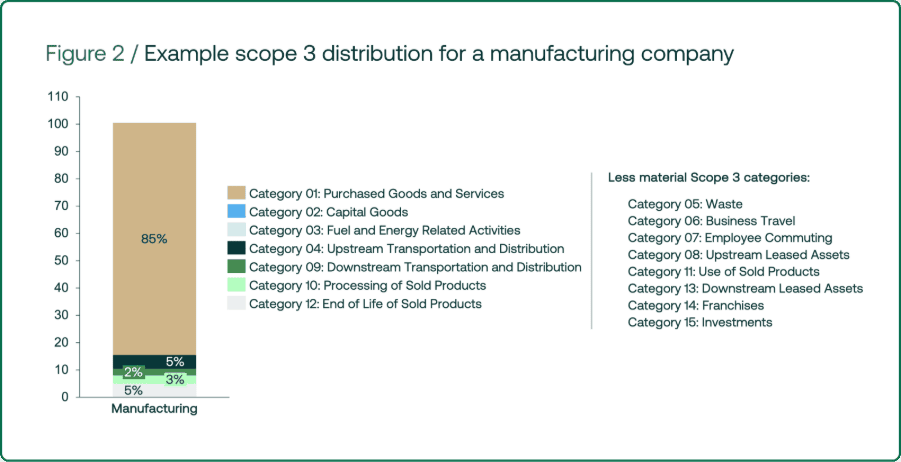
For a detailed guide to measuring upstream carbon emissions in manufacturing, see Mastering Scope 3: Manufacturers’ guide to carbon accounting.
Employee Health and Safety sits at high importance within the Labour theme for manufacturers [2]. A policy document alone won’t score well. EcoVadis analysts look for documented risk assessments, training records, accident frequency data, and ISO 45001 certification where feasible.
Materials, Chemicals and Waste is frequently activated at high importance for manufacturers, particularly those handling hazardous substances, generating complex waste streams, or operating under REACH obligations. Criteria including Product Use, Product End-of-Life, and Customer Health and Safety are typically activated at medium importance. Formal lifecycle analyses, product recall procedures and customer safety communication all contribute here.
Air Pollution and Water importance levels vary depending on operational profile and location. Biodiversity is often non-activated for standard manufacturing operations, so unless your ISIC code or site characteristics trigger it, it is unlikely to carry weight in your scorecard.
For a broader view of the ESG trends and compliance pressures shaping manufacturing today, see ESG leadership for manufacturers: key trends and best practices. Zuzana Struharova, Principal Sustainability Consultant states:
Criteria including Product Use, Product End-of-Life, and Customer Health and Safety are typically activated at medium importance. Formal lifecycle analyses, product recall procedures and customer safety communication all contribute here. For a broader view of the ESG trends and compliance pressures shaping manufacturing today, see ESG leadership for manufacturers: key trends and best practices.
For FMCG companies and consumer goods brands, the assessment looks markedly different. Sustainable Procurement carries more weight, and the Labour theme extends deeper into supply chain risks [4].
Child Labour, Forced Labour and Human Trafficking is activated as a material criterion under the Labour and Human Rights theme for consumer goods companies, particularly those operating in or sourcing from regions where these risks are elevated. This criterion focuses on a company’s own operations: policies prohibiting forced and child labour, awareness training for employees, and documented grievance mechanisms [2].
Customer Health and Safety is also activated for consumer goods companies. EcoVadis looks for product safety policies, labelling procedures and documented emergency response plans for product recalls. If your products reach consumers directly, expect specific and detailed questions on this criterion.
Sustainable Procurement remains the lowest-scoring theme globally, with a global average of 43.1 out of 100 according to EcoVadis’ Index 9th Edition 2025 [4]. For FMCG companies facing growing pressure from the Consumer Goods Forum and regulators on supply chain transparency, this theme represents both the greatest risk and the greatest improvement opportunity.
Scoring well on Sustainable Procurement requires three things at minimum: a supplier code of conduct, evidence of supplier sustainability assessments (questionnaire-based at minimum), and records of buyer training on responsible sourcing [2].
This is also where supply chain-level due diligence is assessed, including audit coverage of the supply base and procurement team training on forced labour and human rights risks. Many FMCG companies have these programmes in place. The gap is usually in translating them into the format and specificity that EcoVadis analysts can verify.

Chemicals companies face the most comprehensive environmental activation across all 21 criteria. Three criteria are typically activated at high importance: Materials, Chemicals and Waste; Air Pollution; and Water [2]. Depending on the specific locations and operations and locations, Biodiversity can be triggered, as well as Employee Health and Safety.
This reflects the sector’s genuine risk profile. Chemical manufacturers handle hazardous substances at scale, emit volatile organic compounds, generate complex waste streams and often operate near water sources. EcoVadis expects evidence that matches the breadth of this exposure.
On Materials, Chemicals and Waste, the assessment probes GHS-aligned substance labelling, hazardous waste treatment procedures and REACH compliance documentation, especially relevant for companies operating in or supplying into the EU [2]. The Together for Sustainability (TfS) audit framework is a recognised third-party audit standard specific to the chemicals sector.
Air Pollution criteria for chemicals companies activate specific questions around atmospheric emissions: SOx, NOx, VOCs, particulate matter and odour management. These require monitoring data, abatement equipment records and documented emergency procedures for accidental releases. For guidance on measuring and managing GHG emissions across the chemicals value chain, including the upstream Scope 3 categories that EcoVadis Reporting scoring depends on, see Mastering Scope 3 for chemical sector: upstream emissions.
Water is similarly assessed in depth. Effluent treatment processes, wastewater quality assessments and quantitative water consumption reporting all contribute to scoring under this criterion [2]. Companies with closed-loop water systems and formal water audits in place are substantially better positioned than those with only a high-level environmental policy. For a broader view of the regulatory and ESG pressures reshaping the chemicals sector, including REACH reforms, circularity requirements and Scope 3 expectations, see ESG trends transforming the chemicals industry.
To navigate the full EcoVadis methodology in 2026, download our guide: EcoVadis 2026 unlocked: How to stay ahead of rising standards.
For the Environment theme overall, chemicals companies should treat ISO 14001 as the foundational certification. Whether it scores well depends on coverage. A certificate covering 30% of your sites contributes far less than one covering 80% [1].
One principle applies regardless of sector. Criteria activated at medium importance still contribute to your overall theme score. A medium-importance criterion scored at zero drags your theme down and can cost you a medal level.
The medal thresholds make this concrete. The percentile-based medal system means the competitive bar rises each cycle: Platinum recognises the top 1% of rated companies; Gold the top 5%; Silver the top 15%; Bronze the top 35% [5]. Based on
The practical implication here is: start every EcoVadis cycle by confirming which criteria are activated in your scorecard and at what importance level. Then sequence your preparation, with high-importance criteria first, medium-importance second, and non-activated criteria not at all. This sequencing is what converts preparation time into points.
Activated criteria are the specific sustainability topics that EcoVadis includes in your assessment, based on your industry classification (ISIC code), company size and operational locations. Of the 21 criteria across four themes, only those deemed material to your business are activated. High-importance criteria carry the greatest weight; medium-importance criteria contribute less; non-activated criteria don’t count [1][2].
EcoVadis assigns different theme weightings and criterion importance levels depending on a company’s ISIC code. A manufacturer faces high-importance scoring on Energy and GHGs and Employee Health and Safety. A chemicals company additionally faces high-importance scoring on Materials/Chemicals and Waste, Air Pollution and Water. An FMCG company faces greater scrutiny on Sustainable Procurement and supply chain labour risks. The questionnaire content also changes by industry, so the specific questions within each criterion differ [1].
Since January 2025, EcoVadis awards medals based on percentile rankings rather than fixed thresholds. Platinum recognises the top 1% of rated companies globally; Gold the top 5%; Silver the top 15%; Bronze the top 35%. Medal eligibility also requires no theme score below 30 out of 100. Read more about medal-specific requirements here:
All four themes are affected, in two ways. Sector determines both which criteria are activated within each theme and how heavily each theme is weighted in your overall score. A manufacturing company’s overall score will reflect a higher combined weight on Environment and Labour. An FMCG company’s scorecard shifts more weight toward Sustainable Procurement. A chemicals company carries a broader environmental activation across more high-importance criteria. These theme-level weighting differences mean two companies can have identical criterion-level performance and still land at different overall scores, simply because their sector profiles assign different importance to each theme.
Start with a sector-specific gap analysis: identify which criteria are activated at high importance in your scorecard, then compare your current evidence against EcoVadis’ seven management indicators (Policies, Endorsements, Measures, Certifications, Coverage, Reporting and 360 Watch). Companies that begin there, rather than applying a generic improvement checklist, typically see the most meaningful score movement in a single assessment cycle. Nexio Projects’ clients achieve an average improvement of 13.8 points from their first assessment with us.
Nexio Projects is an international sustainability consultancy dedicated to guiding organisations on their journey from compliance to positive impact. As EcoVadis’ number one global strategic partner since 2018, Nexio Projects offers expert support across EcoVadis assessment preparation, gap analysis, insights reporting, action plan development and GHG measurement, helping clients achieve an average 13.8-point score improvement.
Recognised as a top boutique ESG and sustainability strategy consultancy by Verdantix and named the best ESG consultancy in the Netherlands by Consultancy NL, we are here to help you understand exactly what your EcoVadis scorecard requires and build the evidence to improve it.
Ready to know which criteria actually matter for your score? Book a free EcoVadis insights call with one of our sector specialists. We’ll walk through your scorecard together and show you exactly where to focus.
[1] EcoVadis. EcoVadis Ratings Methodology Overview and Principles (V2.6). https://www.ecovadis-survey.com/MediaAssets/8_InformationResources/EcoVadis-Ratings-Methodology-Overview-and-Principles-EN_2024-06-03.pdf. Accessed May 2026.
[2] EcoVadis. CSR Rating Methodology: Scoring Principles. https://resources.ecovadis.com/ecovadis-solution-materials/csr-rating-methodology-scoring-principles. April 2026.
[3] EcoVadis Help Centre. Methodology Updates Q4 2025. https://support.ecovadis.com/hc/en-us/articles/32202676805906-Methodology-Updates-Q4-2025. Released January 2026.
[4] EcoVadis. Index 9th Edition: 2025 Global Supply Chain Sustainability Risk and Performance Report. https://resources.ecovadis.com/sustainability-impact/ecovadis-index-9th-edition. Accessed May 2026.
[5] Nexio Projects. EcoVadis 2026 unlocked: How to stay ahead of rising standards. https://nexioprojects.com/ecovadis-2026-unlocked-how-to-stay-ahead-of-raising-standards/. Published February 2026.
[6] Nexio Projects. How the EcoVadis scoring system works in 2025. https://nexioprojects.com/how-the-ecovadis-scoring-system-works-in-2025/. Published October 2025.
[7] Nexio Projects. Why get support with your EcoVadis assessment? https://nexioprojects.com/why-get-support-with-your-ecovadis-assessment/.