

 Navigating the ESG agenda: Strategies for uncertain times
July 25, 2025


“A first EcoVadis medal starts with a management system that people can prove, not a folder they assemble at the deadline.”
A customer request for an EcoVadis score can expose gaps that routine sustainability work leaves hidden. Policies may exist in different departments. Targets may lack owners. Evidence may be difficult to trace back to current practices.
The EcoVadis assessment turns these weaknesses into a visible business issue. The process reviews documented evidence of a company’s sustainability management system, then provides a scorecard with strengths and improvement areas.[1]
Nexio Projects has completed more than 600 EcoVadis projects and supports organisations across international markets. Our public EcoVadis guidance reports that 87% of clients improve their score after working with us.[5]
According to our expertise, the strongest first submissions begin with management ownership. They connect sustainability policies to actions, results, responsibilities, and evidence. Let’s dive deeper into the “how” in this article.
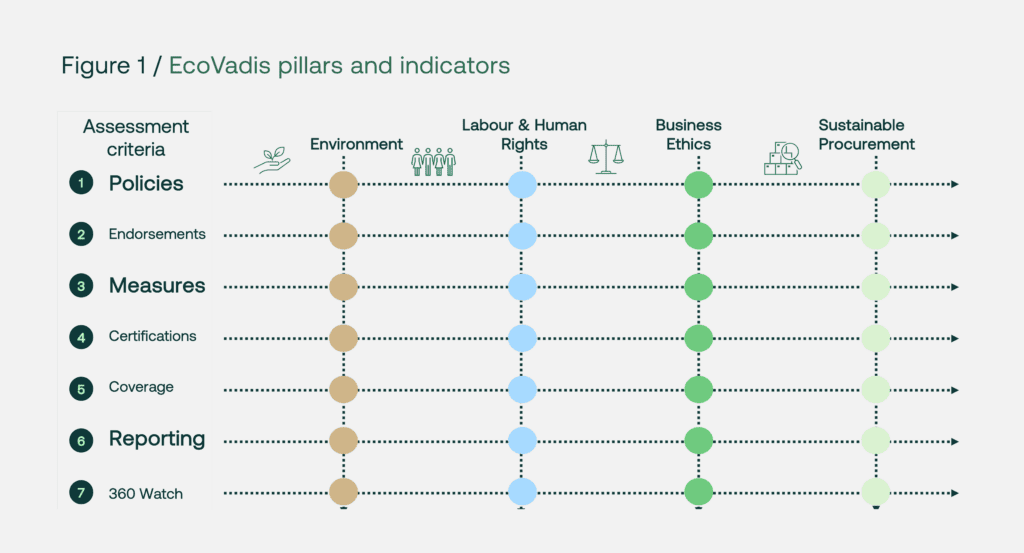
EcoVadis assesses the quality of a company’s sustainability management system through three management pillars: Policies, Actions, and Results.[2]
These pillars are assessed across four sustainability themes:
• Environment
• Labour and human rights
• Ethics
• Sustainable procurement
The questionnaire is customised according to the company’s activity, size, and location. EcoVadis selects relevant criteria from a wider set of sustainability topics based on the company’s business profile and geographical exposure.[2]
Download our EcoVadis guide!

This means that a successful first assessment cannot rely on a generic document library. A policy that is useful for one company may be incomplete for another.
The score also has two dimensions. It reflects the quality of the company’s management system in absolute terms. It also compares the company with other assessed organisations. [2]
That distinction matters for first time applicants. Strong documentation can improve the assessment outcome, but the final medal depends on relative performance and eligibility criteria.
EcoVadis medals are based on percentile ranking rather than fixed score thresholds. The current medal levels are:
• Platinum: top 1%
• Gold: top 5%
• Silver: top 15%
• Bronze: top 35%
The comparison includes all assessed companies in the EcoVadis database over the previous 12 months. Based on the most recent updates this week, EcoVadis announced that drom 2027, companies will be benchmarked against others of a similar size. The percentile positioning will be calculated separately for each size category, such as L against L and XS against XS. The ranking applies across industries rather than within one specific sector.[3]
A company is not eligible for a medal if its score is below 30 in any of the four themes. Other eligibility criteria can also apply, including industry restrictions and findings from the 360° Watch process, where EcoVadis scrapes the Internet for sustainability news related to a company. [3]
This creates three practical priorities for a first submission.
“The strongest first submissions are built by teams that know who owns each theme and why each document matters.”
The EcoVadis assessment process includes registration, questionnaire completion, expert analysis, and results publication.[1]
The questionnaire stage is where many companies lose time. People search for documents while answering questions. Different departments upload overlapping evidence. Older policies remain in circulation beside newer versions.
A simple evidence system reduces these risks.
Give each theme a clear business owner. Sustainability can coordinate the process, but Finance, Human Resources, Procurement, Legal, Operations, and Information Security may hold the relevant evidence.
Each owner should understand four points:
Build a working table with the question, answer, document name, document owner, publication date, and evidence gap. Add a review status so the team can distinguish approved evidence from material awaiting confirmation.
EcoVadis limits supporting documentation to 55 files. Only relevant documents referenced against the appropriate questions support the assessment.[1]
This limit makes selection important. Uploading every available document can weaken the submission if the files are outdated, generic, or poorly connected to the answers.
A useful evidence map should cover the full management cycle:
The evidence should also reflect the company’s current operations. A global policy may need local procedures, training records, site data, or supplier engagement evidence.
Nexio Projects’ EcoVadis assessment services support companies in developing a robust sustainability management system for the assessment process.[8]
A first EcoVadis assessment should involve more than one person. Cross-functional participation improves the evidence base and gives the scorecard greater value after publication.
A practical process includes four stages.
Start with a short briefing for senior management and theme owners. Explain the medal rules, the timetable, the evidence limit, and the business reason for completing the assessment.
This step creates accountability before detailed work begins. It also prevents the sustainability team from becoming the sole owner of information held elsewhere.
Complete a rapid gap analysis before writing final answers. Identify missing policies, weak implementation evidence, unavailable performance data, and topics that require management decisions.
The purpose is prioritisation. Companies rarely have time to improve every area before their first submission. The team should focus on gaps that affect eligibility, material themes, and the credibility of the management system.
Ask a second reviewer to test each important answer. The reviewer should check whether the evidence is current, relevant, specific, and consistent with the answer.
EcoVadis states that its analysts review questionnaire responses, supporting documents, and publicly available sustainability related information. Results typically take six to eight weeks to publish, although timing can vary by company profile and demand.[1]
EcoVadis also introduced a scorecard pre-publication process in 2026. Companies receive a two-business day window to review their scorecard for factual errors before it is shared with requesting partners.[4]
The first scorecard should establish the next improvement cycle. Review each strength and improvement area with the relevant owner. Convert high-priority improvement areas into actions with a deadline, budget, and success measure.
EcoVadis updates its methodology periodically during the year. The latest 2026 changes include more granular improvement areas and changes affecting supporting documents, reporting, and scorecard transparency.[4]
Companies should therefore check the current methodology and questionnaire before every assessment. Nexio Projects’ guide on EcoVadis 2026 methodology changes can support this review.[7]
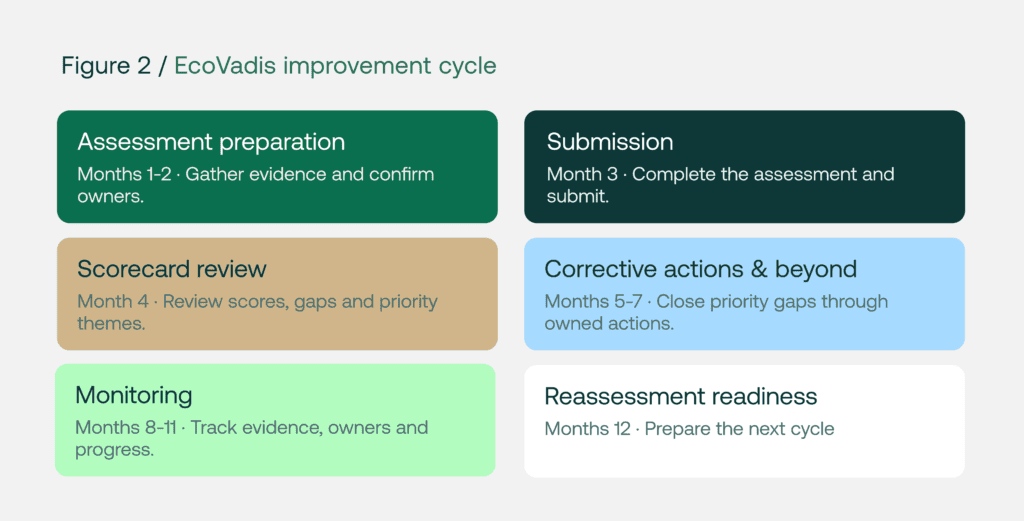
A first EcoVadis medal is achievable when the assessment becomes a shared management project. The practical foundation is clear ownership, carefully selected evidence, cross-functional review, and a plan for improvement after publication.
Companies should begin with the assessment scope and medal rules. They should then work backwards through the four themes, three management Indicators, and evidence requirements.
This approach supports a stronger submission and creates a more durable sustainability management system. It helps organisations move from compliance to purpose while connecting the needs of business and the planet.
“A medal is useful when it gives the business a clear baseline, a shared language, and a next step.”
We are an international sustainability consultancy helping organisations turn EcoVadis preparation into stronger management systems, clearer ownership, and measurable sustainability progress.
Recognised as a leading boutique ESG and sustainability strategy consultancy by Verdantix and a Top Brand in sustainability by EUPD, we are here to help you prepare for your EcoVadis assessment and build a credible path to improvement.
Speak with our EcoVadis assessment team to identify the evidence gaps, ownership questions, and priority actions that will shape your first submission.
[1] EcoVadis. What is the EcoVadis assessment process? https://support.ecovadis.com/hc/en-us/articles/115002653188-What-is-the-EcoVadis-assessment-process. Accessed September 2026.
[2] EcoVadis. What is the EcoVadis methodology? https://support.ecovadis.com/hc/en-us/articles/115002531507-What-is-the-EcoVadis-methodology. Accessed September 2026.
[3] EcoVadis. Understanding EcoVadis Medals and Badges. https://support.ecovadis.com/hc/en-us/articles/210460227-Understanding-EcoVadis-Medals-and-Badges. Accessed September 2026.
[4] EcoVadis. Methodology Updates Q1 2026. https://support.ecovadis.com/hc/en-us/articles/34621845310994-Methodology-Updates-Q1-2026. Accessed September 2026.
[5] Nexio Projects. EcoVadis help desk: Your questions answered. https://nexioprojects.com/ecovadis-help-desk-your-questions-answered/. Accessed September 2026.
[6] Nexio Projects. Top EcoVadis consultants: Your guide to choosing the best partner. https://nexioprojects.com/top-ecovadis-consultants-your-guide-to-choosing-the-best-partner/. Accessed September 2026.
[7] Nexio Projects. EcoVadis 2026: Your questions answered. https://nexioprojects.com/ecovadis-2026-your-questions-answered/. Accessed September 2026.
[8] Nexio Projects. EcoVadis assessment consultancy. https://nexioprojects.com/solutions/ecovadis-assessment/. Accessed September 2026.


