EcoVadis Platinum: From ambition to reality
October 14, 2024


“Climate risk goes beyond compliance and should be treated as an operational threat. It helps you create value when you move from disclosure to quantification, and especially when you fully integrate it in your decision process.”
Climate risk is becoming a business issue for organisations of every size. Nexio Projects recently held a webinar on making climate risk practical. This article follows its main takeaways.
Reporting requirements may change across jurisdictions and company sizes. The commercial drivers remain. Customers request climate information, insurers model physical exposure, lenders assess resilience, and extreme weather disrupts operations.
A climate risk assessment helps organisations understand where exposure sits. It also shows how risks could affect revenue, costs, assets, suppliers, and strategic decisions.
Some companies may fall outside mandatory sustainability reporting thresholds. Their customers, lenders, insurers, and investors can still request climate risk information.
Large buyers may ask suppliers for climate data during and after procurement processes. ESG ratings and questionnaires can also include climate risk information. These requests influence commercial relationships, tender eligibility, and supplier evaluations.
Banks and insurers increasingly include climate exposure in their internal models. This can affect lending conditions, insurance premiums, coverage decisions, and long term relationships.
The practical question is therefore broader than whether an organisation must publish a climate risk assessment report. The more useful question is whether climate conditions could affect its ability to operate, invest, supply customers, or finance growth.
Recent events show how physical climate risk can create immediate business disruption.
Hurricane Helene flooded Baxter’s North Cove facility in the United States. The plant supplied around 60% of intravenous fluids used by United States hospitals. The disruption contributed to an estimated $200 million loss in quarterly sales.
Climate related extreme events in the European Union were 2.5 times higher between 2020 and 2023 than during the previous decade. They caused average annual economic losses of approximately €44.5 billion.
Flooding in Valencia caused an estimated €17.8 billion in direct damage. More than 64,000 businesses were affected, while flooding also halted production at a Ford facility because suppliers were impacted.
Munich Re estimated insured natural disaster losses at $108 billion in 2025. Weather related events represented 97% of those losses.
These examples show why climate risk belongs in operational and financial discussions. Physical conditions can affect production, transport, supply availability, employee safety, asset values, and customer delivery.
Climate risk assessment is composed of evaluating physical risks, and transition risks and opportunities. Let’s discover what they actually mean.
Physical risk emerges when three elements combine: hazard, exposure, and vulnerability.
A hazard is a climate driven event or trend that can trigger harm. Examples of acute hazards include floods, storms, heatwaves, and flash flooding. Chronic hazards include sea level rise, prolonged drought, and long-term changes in temperature.
Exposure describes what or who could be affected. This may include sites, offices, data centres, employees, suppliers, transport routes, or customers.
Vulnerability describes how susceptible an exposed asset or activity is to the hazard. Vulnerability can vary by location, sector, asset design, operating conditions, and existing adaptation measures.
Heat stress provides a useful example. Employees in regions with higher average temperatures may experience heat risk differently from employees in northern Europe. Local conditions, workplace design, working practices, and existing controls all influence when the risk becomes material.
A physical risk assessment should therefore examine the specific assets and activities that matter to the organisation. Generic hazard maps rarely provide enough information for business decisions.
Transition risks arise from the shift towards a lower carbon economy. They can affect policy and legal conditions, markets, technology, and reputation.
Carbon pricing can increase supplier costs. Suppliers may pass these costs through the value chain. New efficiency requirements can require capital expenditure. Changes in technology can make existing equipment less competitive.
Customer expectations can also change demand. Buyers may prefer low carbon products, lower emission services, or suppliers with credible transition plans.
Transition risk analysis should examine the countries where an organisation operates. It should also consider supplier relationships, products, markets, energy use, and strategic dependencies.
Transition creates opportunities alongside risks. Organisations may improve resource efficiency, optimise manufacturing processes, change energy sources, develop lower carbon products, and access new markets.
Resilient supply chains can also create commercial value. Organisations that reduce dependency on concentrated suppliers or vulnerable routes may improve continuity and customer confidence.
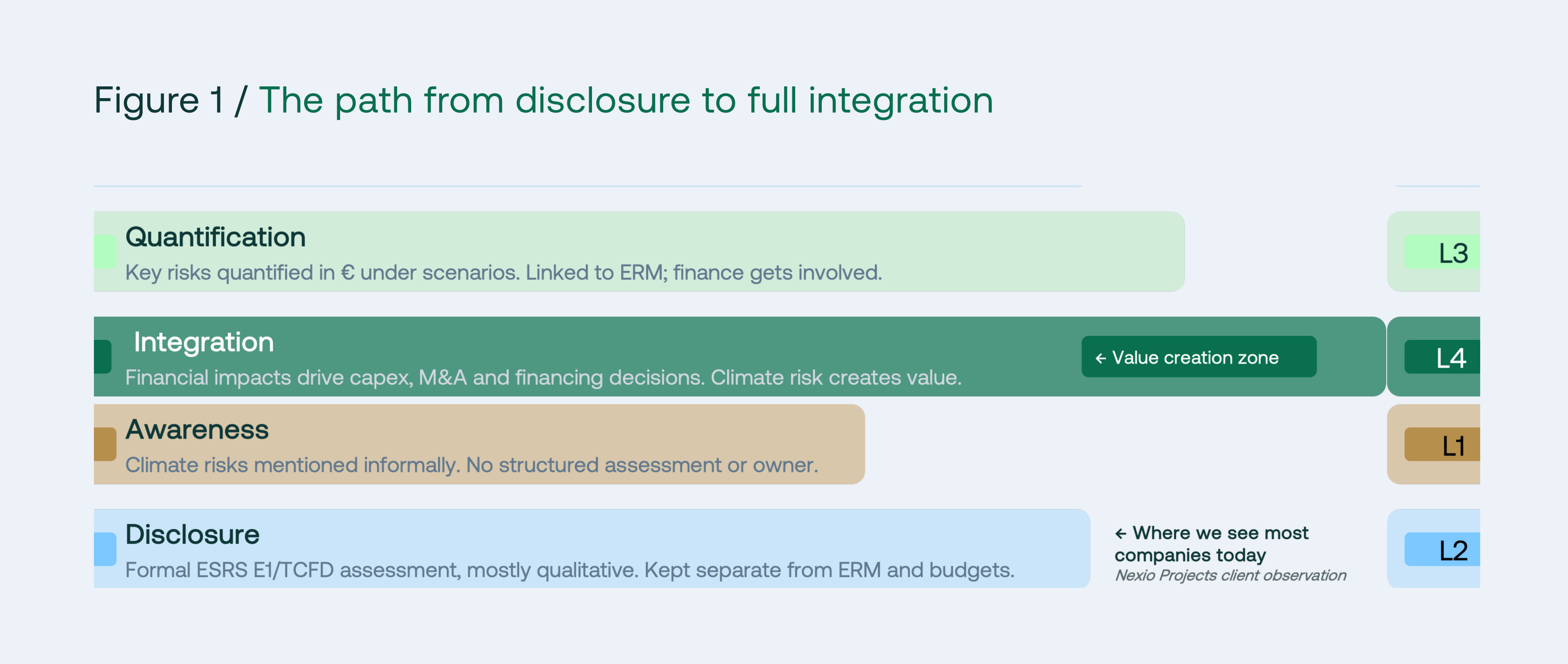
Many organisations begin with qualitative disclosure. They identify risks, describe governance, and prepare information for a reporting framework.
The next step is quantification. Financial quantification translates climate exposure into financialterms. Physical risks may affect downtime, asset damage, water availability, and supplier continuity. Transition risks may affect carbon costs, revenue, technology investment, and customer demand.
Integration happens when these findings change decisions. A climate risk assessment becomes useful when it influences an investment location, procurement strategy, insurance decision, product plan, or capital allocation process. For instance:
“The main objective of climate risk is to make your company more prepared and more resilient to the physical events or the transition events that can potentially impact your business model and how you operate.”
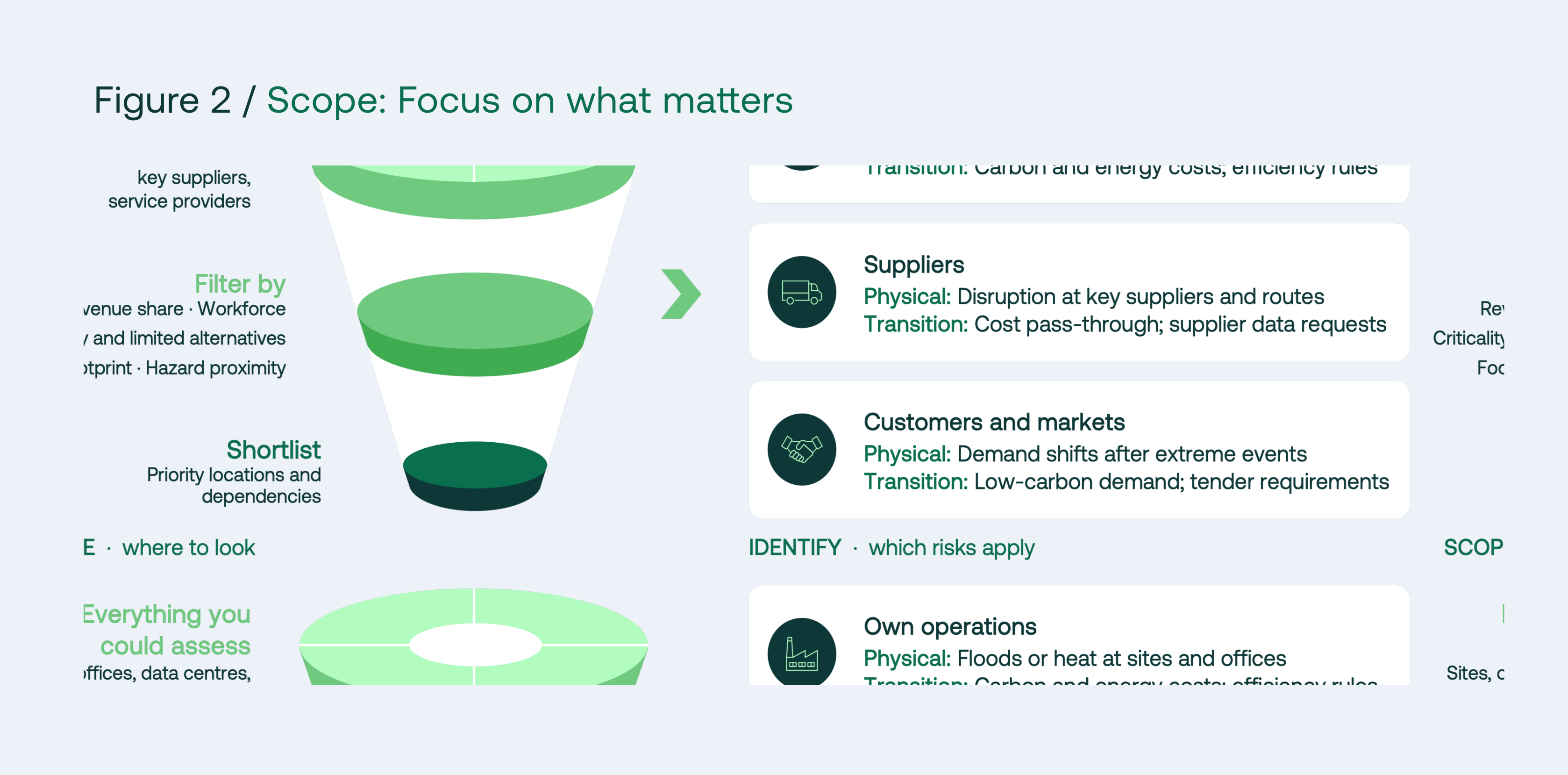
Organisations should begin by focusing on what matters. A first assessment does not need to cover every possible site, supplier, product, and market.
Useful filters include revenue share, workforce size, carbon footprint, criticality, limited alternatives, and hazard proximity.
For suppliers, criticality and substitution options can help identify priorities. For sites, revenue contribution and employee numbers can indicate potential business impact. Geographic exposure can highlight locations affected by specific physical hazards.
The assessment should also consider the value chain. Risks may sit in upstream suppliers, internal operations, logistics networks, customers, or markets.
A focused scope makes the first assessment manageable. It also creates a stronger basis for expanding coverage later.
Scenario analysis tests whether important decisions remain robust under different plausible climate conditions.
Physical risks can be assessed with IPCC and SSP scenarios. Transition risks can be assessed with scenarios from the International Energy Agency and the Network for Greening the Financial System.
The purpose is not to predict one precise future. Scenario analysis stress tests the organisation’s strategy and business model under different conditions.
A high physical risk scenario may show increasing heat, floods, and drought. A high transition risk scenario may show rapid changes in carbon prices, regulation, technology, and demand.
Time horizons should reflect the decisions being tested. Organisations may need to consider baseline conditions, medium term changes, and longer term exposure linked to asset life and investment cycles.
The assessment should also document its assumptions. Scenario assumptions can influence risk ratings, financial estimates, and the actions selected.
A risk assessment becomes valuable when it changes a business decision.
Consider a manufacturing facility exposed to flooding. Flooding could interrupt incoming materials, prevent outbound deliveries, damage assets, and reduce revenue.
The organisation might assess flood barriers, equipment relocation, drainage improvements, alternative routes, contingency plans, or insurance coverage.
Climate findings can influence several business areas:
The right response depends on the organisation’s business model. Each action should address a specific exposure and decision.
Every priority risk needs an action, an owner, a timeline, a trigger, and an existing process for integration.
The action should explain what will change, be investigated, or monitored. The owner should sit in the function that can implement the response. This may be finance, procurement, operations, risk, or another business function.
The timeline should distinguish immediate actions from medium and long term measures. The trigger should identify what would initiate reassessment.
Triggers may include a policy change, a new investment, a major weather event, a supplier disruption, a change in market demand, or a new insurance condition.
Climate risk can then be integrated into existing processes. These may include enterprise risk management, investment approvals, procurement reviews, budgeting, and business continuity planning.
“The important point is that the risk assessment changes something in the way you work so that you are more prepared for these risks.”
Financial quantification depends on the risks, sector, and business model under assessment.
For physical risks, the main lenses may include downtime and asset damage. Water availability may be material for water dependent operations. Supplier concentration may matter when a key supplier sits in a vulnerable region.
For transition risks, the analysis may consider carbon pricing, changes in revenue, customer pressure, and technology investments required for decarbonisation.
The damage function relates to vulnerability and financial quantification.
Vulnerability helps determine when a hazard becomes material for an organisation. It depends on geography, operating conditions, existing controls, and the nature of the activity.
Financial quantification then estimates the value of the potential damage or disruption. The analysis should connect the physical impact to the organisation’s operations and financial information.
Software can help identify hazards and support scenario modelling.
It cannot replace knowledge of the organisation’s business model, processes, dependencies, and operating context. The most useful approach combines software with internal data, expert judgement, and company specific filters.
We are an international sustainability consultancy dedicated to guiding organisations on their sustainability journey from compliance to positive impact. We support decision makers with practical analysis that connects the needs of business and the planet.
Recognised as the best ESG consultancy in the Netherlands in 2025 by Consultancy NL and as a Top Brand in sustainability by EUPD, we are here to help organisations turn climate risk insight into resilient business decisions.
Get in touch with our experts for climate risk assessment, reporting, scenario analysis, financial quantification, and transition planning.