Understanding California’s SB 261: Your guide to climate risk compliance
November 4, 2025


Submitting a CDP response can feel like the final deadline after months of data collection, review, and approval. The work continues after submission. Companies need to confirm whether their response is eligible for scoring, monitor the CDP Portal, understand the score release process, and prepare for questions from investors, customers, and internal stakeholders.
For the 2026 cycle, CDP set the scoring deadline for 16 September 2026. Companies can continue submitting or editing responses until the final disclosure deadline in the week of 26 October, but amendments submitted after the scoring deadline will not be considered for scoring.[1]
The next stage requires a structured plan. Companies should preserve the submitted response, monitor the score process, prepare for publication, and translate the result into practical improvements.
The first priority is to confirm that the response was submitted successfully through the CDP Portal.
The submission lead should retain:
The final response should become the official baseline for future improvement.
A response submitted by the scoring deadline is eligible for CDP scoring, subject to CDP’s terms and other eligibility requirements.[1]
A response submitted after the scoring deadline may not be scored. CDP may offer a limited on demand scoring option for some late submissions, subject to availability, fees, and CDP approval. In 2026, the deadline to request an on-demand late submission was September 29, 2026. [2]
Companies should check the CDP Portal and internal email records for any notification about:
The response team should avoid assuming that a completed online form automatically guarantees a score.
CDP permits amendments within the response window, subject to its terms. Amendments need to be resubmitted before the scoring deadline to be considered in the scored response.[1]
After the scoring deadline, an amendment may update the submitted response without changing the score.
An amendment may be appropriate when the company identifies:
The decision should involve Sustainability, Finance, Risk, and the submission lead. The team should document why an amendment was made and whether it affects scoring eligibility.
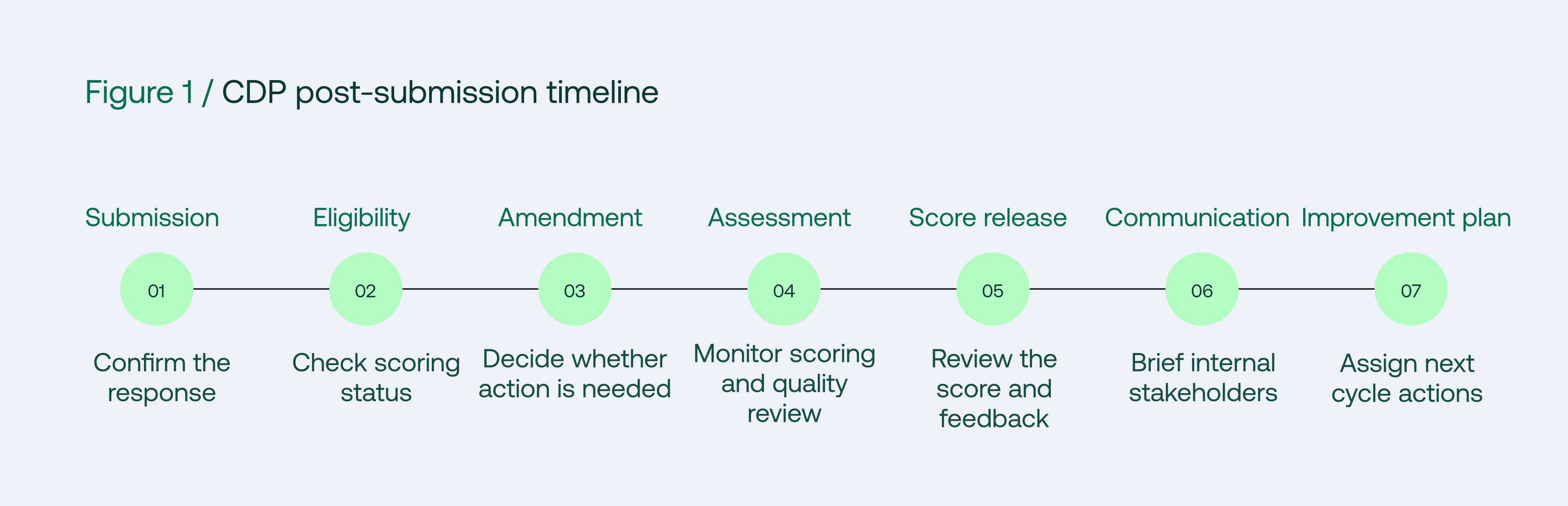
After the response window closes, CDP’s accredited scoring partners and internal scoring teams assess submissions using the relevant scoring methodology and quality assurance processes.[3]
For the 2026 cycle, CDP states that scores will be made available to disclosers during the week of 30 November 2026. Public scores are scheduled for publication later in the same week for companies with a public score.[3]
The exact schedule may be updated. Companies should monitor CDP notifications and the Portal.
The initial score release includes:
CDP’s scoring structure uses levels from D minus to A. The score reflects the detail and comprehensiveness of the response, environmental awareness, management methods, and progress towards environmental leadership.[3]
A company can perform strongly in one section while remaining at a lower overall level. CDP applies minimum thresholds and Essential Criteria for progression between scoring levels.[3]
The scorecard should therefore be reviewed by theme and category. The overall letter alone does not show where the next improvement opportunity sits.
“The most useful scorecard review asks which management practice needs to change, rather than which letter the company wants next.”
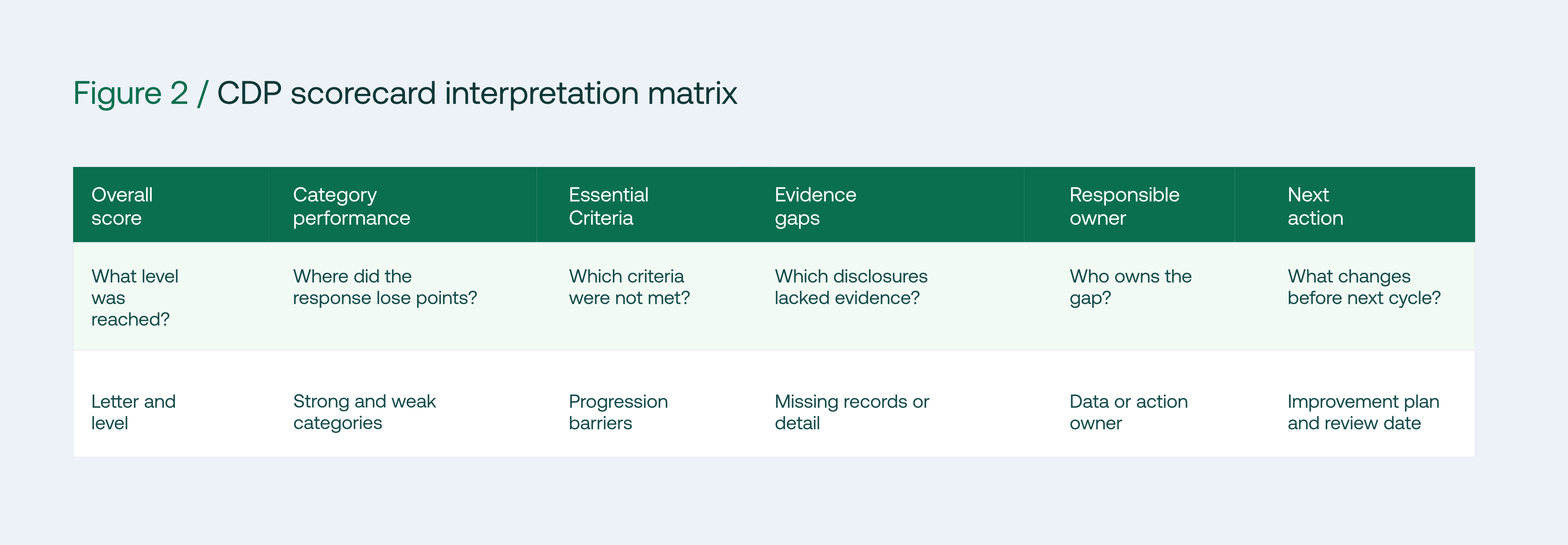
The score should be reviewed through three lenses: accuracy, performance, and business relevance.
CDP provides a score appeal process for disclosers who believe an error occurred in the scoring process. An appeal must be submitted through the relevant CDP process and is reviewed independently by CDP’s scoring oversight team.[4]
CDP may review the wider response as part of the appeal. The appeal outcome is final.[4]
Before submitting an appeal, the company should prepare:
An appeal should focus on a specific scoring issue. It should not be used simply because the result is lower than expected.
The next review should compare the scorecard with the original response plan. It should assess which categories performed as expected, where the response lost points, and which Essential Criteria were not met. It should also identify the data gaps that affected the score, the disclosures that lacked evidence, the targets that lacked progress information, and the governance answers that require more detail.
This analysis creates a more useful improvement plan than a general objective to “improve the CDP score”.
The score should be shared with the people who own the underlying data and actions.
The company should decide in advance who can communicate the score externally.
CDP’s terms distinguish between public and private score situations. The rules depend on the type of discloser, the source of the request, the environmental issue, and whether the company qualifies for a private score option.[5]
Companies should check the current CDP privacy rules before publishing the score on their website, including it in a sustainability report, sharing it in investor presentations, using it in customer proposals, adding it to supplier questionnaires, or referencing it in marketing material.[5]
If the score is shared publicly, companies should follow CDP’s requirements for score disclosure and any required accompanying information.[5]
A company should also avoid presenting a CDP score as a certification. CDP scoring reflects the quality and completeness of a response against CDP’s methodology.
The final step is to convert the scorecard into a management plan. Each action should include:
Some actions may require new data. Others may require stronger governance, better target tracking, improved supplier engagement, or clearer public disclosure.
The company should also identify which improvements support other reporting requirements. CDP data can overlap with information used for CSRD, ESRS, UK SRS, TCFD aligned reporting, customer requests, and internal risk management.
The frameworks remain separate. A coordinated data process can reduce duplication.
The next CDP response should not start when the questionnaire opens. The post submission period should be used to archive the response, review the scorecard, assign improvement owners, update the data collection plan, improve evidence storage, test calculations, engage suppliers, review targets, and update management reporting. This turns CDP from an annual questionnaire into a continuous environmental management process.
CDP submission is a transition point between reporting cycles. Companies should confirm their scoring position, preserve the submitted response, monitor the Portal, review the scorecard, and communicate the result responsibly.
The strongest next step is a focused improvement plan. It should connect scorecard feedback with data ownership, governance, targets, supplier engagement, and wider sustainability reporting.
That approach helps organisations move from compliance to positive impact by turning disclosure into better environmental management.
“The real value of a CDP submission appears after the score, when the organisation turns feedback into action.”
We are an international sustainability consultancy helping organisations prepare CDP responses, improve environmental data, and turn scorecards into practical improvement plans.
Recognised as a leading European sustainability consultancy by Consultancy EU and a Top Brand in sustainability by EUPD, we are here to help you review your CDP result and strengthen the next response.
Contact our CDP advisory team to assess your scorecard, data gaps, governance evidence, and next cycle priorities.
[1] CDP Help Center. Submitting and Editing Your CDP Response as a Discloser. https://help.cdp.net/en-us/knowledgebase/article/KA-01079. Accessed September 2026.
[2] CDP. Terms of Disclosure 2026. https://www.cdp.net/en/terms-of-disclosure. Accessed September 2026.
[3] CDP Help Center. Understand Your Score as a Disclosing Company. https://help.cdp.net/en-us/knowledgebase/article/KA-01160 Accessed September 2026.
[4] CDP Help Center. Understand Your Score as a Disclosing Company: Score Appeal Process. https://help.cdp.net/en-us/knowledgebase/article/KA-01079. Accessed September 2026.
[5] CDP Help Center. Understanding Response and Score Privacy. https://help.cdp.net/en-us/knowledgebase/article/KA-01156. Accessed September 2026.