Bridging the gap: Practical implementation of scope 3 and circular economy
November 26, 2025



Fewer datapoints can make sustainability reporting appear easier. The remaining information still needs a clear owner, a defined method, reliable evidence and a decision trail.
The central question is therefore how organisations should adapt their data models, governance and technology for the next reporting cycle.
This article summarises a shared webinar we delivered at Nexio Projects with our partner Sweep on managing ESG data after the Omnibus simplification. We bring the consultancy perspective, while Sweep brings the software implementation lens, giving organisations a complete view of the next steps.
As Romina Coral Andrade, Sustainability Consultant at Nexio Projects, stated:
“You don’t have to start over. You can take this as an opportunity to make things smarter and more efficient for yourselves for the long run.”
The Corporate Sustainability Reporting Directive, or CSRD, establishes the European Union’s legal framework for corporate sustainability reporting. The European Sustainability Reporting Standards, or ESRS, translate that framework into the topics, disclosures and datapoints companies use in their sustainability statements.
Companies apply double materiality to identify which impacts, risks and opportunities are relevant to their business. This assessment determines which ESRS disclosures they need to prepare and explain.
Following the Omnibus simplification, the European Commission adopted revised ESRS that update the original standards. The revised ESRS reduce and reorganise disclosure requirements, remove voluntary datapoints and introduce additional reliefs, while keeping the core reporting architecture in place. [2][3]
It reduces the number of companies expected to report and the number of mandatory datapoints.
The architecture of sustainability reporting remains in place. Double materiality, external assurance and the environmental, social and governance structure continue to shape the reporting process.
The change reduces the reporting inventory. It does not remove the need to understand the organisation’s impacts, risks and opportunities.
A company may fall outside mandatory reporting requirements and still receive requests from customers, banks, investors or procurement teams.
This means companies need to distinguish between information required for formal reporting and information that remains useful for commercial or financial relationships.
Removing a datapoint from the reporting model does not automatically make the underlying information irrelevant.
The simplified approach places greater emphasis on a top down assessment. Organisations should begin with their strategy, business model and material impacts, risks and opportunities.
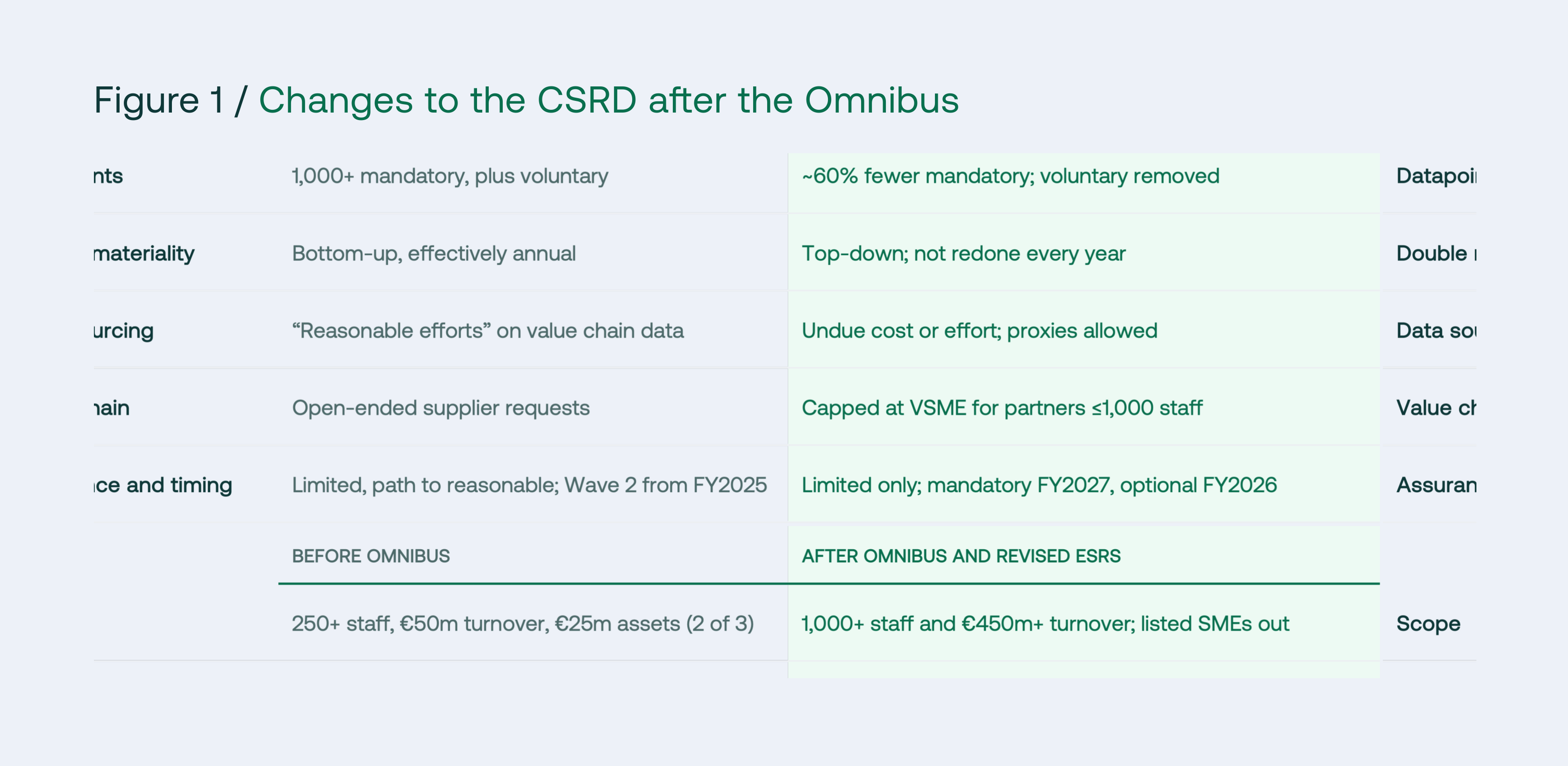
The aim is to collect information that supports meaningful reporting and decision making. Teams should avoid building large inventories before deciding what matters.
Companies that began collecting data under the original ESRS should review every datapoint against the revised requirements. Each datapoint will generally fall into one of four categories:
Previous work is still valuable. Existing definitions, evidence and ownership structures can provide a starting point for the revised model.
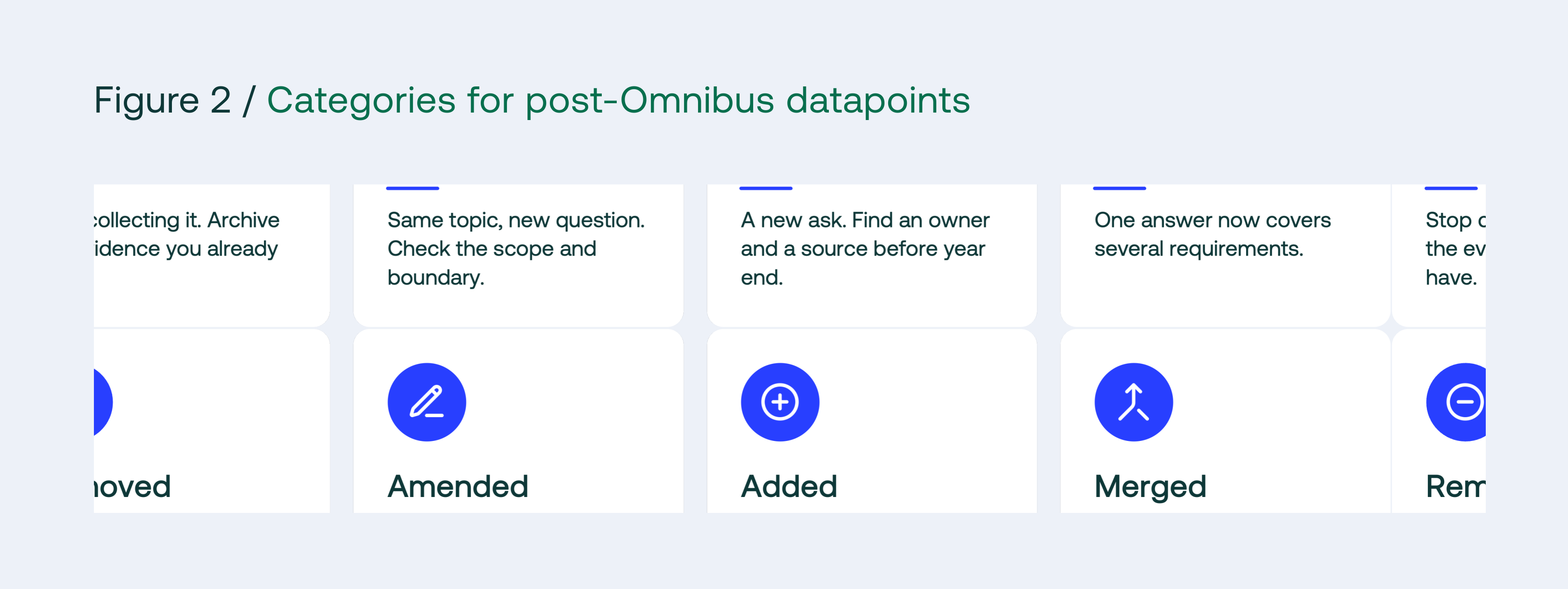
With fewer datapoints, each remaining number needs stronger support. Teams need to show where information comes from, who owns it and how it was calculated.
As Ines Kisielewski, Solutions Engineer at Sweep, stated:
“The effort moves from collecting data to more defending the decisions and why they’ve been left out.”
Every material datapoint should have a definition, method, source, owner and audit trail.
Companies should also document estimates, proxies and sector averages. The method and assumptions should remain connected to the reported number.
Supplier and value chain requests should become more proportionate. Organisations need to understand which information suppliers can reasonably provide and which requirements apply to the relationship.
This requires a review of supplier questionnaires, data requests and contractual requirements. Companies should also label modelled gaps and explain how they have been addressed.
Structured reporting will continue to influence ESG data management. Companies should therefore build information in a way that supports future tagging and digital outputs.
A reusable data model can serve formal reporting, stakeholder requests and internal management needs.
Materiality should determine the reporting inventory. Companies need to identify which impacts, risks and opportunities require information before assigning large collection exercises.
This approach helps reporting teams focus on decision useful information. It also creates a clear basis for explaining why some datapoints are included and others are excluded.
Ownership should sit with a named person, rather than an undefined department.
Different functions may own different information. Procurement may manage supplier data. Finance may validate financial information. Human resources may manage workforce data. Operations may own production metrics.
Each owner should understand the relevant definition, method, evidence requirement and review process.
A mock audit can reveal gaps before the reporting cycle closes. Companies should select material datapoints and trace them from their source to their final disclosure.
The exercise should test:
Software can connect information from different systems and contributors. It can consolidate data from entities, departments and locations.
It can also flag unusual results, missing information or changes that require review. This helps teams focus their attention where intervention is needed.
A platform can keep a full trail of changes, submissions and approvals. It can connect evidence to individual datapoints and show who made or approved a change.
This creates visibility across the reporting process. It also reduces the risk of losing explanations in separate spreadsheets or email threads.
Software can apply proxies or suggest emission factors. It can help teams record assumptions, compare versions and identify missing evidence.
It can also assign tasks, monitor deadlines and support different reporting views across entities and business units.
Software is particularly useful when organisations need to consolidate information from several sources or manage changes caused by mergers and acquisitions.
Data owners may contribute through surveys, spreadsheets, integrations or APIs. A flexible platform can accommodate these different methods while preserving a consistent reporting structure.
This makes implementation more practical for contributors with different roles and levels of sustainability expertise.
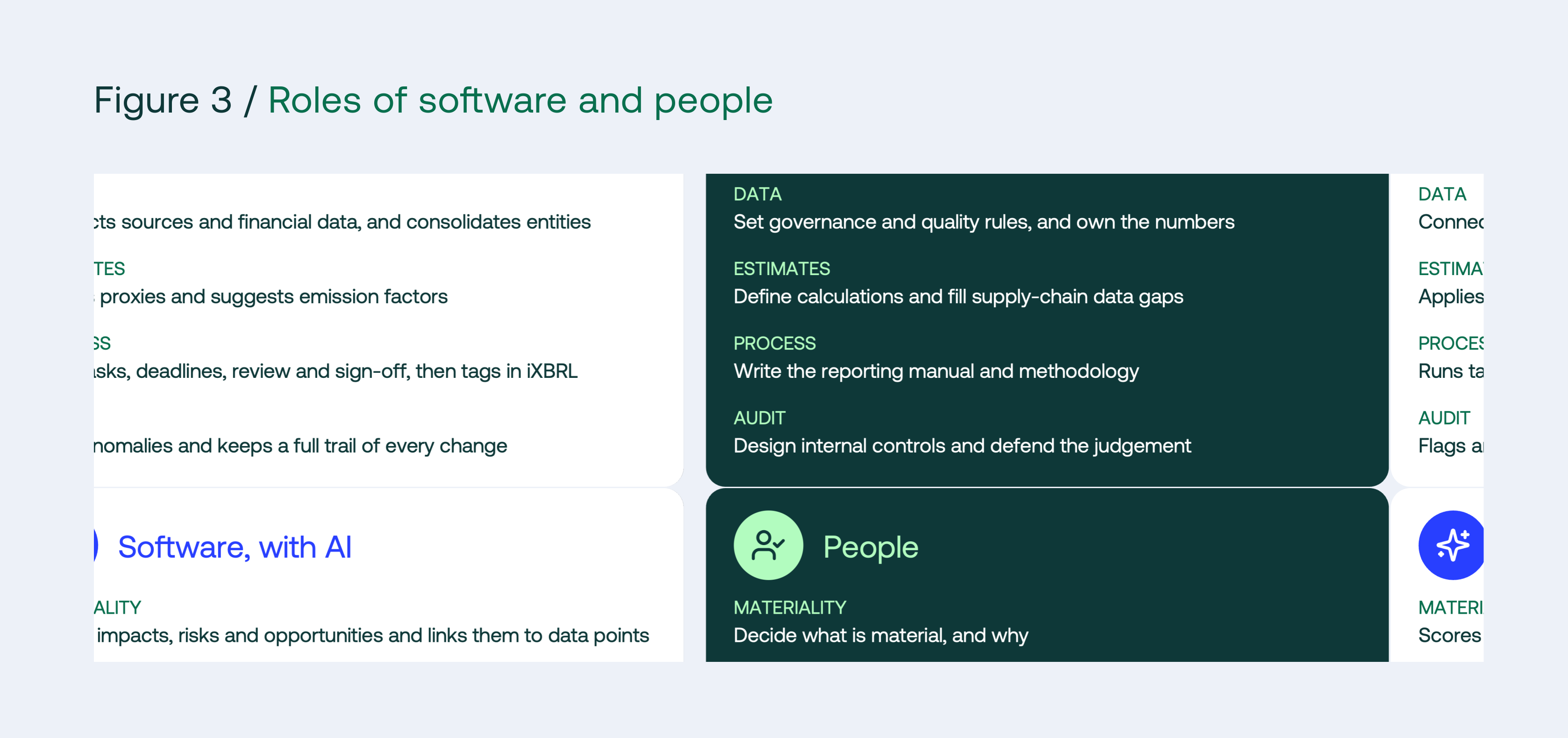
Software can score impacts, risks and opportunities and link them to datapoints. People must decide what is material and explain why.
That decision depends on the organisation’s strategy, business model, value chain and stakeholder relationships.
Software can connect sources and identify anomalies. People must define the rules and own the numbers.
They need to decide which sources are reliable, how boundaries are applied and which methods are appropriate.
Software can apply a proxy or suggest an emission factor. People must choose the method and document the reasoning.
This is especially important where direct data is unavailable or where companies use sector averages and other estimates.
Software can record every change and approval. People must explain their decisions to management, auditors and other stakeholders.
This includes explaining why information was excluded, why an estimate was used and why a particular methodology was selected.
Technology can organise the process. It cannot replace materiality decisions, regulatory interpretation, stakeholder management or professional judgement.
Before the next reporting cycle, companies should take five actions:
The right balance will differ between organisations. Some companies may need to strengthen their reporting manual and controls first. Others may need a dedicated platform because of their size, number of entities or volume of stakeholder requests.
The decision should follow the reporting model. Technology works best when the organisation already understands what it needs to collect, who owns it and how it will be reviewed.
Consultancy perspective: A company does not necessarily need to repeat its double materiality assessment from the beginning. However, a targeted review is recommended, especially if the assessment was aligned with the original ESRS guidance.
The original assessment may have identified more material topics and datapoints than the revised ESRS now require. Companies should therefore map the existing assessment against the revised standards and check whether its conclusions still reflect their current strategy, impacts, risks and opportunities.
A targeted refresh can still help companies remove irrelevant datapoints and align their reporting model with the revised requirements.
Data perspective: An updated assessment can reduce unnecessary collection tasks. It can also help the organisation assign the right information to the right data owners.
Consultancy perspective: The answer depends on the company’s legal structure, reporting basis and the final applicable requirements. There may be substantial overlap between the information needed for European and UK reporting.
Companies should still complete an entity specific assessment before relying on one reporting process for both frameworks.
Data perspective: A shared data model can reduce duplication. Information such as emissions, climate risks and governance data can be collected once and mapped to different outputs where the definitions are compatible.
The Omnibus simplification reduces the amount of information many companies need to collect. It also raises the standard for the information that remains.
Reliable ESG data requires more than a platform. It requires clear materiality decisions, named owners, documented methods, strong evidence and people who can defend their judgements.
At Nexio Projects, we combine consultancy expertise with practical implementation support to help organisations build reporting systems that connect business decisions, data and sustainability performance. Recognised among leading European sustainability consultancies by Consultancy EU and recognised as a sustainability Top Brand by EUPD, we help organisations move from compliance to positive impact.
You can book a demo with Sweep experts for ESG software implementation support. To discuss your ESG data model and reporting controls, contact the Nexio Projects team below!