

 SBTi near-term and net-zero targets: Setting both under Corporate Net-Zero Standard V2.0
October 6, 2026


Almost every large company now has a public net zero commitment. Fewer than one in three have a credible plan to deliver it.
A decarbonisation strategy goes much beyond a commitment. It is a working plan: one that connects your verified emissions baseline to funded reduction actions, tracks progress against science-aligned targets and holds specific functions accountable for delivery.
In this article, we explain the practical framework Nexio Projects uses when building decarbonisation strategies with sustainability directors and their boards.
Our decarbonisation roadmap consists of 4 main components:
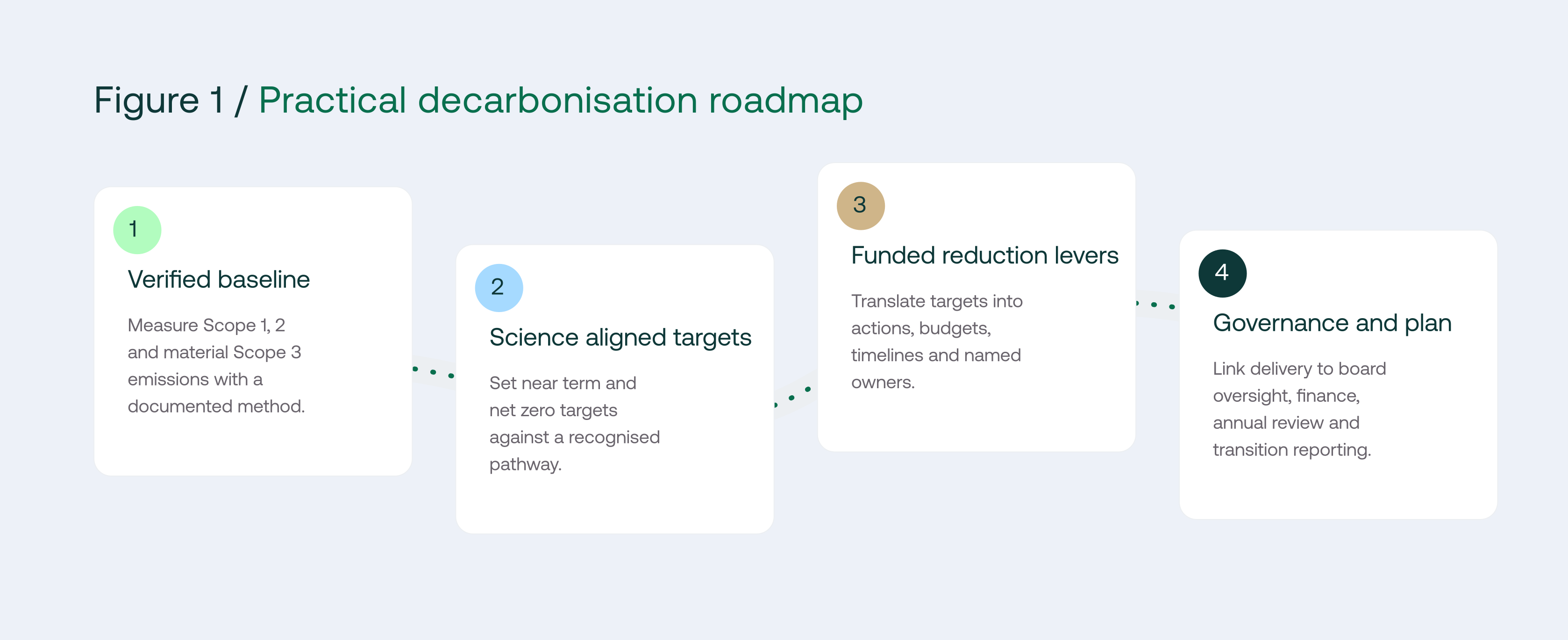
A decarbonisation strategy cannot be credible without a complete and credible emissions baseline. This sounds obvious. It is routinely skipped or underinvested.
Your baseline is the starting point against which all progress is measured. A target that says “reduce emissions 50% by 2030” is meaningless if no one agrees on what the 2030 base figure is, what methodology was used, or whether it covers all material emission categories.
A credible baseline is:
CSRD ESRS E1 requires disclosure of your gross Scope 1, 2, and 3 emissions with limited assurance. Your baseline is the foundation of that disclosure. Build it to disclosure standards from the start.
To achieve this, you need to conduct your corporate GHG inventory, that covers all scopes and provide a transparent, repeatable basis for carbon management, via excel-based or software-led modelling.
“Every decarbonisation strategy we build starts in the same place: a verified baseline. Not because it’s the exciting part, but because everything else depends on it. If your emissions figure isn’t credible, your target isn’t credible either.”
Once your baseline is established, your targets should be set against a recognised framework. The Science Based Targets initiative (SBTi) is the most widely accepted standard for corporate net zero target-setting.
SBTi’s Corporate Net-Zero Standard V2.0 requires:
Download our SBTi guide to dive deeper into the new standards!
Targets outside the SBTi framework should still be specific, time-bound, and externally verifiable. ESRS E1 requires disclosure of whether your targets are aligned with a 1.5°C pathway and whether they have been validated by an external body.
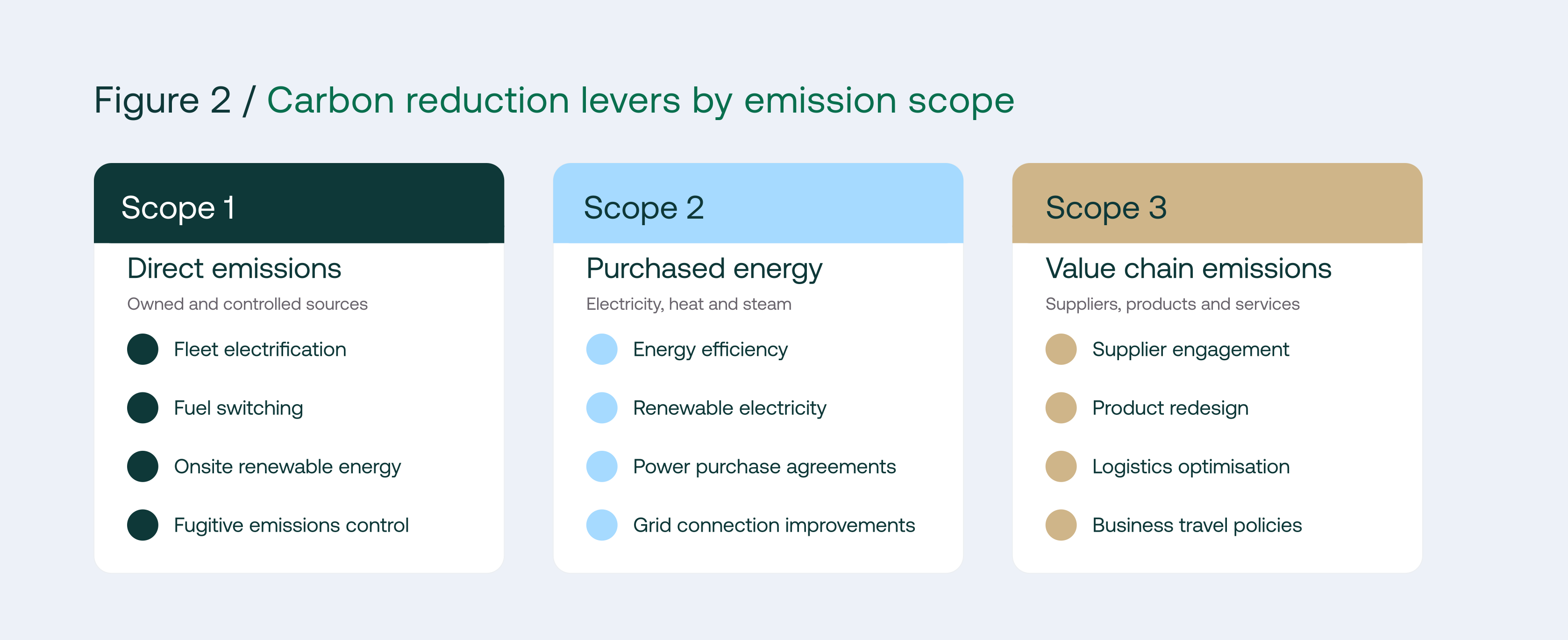
Targets without funded actions are aspirations. A practical decarbonisation strategy maps specific reduction levers to specific emission categories, with timelines, cost estimates, and responsible owners. Find below examples of levers per scope (Note: this is not an exhaustive list, only examples of possible levers).
For each lever: who owns it, what it costs, what emission reduction it delivers, and when.
A decarbonisation strategy without governance is a document. Governance means: who is accountable for each lever, how progress is reported to the board, and how the strategy connects to financial planning.
Under CSRD ESRS E1, companies must disclose their climate transition plan. This is a structured disclosure of: how the company plans to meet its climate targets, how it will finance the transition, and how the board oversees climate risk and opportunity.
Your decarbonisation strategy and your CSRD transition plan disclosure are not two separate documents. They are the same programme, described at different levels of detail for different audiences.
Key governance requirements for a credible strategy:
What is the difference between a net zero target and a decarbonisation strategy?
A net zero target is a commitment. A decarbonisation strategy is the implementation plan. You need both. The target sets the destination; the strategy defines the pathway, the funded actions, and the governance that will get you there.
Does CSRD require a decarbonisation strategy?
CSRD’s ESRS E1 requires disclosure of a climate transition plan, which describes how your company plans to reduce emissions and align with a 1.5°C pathway. A credible, funded decarbonisation strategy is the substance behind that disclosure.
How far ahead should a decarbonisation strategy look?
At minimum, to 2030 for near-term SBTi targets, and to 2050 for long-term net zero alignment. The practical planning horizon for funded actions is three to five years, with annual reviews.
Should we set Scope 3 targets if our supplier data is incomplete?
Yes, with appropriate caveats and a data collection roadmap. SBTi requires Scope 3 target coverage even where primary supplier data is limited. Use spend-based estimates as interim baselines, disclose the methodology, and set a timeline for transitioning to primary data.
What does Nexio do differently in decarbonisation strategy work?
Nexio integrates verified GHG accounting, science-based target-setting, and supplier engagement into a single, connected programme. We hold the number one position as a global EcoVadis strategic partner and have delivered 600+ sustainability projects since 2018, giving us practical experience across Scope 1 to 3 reduction programmes in manufacturing, chemicals, FMCG, and financial services.
Nexio Projects has delivered 600+ sustainability and climate projects since 2018. Our experts can support with end-to-end decarbonisation processes includising:
A decarbonisation strategy built on a verified baseline, funded by credible levers, and governed through board-level accountability will withstand CSRD assurance, SBTi validation, and investor scrutiny. One built on targets alone will not.
If your sustainability mandate includes a net zero commitment and you need to build the strategy behind it, speak to a Nexio Projects net zero specialist.
EcoVadis (2026) 10th Edition Sustainability Ratings Index. Available at: https://ecovadis.com (Accessed: 16 October 2026).
EFRAG (2023) ESRS E1 Climate Change. Brussels: European Financial Reporting Advisory Group. Available at: https://efrag.org (Accessed: 16 October 2026).
Science Based Targets initiative (SBTi) (2026) Corporate Net-Zero Standard, Version 2.0. Available at: https://sciencebasedtargets.org (Accessed: 16 October 2026).
World Resources Institute and World Business Council for Sustainable Development (2004) The Greenhouse Gas Protocol: A Corporate Accounting and Reporting Standard. Rev. edn. Washington, DC: WRI; Geneva: WBCSD. Available at: https://ghgprotocol.org (Accessed: 16 October 2026).


